
Research article · 2026 · Full text
International Journal of Horticulture and Food ScienceFloristic Diversity, Taxonomic Composition and Conservation Significance of Climbing Angiosperms in Gujarat, India
Volume 8(4) · Pages 35–42 · DOI: 10.33545/26631067.2026.v8.i4a.508 ↗
Research areasBotany and Plant Ecology StudiesEthnobotanical and Medicinal Plants StudiesForest Ecology and Conservation
Abstract
Author-writtenClimbing plants, a key functional group in Gujarat’s forests, rely on host trees for canopy access amid fierce resource competition. Our dataset documents 255 species across 36 families, dominated by Fabaceae (50 spp.), Convolvulaceae (49), Cucurbitaceae (34), and Apocynaceae (31), which collectively comprise 64% of the flora. These climbers offer immense ethnobotanical value to Bhil, Rathwa, and Choudhary communities for medicines, veterinary uses, and food, while fueling herbal industries. Yet, anthropogenic pressures and climate-induced heat stress threaten them, including 31 RET (Rare, Endangered, and Threatened) species like Corallocarpus epigaeus, Ipomoea muricata, and Tinospora cordifolia. Conservation is vital, with potential in urban green walls for cooling and air purification.
Summary
Source-checkedPlain-language reading of the full paper, prepared with AI and checked against the text. Each point links to the authors' own words.
Why it matters
- Climbing plants are a specialized group of plants that cannot support themselves and instead use external structures to reach the forest canopy for sunlight. View evidence ↗
- Gujarat is a critical transition zone for plant life, covering about 196,024 sq. km where arid desert ecosystems meet humid, biodiversity-rich regions. View evidence ↗
- Climbing plants are highly valuable to local tribal communities (Bhil, Rathwa, and Choudhary) for food, medicine, and veterinary purposes, and they support the herbal industry. View evidence ↗
The question
- The objective of this review is to systematically document the climbing plants found in Gujarat. View evidence ↗
What they did
- The authors compiled their dataset using various sources, including the Forest flora of Gujarat state (1971) and the E-Flora of Gandhinagar. View evidence ↗
What they found
- The study documented a total of 255 climbing plant species belonging to 36 different families in Gujarat. View evidence ↗
- Four families dominate the flora: Fabaceae (50-51 species, ~19.6%), Convolvulaceae (49 species), Cucurbitaceae (34 species), and Apocynaceae (31 species). View evidence ↗
- The four most dominant families collectively account for 164 species, which is approximately 64% of the total recorded climbing flora. View evidence ↗
- Species such as Tinospora cordifolia, Ipomoea muricata, and Corallocarpus epigaeus are identified as being at the highest risk. View evidence ↗
- Climate-induced heat stress negatively impacts climbers by denaturing proteins like Rubisco, which slows photosynthesis and causes pollen sterility. View evidence ↗
- To avoid dehydration during stress, climbing plants close their stomata, which prevents CO2 intake and hinders growth. View evidence ↗
What it means
- The authors conclude that conservation is vital and suggest using climbing plants in urban green walls to purify air, improve aesthetics, and reduce urban heat islands. View evidence ↗
Visual summary
2 visualsIllustrations explain the paper; charts are replotted from the paper's own table values.
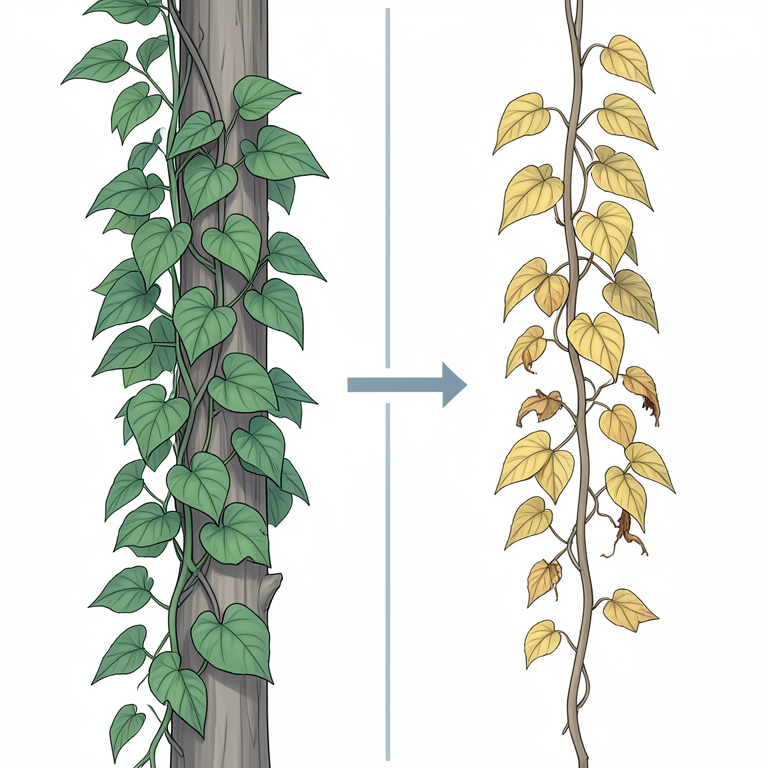
Impact of Heat Stress on Climbing Plants
AI-generated conceptual illustration (climbing angiosperms on a tree trunk). It explains the idea and does not show study data.
View source evidence ↗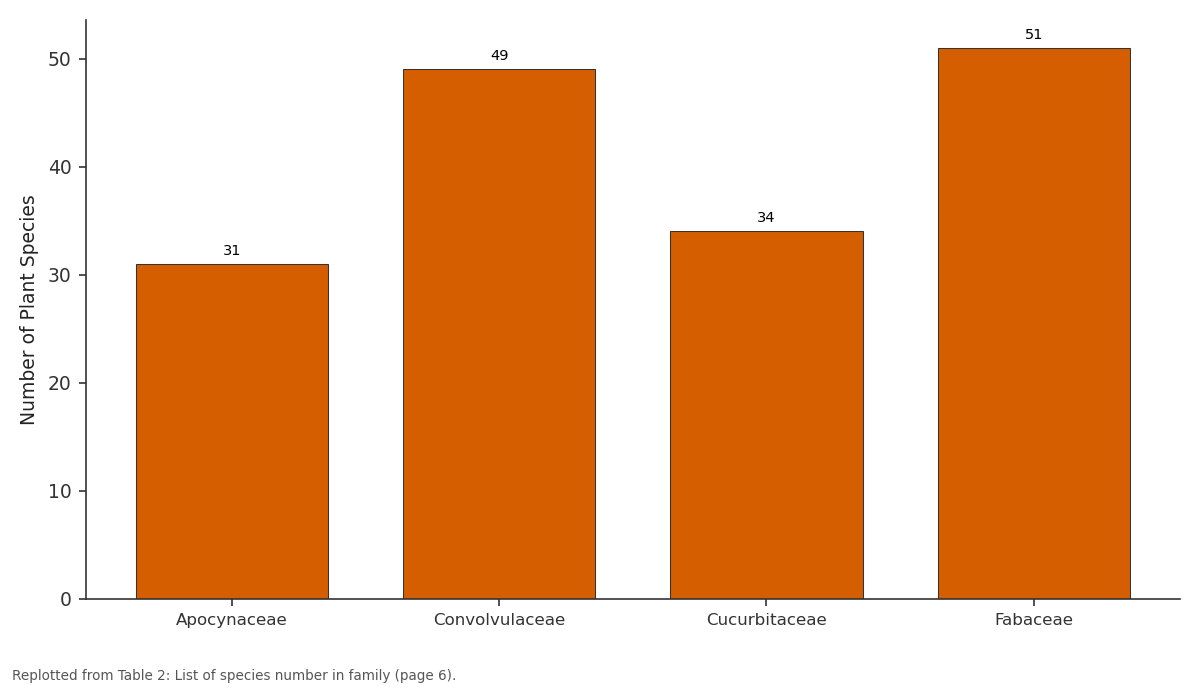
Number of Plant Species: Apocynaceae vs Convolvulaceae vs Cucurbitaceae vs Fabaceae
Replotted from Table 2 (page 6) of the original paper. Every bar is the paper's own table value.
View source evidence ↗Figures & tables
From the original paper Table 1
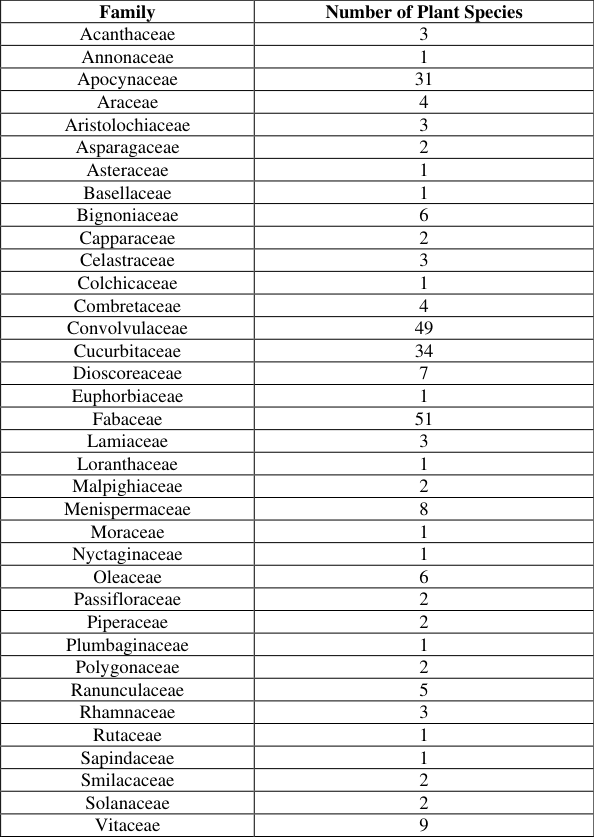 Table 2
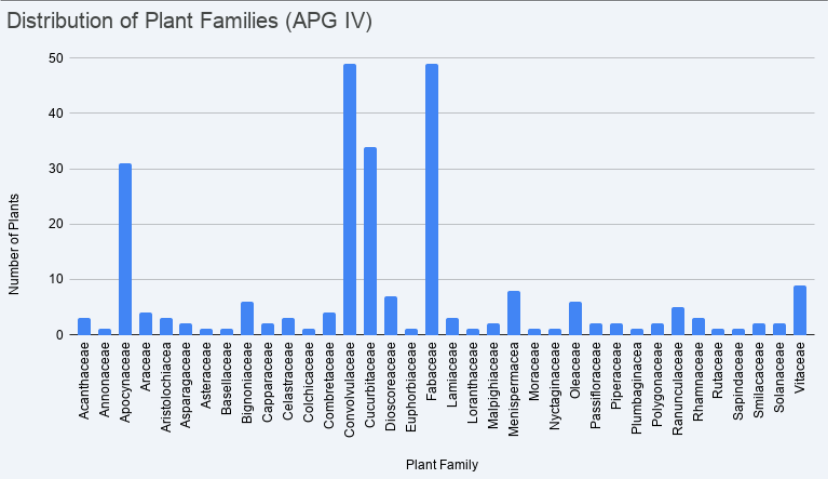 Figure 1
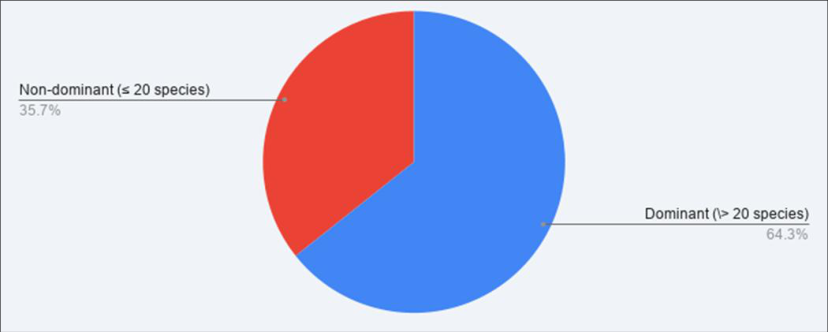 Figure 2
Introduction
A climber is a specialized functional group of plants characterized by its non-self-supporting growth habit. Unlike trees, shrubs, or herbs, climbers lack the structural rigidity to stand upright but climber plants rely on external supports like other plants, rocks, or manmade structures. In forests, climbers reach the upper canopy levels to maximise sunlight [1] . It is estimated that there are about 25,000 climber plant species in the world [2] . According to the comprehensive checklist data, there are 2624 climber plant species across India [3] . In Gujarat, about 180 species were recorded by G.L. Shah in the Flora of Gujarat in 1978. Gujarat encompasses a total geographical area of approximately 196,024 sq. km, positioned between 20°06'N to 24°42'N latitude and 68°10'E to 74°28'E longitude. The state represents a critical phytogeographical transition zone where the arid ecosystems of the Thar Desert meet the humid, biodiversity-rich environments of the Western Ghats and the Vindhya Satpura ranges [4] .
Map 1: Geographical map of Gujarat state, Vegetation cover is indicated by colours.
Climbing plants exhibit remarkable diversity in their physical adaptation. They can be categorized by their specific climbing mechanisms into root climbers, hook climbers, tendril climbers, leaf or stem climbers, and twiners. By utilizing these varied methods to ascend, they engage in intense competition with trees for essential resources both above and below the soil. This competitive pressure significantly hinders tree growth, slows the natural regeneration of seedlings, and suppresses the development of new sprouts [6] . Climbing plant growth follows a sharp seasonal cycle driven by water availability. The highest growth occurs during the monsoon (July to September), where high humidity and soil moisture trigger rapid stem elongation and leaf production. Growth slows significantly or stops during the winter (November to February). In Gujarat, a study of climber plants recorded 81 species by M.S. [7] for the Medicinal Flora of Gujarat. In Valsad Taluka, 61 climber species were recorded in 2018 by G.K.
Tandel and M.S. Jangid. In the Bhavnagar forest area, 63 climber species were recorded by Naresh H. Chavda and Shailesh K. Mehat, respectively. Furthermore, in Gandhinagar, 78 climber species were recorded in the e-Flora of Gandhinagar by Dr. Maulik Gadani and Dr. Goral Jani. Therefore, the objective of this review paper is to document these climber plants in a systematic manner.
Taxonomic Diversity
The climbing flora data comprises a total of 255 species distributed across 36 distinct families, showcasing a diverse botanical landscape (Table 1). The collection is significantly dominated by four key families: Fabaceae, which is the most prevalent with 50 species (approximately 19.6%), followed closely by Convolvulaceae with 49 species, Cucurbitaceae with 34 species, and Apocynaceae with 31 species. Together, these four dominant families account for 164 species, representing approximately 64% of the total climber flora recorded in the dataset.
| Sr. No. | Scientific Name | Family Name (APG) | Fam (Bentham & Hooker) | Common Name |
|---|---|---|---|---|
| 1. | Abrus precatorius L. | Fabaceae | Leguminosae | Rosary Pea / Chanothi |
| 2. | Allamanda cathartica L. | Apocynaceae | Apocynaceae | Yellow Bell / Pilu karel |
| 3. | Allamanda violacea Gardner | Apocynaceae | Apocynaceae | Purple Allamanda |
| 4. | Ampelocissus arnottiana Planch. | Vitaceae | Ampelidaceae | Wild Grape |
| 5. | Ampelocissus latifolia (Roxb.) Planch. | Vitaceae | Ampelidaceae | Jungle Angur / Khat-khatumbo |
| 6. | Ampelocissus tomentosa (Roth) Planch. | Vitaceae | Ampelidaceae | Hairy Wild Grape |
| 7. | Antigonon leptopus Hook. & Arn. | Polygonaceae | Polygonaceae | Coral Vine / Laila Majnu |
| 8. | Argyreia nervosa (Burm.f.) Bojer | Convolvulaceae | Convolvulaceae | Elephant Creeper / Samudra shosh |
| 9. | Argyreia sericea Dalzell & A.Gibson | Convolvulaceae | Convolvulaceae | Silky Elephant Creeper |
| 10. | Argyreia strigosa (Roth) Roberty | Convolvulaceae | Convolvulaceae | Bristly Elephant Creeper |
| 11. | Aristolochia bracteolata Lam. | Aristolochiaceae | Aristolochiaceae | Worm Killer / Kidamari |
| 12. | Aristolochia elegans Mast. | Aristolochiaceae | Aristolochiaceae | Calico Flower / Duck Flower |
| 13. | Aristolochia indica L. | Aristolochiaceae | Aristolochiaceae | Indian Birthwort / Sapasan |
| 14. | Artabotrys hexapetalus (L.f.) Bhandari | Annonaceae | Annonaceae | Climbing Ylang-Ylang / Lilo champo |
| 15. | Asparagus gonoclados Baker | Asparagaceae | Liliaceae | Shatavari variety |
| 16. | Asparagus racemosus Willd. | Asparagaceae | Liliaceae | Asparagus / Shatavari |
| 17. | Aspidopterys cordata (B.Heyne ex Wall.) A.Juss. | Malpighiaceae | Malpighiaceae | Heart-leaved Climber / Bokadvel |
| 18. | Atylosia platycarpa Benth. | Fabaceae | Leguminosae | Broad-podded Atylosia |
| 19. | Atylosia scarabaeoides (L.) Benth. | Fabaceae | Leguminosae | Beetle Atylosia / Ran-tur |
| 20. | Basella alba L. | Basellaceae | Chenopodiaceae | Malabar Spinach / Poi ni bhaji |
| 21. | Bauhinia vahlii Wight & Arn. | Fabaceae | Leguminosae | Camel's Foot Climber / Maljan |
| 22. | Beaumontia grandiflora Wall. | Apocynaceae | Apocynaceae | Herald's Trumpet |
| 23. | Blastania garcinii (Burm.f.) Cogn. | Cucurbitaceae | Cucurbitaceae | Garcini's Gourd |
| 24. | Bougainvillea spectabilis Willd. | Nyctaginaceae | Nyctaginaceae | Bougainvillea / Boganvel |
| 25. | Butea parviflora Roxb. | Fabaceae | Leguminosae | Climbing Palash / Khakhari |
| 26. | Butea superba Roxb. | Fabaceae | Leguminosae | Superb Palash / Vel-khakhro |
| 27. | Caesalpinia bonduc (L.) Roxb. | Fabaceae | Leguminosae | Fever Nut / Kachka |
| 28. | Caesalpinia crista L. | Fabaceae | Leguminosae | Nicker Bean / Kankach |
| 29. | Caesalpinia decapetala (Roth) Alston | Fabaceae | Leguminosae | Mysore Thorn / Chilari |
| 30. | Calycopteris floribunda Lam. | Combretaceae | Combretaceae | Paper Flower Climber / Ukshi |
| 31. | Campsis radicans (L.) Seem. | Bignoniaceae | Bignoniaceae | Trumpet Vine |
| 32. | Canavalia gladiata (Jacq.) DC. | Fabaceae | Leguminosae | Sword Bean / Tarvardi |
| 33. | Canavalia virosa (Roxb.) Wight & Arn. | Fabaceae | Leguminosae | Wild Sword Bean / Kadu-tarvardi |
| 34. | Capparis sepiaria L. | Capparaceae | Capparidaceae | Wild Caper / Kanthar |
| 35. | Capparis zeylanica L. | Capparaceae | Capparidaceae | Ceylon Caper / Govindphal |
| 36. | Cardiospermum halicacabum L. | Sapindaceae | Sapindaceae | Balloon Vine / Kagdoliyo |
| 37. | Carissa congesta Wight | Apocynaceae | Apocynaceae | Karanda / Karamdi |
| 38. | Cayratia carnosa (Lam.) Gagnep. | Vitaceae | Ampelidaceae | Fox Grape / Khat-khatumbo |
| 39. | Cayratia trifolia (L.) Domin | Vitaceae | Ampelidaceae | Three-leaved Caper / Khat-khatumbo |
| 40. | Celastrus paniculatus Willd. | Celastraceae | Celastraceae | Black Oil Plant / Malkangani |
| 41. | Ceropegia bulbosa Roxb. | Apocynaceae | Asclepiadaceae | Bulbous Ceropegia / Patal-tumbdi |
| 42. | Ceropegia evansii McCann | Apocynaceae | Asclepiadaceae | Evans' Ceropegia |
| 43. | Ceropegia hirsuta Wight & Arn. | Apocynaceae | Asclepiadaceae | Hairy Ceropegia |
| 44. | Ceropegia odorata Nimmo | Apocynaceae | Asclepiadaceae | Fragrant Ceropegia |
| 45. | Chonemorpha fragrans (Moon) Alston | Apocynaceae | Apocynaceae | Frangipani Vine |
| 46. | Cissampelos hernandiifolia Willd. | Menispermaceae | Menispermaceae | Hernandia-leaved Velvetbean |
| 47. | Cissampelos pareira L. | Menispermaceae | Menispermaceae | Velvetleaf / Venivel |
Table text extracted from the original PDF; superscript letters are shown inline. The original table image is below.
View original table image
Non dominant families
The families with only one or two species represent the lowfrequency members of the ecosystem, indicating high taxonomic variety but limited ecological dominance compared to the more prevalent groups.
Ethnobotanical Importance
In Gujarat, climber plants (locally known as Velos) are used as traditional medicine for tribal communities such as the Bhils, Rathwas, and Choudharys. Because climbers have concentrated phytochemicals in their stems and tubers, they are highly valued in ethnobotany. The flowers of the Pergularia pallida (locally known as Bugdodi in the Tapi district) are finely chopped and cooked with oil and spices to be administered as a traditional veterinary remedy for treating udder inflammation in cattle. [12] . Aganosna dichotoma flower and leaf powder are used to treat bronchitis and eye conditions [13] . To treat snake bites, the juice extracted from the leaves of Aristolochia indica L. is traditionally administered [13] . Eighty-one species of climber plants were recorded 81 species by M.S. [7] for the Medicinal Flora of Gujarat.
Economic importance
Climbing plants are primary sources for the herbal drug industry [14] . The tubers of Dioscorea species are rich in starch and are traditionally used as a food substitute by tribes, reducing their dependence on purchased grains. The rapid expansion of the pharmaceutical industry has led to an increased global demand for these plants. Traditional knowledge of these plants serves as a foundation for researching novel bioactive compounds and developing purified natural products or synthetic derivatives with increased profitability [15] .
Threats and conservation status
In a natural environment, due to anthropogenic stresses, climbers are, quite frequently, unable to find their ideal hosts conveniently or nearby since the host population and distribution are adversely affected by such stresses [16] . Among the 31 RET climber species documented, endangered species include Ceropegia mannarana (Asclepiadaceae) and Gloriosa superba (Liliaceae). Rare species include Celastrus paniculatus (Celastraceae) and Aganosma cymosa (Apocynaceae) [17] . Highest Risk: Species such as Corallocarpus epigaeus, Ipomoea muricata, and Tinospora cordifolia are at the highest risk [9] .
Environmental impact on climbers
Climate change significantly affects climbing plants, altering their growth, distribution, and climbing behaviors. These impacts stem from shifts in temperature, precipitation, and related environmental factors, with climbers showing varied responses based on species and habitat. Heat Stress: High temperatures can denature proteins and enzymes (like Rubisco), slowing down photosynthesis. It also causes pollen sterility, meaning the plant might look healthy but won't produce seeds or fruit [18] . Stomatal Closure: To prevent dehydration, plants close their stomata. While this saves water, it also stops CO2 intake, effectively starving and affecting plant growth.
Contribution to sustainable development
In cities, climbers reduce urban heat islands, purify air, and boost aesthetics by covering structures. They lower carbon allocation to stems, promoting energy-efficient growth suitable for green walls and near-zero-energy buildings. The use of climbers in restoration matrices prioritises species with ornamental or medicinal value common in India. For pharmacognosy-focused work in Gujarat, climbers like those in Dombivli support conservation amid urbanization [19] .
Figures and tables from the paper
| Family | Number of Plant Species |
|---|---|
| Acanthaceae | 3 |
| Annonaceae | 1 |
| Apocynaceae | 31 |
| Araceae | 4 |
| Aristolochiaceae | 3 |
| Asparagaceae | 2 |
| Asteraceae | 1 |
| Basellaceae | 1 |
| Bignoniaceae | 6 |
| Capparaceae | 2 |
| Celastraceae | 3 |
| Colchicaceae | 1 |
| Combretaceae | 4 |
| Convolvulaceae | 49 |
| Cucurbitaceae | 34 |
| Dioscoreaceae | 7 |
| Euphorbiaceae | 1 |
| Fabaceae | 51 |
| Lamiaceae | 3 |
| Loranthaceae | 1 |
| Malpighiaceae | 2 |
| Menispermaceae | 8 |
| Moraceae | 1 |
| Nyctaginaceae | 1 |
| Oleaceae | 6 |
| Passifloraceae | 2 |
| Piperaceae | 2 |
| Plumbaginaceae | 1 |
| Polygonaceae | 2 |
| Ranunculaceae | 5 |
| Rhamnaceae | 3 |
| Rutaceae | 1 |
| Sapindaceae | 1 |
| Smilacaceae | 2 |
| Solanaceae | 2 |
| Vitaceae | 9 |
Table text extracted from the original PDF; superscript letters are shown inline. The original table image is below.
View original table image
References
21 in the original paper- Gianoli E. The behavioural ecology of climbing plants. AoB Plants. 2015 Jan;7:plv013. doi: 10.1093/aobpla/plv013.
- Wang H, Zhang G. Diversity, pattern, and environmental drivers of climbing plants in China. Plants. 2025 Oct;14(21):3281. doi: 10.3390/plants14213281.
- Pandi V, Babu KN. The climbing flora of India: A comprehensive checklist. F1000Research. 2022 Aug;11:980. doi: 10.12688/f1000research.123818.1.
- Rana K, Nagar P. Diversity and distribution of endemic angiosperms in Gujarat. Int J Adv Res. 2017 Jun;5(6):730. doi: 10.21474/ijar01/4472.
- Patel H, Vyas R. Reptiles of Gujarat, India: Updated checklist, distribution, and conservation status. Herpetology Notes. 2019 Jul;12:765. Accessed: Oct 2025. Available from: https://biotaxa.org/hn/article/view/39475/48836.
- Tandel GK, Jangid MS. Climbers of Valsad Taluka (Gujarat), India. Int J Sci Agric Res Technol (IJSART). 2018;4(5):1052.
- Jangid MS, Sharma SS. Climbers of Taluka Modasa, District Sabarkantha (Gujarat), India. Life Sci Leaflets. 2011;14:466.
- Shah GL. Flora of Gujarat State. Japan Society of Medical Entomology and Zoology; 1978. Accessed: Nov 2025. Available from: http://ci.nii.ac.jp/ncid/BA86561049.
- Gajjar D, Mahato AKR, Sorathia KD. Community structure and distribution of climbers across ecosystem gradients in the dryland of Kachchh, Gujarat, India. Adv Zool Bot. 2023 Aug;11(5):336. doi: 10.13189/azb.2023.110502.
- Patel MJ, Patel KC. Study of climber and creeper plant species growing in Talod taluka of Sabarkantha district, Gujarat. Int J Creative Res Thoughts (IJCRT). 2020;8(6):3433.
- Patel RS, Kanjaria KV, Patel KC. Investigations on climber resources used by tribal inhabitants of Ambaji forest of Banaskantha district (North Gujarat). Life Sci Leaflets. 2010;10:251.
- Gamit S, Sojitra R, Gadhvi K, Vyas S, Gamit S. Ethnobotanical documentation of wild edible plants and their uses in Tapi District, Gujarat. Int J Botany Stud. 2025;10(11):37.
- Satapathy S, Marndi S, Kumar S. Some medicinal climbers of Rairangpur, Mayurbhanj, Odisha. Centurion J Multidiscip Res. 2018;9(1):33.
- Seliya AR, Patel NK. Ethnomedicinal uses of climbers from Saraswati River region of Patan district, North Gujarat. OpenSIUC. 2009 Jan;2009(7):5. Accessed: Mar 2026. Available from: https://opensiuc.lib.siu.edu/ebl/vol2009/iss7/5.
- Ali M, Isah T, Dipti, Mujib A. Climber plants: Medicinal importance and conservation strategies. 2015;101. doi: 10.1007/978-3-319-19288-8_4.
- Wyka TP, Zadworny M, Mucha J, Żytkowiak R, Nowak K, Oleksyn J. Species-specific responses of growth and biomass distribution to trellis availability in three temperate lianas. Trees. 2019 Feb;33(3):921. doi: 10.1007/s00468-019-01828-3.
- Patel D, Patel J, Patel D. Rare, endangered and threatened climbing plants of the Southern Western Ghats Hills, India. Indian Forester. 2025.
- Salvucci ME, Crafts-Brandner SJ. Relationship between the heat tolerance of photosynthesis and the thermal stability of Rubisco activase in plants from contrasting thermal environments. Plant Physiol. 2004 Apr;134(4):1460. doi: 10.1104/pp.103.038323.
- Chaudhari A, Jamdhade VM. Investigation of climbing species in Dombivli district Thane: A floristic view. Int J Adv Educ Res. 2024;9(1):60.
- Gadani M. E-Flora of Gandhinagar. Gujarat Forestry Research Foundation; 2009. Available from: https://www.efloraofgandhinagar.in/.
- Patel RI. Forest flora of Gujarat state. Forest Department, Gujarat State; 1971.