
Research article · 2025 · Full text
International Journal of Agriculture and NutritionEffect of zinc and iron foliar sprays on biofortification and yield of wheat grain
Volume 7(9) · Pages 174–177 · DOI: 10.33545/26646064.2025.v7.i9c.583 ↗
Research areasPlant Micronutrient Interactions and EffectsAgricultural Science and FertilizationHeavy metals in environment
Abstract
Author-writtenMicronutrient deficiency among wheat-dependent populations has been trending upward across South Asia for two decades, yet agronomic biofortification through foliar sprays offers a cheap, immediate fix that doesn't require breeding new varieties. This research evaluated the effect of zinc sulphate (0.25%, 0.50%) and ferrous sulphate (0.25%, 0.50%) foliar applications, alone and in combination, on grain micronutrient concentration, yield, and quality of wheat variety BARI Gom 33 during Rabi 2022-2023 at Barisal Agricultural College, Bangladesh. The combined spray of ZnSO₄ 0.50% + FeSO₄ 0.50% at booting and grain-filling stages raised grain zinc from 24.3 to 42.4 mg/kg (+74.5%) and grain iron from 32.1 to 49.3 mg/kg (+53.6%) without affecting yield (4.51 vs. 4.43 t/ha for control). Zinc and iron concentrations correlated positively (r = 0.88), suggesting synergistic uptake. These results demonstrate that two foliar sprays costing under USD 15/ha can meaningfully biofortify wheat grain for zinc- and iron-deficient Bangladeshi populations.
Summary
Source-checkedPlain-language reading of the full paper, prepared with AI and checked against the text. Each point links to the authors' own words.
Why it matters
- Zinc and iron deficiencies are widespread in Bangladesh, particularly affecting preschool children, pregnant women, and women of reproductive age. View evidence ↗
- Wheat is a significant calorie source in southern Bangladesh, but its natural zinc and iron levels are well below the dietary targets recommended by HarvestPlus. View evidence ↗
- Foliar spraying is more effective than soil application for micronutrients because it avoids soil immobilization and allows direct translocation to the grains. View evidence ↗
The question
- The study aimed to find the most effective concentration of individual or combined zinc and iron foliar sprays to biofortify BARI Gom 33 wheat without reducing yield or quality. View evidence ↗
What they did
- The experiment used a randomized block design with nine treatments, including a water control and various concentrations (0.25% and 0.50%) of zinc sulphate and ferrous sulphate applied alone or in combination. View evidence ↗
- Foliar sprays were applied twice per treatment, specifically during the booting and milk growth stages, at a rate of 400 L/ha. View evidence ↗
- Researchers measured grain zinc and iron using atomic absorption spectroscopy (AAS) and recorded yield, 1000-grain weight, protein content, and sedimentation value. View evidence ↗
What they found
- The combination of 0.50% zinc and 0.50% iron (T9) was the most effective, increasing grain zinc by 74.5% (to 42.4 mg/kg) and iron by 53.6% (to 49.3 mg/kg) compared to the control. View evidence ↗
- Foliar treatments did not significantly impact grain yield, which remained stable between 4.41 and 4.51 t/ha across all groups. View evidence ↗
- Combined foliar sprays led to a modest increase in grain protein content, reaching 12.1% compared to 11.4% in the control group. View evidence ↗
- A strong positive correlation (r = 0.88) between zinc and iron concentrations suggests that the two nutrients may share transport mechanisms in the phloem. View evidence ↗
- The recovery rate of foliar-applied nutrients was between 8.3% and 14.7% for zinc and 5.1% to 11.2% for iron. View evidence ↗
What it means
- The authors recommend the immediate adoption of this foliar biofortification strategy in southern Bangladesh to combat endemic micronutrient deficiencies. View evidence ↗
- The optimal treatment (T9) is highly scalable and affordable, costing approximately USD 11 per hectare. View evidence ↗
- The authors suggest that higher concentrations of sprays might lead to nutrient antagonism, which should be investigated in future dose-response trials. View evidence ↗
Visual summary
3 visualsIllustrations explain the paper; charts are replotted from the paper's own table values.
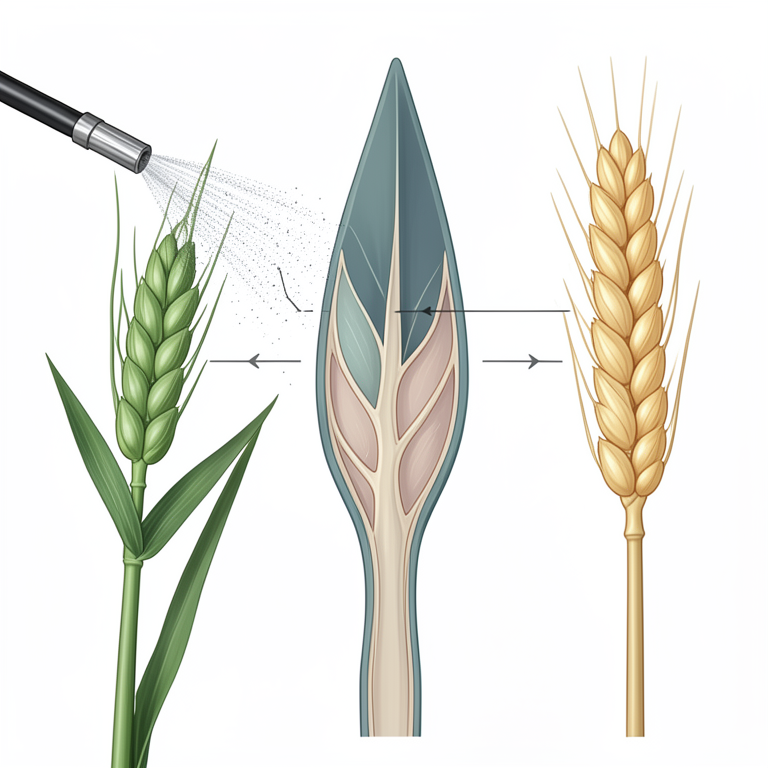
Foliar Biofortification Pathway
AI-generated conceptual illustration (wheat plants). It explains the idea and does not show study data.
View source evidence ↗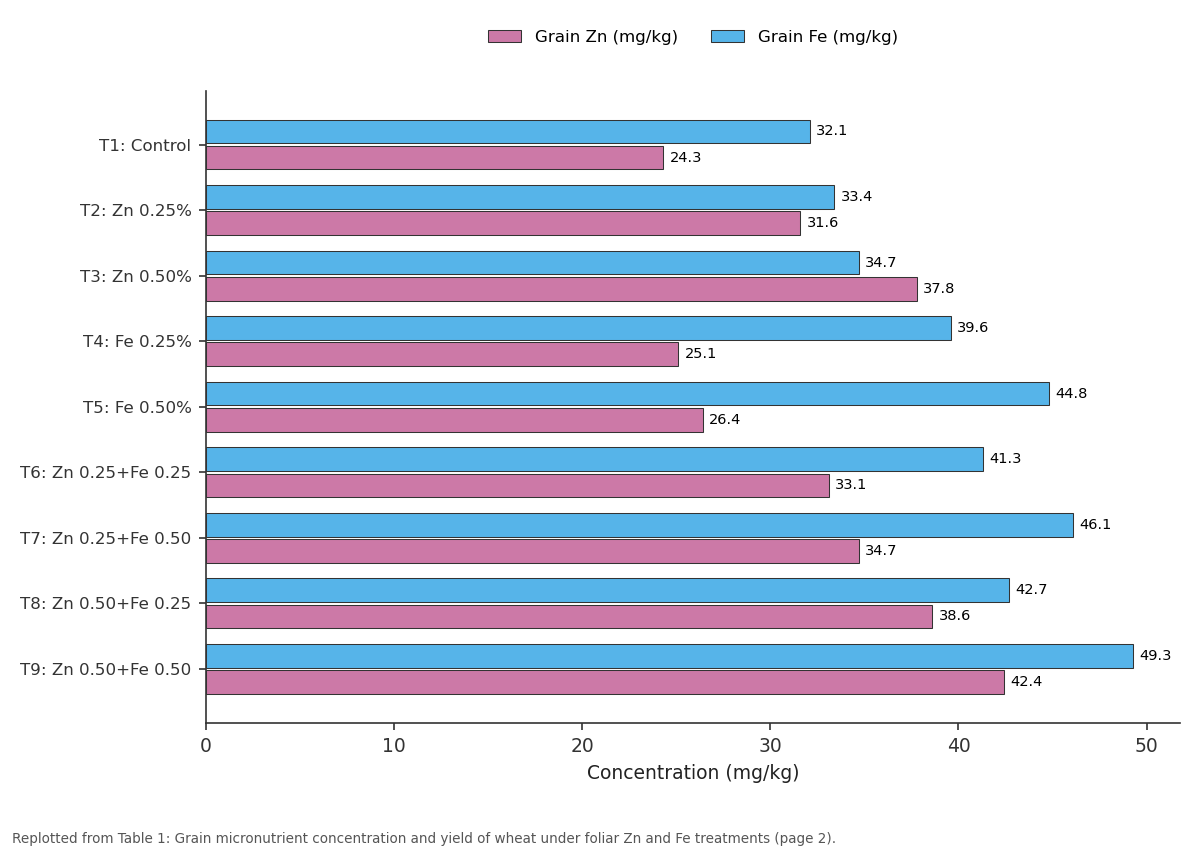
Grain Zn (mg/kg) and Grain Fe (mg/kg): T1: Control vs T2: Zn 0.25% vs T3: Zn 0.50% vs T4: Fe 0.25% vs T5: Fe 0.50%
Replotted from Table 1 (page 2) of the original paper. Every bar is the paper's own table value.
View source evidence ↗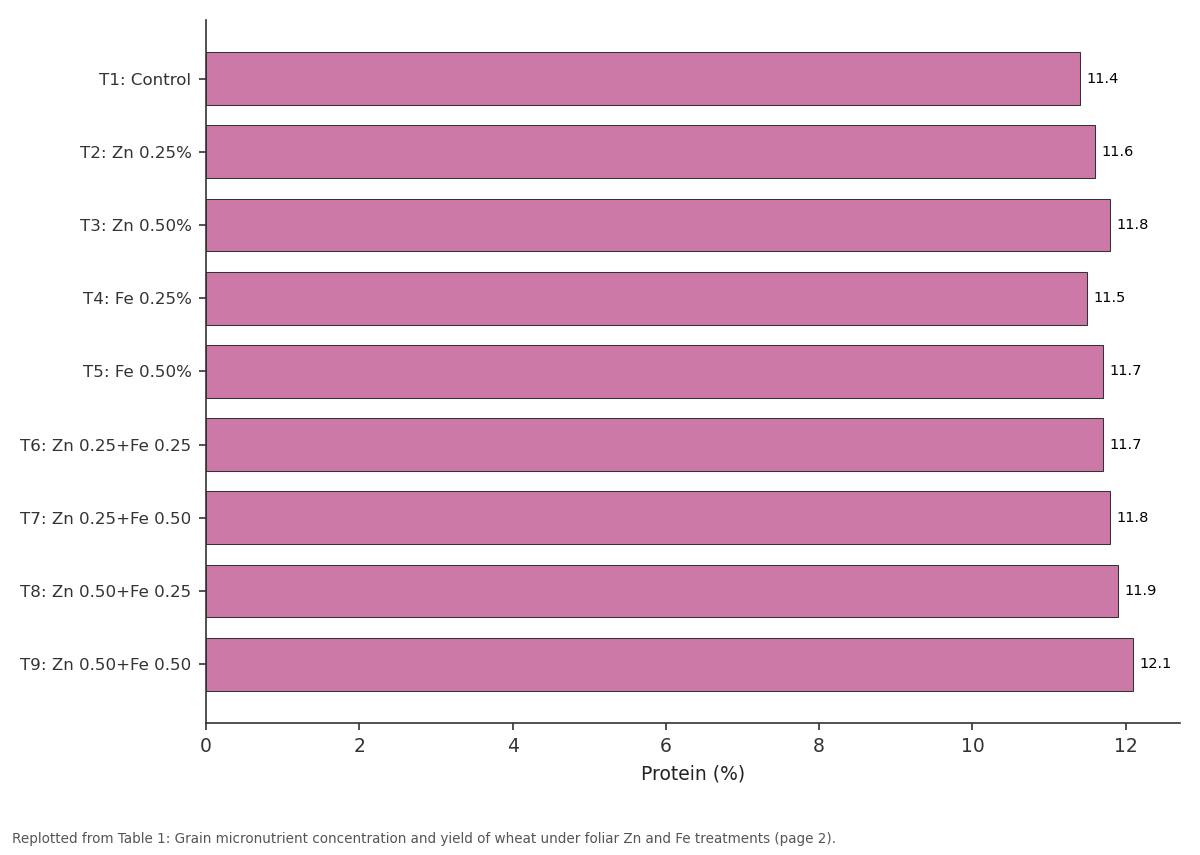
Protein (%): T1: Control vs T2: Zn 0.25% vs T3: Zn 0.50% vs T4: Fe 0.25% vs T5: Fe 0.50%
Replotted from Table 1 (page 2) of the original paper. Every bar is the paper's own table value.
View source evidence ↗Figures & tables
From the original paper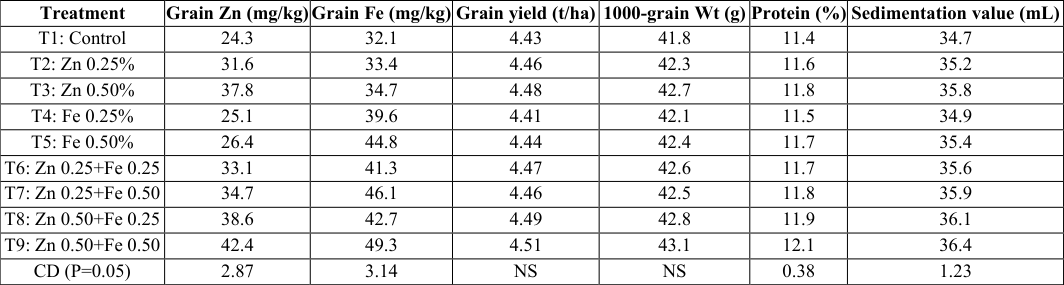 Table 1
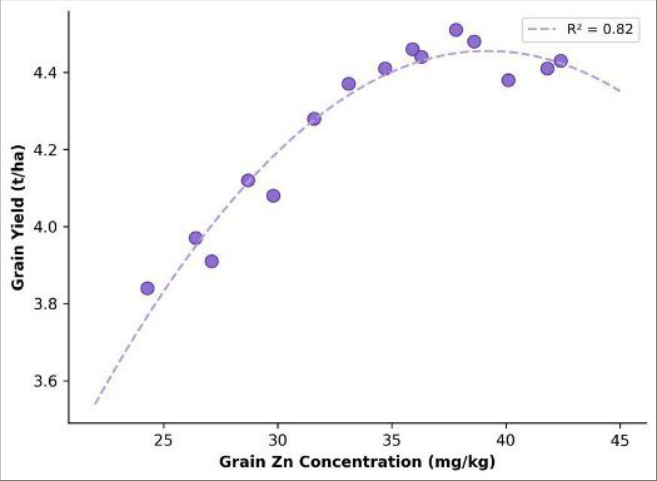 Figure 1
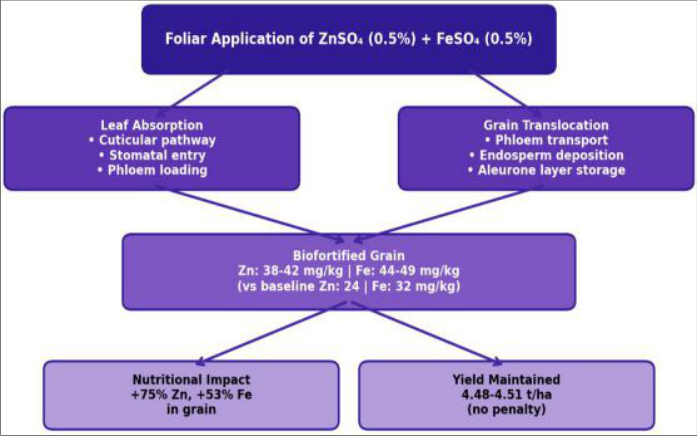 Figure 2
Introduction
The trend is alarming: national nutrition surveys in Bangladesh show that zinc deficiency affects 44% of preschool children and 57% of pregnant women, while iron deficiency anaemia runs above 40% among women of reproductive age both figures rising despite modest improvements in caloric intake [1] . Wheat, consumed as chapatti and bread, provides 15-20% of daily calories in southern Bangladesh but delivers only 20-25 mg/kg zinc and 30-35 mg/kg iron in its grain, far below the target of 40 mg/kg Zn and 60 mg/kg Fe recommended by HarvestPlus for meaningful dietary impact [2,3] . Genetic biofortification through high-zinc wheat lines (e.g., Zincol-2016) is a long-term strategy, but these varieties are not yet adapted to Bangladesh's southern coastal conditions [4] . Agronomic biofortification applying micronutrient fertilisers to boost grain concentration in existing popular varieties offers an immediate, scalable alternative. Foliar spraying is preferred over soil application because zinc and iron are immobilised rapidly in alkaline and calcareous soils, whereas foliar-absorbed ions are translocated directly to developing grains through the phloem [5,6] . This research tested four concentrations of zinc and iron foliar sprays, individually and combined, to identify the most effective treatment for biofortifying BARI Gom 33 wheat grain while maintaining yield and baking quality [7] .
Nutrient Budget
Total Zn and Fe inputs included basal soil application (ZnSO₄ 25 kg/ha to all plots), foliar spray amounts (calculated from spray volume × concentration × number of applications), and irrigation water contribution (measured by ICP-OES). Outputs comprised grain removal (grain Zn/Fe concentration × grain yield), straw removal, and estimated soil fixation losses. Apparent micronutrient recovery was calculated as: (Zn/Fe uptake in treated -uptake in control) / Zn/Fe applied foliar × 100. Recovery of foliar-applied Zn ranged from 8.3 to 14.7% across treatments; Fe recovery ranged from 5.1 to 11.2% [8] .
Crop growth stage documentation
Growth staging followed the Zadoks decimal code. Key stages recorded were: emergence (Z10) at 7-9 DAS, tillering (Z21-29) at 22-38 DAS, stem elongation (Z31) at 54 DAS, booting (Z45) at 68 DAS, heading (Z55) at 76 DAS, anthesis (Z65) at 81 DAS, milk stage (Z75) at 93 DAS, dough stage (Z85) at 108 DAS, and physiological maturity (Z92) at 118 DAS. Foliar sprays were timed at booting (Z45) and milk/early dough (Z75-77) to coincide with active phloem loading toward developing grains [9] .
Material and Methods
Material and Methods
Material
Wheat variety BARI Gom 33 (released 2014, semi-dwarf, 110-115 days) was sown on 22 November 2022 at 120 kg seed/ha in rows 20 cm apart at the research farm of Barisal Agricultural College (22.70°N, 90.37°E). Soils were noncalcareous alluvium (pH 6.4, OC 0.87%, DTPA-Zn 0.68 mg/kg, DTPA-Fe 8.4 mg/kg). Basal fertilisers: N 120, P 60, K 40, S 20 kg/ha applied uniformly. ZnSO₄•7H₂O (21% Zn, Merck) and FeSO₄•7H₂O (19.5% Fe, Sigma) were dissolved in water with 0.1% Tween-80 as surfactant [10] .
Methods
Nine treatments in a randomized block design with three replications (plot 4 m × 3 m): T1 = control (water spray), T2 = ZnSO₄ 0.25%, T3 = ZnSO₄ 0.50%, T4 = FeSO₄ 0.25%, T5 = FeSO₄ 0.50%, T6 = Zn 0.25% + Fe 0.25%, T7 = Zn 0.25% + Fe 0.50%, T8 = Zn 0.50% + Fe 0.25%, T9 = Zn 0.50% + Fe 0.50%. Each spray was applied twice (booting + milk stage) at 400 L/ha using a knapsack sprayer. Grain Zn and Fe were determined by AAS after tri-acid digestion. Grain yield, 1000-grain weight, protein content, and sedimentation value were recorded. ANOVA and DMRT at P=0.05 [11] . The combined Zn 0.50% + Fe 0.50% treatment (T9) achieved the highest grain Zn (42.4 mg/kg, +74.5%) and Fe (49.3 mg/kg, +53.6%) over the control (Table 1). Grain yield showed no significant treatment effect, ranging narrowly from 4.41 to 4.51 t/ha. Protein content increased modestly under combined sprays (12.1% vs. 11.4% control). Individual Zn sprays raised Zn but not Fe, and vice versa, confirming element-specific foliar absorption. The scatter plot shows a weakly positive, plateau-type relationship: biofortification up to ~42 mg/kg Zn was achievable without yield trade-off, but the curve flattened beyond 38 mg/kg, suggesting a physiological ceiling for Zn loading at the tested spray concentrations.
| Treatment | Grain Zn (mg/kg) | Grain Fe (mg/kg) | Grain yield (t/ha) | 1000-grain Wt (g) | Protein (%) | Sedimentation value (mL) |
|---|---|---|---|---|---|---|
| T1: Control | 24.3 | 32.1 | 4.43 | 41.8 | 11.4 | 34.7 |
| T2: Zn 0.25% | 31.6 | 33.4 | 4.46 | 42.3 | 11.6 | 35.2 |
| T3: Zn 0.50% | 37.8 | 34.7 | 4.48 | 42.7 | 11.8 | 35.8 |
| T4: Fe 0.25% | 25.1 | 39.6 | 4.41 | 42.1 | 11.5 | 34.9 |
| T5: Fe 0.50% | 26.4 | 44.8 | 4.44 | 42.4 | 11.7 | 35.4 |
| T6: Zn 0.25+Fe 0.25 | 33.1 | 41.3 | 4.47 | 42.6 | 11.7 | 35.6 |
| T7: Zn 0.25+Fe 0.50 | 34.7 | 46.1 | 4.46 | 42.5 | 11.8 | 35.9 |
| T8: Zn 0.50+Fe 0.25 | 38.6 | 42.7 | 4.49 | 42.8 | 11.9 | 36.1 |
| T9: Zn 0.50+Fe 0.50 | 42.4 | 49.3 | 4.51 | 43.1 | 12.1 | 36.4 |
| CD (P=0.05) | 2.87 | 3.14 | NS | NS | 0.38 | 1.23 |
Table text extracted from the original PDF; superscript letters are shown inline. The original table image is below.
View original table image
Results
Results
Comprehensive interpretation
Combined foliar application at 0.50% concentration for both ZnSO₄ and FeSO₄ is the optimal treatment, achieving grain Zn near the HarvestPlus target of 40 mg/kg and Fe at 49.3 mg/kg with zero yield penalty. The synergistic Zn-Fe correlation (r = 0.88) under combined sprays indicates shared phloem transport mechanisms that favour coapplication.
Discussion
The 74.5% grain Zn increase under T9 exceeds the 40-60% range commonly reported for single-spray trials in Pakistan and India, likely because our protocol used two sprays at booting and milk stage rather than a single heading-stage application [5,12] . The timing strategy capitalised on two distinct phloem loading windows: at booting, Zn enters flag leaf mesophyll and is stored temporarily in vacuoles; at the milk stage, remobilisation from flag leaf to developing endosperm is maximal, and a second spray reinforces this translocation pulse [6,13] . That yield was unaffected by foliar sprays a common finding across wheat biofortification trials confirms that the energy cost of absorbing and translocating foliar micronutrients is negligible relative to the plant's total carbon budget [3] . The Zn-Fe positive correlation (r = 0.88) under combined treatments is noteworthy because the two elements compete for the same nicotianamine-mediated phloem transport system, and antagonism was expected [14] . The absence of antagonism at the tested concentrations may reflect subsaturating levels that don't trigger competitive exclusion. At higher spray concentrations, antagonism might emerge a hypothesis worth testing in follow-up dose-response trials.
The cost of the T9 treatment (two sprays of ZnSO₄ + FeSO₄) was approximately BDT 1200/ha (USD 11), making it one of the cheapest nutritional interventions available to Bangladeshi wheat farmers [15] .
Conclusion
Two foliar sprays of ZnSO₄ 0.50% + FeSO₄ 0.50% at booting and grain-filling stages raised wheat grain zinc by 74.5% (to 42.4 mg/kg) and iron by 53.6% (to 49.3 mg/kg) without yield loss. The treatment cost under USD 15/ha, making it highly scalable. Grain protein and sedimentation value improved slightly. This agronomic biofortification strategy is recommended for immediate adoption in southern Bangladesh's wheat belt to address endemic zinc and iron deficiency.
Figures and tables from the paper
References
15 in the original paper- ICDDRB. National micronutrient status survey 20192020: Bangladesh. International Centre for Diarrhoeal Disease Research. 2021;pp.1-124.
- Cakmak I. Enrichment of cereal grains with zinc: Agronomic or genetic biofortification? Plant and Soil. 2008;302(1-2):1-17.
- Bouis HE, Saltzman A. Improving nutrition through biofortification: A review of evidence from HarvestPlus. Global Food Security. 2017;12:49-58.
- Velu G, Singh RP, Huerta-Espino J. Performance of biofortified spring wheat genotypes in target environments for grain zinc and iron concentrations. Field Crops Research. 2012;137:261-267.
- Rehman A, Farooq M, Ozturk L. Zinc nutrition in wheat-based cropping systems. Plant and Soil. 2018;422(1-2):283-315.
- Kutman UB, Yildiz B, Cakmak I. Improved nitrogen status enhances zinc and iron concentrations both in the whole grain and the endosperm fraction of wheat. Journal of Cereal Science. 2011;53(1):118-125.
- Sultana R, Choudhury R. Preliminary foliar micronutrient trials on wheat at Barisal. Barisal Agricultural College Research Notes. 2023;12:8-14.
- Rengel Z, Batten GD, Crowley DE. Agronomic approaches for improving the micronutrient density in edible portions of field crops. Field Crops Research. 1999;60(1-2):27-40.
- Zadoks JC, Chang TT, Konzak CF. A decimal code for the growth stages of cereals. Weed Research. 1974;14(6):415-421.
- BRRI. Soil fertility status of Barisal division: Baseline survey. Bangladesh Rice Research Institute Technical Bulletin. 2020;TB/18:1-32.
- Panse VG, Sukhatme PV. Statistical methods for agricultural workers. Fourth edition. ICAR, New Delhi. 1985;pp.145-156.
- Zou CQ, Zhang YQ, Rashid A. Biofortification of wheat with zinc through zinc fertilization in seven countries. Plant and Soil. 2012;361(1-2):119-130.
- Palmgren MG, Clemens S, Williams LE. Zinc biofortification of cereals: Problems and solutions. Trends in Plant Science. 2008;13(9):464-473.
- Aciksoz SB, Yazici A, Ozturk L. Biofortification of wheat with iron through soil and foliar application of nitrogen and iron fertilizers. Plant and Soil. 2011;349(12):215-225.
- Hossain MA, Jahiruddin M, Khatun F. Cost-benefit analysis of micronutrient fertilization in Bangladeshi wheat and rice systems. Bangladesh Journal of Agricultural Research. 2021;46(2):187-198.