
Research article · 2025 · Full text
International Journal of Agriculture and NutritionEffect of elevated CO₂ on biomass partitioning and grain filling in indica rice varieties
Volume 7(5) · Pages 38–41 · DOI: 10.33545/26646064.2025.v7.i5a.541 ↗
Research areasPlant responses to elevated CO2Rice Cultivation and Yield ImprovementClimate change impacts on agriculture
Abstract
Author-writtenRising atmospheric CO₂ should theoretically benefit C3 crops like rice through enhanced photosynthesis, yet field-level yield responses have been surprisingly inconsistent across genotypes. This research examined the effect of elevated CO₂ (550±20 ppm) versus ambient (~410 ppm) on biomass partitioning and grain filling in five indica rice varieties grown in open-top chambers at Acharya NG Ranga Agricultural University, Tirupati, Andhra Pradesh, India, during kharif 2022 and 2023. A split-plot design with CO₂ level as the main plot and variety as the subplot (three replications) was used. Elevated CO₂ increased total plant biomass by 14.8-28.9% depending on variety. Root biomass showed the largest proportional increase (22.4-30.3%). Grain filling rate improved by 16.7-24.1%, while filling duration was shortened by 2-4 days. WGL-14 captured the greatest yield benefit (+22.3%) and maintained the highest harvest index (0.39) under elevated CO₂. Stepwise regression identified grain filling rate as the dominant contributor (58.4%) to yield increase. A quality-quantity trade-off was observed: grain protein content declined by 6.8-11.2%. These results highlight genotypic variation in CO₂ responsiveness and the need to breed varieties that capture yield benefits without sacrificing grain quality.
Summary
Source-checkedPlain-language reading of the full paper, prepared with AI and checked against the text. Each point links to the authors' own words.
Why it matters
- While increased atmospheric CO₂ is expected to help C3 crops like rice by improving photosynthesis, actual yield responses in the field vary significantly between different genotypes. View evidence ↗
- Elevated CO₂ levels typically lead to a 5-15% decrease in grain protein in cereals, which is thought to be caused by nitrogen dilution and changes in amino acid metabolism. View evidence ↗
- Indica rice, common in South and Southeast Asia, has not been as extensively studied under elevated CO₂ as other types, and existing data indicate high variation in how different varieties respond. View evidence ↗
The question
- The study aimed to measure how five indica rice varieties partition biomass under elevated CO₂, evaluate the roles of grain filling rate and duration in yield changes, and assess effects on grain quality. View evidence ↗
What they did
- The experiment compared elevated CO₂ (550±20 ppm) to ambient levels (~410 ppm) using five indica rice varieties in open-top chambers in Tirupati, India, during the 2022 and 2023 kharif seasons. View evidence ↗
- The five varieties tested included BPT-5204, MTU-1010, NLR-34449, WGL-14, and IR-64, representing various maturity groups and yield potentials. View evidence ↗
- A split-plot design was employed with two CO₂ levels as the main plot and five varieties as the subplot, using three replications. View evidence ↗
- Grain filling rate was measured by sampling 10 tagged panicles every 7 days from anthesis, while duration was defined as the time from anthesis to 95% of final grain weight. View evidence ↗
What they found
- Elevated CO₂ led to an increase in total plant biomass ranging from 14.8% to 28.9%, depending on the rice variety. View evidence ↗
- The most significant proportional increase in biomass occurred in the roots, which grew by 22.4% to 30.3%. View evidence ↗
- Under elevated CO₂, the grain filling rate increased by 16.7% to 24.1%, but the duration of the filling process was reduced by 2 to 4 days. View evidence ↗
- The WGL-14 variety exhibited the strongest response to elevated CO₂ with a 22.3% response index, characterized by the highest grain filling rate increase (24.1%) and the lowest protein loss (6.8%). View evidence ↗
- Stepwise regression analysis showed that the grain filling rate was the primary driver of yield increases, accounting for 58.4% of the variation. View evidence ↗
- A trade-off between quantity and quality was found, as grain protein content decreased by 6.8% to 11.2% despite yield gains. View evidence ↗
What it means
- The authors recommend that breeding programs focus on varieties like WGL-14 that maintain high CO₂ responsiveness with low protein loss, using grain filling rate and nitrogen remobilization efficiency as key selection criteria. View evidence ↗
- The use of open-top chambers (OTC) is a limitation, as they may not fully replicate open-field conditions because of differences in light interception and wind patterns. View evidence ↗
Visual summary
3 visualsIllustrations explain the paper; charts are replotted from the paper's own table values.
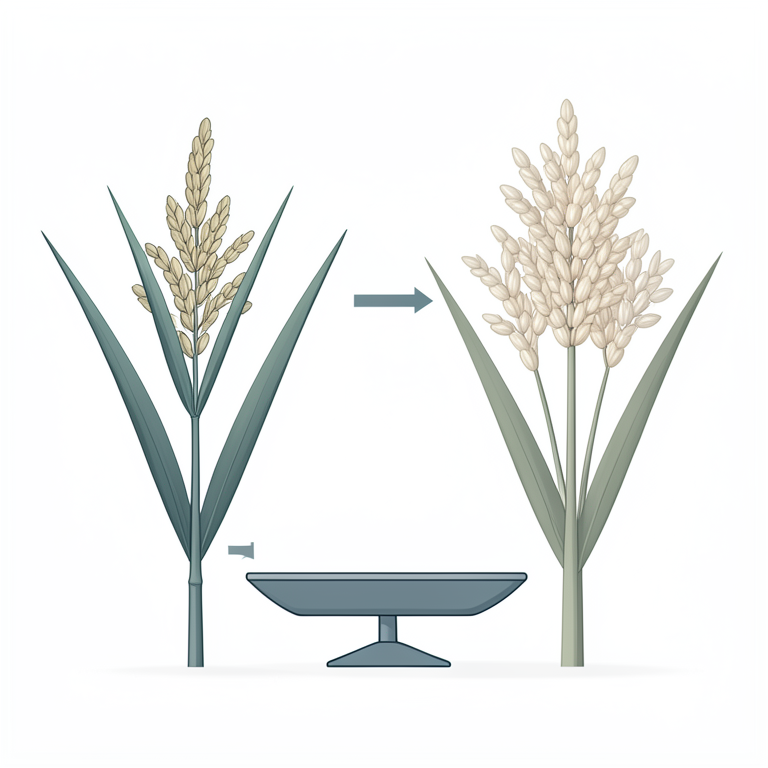
The Quality-Quantity Trade-off in Rice
AI-generated conceptual illustration (indica rice plants). It explains the idea and does not show study data.
View source evidence ↗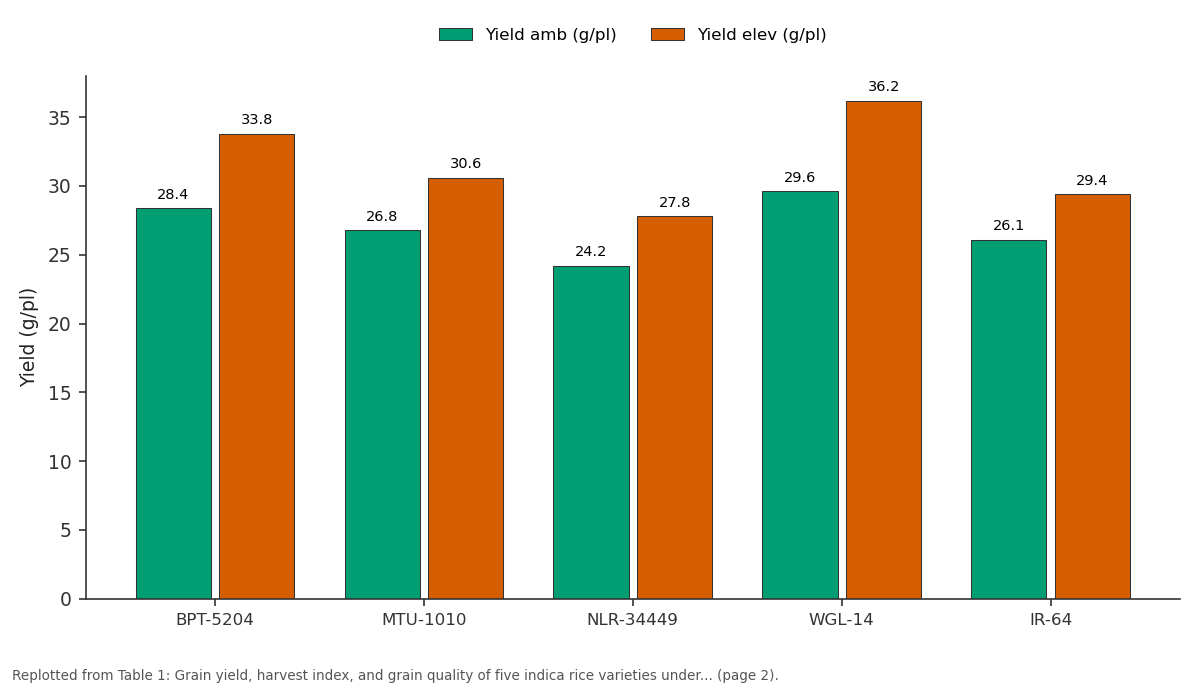
Yield amb (g/pl) and Yield elev (g/pl): BPT-5204 vs MTU-1010 vs NLR-34449 vs WGL-14 vs IR-64
Replotted from Table 1 (page 2) of the original paper. Every bar is the paper's own table value.
View source evidence ↗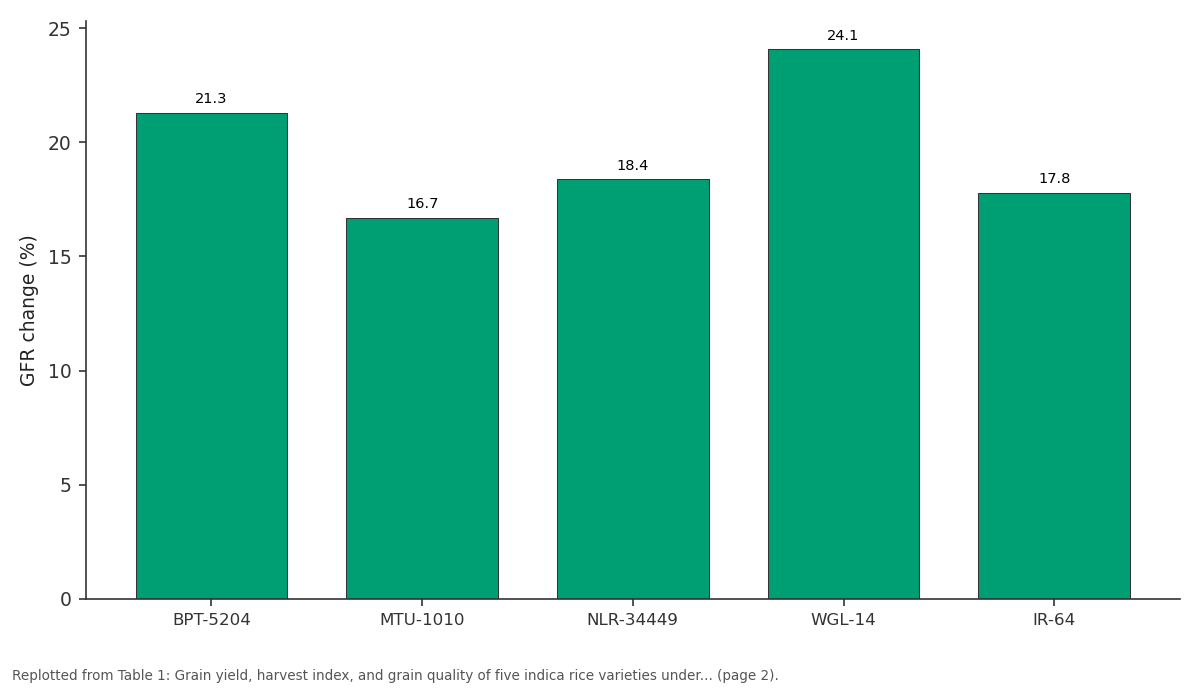
GFR change (%): BPT-5204 vs MTU-1010 vs NLR-34449 vs WGL-14 vs IR-64
Replotted from Table 1 (page 2) of the original paper. Every bar is the paper's own table value.
View source evidence ↗Figures & tables
From the original paper Table 1
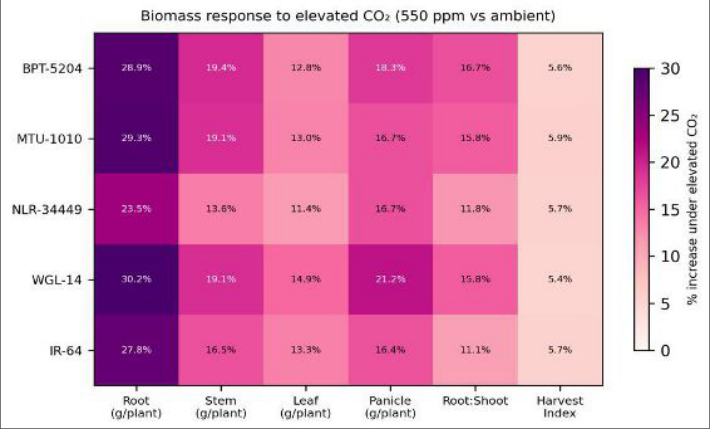 Figure 1
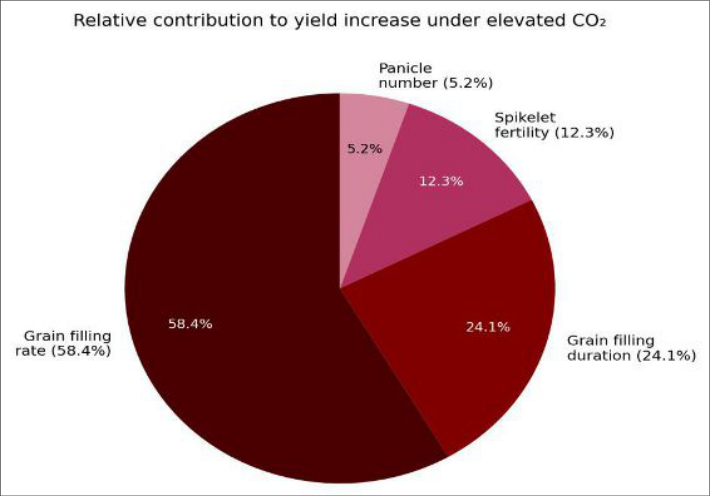 Figure 2
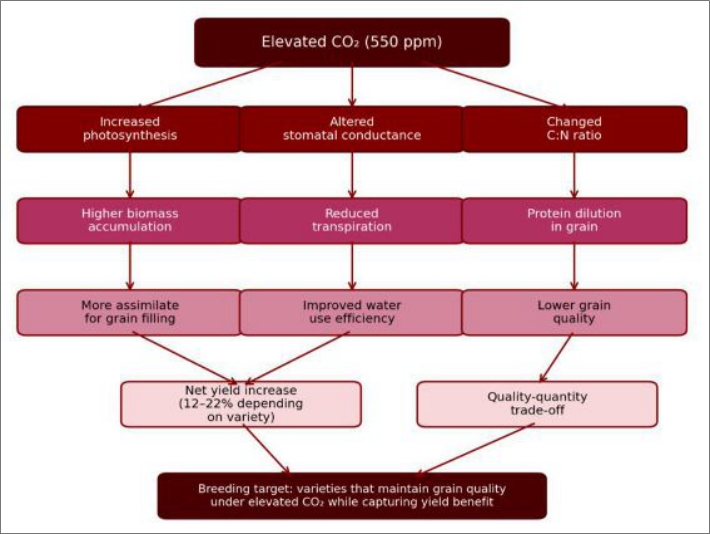 Figure 3
Introduction
Here is the paradox of carbon fertilization: while atmospheric CO₂ has risen by over 50% since pre-industrial times, rice yields in tropical Asia haven't responded proportionally-and in some regions, they've stagnated or even declined [1] . The theoretical basis for a CO₂ benefit is sound: rice is a C3 plant, and higher CO₂ should increase RuBisCO carboxylation efficiency, reduce photorespiration, and boost net photosynthesis by 20-40% [2] . Free-air CO₂ enrichment (FACE) experiments in Japan and China have confirmed yield gains of 12-18% in japonica rice at 550 ppm [3,4] . But indica rice-the type grown across South and Southeast Asia-has been far less studied under elevated CO₂, and the limited data suggest that genotypic variation in response is large [5] . Some varieties channel extra assimilates predominantly into vegetative biomass (stems, roots) rather than grain, leading to lower harvest indices and disappointing yield gains despite higher total biomass [6] . The efficiency of grain filling-both its rate and durationappears to be a critical determinant of whether additional photosynthate reaches the grain [7] . Another concern is grain quality: elevated CO₂ consistently reduces grain protein content across cereals by 5-15%, a phenomenon attributed to nitrogen dilution and altered amino acid metabolism [8,9] . This creates a quality-quantity trade-off that breeding programs must address. This research aimed to (a) quantify biomass partitioning responses of five popular indica rice varieties to elevated CO₂, (b) determine the relative contribution of grain filling rate versus duration to yield change, and (c) assess the impact on grain quality parameters.
Open-Top Chamber Specifications
Six open-top chambers (OTCs, 3 m diameter × 2.4 m height) constructed from aluminium frames with transparent polyethylene walls (UV-stabilized, 200 µm) were installed at the crop physiology research field of ANGRAU, Tirupati. Three chambers were maintained at elevated CO₂ (550±20 ppm) using pure CO₂ from pressurized cylinders metered through mass flow controllers (Aalborg GFC171). Three served as ambient controls (~410 ppm).
CO₂ concentration was monitored continuously with a nondispersive infrared analyzer (LI-COR LI-840A) at canopy height. Ventilation fans maintained air circulation at 0.8 m s⁻¹ to prevent thermal buildup. Day and night temperatures inside chambers were within 1.2 °C of outside ambient conditions throughout both seasons.
Material and Methods
Material and Methods
Material
Five indica rice varieties representing different maturity groups and yield potential were tested: BPT-5204 (Samba Mahsuri, medium duration), MTU-1010 (Cottondora Sannalu, early), NLR-34449 (medium-late), WGL-14 (Warangal, medium), and IR-64 (early). Seeds were sown in a nursery and transplanted at 25 days into 15 L pots (one hill per pot, three pots per variety per chamber) filled with puddled alluvial soil (pH 6.8, available P 12.4 mg kg⁻¹). Fertilization was at 120:60:40 kg N:P₂O₅:K₂O ha⁻¹ equivalent. Chambers were flooded to 5 cm throughout the vegetative and reproductive stages.
Methods
CO₂ enrichment began at transplanting and continued until physiological maturity. The experiment used a split-plot design: CO₂ level (2) as main plot and variety (5) as subplot, with three replications (chambers). Destructive harvests at flowering and maturity quantified root, stem, leaf, and panicle dry weights. Grain filling rate (GFR, mg grain⁻¹ day⁻¹) was calculated from sequential sampling of 10 tagged panicles per variety at 7-day intervals from anthesis. Grain filling duration (GFD) was defined as the interval from anthesis to 95% final grain weight. Harvest index = grain dry weight / total aboveground biomass. Grain protein was determined by Kjeldahl N × 5.95. Amylose content was measured by iodine colorimetry. Data were analyzed as split-plot ANOVA with LSD at p ≤ 0.05 in SAS 9.4.
CO₂ Response Index Calculation
A CO₂ response index (CRI) was calculated for each variety as: CRI = (yield at elevated CO₂ -yield at ambient) / yield at ambient × 100. Varieties were classified as high responders (CRI > 18%), moderate (10-18%), and low (<10%). This index was regressed against physiological traits to identify predictors of CO₂ responsiveness. WGL-14 showed the highest CO₂ response index (22.3%), driven by the largest grain filling rate increase (24.1%) and the smallest protein loss (6.8%) (Table 1). IR-64 was the least responsive (CRI 12.6%) and suffered the greatest protein decline (11.2%). Harvest index increased slightly under elevated CO₂ in all varieties, indicating that extra assimilate did reach the grain.
| Variety | Yield amb (g/pl) | Yield elev (g/pl) | CRI (%) | HI amb | HI elev | Protein loss (%) | GFR change (%) |
|---|---|---|---|---|---|---|---|
| BPT-5204 | 28.4 | 33.8 | +19.0 | 0.36 | 0.38 | −8.4 | +21.3 |
| MTU-1010 | 26.8 | 30.6 | +14.2 | 0.34 | 0.36 | −10.1 | +16.7 |
| NLR-34449 | 24.2 | 27.8 | +14.9 | 0.35 | 0.37 | −7.6 | +18.4 |
| WGL-14 | 29.6 | 36.2 | +22.3 | 0.37 | 0.39 | −6.8 | +24.1 |
| IR-64 | 26.1 | 29.4 | +12.6 | 0.35 | 0.37 | −11.2 | +17.8 |
| LSD (0.05) | 1.8 | 2.3 | 0.02 | 0.02 | 1.4 | 2.6 |
Table text extracted from the original PDF; superscript letters are shown inline. The original table image is below.
View original table image
Results
Results
Comprehensive Interpretation
The concept map (Figure 3) captures the central paradox: elevated CO₂ simultaneously increases yield potential through enhanced photosynthesis and grain filling, while reducing grain quality through nitrogen dilution. WGL-14's superior performance appears to reflect both a higher intrinsic photosynthetic capacity and better nitrogen remobilization efficiency, resulting in the smallest protein penalty.
Discussion
The 12.6-22.3% yield increases observed here fall within the range reported from FACE experiments on japonica rice (12-18%) but show substantially more genotypic variation [3,4] . The strong contribution of grain filling rate (58.4%) to yield increase suggests that the ability to rapidly translocate extra assimilates to developing grains is the key trait separating high-and low-responding varieties. WGL-14's 24.1% increase in GFR was nearly double that of IR-64 (17.8%), which may explain the twofold difference in CRI.
The protein decline of 6.8-11.2% aligns with global metashowing 5-15% protein reduction in cereals under elevated CO₂ [8,9] . This is generally attributed to a dilution effect: carbon fixation increases faster than nitrogen uptake, lowering the C:N ratio in grain tissue. IR-64's greater protein loss suggests weaker nitrogen remobilization from senescing leaves to grain-a trait that could be targeted by breeding. Root biomass showed the largest proportional response to elevated CO₂ (22-30%), consistent with the hypothesis that International Journal of Agriculture and Nutrition https://www.agriculturejournal.net excess carbon is allocated belowground when sink strength of above-ground organs is saturated [6] .
Acknowledgement
Acknowledgements Funding SourcesThis research was supported by the Department of Crop Physiology, Acharya NG Ranga Agricultural University, Tirupati, through the climate change physiology research programme.
Figures and tables from the paper
References
19 in the original paper- Ray DK, Ramankutty N, Mueller ND, West PC, Foley JA. Recent patterns of crop yield growth and stagnation. Nature Communications. 2012;3:1293.
- Ainsworth EA, Long SP. What have we learned from 15 years of free-air CO₂ enrichment? A meta-analytic review. New Phytologist. 2005;165(2):351-372.
- Hasegawa T, Sakai H, Tokida T, Nakamura H, Zhu C. Rice cultivar responses to elevated CO₂ at two free-air CO₂ enrichment sites in Japan. Functional Plant Biology. 2013;40(2):148-159.
- Zhu C, Kobayashi K, Loladze I, Zhu J, Jiang Q, Xu X. Carbon dioxide levels this century will alter the protein, micronutrients, and vitamin content of rice grains with potential health consequences. Science Advances. 2018;4(5):eaaq1012.
- Krishnan P, Ramakrishnan B, Reddy KR, Reddy VR. High-temperature effects on rice growth, yield, and grain quality. Advances in Agronomy. 2011;111:87206.
- Nakano H, Makino A, Mae T. The effect of elevated partial pressures of CO₂ on the relationship between photosynthetic capacity and N content in rice leaves. Plant Physiology. 1997;115(1):191-198.
- Yang J, Zhang J. Grain filling of cereals under soil drying. New Phytologist. 2006;169(2):223-236.
- Myers SS, Zanobetti A, Kloog I, Huybers P, Leakey ADB. Increasing CO₂ threatens human nutrition. Nature. 2014;510(7503):139-142.
- Taub DR, Miller B, Allen H. Effects of elevated CO₂ on the protein concentration of food crops: a metaanalysis. Global Change Biology. 2008;14(3):565-575.
- Kim HY, Lieffering M, Kobayashi K, Okada M, Miura S. Seasonal changes and varietal differences in the effects of elevated CO₂ on growth and yield of rice. Plant, Cell and Environment. 2003;26(8):1287-1298.
- Shimono H, Okada M, Yamakawa Y, Nakamura H, Kobayashi K. Genotypic variation in rice yield enhancement by elevated CO₂ relates to growth before heading, and not to maturity group. Journal of Experimental Botany. 2009;60(2):523-532.
- Seneweera S, Conroy JP. Growth, grain yield and quality of rice under free-air CO₂ enrichment. Functional Plant Biology. 2005;32(4):277-285.
- Peng S, Huang J, Sheehy JE, Laza RC, Visperas RM, Zhong X. Rice yields decline with higher night temperature from global warming. Proceedings of the National Academy of Sciences. 2004;101(27):99719975.
- Yoshida H, Horie T, Shiraiwa T. A model explaining genotypic and environmental variation of rice spikelet number per unit area measured by cross-locational experiments in Asia. Field Crops Research. 2006;97(23):135-143.
- Baker JT, Allen LH, Boote KJ. Response of rice to carbon dioxide and temperature. Agricultural and Forest Meteorology. 1992;60(3-4):153-166.
- Liang S, Ren C, Wang P, Wang X, Li Y, Xu F. Yield and quality responses of different indica rice cultivars to free-air CO₂ enrichment. Chinese Science Bulletin. 2012;57(28-29):3693-3699.
- De Costa WAJM, Weerakoon WMW, Herath HMLK, Amaratunga KSP. Physiology of yield determination of rice under elevated carbon dioxide at high temperatures in a subhumid tropical climate. Field Crops Research. 2006;96(2-3):336-347.
- Yang L, Huang J, Yang H, Zhu J, Liu H, Dong G. The impact of free-air CO₂ enrichment and nitrogen supply on grain quality of rice. Field Crops Research. 2006;96(2-3):361-370.
- Seneweera S, Norton RM. Plant responses to increased carbon dioxide. Crop Adaptation to Climate Change. 2011;Wiley-Blackwell:198-217.