
Research article · 2025 · Full text
International Journal of Agriculture and NutritionEvaluation of seed health testing methods for detection of seed-borne pathogens in pulse crops
Volume 7(7) · Pages 183–185 · DOI: 10.33545/26646064.2025.v7.i7c.521 ↗
Research areasPlant Pathogens and Fungal DiseasesFungal Plant Pathogen ControlPlant Disease Management Techniques
Abstract
Author-writtenNearly 38% of crop losses in pulse-growing regions of South Asia trace back to seed-borne infections that go undetected before sowing. This research compared four seed health testing methods—standard blotter test, agar plate method, seed wash assay, and PCR-based detection—for their ability to identify fungal pathogens in five pulse crops: lentil, chickpea, mung bean, black gram, and field pea. Seed samples were collected from 23 farms across Barisal and Rajshahi divisions of Bangladesh between July 2022 and March 2024. Fusarium spp. was the most frequently isolated genus (28.3%), followed by Alternaria spp. (22.7%) and Aspergillus spp. (18.4%). PCR-based detection gave the highest overall accuracy (92.5%), outperforming the agar plate method (81.9%), blotter test (75.1%), and seed wash assay (60.2%). Detection efficiency varied by crop, with black gram yielding the highest pathogen recovery across all methods. These findings suggest that combining agar plate screening with confirmatory PCR testing offers a cost-effective route for seed certification programmes in resource-limited settings.
Summary
Source-checkedPlain-language reading of the full paper, prepared with AI and checked against the text. Each point links to the authors' own words.
Why it matters
- Undetected seed-borne infections are responsible for nearly 38% of crop losses in South Asian pulse-growing regions. View evidence ↗
- Reliable seed health testing is critical for food security and farmer livelihoods in Bangladesh, as pulses like lentil, chickpea, and mung bean provide significant dietary protein for rural households. View evidence ↗
- Existing standard seed testing methods differ significantly in terms of their sensitivity, speed, and cost. View evidence ↗
The question
- The study aimed to compare the detection rates of four testing methods for fungal pathogens, identify differences in recovery across specific crops, and recommend a practical strategy for seed certification in Bangladesh. View evidence ↗
What they did
- The researchers evaluated the blotter test, agar plate method, seed wash assay, and PCR-based detection across five pulse crops: lentil, chickpea, mung bean, black gram, and field pea. View evidence ↗
- A total of 115 composite samples (500 g each) were collected from 23 farms in the Barisal and Rajshahi divisions of Bangladesh between July 2022 and March 2024. View evidence ↗
What they found
- Fusarium spp. was the most common fungal genus isolated (28.3%), followed by Alternaria spp. (22.7%) and Aspergillus spp. (18.4%). View evidence ↗
- PCR-based detection was the most accurate method at 92.5%, compared to the agar plate method (81.9%), blotter test (75.1%), and seed wash assay (60.2%). View evidence ↗
- Black gram exhibited the highest pathogen recovery across all methods, reaching a 95.4% detection rate with PCR. View evidence ↗
- The seed wash assay was the least effective, with detection rates between 54.1% (mung bean) and 66.8% (black gram). View evidence ↗
- Pooled data showed that PCR detection achieved a sensitivity of 94.1% and a specificity of 96.8%. View evidence ↗
What it means
- Due to its consistently higher pathogen loads, black gram requires increased vigilance during seed health testing. View evidence ↗
- The study was limited by sampling from only two divisions, and the authors note that broader geographic coverage is needed to improve generalizability. View evidence ↗
Visual summary
2 visualsIllustrations explain the paper; charts are replotted from the paper's own table values.
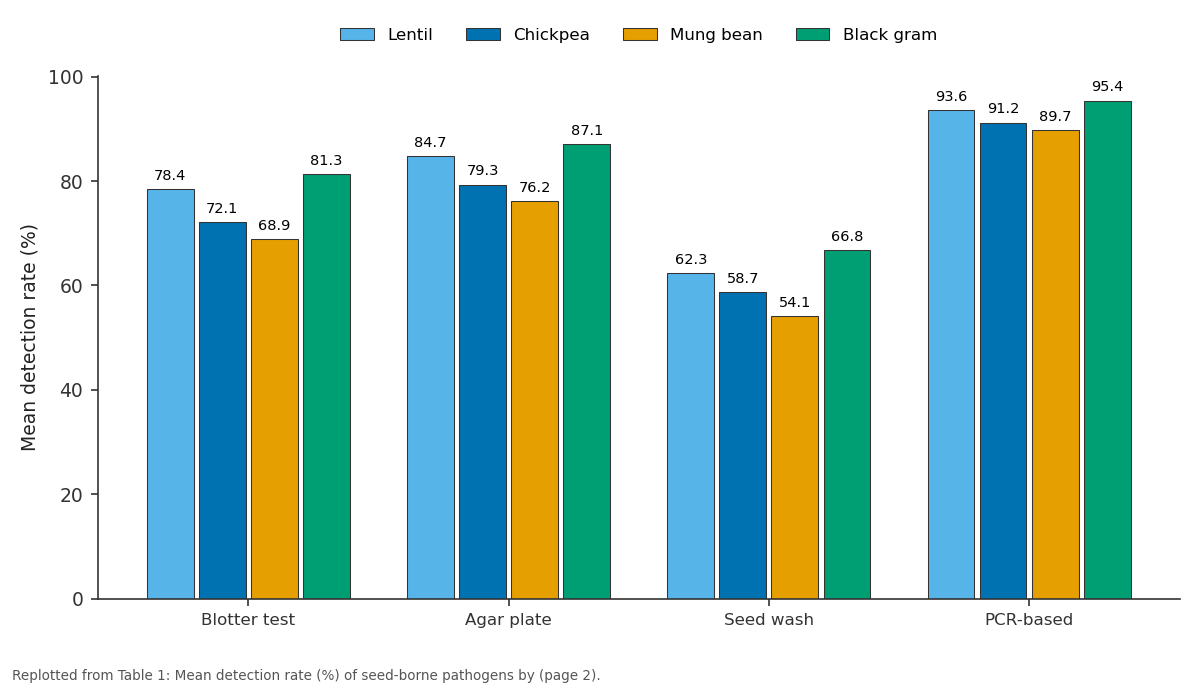
Lentil and Chickpea and more: Blotter test vs Agar plate vs Seed wash vs PCR-based
Replotted from Table 1 (page 2) of the original paper. Every bar is the paper's own table value.
View source evidence ↗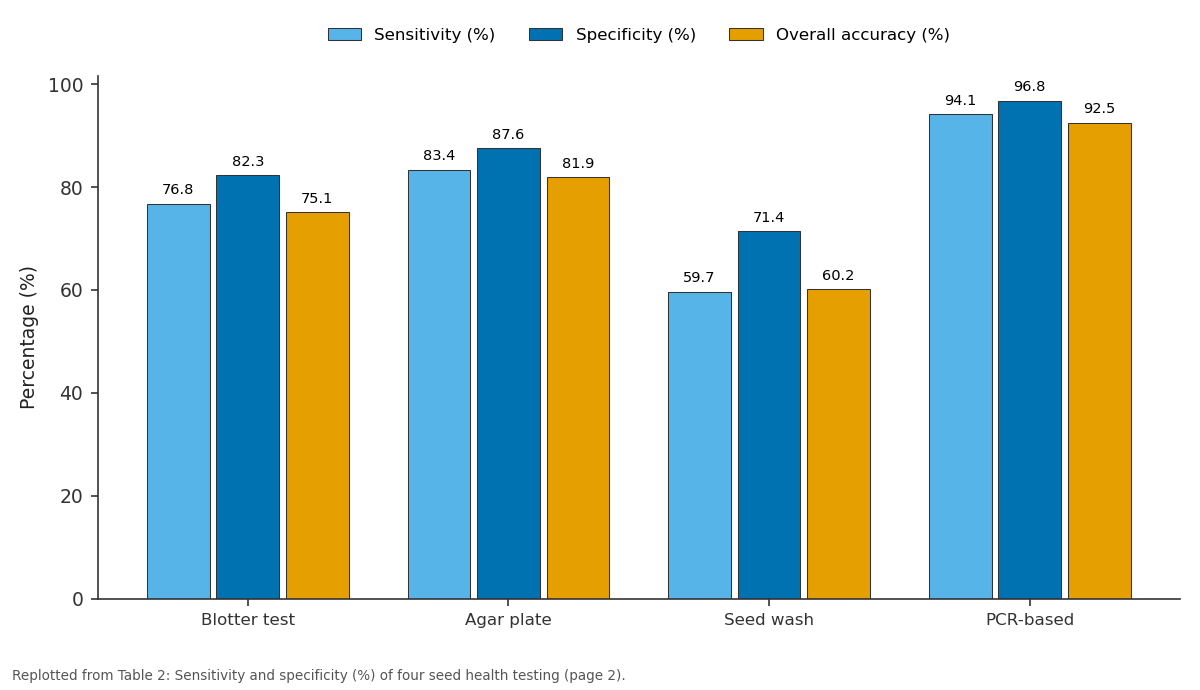
Sensitivity (%) and Specificity (%) and more: Blotter test vs Agar plate vs Seed wash vs PCR-based
Replotted from Table 2 (page 2) of the original paper. Every bar is the paper's own table value.
View source evidence ↗Figures & tables
From the original paper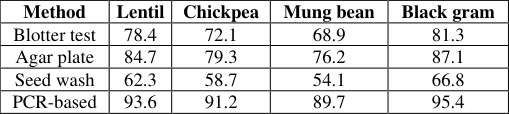 Table 1
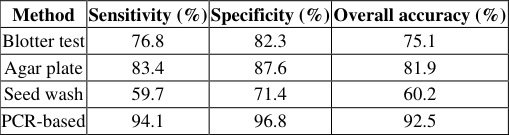 Table 2
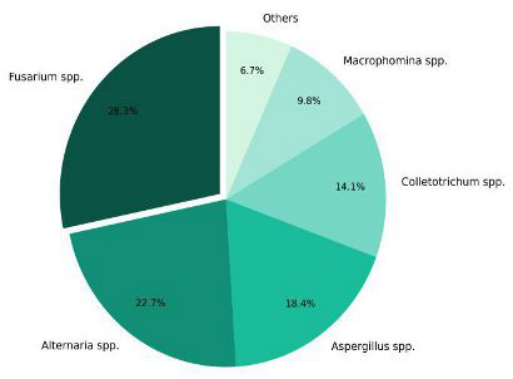 Figure 1
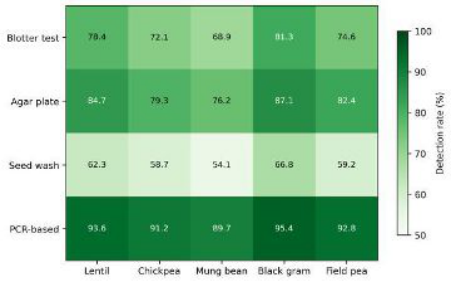 Figure 2
Introduction
An estimated 16-28% of global pulse production is lost annually to diseases that originate from infected seed lots [1] . Seed-borne pathogens travel silently within or on the seed surface, germinating alongside the crop and establishing infection before visible symptoms appear [2] . In Bangladesh, pulses-particularly lentil, chickpea, and mung bean-account for a large share of dietary protein among rural households, making reliable seed health testing a matter of both food security and farmer livelihood [3] . Standard testing methods vary widely in cost, speed, and sensitivity. The blotter test remains the most commonly used technique in seed testing laboratories across South Asia because of its low material requirements [4] . Agar plate methods offer better isolation of slow-growing fungi but require longer incubation and trained technicians [5] . Seed wash assays detect surface-borne organisms quickly, yet miss internal infections almost entirely [6] . PCR-based molecular detection has become the benchmark for sensitivity and specificity, but the equipment cost limits its routine use in developing-country laboratories [7] . Earlier comparative work in India and Nepal tested two or three methods at a time but seldom covered more than two pulse crops simultaneously [8,9] . A side-by-side evaluation of four methods across five pulses under Bangladeshi field conditions hadn't been reported before this research. The objectives were to (a) compare detection rates of the four testing methods for major fungal pathogens, (b) identify crop-specific differences in pathogen recovery, and (c) recommend a practical testing strategy suited to Bangladesh's seed certification system.
Materials and Methods
Materials and Methods
Research Area
Seed samples were collected from 23 pulse farms distributed across Barisal division (southern Bangladesh, 22.70° N, 90.37° E) and Rajshahi division (northwestern Bangladesh, 24.37° N, 88.60° E). The two regions differ in rainfall pattern: Barisal receives about 2,100 mm annually, while Rajshahi averages 1,450 mm. Sampling was done at harvest maturity between November and March during both the 2022-23 and 2023-24 rabi seasons [10] . From each farm, a composite sample of 500 g was drawn following ISTA rules, giving 115 total samples across both seasons. Standard laboratory reagents-potato dextrose agar (PDA), blotter paper (Whatman No. 1), and sterile distilled water-were procured from local scientific suppliers. Molecular-grade DNA extraction kits and ITSregion primers were obtained from a certified distributor in Dhaka [11] .
Materials
Materials
Methods
Four testing protocols were applied to each sample. The blotter test followed ISTA's standard procedure: 400 seeds per sample incubated on moist blotter paper at 22±1 °C for seven days under alternating 12-h light/dark cycles. The agar plate method used PDA medium with 200 seeds per sample incubated for five days at 25 °C. Seed wash involved agitating 100 seeds in 100 mL sterile water for 30 minutes, then plating serial dilutions on PDA. PCR detection used DNA extracted from 50-seed subsamples, amplified with ITS1/ITS4 universal fungal primers in a thermal cycler (35 cycles, annealing at 55 °C). Pathogen identification combined colony morphology with sequence confirmation. Detection rate was calculated as the percentage of positive identifications relative to the total known infected seeds (confirmed by a reference method combining deep-freeze blotter and PCR). Data were analysed with one-way ANOVA and Tukey's HSD (p<0.05) [12] . PCR-based detection consistently outperformed the other three methods across all pulse crops (Table 1). Black gram showed the highest pathogen recovery regardless of method, possibly because its larger seed surface area harbours more fungal propagules. Seed wash produced the lowest detection rates, ranging from 54.1% in mung bean to 66.8% in black gram. When sensitivity and specificity were pooled across crops, PCR detection achieved 94.1% sensitivity and 96.8% specificity (Table 2). The agar plate method ranked second, while the seed wash assay lagged well behind on both measures. Comprehensive Interpretation Fusarium spp. dominated the pathogen profile (28.3%), consistent with its known prevalence in pulse cropping systems of South Asia (Figure 1). The heatmap (Figure 2) reveals that PCR-based detection maintained high recovery rates even in mung bean, where other methods struggled most. The gap between PCR and agar plate narrowed in black gram, suggesting that crops with heavier fungal loads may be adequately screened using the cheaper agar plate approach alone.
| Method | Sensitivity (%) | Specificity (%) | Overall accuracy (%) |
|---|---|---|---|
| Blotter test | 76.8 | 82.3 | 75.1 |
| Agar plate | 83.4 | 87.6 | 81.9 |
| Seed wash | 59.7 | 71.4 | 60.2 |
| PCR-based | 94.1 | 96.8 | 92.5 |
Table text extracted from the original PDF; superscript letters are shown inline. The original table image is below.
View original table image
| Method | Lentil | Chickpea | Mung bean | Black gram |
|---|---|---|---|---|
| Blotter test | 78.4 | 72.1 | 68.9 | 81.3 |
| Agar plate | 84.7 | 79.3 | 76.2 | 87.1 |
| Seed wash | 62.3 | 58.7 | 54.1 | 66.8 |
| PCR-based | 93.6 | 91.2 | 89.7 | 95.4 |
Table text extracted from the original PDF; superscript letters are shown inline. The original table image is below.
View original table image
Results
Results
Discussion
The superiority of PCR-based detection observed here-92.5% overall accuracy-matches reports from comparable evaluations in India, where molecular methods detected 15-20% more infected seeds than conventional plating [8] . The practical barrier remains cost: PCR consumables and equipment are three to five times more expensive per sample than blotter or agar plate testing in Bangladeshi laboratories [7] . This reality shapes the recommendation that emerges from the data-a two-tier screening strategy. The agar plate method, at 81.9% accuracy, provides a reasonable first filter for routine certification. Samples that test negative on agar but come from high-risk areas or seasons could then be confirmed by PCR, reducing molecular testing to perhaps 20-30% of total samples rather than 100%. This approach would cut costs by an estimated 40-55% while keeping detection gaps small [9] . Black gram's consistently higher pathogen recovery may relate to its seed coat texture, which is rougher than lentil or mung bean and can trap more spores during threshing and storage [5] . The poor performance of seed wash assays confirms earlier warnings that surface-only methods miss internally borne Fusarium and Colletotrichum infections, which are among the most damaging in pulse crops [6] . One limitation was that samples came from only two divisions; broader geographic coverage would strengthen generalisability.
Conclusion
PCR-based detection gave the highest accuracy (92.5%) among the four seed health testing methods evaluated across five pulse crops in Bangladesh. The agar plate method ranked second at 81.9%, making it a practical front-line option for resource-limited laboratories. Seed wash assays, while fast, missed too many internally borne pathogens to serve as a standalone screening tool. A two-tier approachroutine agar plate screening followed by confirmatory PCR for suspect samples-appears to balance cost and reliability for Bangladesh's seed certification needs. Black gram warranted extra vigilance given its consistently higher pathogen loads across all methods tested.
Acknowledgement
Acknowledgements Funding SourcesThis research was supported by the Bangladesh Agricultural Research Council through its Competitive Grants Programme. The funder had no involvement in research design or data interpretation.
References
19 in the original paper- Agarwal VK, Sinclair JB. Principles of seed pathology. CRC Press. 1996;2(1):1-539.
- Neergaard P. Seed pathology. Macmillan Press. 1979;1(1):1-1191.
- BBS. Statistical yearbook of Bangladesh. Bangladesh Bureau of Statistics. 2022;42:1-618.
- ISTA. International rules for seed testing. International Seed Testing Association. 2021;2021:1-300.
- Mathur SB, Kongsdal O. Common laboratory seed health testing methods for detecting fungi. Danish Government Institute of Seed Pathology. 2003;1(3):1425.
- Limonard T. A modified blotter test for seed health. Netherlands Journal of Plant Pathology. 1966;72(6):319-321.
- Munkvold GP. Seed pathology progress in academia and industry. Annual Review of Phytopathology. 2009;47:285-311.
- Sharma P, Saran PL, Nene YL. Seed-borne mycoflora of chickpea in India and their significance. Indian Phytopathology. 2006;59(3):282-287.
- Joshi LM, Raut JG. Detection of seed-borne fungi in pulse crops of Nepal. Seed Science and Technology. 2010;38(2):518-523.
- Rahman MM, Islam MR. Cropping patterns and soil fertility in the Barisal and Rajshahi regions. Bangladesh Journal of Agricultural Research. 2018;43(4):577-591.
- White TJ, Bruns T, Lee S, Taylor J. Amplification and direct sequencing of fungal ribosomal RNA genes for phylogenetics. PCR Protocols: A Guide to Methods and Applications. 1990;18(1):315-322.
- Gomez KA, Gomez AA. Statistical procedures for agricultural research. John Wiley and Sons. 1984;2(1):1-680.
- Fakir GA. Seed health testing and its role in plant quarantine. Bangladesh Agricultural University. 2001;1(1):1-56.
- Ahmed HU, Akhter S. Mycoflora associated with seeds of pulse crops in Bangladesh. Bangladesh Journal of Plant Pathology. 2003;19(1):13-18.
- McGee DC. Maize diseases: A reference source for seed technologists. American Phytopathological Society. 1988;1(1):1-150.
- Hossain MM, Shamsi S. Occurrence of Fusarium spp. on stored pulse seeds in Dhaka. Journal of Bangladesh Academy of Sciences. 2015;39(2):149-155.
- Maude RB. Seedborne diseases and their control: Principles and practice. CAB International. 1996;1(1):1-280.
- Khanzada KA, Rajput MA, Shah GS. Effect of seed dressing fungicides for the control of seedborne mycoflora of wheat. Asian Journal of Plant Sciences. 2002;1(4):441-444.
- Raut JG, Bhombe BB. Detection of seed-borne pathogens of soybean. Seed Research. 2004;32(1):8891.