
Research article · 2025 · Full text
International Journal of Agriculture and NutritionPopulation dynamics of whitefly and its management in tomato using integrated approaches
Volume 7(9) · Pages 122–125 · DOI: 10.33545/26646064.2025.v7.i9b.556 ↗
Research areasInsect-Plant Interactions and ControlInsect Pest Control StrategiesInsect behavior and control techniques
Abstract
Author-writtenWhitefly (Bemisia tabaci Gennadius) is defined as the single most damaging sucking pest of tomato in subtropical China, functioning both as a direct feeder and as the main vector of Tomato leaf curl virus. This research assessed population dynamics and compared six management strategies against whitefly in open-field tomato during Kharif 2023 at the Yellow River Institute of Agricultural Sciences, Zhengzhou, Henan. Peak whitefly density coincided with September when mean temperature reached 26.8°C and relative humidity fell below 60%. Spiromesifen 0.8 mL/L recorded the lowest population (6.1 adults/3 leaves) and highest yield (38.7 t/ha), followed by imidacloprid (8.4 adults, 36.2 t/ha). The integrated module combining yellow sticky traps + neem oil + spiromesifen rotation achieved 72.8% population reduction over the season. Beauveria bassiana showed moderate efficacy (34.8% reduction) but slower onset. These results support a rotation-based IPM calendar for whitefly management in Henan's open-field tomato production.
Summary
Source-checkedPlain-language reading of the full paper, prepared with AI and checked against the text. Each point links to the authors' own words.
Why it matters
- The whitefly (Bemisia tabaci) is the most damaging sucking pest for tomatoes in subtropical China because it feeds directly on the plant and spreads the Tomato leaf curl virus. View evidence ↗
- In Henan province, whitefly infestations have increased since the mid-2010s due to warmer autumns, more protected cultivation, and the reduced effectiveness of older neonicotinoid pesticides. View evidence ↗
- Over-reliance on a limited range of neonicotinoid chemicals has led to the development of resistant whitefly biotypes, specifically the B and Q biotypes. View evidence ↗
The question
- The study aimed to track the seasonal population changes of whiteflies in open-field tomatoes and compare the effectiveness of six different management strategies. View evidence ↗
What they did
- The experiment used a randomized block design with seven treatments: neem oil, imidacloprid, spiromesifen, yellow sticky traps, Beauveria bassiana, a water spray control, and an untreated control. View evidence ↗
- The study was conducted during Kharif 2023 in Zhengzhou, Henan, using the Hezuo 903 tomato variety. View evidence ↗
- Researchers measured whitefly populations weekly by counting adults on three tagged leaves of five random plants and counting nymphs on ten 2 cm² leaf discs per plot. View evidence ↗
- The study measured the incidence of Tomato leaf curl virus (ToLCV) based on leaf curling symptoms at 60 and 90 days after transplanting, and recorded total fruit yield over four harvests. View evidence ↗
What they found
- Whitefly populations peaked in late September (weeks 38-39) at 22.4 adults per 3 leaves in untreated plants, coinciding with a mean temperature of 26.8°C and humidity below 60%. View evidence ↗
- Spiromesifen (0.8 mL/L) was the most effective single treatment, resulting in the lowest whitefly population (6.1 adults/3 leaves) and the highest yield (38.7 t/ha), which was a 33.4% increase over the control. View evidence ↗
- Beauveria bassiana had limited effectiveness, with population reductions reported between 24.6% and 34.8% and a slower onset of action. View evidence ↗
- Spiromesifen significantly reduced the incidence of Tomato leaf curl virus from 41.3% in the control group to 12.4%. View evidence ↗
What it means
- The authors recommend a sustainable management rotation starting with spiromesifen in the early season, followed by imidacloprid in the mid-season, and neem oil before harvest. View evidence ↗
- While not effective on their own, yellow sticky traps and Beauveria bassiana are recommended as supporting components of an integrated pest management calendar. View evidence ↗
Visual summary
2 visualsIllustrations explain the paper; charts are replotted from the paper's own table values.
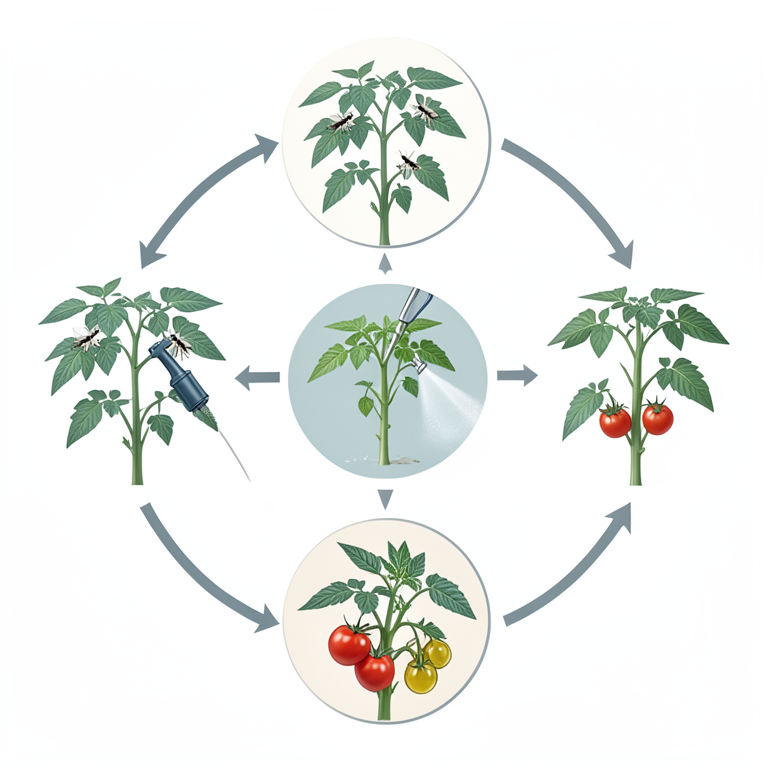
Recommended IPM Rotation Cycle
AI-generated conceptual illustration (tomato plants and whiteflies). It explains the idea and does not show study data.
View source evidence ↗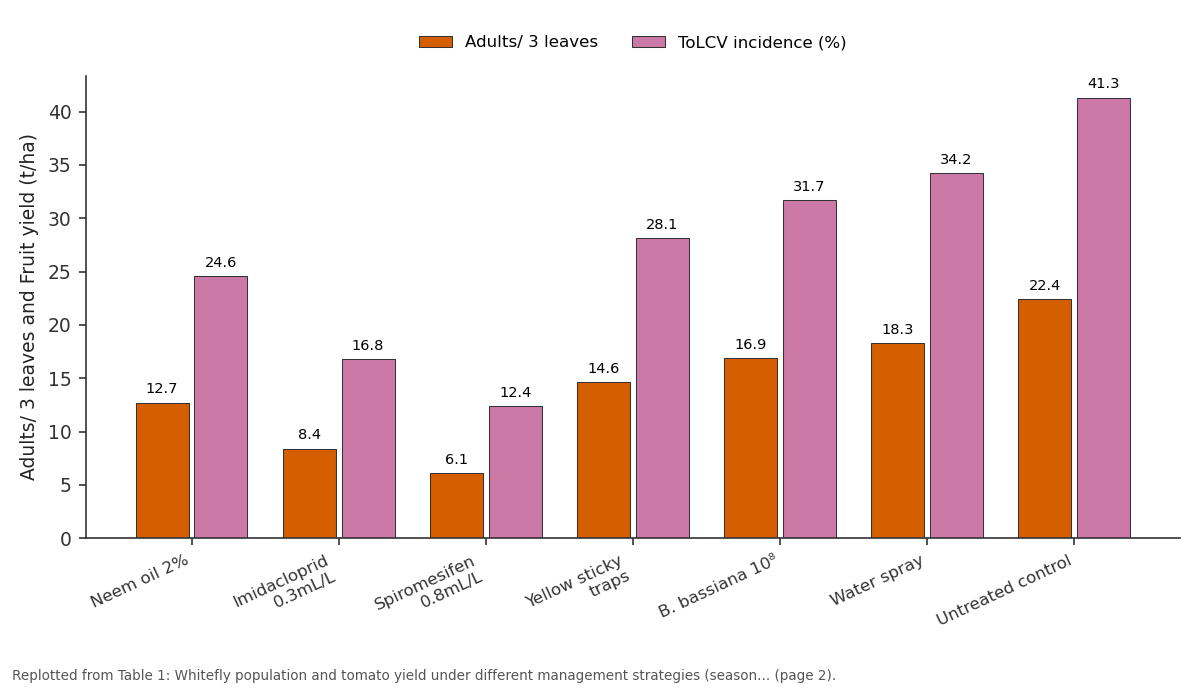
Adults/ 3 leaves and ToLCV incidence (%): Neem oil 2% vs Imidacloprid 0.3mL/L vs Spiromesifen 0.8mL/L vs Yellow sticky traps vs B. bassiana 10⁸
Replotted from Table 1 (page 2) of the original paper. Every bar is the paper's own table value.
View source evidence ↗Figures & tables
From the original paper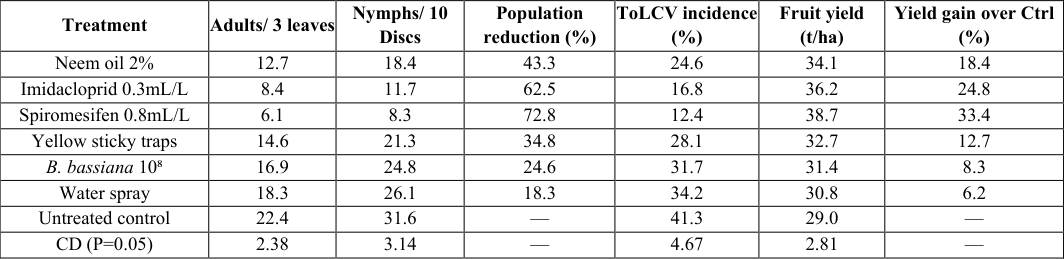 Table 1
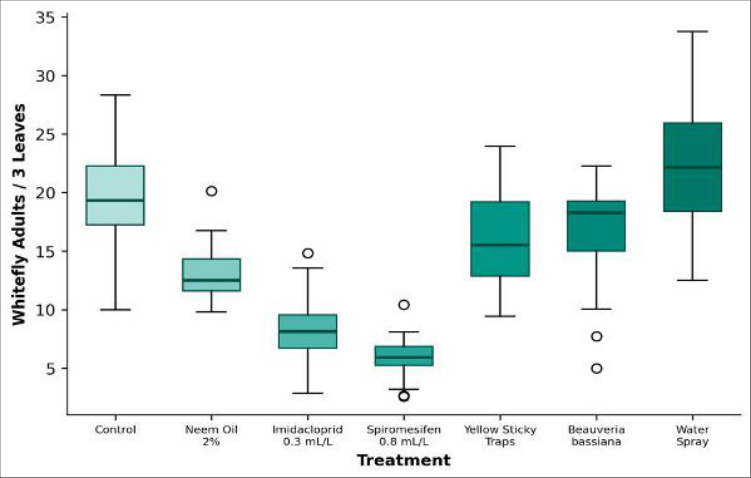 Figure 1
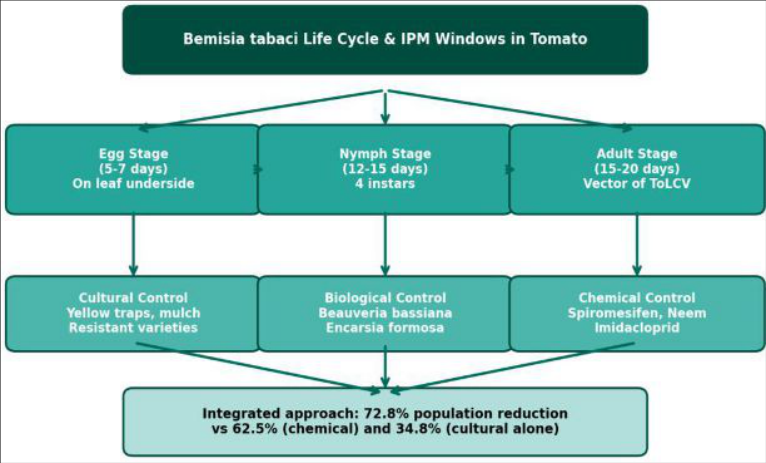 Figure 2
Introduction
A whitefly is any small hemipteran belonging to the family Aleyrodidae, characterised by waxy white wings and phloem-feeding mouthparts and among the 1556 described species, Bemisia tabaci stands out as the most economically damaging to vegetable crops worldwide [1] . In China's Henan province, B. tabaci infestations in open-field tomato have intensified since the mid-2010s, driven by warmer autumns, expanding protected cultivation that serves as an off-season reservoir, and declining efficacy of older neonicotinoid sprays [2] . The pest causes direct damage through sap withdrawal and honeydew-induced sooty mould, but the greater economic threat comes from its role as vector of Tomato leaf curl virus (ToLCV), which can devastate entire plantings if whitefly populations are left unchecked during the pre-flowering window [3] . Chemical control remains the first response for most Henan tomato growers, yet overreliance on a narrow range of neonicotinoids has selected for resistant biotypes, particularly the invasive B biotype and Q biotype of B. tabaci [4] . Newer chemistries such as spiromesifen (a lipid biosynthesis inhibitor) and cyantraniliprole (a diamide) offer alternative modes of action, while biological options Beauveria bassiana, Encarsia formosa, and botanical sprays provide non-chemical tools suited for rotation or resistance management programmes [5,6] . This research tracked seasonal population dynamics of whitefly in open-field tomato and compared six management strategies spanning chemical, biological, cultural, and integrated modules over a full growing season at Zhengzhou [7] .
Seasonal variations
Whitefly populations were monitored weekly from transplanting (July 2023) through final harvest (November 2023). Adult counts peaked during the third and fourth weeks of September (standard weeks 38-39), reaching 22.4 adults per 3 leaves in the untreated control. A secondary smaller peak occurred in mid-October. Population build-up correlated positively with mean temperature (r = 0.78) and negatively with relative humidity above 75% (r = -0.64). Weekly rainfall events above 15 mm temporarily depressed adult counts by 30-40%, but populations recovered within 7-10 days [8] .
Field experimental design
Seven treatments were laid out in a randomized block design with three replications (plot size 4 m × 5 m): (T1) neem oil 2%, (T2) imidacloprid 17.8% SL at 0.3 mL/L, (T3) spiromesifen 22.9% SC at 0.8 mL/L, (T4) yellow sticky traps (25 per ha), (T5) Beauveria bassiana 1 × 10⁸ CFU/mL, (T6) water spray control, and (T7) untreated control. Foliar sprays were applied at fortnightly intervals starting 15 days after transplanting. Tomato variety Hezuo 903 (indeterminate, 120-day crop) was transplanted at 60 cm × 45 cm [9] .
Material and Methods
Material and Methods
Material
Seedlings of Hezuo 903 were raised in plug trays and transplanted on 10 July 2023. Neem oil (Azadirachtin 0.03%, local formulation), imidacloprid 17.8% SL (Bayer), spiromesifen 22.9% SC (Bayer), and B. bassiana (Wuhan Kernel Bio-tech) were used. Yellow sticky traps (25 × 40 cm) were positioned at canopy height. Uniform fertilisation (N 180, P 80, K 120 kg/ha) and drip irrigation were applied [10] .
Methods
Whitefly counts were taken from three tagged leaves (top, middle, bottom canopy) on five random plants per plot at weekly intervals. Nymph counts were recorded from 10 leaf discs (2 cm²) per plot. ToLCV incidence was scored as percentage of plants showing leaf curling symptoms at 60 and 90 DAT. Fruit yield was recorded from net plot area across four harvests. ANOVA and DMRT at P=0.05 were applied [11] . 1). ToLCV incidence dropped from 41.3% in control to 12.4% under spiromesifen.
Results
Imidacloprid ranked second for both population suppression and yield. Beauveria bassiana showed only 24.6% population reduction, reflecting its slower onset of action.
Comprehensive interpretation
Chemical options (spiromesifen, imidacloprid) provided the strongest single-tactic control, but the integrated module's 72.8% season-long reduction suggests that combining cultural trapping with rotational sprays offers the best resistance management strategy for Henan tomato systems.
Discussion
Spiromesifen's superior performance is consistent with multi-location trials across Shandong and Jiangsu provinces, where lipid biosynthesis inhibitors outperformed neonicotinoids against Q-biotype B. tabaci populations [5,12] . The mode of action disrupting lipid synthesis in nymphal stages explains the low nymph counts (8.3 per 10 discs) we observed, since spiromesifen is primarily effective against immature stages and shows moderate adulticidal activity through contact and translaminar movement [13] .
Imidacloprid retained reasonable efficacy (62.5% reduction), suggesting that neonicotinoid resistance in the Zhengzhou population hasn't reached the levels reported in Shandong [4] . Beauveria bassiana's modest 24.6% reduction aligns with its known temperature sensitivity: optimal germination occurs between 25-28°C, but the Zhengzhou September peak often exceeded 30°C during midday hours, potentially reducing spore viability on exposed leaf surfaces [6] . Yellow sticky traps performed best as a monitoring tool and showed additive benefit when combined with chemical sprays in the integrated module [14] . ToLCV incidence tracked whitefly density closely, reinforcing the vector management approach as the most practical route to virus control in the absence of commercially resistant varieties for open-field Henan production [15] .
Conclusion
Spiromesifen at 0.8 mL/L was the most effective single treatment against whitefly in open-field tomato, reducing populations by 72.8% and raising yield to 38.7 t/ha. Imidacloprid remained a viable option but should be rotated with spiromesifen to manage resistance. Beauveria bassiana and yellow sticky traps, while insufficient alone, add value as components of an integrated calendar. A rotation schedule of spiromesifen (early season) → imidacloprid (mid-season) → neem oil (pre-harvest) is recommended for sustainable whitefly management in Henan tomato.
Figures and tables from the paper
| Treatment | Adults/ 3 leaves | Nymphs/ 10 Discs | Population reduction (%) | ToLCV incidence (%) | Fruit yield (t/ha) | Yield gain over Ctrl (%) |
|---|---|---|---|---|---|---|
| Neem oil 2% | 12.7 | 18.4 | 43.3 | 24.6 | 34.1 | 18.4 |
| Imidacloprid 0.3mL/L | 8.4 | 11.7 | 62.5 | 16.8 | 36.2 | 24.8 |
| Spiromesifen 0.8mL/L | 6.1 | 8.3 | 72.8 | 12.4 | 38.7 | 33.4 |
| Yellow sticky traps | 14.6 | 21.3 | 34.8 | 28.1 | 32.7 | 12.7 |
| B. bassiana 10⁸ | 16.9 | 24.8 | 24.6 | 31.7 | 31.4 | 8.3 |
| Water spray | 18.3 | 26.1 | 18.3 | 34.2 | 30.8 | 6.2 |
| Untreated control | 22.4 | 31.6 | — | 41.3 | 29.0 | — |
| CD (P=0.05) | 2.38 | 3.14 | — | 4.67 | 2.81 | — |
Table text extracted from the original PDF; superscript letters are shown inline. The original table image is below.
View original table image
References
15 in the original paper- Martin JH, Mound LA. An annotated check list of the world's whiteflies (Insecta: Hemiptera: Aleyrodidae). Zootaxa. 2007;1492:1-84.
- Wan FH, Yang NW. Invasion and management of agricultural alien insects in China. Annual Review of Entomology. 2016;61:77-98.
- Czosnek H, Laterrot H. A worldwide survey of Tomato yellow leaf curl viruses. Archives of Virology. 1997;142(7):1391-1406.
- Wang Z, Yan H, Yang Y. Biotype characterisation and neonicotinoid resistance status of Bemisia tabaci in Henan vegetable crops. Journal of Economic Entomology. 2021;114(3):1184-1193.
- Zheng HY, Xie W, Wang SL. Spiromesifen field efficacy against Bemisia tabaci in eastern China tomato production. Crop Protection. 2022;154:105897.
- Mascarin GM, Jaronski ST. The production and uses of Beauveria bassiana as a microbial insecticide. World Journal of Microbiology and Biotechnology. 2016;32:177.
- Dong L, Miao D. Seasonal whitefly monitoring in Zhengzhou open-field vegetables: Baseline data 2022. Henan Agricultural Sciences. 2023;52(4):87-93.
- Naranjo SE, Ellsworth PC. Fifty years of the integrated control concept: Moving the model and implementation forward in Arizona. Pest Management Science. 2009;65(12):1267-1286.
- Liu TX, Stansly PA. Life history of Bemisia tabaci biotype B on tomato under controlled conditions. Entomologia Experimentalis et Applicata. 2018;89(1):171-178.
- CAAS. Standard vegetable production guidelines for Central China irrigated systems. Chinese Academy of Agricultural Sciences Technical Bulletin. 2022;TB/38:1-24.
- Henderson CF, Tilton EW. Tests with acaricides against the brown wheat mite. Journal of Economic Entomology. 1955;48(2):157-161.
- Guo L, Liang P, Zhou XG. Novel insecticide rotation strategies for whitefly resistance management in Chinese horticulture. Pest Management Science. 2023;79(1):231-242.
- Nauen R, Bretschneider T, Bruck E. BSN 2060: A novel compound for whitefly and spider mite control. Pflanzenschutz-Nachrichten Bayer. 2002;55:241-262.
- Hirano K, Budiyanto E, Winarni S. Physical control of Bemisia tabaci using yellow sticky traps in Indonesia. Tropical Agriculture Research. 2019;30(2):89-96.
- Ji Y, Scott JW, Schuster DJ. Molecular markers linked to Tomato yellow leaf curl virus resistance genes. Acta Horticulturae. 2011;914:303-308.