
Research article · 2026 · Full text
International Journal of Biology SciencesClimate change and agroforestry
Volume 8(4) · Pages 127–130 · DOI: 10.33545/26649926.2026.v8.i4b.806 ↗
Research areasAgroforestry and silvopastoral systemsForest Ecology and ConservationAfrican Botany and Ecology Studies
Abstract
Author-writtenAgroforestry offers a special chance to integrate the two goals of mitigation and adaptation to climate change. The estimated area under agroforestry in India is 25.3 m ha, which can be expanded to a level that is taken into consideration. It can strengthen the system's ability to withstand the negative effects of climate change. Agroforestry also helps to relieve strain on natural forests, which are the biggest sinks of terrestrial carbon, by sequestering elemental carbon in the trees. The application of agroforestry technology for soil conservation, which may improve carbon storage in trees and soils, is another indirect method of sequestering carbon. Agroforestry systems in India are thought to have a carbon sequestration capacity of 0.25-76.55 mg C/ha/year for trees and 0.01-0.60 mg C/ha/year for crops. Agroforestry's contribution to soil carbon sequestration ranged from 0.003 to 3.98 mg C/ha/year. Depending on the location, species types, system, site quality, and past land use, each component's total carbon sequestered varies significantly. According to the review, the agroforestry model's technological advancement and its contribution to environmental services, particularly carbon sequestration, offer a great chance to raise the country's tree cover to 33% of its total land area, as required by the National Forest Policy.
Summary
Source-checkedPlain-language reading of the full paper, prepared with AI and checked against the text. Each point links to the authors' own words.
Why it matters
- Agroforestry is considered a valuable tool for simultaneously addressing the mitigation and adaptation of climate change. View evidence ↗
- By sequestering carbon in trees, agroforestry reduces the pressure on natural forests, which serve as the primary terrestrial carbon sinks. View evidence ↗
- Advancements in agroforestry could help India reach its National Forest Policy goal of 33% total land area tree cover. View evidence ↗
The question
- The authors aim to highlight the need to bring agroforestry into mainstream science to fully realize its ecological and regional potential. View evidence ↗
What they did
- The review notes that the estimated area currently under agroforestry in India is 25.3 million hectares. View evidence ↗
- The paper reports that Indian agroforestry systems have a carbon sequestration capacity of 0.25-76.55 mg C/ha/year for trees and 0.01-0.60 mg C/ha/year for crops. View evidence ↗
- The contribution of agroforestry to soil carbon sequestration is reported to range from 0.003 to 3.98 mg C/ha/year. View evidence ↗
What they found
- In a 22-year model, integrating teak and papaya with agricultural crops provided significantly higher net returns (Rs. 12,316 ha-1yr-1) than field crops alone (Rs. 3,546 ha-1yr-1). View evidence ↗
- Between 1992 and 2007, the private sector's promotion of clonal eucalyptus plantations led to the planting of 8 million hectares. View evidence ↗
- Cardamom-based agroforestry systems stored 3.5 times more carbon than rainfed agriculture. View evidence ↗
- Cardamom-based agroforestry produces 4.5 to 5.5 Mg ha-1 of woody biomass per year, exceeding the fuel wood requirements for curing by more than five times. View evidence ↗
- A holistic integrated farming systems study showed a 6.8-fold improvement in net returns over variable costs and a 51.4% increase in household consumption value. View evidence ↗
What it means
- The authors conclude that priority should be given to four R&D areas: smallholder production and markets, local nurseries, climate change adaptation of techniques, and improving environmental services. View evidence ↗
- The authors state that agroforestry is a viable option for making smallholder farming systems more sustainable. View evidence ↗
- The authors note that the full potential of agroforestry remains largely unrealized because many technologies have not been widely adopted. View evidence ↗
Visual summary
1 visualsIllustrations explain the paper; they do not show study data.
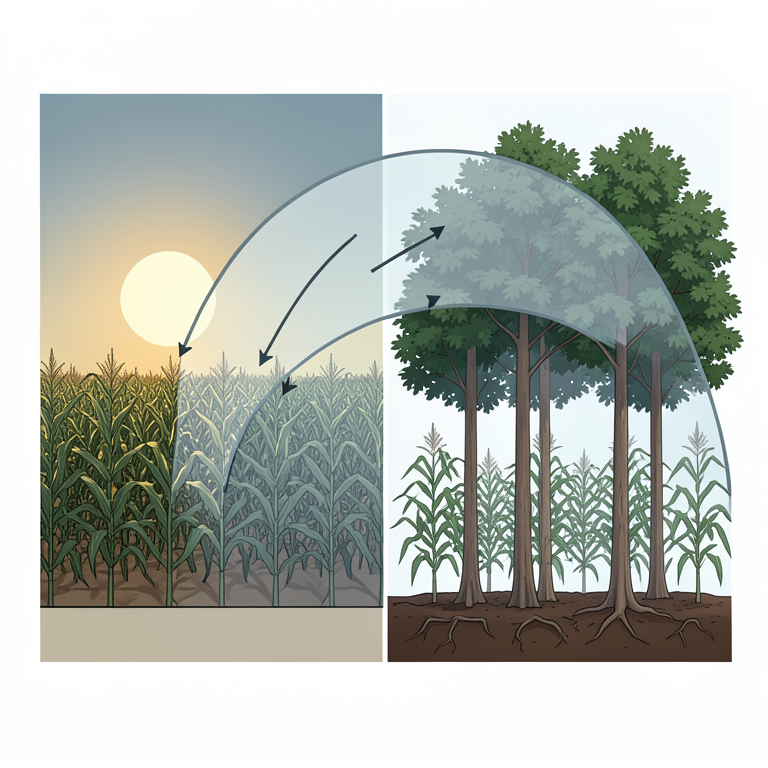
Agroforestry as a Climate Buffer
AI-generated conceptual illustration (Maize crops integrated with walnut trees in a rural landscape). It explains the idea and does not show study data.
View source evidence ↗Introduction
Since organized agroforestry research began some 50 years ago, India has been at the forefront of this field. Researchers, policymakers, and others have given agroforestry a lot of attention in India because of its perceived capacity to greatly contribute to economic growth, poverty alleviation, and environmental security. As a result, agroforestry is now recognized as a key component of the "evergreen revolution" movement in the nation. In many regions of the nation, the potential of agroforestry has been amply proved by thirty years of research spending, and certain methods have been widely embraced. However, many technologies have not been extensively adopted, and the enormous promise is still mostly unrealized. In order to fully utilize the potential of agroforestry systems (AFS) at the ecological, regional, and global levels for the benefit of the land and its current and future users, research and development (R&D) efforts in the twenty-first century should concentrate on bringing agroforestry into the mainstream of science.
Agroforestry: A Brief History of Development
Early in the 1970s, industry involvement in commercial tree species plantations through Indian Council of Agricultural Research (ICAR) institutes marked the beginning of structured research in India. In response, the ICAR established the National Research Center for Agroforestry in 1988 and the All India Coordinated Research Project (AICRP) on agroforestry in 1983. Currently, 37 AICRP centers on agroforestry are situated in State Agricultural Universities, ICAR institutes, and ICFRE institutes. These centers operate in network mode to undertake research in various agroclimatic zones. Because agroforestry systems offer ecosystem services including carbon sequestration, biodiversity conservation, improved water quality, and land degradation, they may be a better alternative for mitigating climate change than ocean and other terrestrial solutions. In order to mitigate and adapt to climate change, agroforestry was incorporated into international programs like reduced emissions from forest degradation and deforestation (REDD). (Sharma and others, 2001) [6] .
Environmental Services of Agroforestry
One of the main advantages of incorporating trees into farming systems is the function that agroforestry plays in safeguarding the environment and offering various ecosystem services. After extensive evaluation, the advantages of agroforestry are finally becoming apparent to farmers and landowners. Agroforestry affects the environment on a variety of temporal and spatial scales, ranging from fine-scale effects on soil quality and structure to regional or global effects on civilization. Through the intensification, diversity, and buffering of trees in farming systems, agroforestry gives agricultural output resilience to both short-term climate fluctuation and long-term climate change. Well-known techniques like windbreaks and shelterbelts alter the microclimate and improve crop productivity by lowering moisture loss, especially in arid regions.
Agroforestry as Livelihood Options
It has been discovered that the farming systems approach is an effective tool for spreading agricultural technologies in rural areas. In order to maintain soil fertility and the agroecosystem while meeting the ever-increasing need for food, feed, fiber, and fuel, crop diversity is thought to be a desired transition in the current system toward a more balanced cropping system. Desired diversity in the farming system perspective is crucial in a nation where over 85% of people are small holders and 67% have only 0.38 ha to feed their family and make a good living. The profitability of highly location-specific systems is found to be improved by holistic and innovative techniques (Chand et al., 2012) [1] . According to Gangwar and Ravishankar (2015) [3] , an onfarm integrated farming systems study employing a holistic approach offers a 6.8-fold improvement in net returns over variable costs of interventions in enhanced farming systems with a 51.4% rise in the value of household consumption (generated within the farm).
Recent Technological Development in Agroforestry and Their Adoption
The technologies created in agroforestry differ in various agroclimatic zones since agroforestry research is site and region specific. The agroforestry system is described for various agroclimatic zones based on potential tree species for a specific agroclimatic zone. Some of the agroforestry technologies developed in different agro-climatic zones are briefly described below:
Poplar Based Agroforestry Technology
In the Indo-Gangetic plains of North India, poplar-based agroforestry (PBAF) is an effective land use intervention that sustains farming and helps the farming community. The match business WIMCO Ltd. began promoting PBAF in the 1970s in order to secure matchwood output for its factory in Uttar Pradesh, India, using its own resources up until 1984 and an under contract farming model from 1984 to 1995. Approximately 15,000 farmers receive poplar saplings from WIMCO each year. Nowadays, just 0.2% of all poplar wood produced is used by the company for match splints; the remainder is used by other companies. Since the current land rules prohibit the sector from holding property for the purpose of growing industrial plantations, the industry has embraced this strategy and collaboration with farmers. Nowadays, the majority of government forests are preserved for environmental purposes. Poplars and other farm-grown trees provide the majority of the wood used for home and industrial purposes. Currently, 99% of the 0.312 million hectares of poplar cultivation are produced in agroforestry by more than 0.3 million small growers, with 40% growing on field margins and 60% inside fields. Dhiman (2015) [2] .
Teak Based Agroforestry System
Teak is one of the greatest trees to grow for lumber. It works well on alley, bund, border, and channel side plantings. Arable crops (Sorghum, groundnut, chilli, and ragi), silvicultural crops (teak), horticultural crops (papaya), and pastoral crops (subabul and grass) are all included in the teak-based agri-silvi-horticultural models created by Agricultural Research Station, Dharwad. After a 22-year agroforestry model, the integration of teak and papaya with agricultural crops yielded the best net returns (Rs. 12,316 ha-1yr-1) compared to field crops (Rs. 3,546 ha-1yr-1). Teak + papaya + grass + field crops (Rs. 10,977 ha-1yr-1) and teak + papaya + subabul (Rs. 9,328 ha-1yr-1). With certain adjustments suitable for local field conditions (e.g., border planting in one or two rows along the irrigation channels), many farmers in the transitional zone and under irrigation have adopted the practice of growing teak in alleys or bunds.
Eucalyptus Based Agroforestry
After teak, it is the second most often planted species in India. It has been widely planted throughout the nation, with the exception of the northeastern states. In the Indo-Gangetic plains of India, eucalyptus-based agroforestry technology has become increasingly popular in recent developments in agroforestry research and its role in climate change adaptation and mitigation. The most common option for planting along the borders, or bunds, of agricultural fields is eucalyptus, which seems to be well integrated and accepted in Indian agroforestry. When the spacing is 5 m x 2 m, a variety of crops can be cultivated in agrisilvicuture, allowing for intercropping for up to three years. Block plantations, which can accommodate 2222 plants per hectare and permit intercrops in the first two years of a four-year rotation period, have tree spacing of three meters and row spacing of 1.5 meters. Intercrops such as chilies, cotton, tobacco, black gram, green gram are widely grown with eucalyptus during the initial years. Agroforestry and farm forestry promoted by Private sector with clonal eucalyptus plantations benefited thousands of farmers who planted 8 million ha during 1992 to 2007 (Lal, 2015) [4] .
Sapota-Teak Based Agroforestry System in Hill Zone
In Karnataka's hilly and transitional regions, sapota is a significant tropical fruit crop that is both rainfed and irrigated. In the initial years, there are plenty of opportunities for intercropping when this crop is spaced widely. Both the hill zone and medium-deep soils with irrigation capabilities can benefit from this approach. Under the National Extension Technology Programs ORP-II (Technology Extension Project on Agroforestry), it is exhibited in the farmer's field over a 50 ha area. Farmers need to know about other native timber tree species that can be planted in orchards, in addition to teak. Instead of planting the three trees that are advised, farmers would rather plant just one tree between two mango or sapota trees.
Cardamom Based Agrisilviculture
Large cardamom capsules that were gathered from natural forests were the first people to live in Sikkim. Large tracts of cardamom-based agroforestry systems and new plantations have been transformed into monocultures of N2fixing actinorhizal Alnus nepalensis as shade trees (Sharma et al., 1998) [7] . By sequestering atmospheric carbon, the cardamom agroforestry stored 3.5 times more carbon than rainfed agriculture, demonstrating the agroforestry's potential for mitigation. Cardamom-based agroforestry produces 4.5 to 5.5 Mg ha-1 of woody biomass annually, which is more than five times the amount of fuel wood needed for curing (Sharma et al., 2001) [6] .
Role of Agroforestry Research in Addressing the
Role of Agroforestry Research in Addressing the
Challenges of Twenty First Century Food security
Subsistence farming in India is reliant on irrigation resources and the weather. Due to their low per capita land holdings, our rural residents rely heavily on agriculture and are extremely impoverished. However, as people's lifestyles change, so does their demand. Restoring soil health is the first and most crucial step in farming for raising agricultural yield. Increasing biomass in the farming system with richer sources of organic nutrients is the most pressing demand in order to supplement the quantity of inorganic fertilizer that farmers can afford to apply. Crop-livestock-tree systems that offer high-quality fodder must be integrated in order to increase livestock productivity. Therefore, the agroforestry system provides farming communities with numerous chances for secure livelihood.
Climate change adaptation and mitigation
Agroforestry interventions are seen to be the most effective ways to help communities adapt and become resilient to the effects of climate change because of their capacity to yield both economic and environmental advantages. Changes in the microclimate, protection through the provision of permanent cover, opportunities for agricultural system diversification, increased soil, water, and climatic resource efficiency, improvement of soil fertility, and carbon reduction are all crucial components of an agroforestry system that can significantly contribute to climate change adaptation.
Ecosystem services
In order to solve a variety of problems, including soil degradation, biodiversity conservation, and climate change, agroforestry is becoming a crucial tool for integrated natural resource management. It is imperative that agroforestry concentrate on ecosystem benefits in addition to profitoriented methods and technology. Present and past evidences indicate that agroforestry as a multifunctional landscape for different environmental services such as provisioning services (food, fuel, fibre, fresh water and genetic resources), regulating services (climate regulation, water maintenance and erosion control), cultural services (spiritual enrichment, reflection, recreation and aesthetic values) and supporting services (production of oxygen and soil formation).
Bio-fuel
A key global worry is the energy crisis. Nowadays, there is a lot of focus on producing clean, safe energy utilizing biomass and tree-born oil together without interfering with crop development. When compared to conventional petrodiesel, the usage of biodiesel is anticipated to significantly reduce automobile emissions. Promoting the use of oils derived from trees may also offer a way to reduce poverty in rural regions. Farmers can cultivate these trees on waste, unused, and seldom used land and profit from the yearly production, which will increase their revenue.
Strategies for mitigation of climate change
It is now widely recognized that there are three ways to achieve biological mitigation: (i) conserving the current carbon pool; (ii) sequestering carbon by expanding the pool; and (iii) substituting sustainably produced biological products, such as using wood instead of high energyintensive building materials or biomass to replace energy production from fossil fuels. Option 3 can go on forever, while options 1 and 2 increase carbon stocks but may also result in future increases in carbon emissions (NRCAF, 2007). The following list of agroforestry techniques is applicable to many suitable locations for storing atmospheric carbon in soils and wood biomass: Increasing carbon sinks 1. Agri-silviculture or agrihorticulture systems for producing fruit, timber, and food. 2. Planting contours and boundaries to protect the soil and wind. 3. A silvi-pastoral system for producing feed and conserving water and soil. 4. Complex agroforestry systems, such as home gardens, multitree gardens, agrisilvi-horticulture, and horti-silvipasture systems for food, fruits, and fodder, particularly in hilly and mountainous areas. 5. Non-timber tree farms for rattan, bamboo, rubber, tannins, medicines, etc. 6. Plantations producing biofuel. 7. The Taungya system is used in conjunction with forest management. 8. Intercropping hedgerows with trees that fix nitrogen. 9. Better fallows.
Conclusion
The biggest issue facing human health and agricultural productivity now is climate change. For the welfare and development of humanity, natural resources including land, water, and vegetation are crucial. The option of agroforestry could make smallholder farming systems more sustainable. Agroforestry is a type of agriculture that respects the environment, emulates nature, and doesn't degrade the soil. It can be understood if agroforestry has not yet been adopted in the mainstreaming forestry and agriculture development in India. Therefore, it is necessary to highlight and prioritize four research and development areas: 1) Smallholder production systems and markets of agroforestry techniques 2) Local tree nurseries 3) Adapting agroforestry techniques to the effects of climate change 4) Improving environmental services through agroforestry. The national strategy outlines the implementation strategy for the aforementioned priority research issues in addition to these topics.
References
9 in the original paper- Chand R, Lakshmi Prasanna PA, Singh A. Farm and productivity: understanding the strength of smallholders International Journal of Biology Sciences https://www.biologyjournal.net and improving their livelihoods. Econ Polit Weekly. 2011;46(26-27):73-80.
- Dhiman RC. Contractual arrangements for sustainable agroforestry with special reference to WIMCO's Poplar program. In: Dhyaniet al., editors. AgroforestryPresent status and way forward. New Delhi: Biotech Books; 2015. p. 135-170.
- Gangwar B, Ravishanker N. Innovative approach in farming system research to adopt crop diversification. In: Dhyaniet al., editors. Agroforestry -Present status and way forward. New Delhi: Biotech Books; 2015. p. 487-502.
- Lal P. Clonal plantation in India: Historical perspective and future potential. In: Present status and way forward. New Delhi: Biotic Books; 2015. p. 121-134.
- National Research Centre for Agroforestry. Perspective Plan Vision 2025. Jhansi, Uttar Pradesh; 2007.
- Sharma NK, Sarma JS, Singh HP. Poplar (Populus deltoides) based agroforestry system for an alluvial soil under irrigated conditions in western Uttar Pradesh. Indian Forester. 2001;127(1):61-69.
- Sharma R, Singh KK, Sharma E. Large cardamom farming: an appropriate livelihood option for mountain people. Research for Mountain Development: Some Initiatives and Accomplishments. Publication No. 12. Almora: GBPHED; 1998. p. 273-288.
- Singh VS, Pandey DN. Multifunctional agroforestry systems in India: Science-based policy options. RSPCB Occasional Paper No. 4/2011. Rajasthan State Pollution Control Board; 2011.
- Yadava AK. Carbon sequestration: Under-exploited environmental benefits of Tari agroforestry system. Report and Opinion. 2010;2(11):35-41.