
Research article · 2025 · Full text
International Journal of Agriculture and NutritionPerformance of different herbicide combinations for weed management in transplanted rice
Volume 7(9) · Pages 190–193 · DOI: 10.33545/26646064.2025.v7.i9c.587 ↗
Research areasWeed Control and Herbicide ApplicationsAllelopathy and phytotoxic interactionsPesticide and Herbicide Environmental Studies
Abstract
Author-writtenHere is a surprising fact: weeds cause higher yield losses in Nigerian rice than any insect or disease, yet most smallholders in Benue State still rely on one or two hand weedings that arrive too late to prevent the critical first-flush competition. This research compared six herbicide combinations and two manual weeding controls for weed management in transplanted rice variety FARO 44 during the 2023 wet season at Niger-Benue Agricultural University, Makurdi, Nigeria. Pendimethalin 30 EC (1.0 kg a.i./ha) applied pre-emergence followed by bispyribac-sodium 10 SC (25 g a.i./ha) at 25 DAT achieved the highest weed control efficiency of 91.8% and grain yield of 4.87 t/ha, representing a 127.6% increase over the weedy check (2.14 t/ha). Two hand weedings at 20 and 40 DAT gave 87.4% WCE and 4.62 t/ha but cost 3.4 times more labour than the herbicide combination. Pendimethalin alone controlled grasses adequately but missed sedges, underscoring the value of sequential tank-mix strategies. The pendimethalin + bispyribac combination is recommended as the most cost-effective weed management option for transplanted rice in Nigeria's middle belt.
Summary
Source-checkedPlain-language reading of the full paper, prepared with AI and checked against the text. Each point links to the authors' own words.
Why it matters
- In Nigerian rice production, weed competition is a more significant cause of yield loss than diseases or insects. View evidence ↗
- Unweeded rice crops in Benue State, Nigeria, can experience potential yield losses ranging from 68% to 100%. View evidence ↗
- Manual weeding is becoming prohibitively expensive for smallholders due to labor scarcity and costs that can reach 25-35% of total production expenses. View evidence ↗
The question
- The study aimed to compare six herbicide combinations and two manual weeding regimes to evaluate their effects on grain yield, crop selectivity, and weed spectrum control in transplanted lowland rice. View evidence ↗
What they did
- The experiment used rice variety FARO 44 during the 2023 wet season at Niger-Benue Agricultural University in Makurdi, Nigeria. View evidence ↗
- The study employed a randomized block design with eight treatments, three replications, and plot sizes of 5 m × 4 m. View evidence ↗
- Researchers measured weed dry weight and density using 0.25 m² quadrats at 30, 45, and 60 days after transplanting (DAT), and recorded grain yield from an 8 m² area at 14% moisture. View evidence ↗
What they found
- The combination of pendimethalin followed by bispyribac (T1) resulted in the highest weed control efficiency (91.8%) and a grain yield of 4.87 t/ha, which was 127.6% higher than the weedy check. View evidence ↗
- While two hand weedings (T6) provided similar results (87.4% WCE and 4.62 t/ha), they required 21.8 person-days/ha compared to only 6.4 person-days/ha for the pendimethalin + bispyribac treatment. View evidence ↗
- All tested herbicide treatments showed good crop selectivity, with no phytotoxicity observed (score of 0 on a 0-10 scale). View evidence ↗
- Pendimethalin used alone (T3) was effective against grasses but failed to control sedges, as evidenced by a Cyperus difformis density of 8.3/m² at 60 DAT. View evidence ↗
What it means
- The authors recommend the sequential application of pendimethalin and bispyribac-sodium as the standard weed management package for transplanted lowland rice in Nigeria's middle belt. View evidence ↗
- To prevent the development of herbicide resistance, the authors suggest rotating the recommended treatment with alternative ALS-inhibitors. View evidence ↗
Visual summary
3 visualsIllustrations explain the paper; charts are replotted from the paper's own table values.
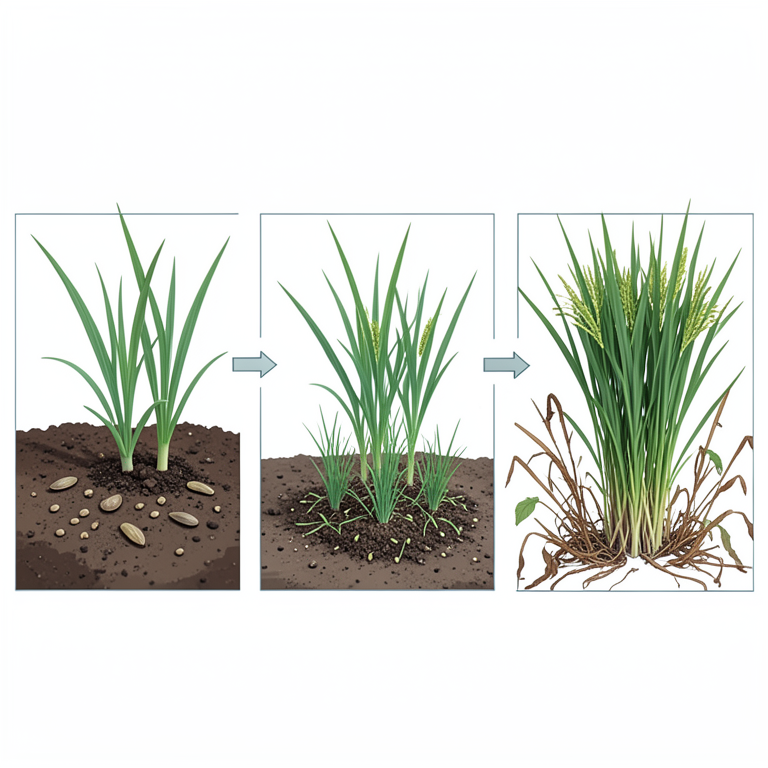
Sequential Herbicide Action
AI-generated conceptual illustration (transplanted rice plants and common weeds (grasses, sedges, and broadleaf weeds) in a paddy field). It explains the idea and does not show study data.
View source evidence ↗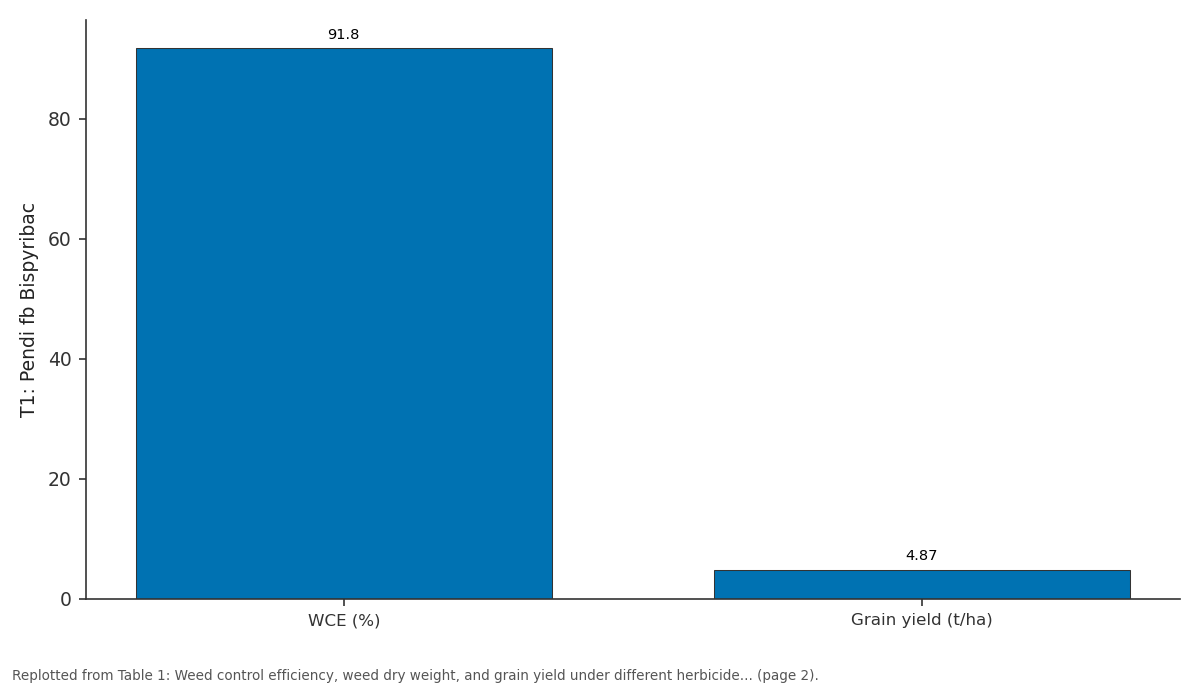
T1: Pendi fb Bispyribac: WCE (%) vs Grain yield (t/ha)
Replotted from Table 1 (page 2) of the original paper. Every bar is the paper's own table value.
View source evidence ↗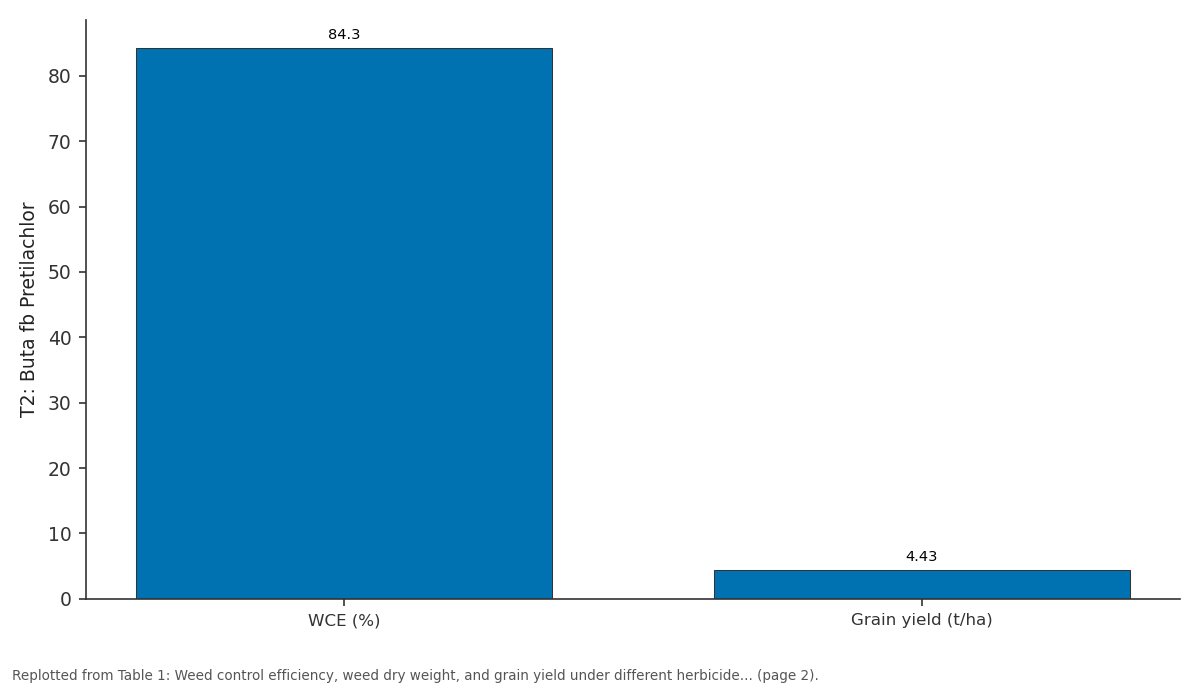
T2: Buta fb Pretilachlor: WCE (%) vs Grain yield (t/ha)
Replotted from Table 1 (page 2) of the original paper. Every bar is the paper's own table value.
View source evidence ↗Figures & tables
From the original paper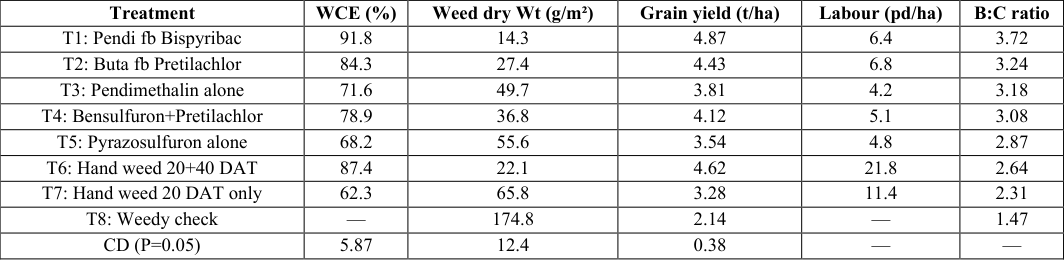 Table 1
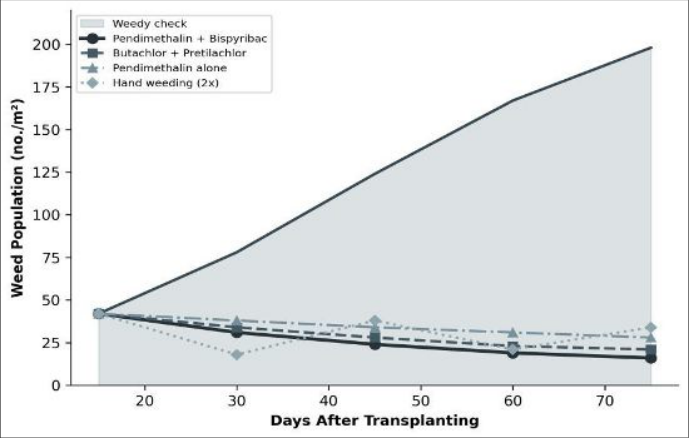 Figure 1
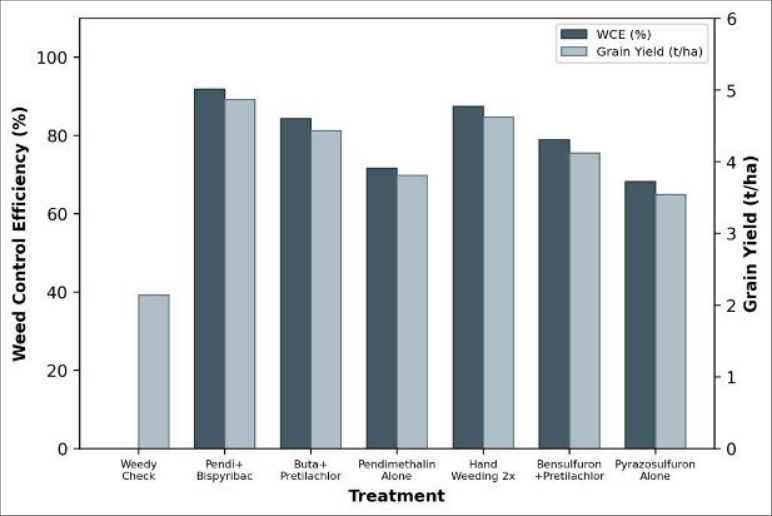 Figure 2
Introduction
It may surprise growers outside the tropics to learn that a single unweeded rice crop in Nigeria's Benue State can lose 68-100% of its potential yield to weed competition a figure that eclipses losses from blast, stem borers, and grain bugs combined [1] . The critical period of weed competition in transplanted rice spans roughly 20-45 days after transplanting, during which grasses (Echinochloa colona, Leptochloa chinensis), sedges (Cyperus difformis, Fimbristylis miliacea), and broadleaf weeds (Ludwigia octovalvis, Monochoria vaginalis) establish dense canopies that shade rice seedlings and compete for nitrogen [2,3] . Manual weeding remains the dominant control method among Nigerian smallholders, but labour scarcity and rising wages have made two properly timed hand weedings prohibitively expensive for many farmers, costing 25-35% of total production expenses [4] . Herbicides offer a labour-saving alternative: pre-emergence products like pendimethalin and butachlor control germinating grass seeds, while post-emergence options like bispyribac-sodium and pyrazosulfuron target escaped grasses and sedges through ALS inhibition [5] . Sequential application of a pre-emergence residual followed by a post-emergence rescue spray provides broader-spectrum and longer-duration control than either product alone, but locally validated combinations for the mixed weed flora of Benue State are lacking [6] . This research compared six herbicide combinations and two manual weeding regimes for weed spectrum control, crop selectivity, and grain yield in transplanted lowland rice at Makurdi [7] .
Field experimental design
Eight treatments were arranged in a randomized block design with three replications. Individual plots measured 5 m × 4 m with 1 m bunds between plots to prevent herbicide drift. Treatments: T1 = pendimethalin 30 EC pre-em (1.0 kg a.i./ha) fb bispyribac-sodium 10 SC post-em 25 DAT (25 g a.i./ha); T2 = butachlor 50 EC pre-em (1.5 kg a.i./ha) fb pretilachlor 30.7 EC post-em (0.45 kg a.i./ha); T3 = pendimethalin alone pre-em; T4 = bensulfuron-methyl 0.6% + pretilachlor 6% GR (0.66 kg/ha); T5 = pyrazosulfuron-ethyl 10 WP post-em (20 g a.i./ha); T6 = hand weeding at 20 and 40 DAT; T7 = hand weeding at 20 DAT only; T8 = weedy check. Pre-emergence herbicides were sprayed 3 DAT using a knapsack sprayer at 500 L/ha [8] .
Economic and sustainability assessment
Treatment costs included herbicide purchase, spraying labour (at NGN 3500/person-day), and weeding labour (at NGN 4000/person-day for manual). Gross returns were based on paddy sale price of NGN 320,000/t. Net returns and B:C ratio were calculated. Labour requirement was expressed as person-days per hectare. A weed shift risk assessment noted species that showed tolerance to specific herbicides, flagging potential resistance concerns for longterm sustainability [9] .
Material and Methods Material
Rice variety FARO 44 (medium-duration, 120 days, lowland-adapted) was transplanted on 18 July 2023 at 20 cm × 20 cm spacing using 21-day-old seedlings, two per hill.
The trial site at Niger-Benue Agricultural University, Makurdi (7.73°N, 8.54°E; 97 m elevation) had hydromorphic clay soil (pH 5.9, OC 1.47%). Uniform basal NPK at 80-40-40 kg/ha was applied. All herbicide formulations were commercially sourced from registered dealers in Makurdi [10] .
Methods
Weed density and dry weight were recorded from two 0.25 m² quadrats per plot at 30, 45, and 60 DAT. Weed Control Efficiency (WCE) was calculated as: (weed dry weight in check -weed dry weight in treatment) / weed dry weight in check × 100. Crop phytotoxicity was scored visually on a 0-10 scale at 7 and 14 days after herbicide application. Grain yield was recorded from 8 m² net plot area at 14% moisture. Weed species were identified and categorised as grasses, sedges, or broadleaves. ANOVA and DMRT at P=0.05 were applied [11] .
Results
Results
Comprehensive interpretation
The sequential pre+post herbicide approach outperformed all alternatives on WCE, yield, labour efficiency, and economics. The pre-emergence component (pendimethalin) eliminated early grass flushes, while the post-emergence bispyribac targeted sedges and escaped broadleaves a complementary spectrum that no single product achieved alone.
Discussion
The 91.8% WCE under pendimethalin + bispyribac matches or exceeds results from similar sequential programmes in Indian and Philippine transplanted rice, where WCE of 85-93% has been reported for pre-fb-post combinations [5,12] . Pendimethalin's dinitroaniline mode of action provides 15-20 days of residual soil activity against germinating grass seeds, effectively covering the critical weed-free period from transplanting through early tillering [3,13] . Bispyribacsodium, applied as a post-emergence rescue at 25 DAT, targets ALS-sensitive species including Echinochloa and Cyperus that escape pre-emergence control, and its systemic activity ensures translocation to growing points even in established weeds [14] . The economic advantage of the herbicide combination (B:C 3.72 vs. 2.64 for hand weeding) reflects both the lower labour input (6.4 vs. 21.8 person-days/ha) and the 5.4% higher yield, which likely results from earlier, more complete weed suppression during the critical window [4] . Pendimethalin alone (T3) controlled grasses well but missed sedges (Cyperus difformis density 8.3/m² at 60 DAT), confirming that graminicides alone are insufficient for the mixed weed flora typical of Benue State lowlands [6] . No phytotoxicity was observed in any herbicide treatment (score 0 on the 0-10 scale at both observation dates), indicating good crop selectivity of all tested products on FARO 44 [15] .
Conclusion
Sequential application of pendimethalin pre-emergence followed by bispyribac-sodium post-emergence at 25 DAT provided the highest weed control efficiency (91.8%) and grain yield (4.87 t/ha) in transplanted rice at Makurdi, with a B:C ratio of 3.72 and 70% labour saving compared with hand weeding. This combination controlled grasses, sedges, and broadleaves effectively with no crop phytotoxicity. It is recommended as the standard weed management package for transplanted lowland rice in Nigeria's middle belt. Rotation with ALS-inhibitor alternatives should be practised to delay herbicide resistance.
Figures and tables from the paper
| Treatment | WCE (%) | Weed dry Wt (g/m²) | Grain yield (t/ha) | Labour (pd/ha) | B:C ratio |
|---|---|---|---|---|---|
| T1: Pendi fb Bispyribac | 91.8 | 14.3 | 4.87 | 6.4 | 3.72 |
| T2: Buta fb Pretilachlor | 84.3 | 27.4 | 4.43 | 6.8 | 3.24 |
| T3: Pendimethalin alone | 71.6 | 49.7 | 3.81 | 4.2 | 3.18 |
| T4: Bensulfuron+Pretilachlor | 78.9 | 36.8 | 4.12 | 5.1 | 3.08 |
| T5: Pyrazosulfuron alone | 68.2 | 55.6 | 3.54 | 4.8 | 2.87 |
| T6: Hand weed 20+40 DAT | 87.4 | 22.1 | 4.62 | 21.8 | 2.64 |
| T7: Hand weed 20 DAT only | 62.3 | 65.8 | 3.28 | 11.4 | 2.31 |
| T8: Weedy check | — | 174.8 | 2.14 | — | 1.47 |
| CD (P=0.05) | 5.87 | 12.4 | 0.38 | — | — |
Table text extracted from the original PDF; superscript letters are shown inline. The original table image is below.
View original table image
References
14 in the original paper- Akobundu IO, Agyakwa CW. A handbook of West African weeds. Second edition. International Institute of Tropical Agriculture, Ibadan. 1998; p.1-564.
- Chauhan BS, Johnson DE. Row spacing and weed control timing affect yield of aerobic rice. Field Crops Research. 2011;121(2):226-231.
- Rao AN, Johnson DE, Sivaprasad B. Weed management in direct-seeded rice. Advances in Agronomy. 2007;93:153-255.
- Rodenburg J, Johnson DE. Weed management in ricebased cropping systems in Africa. Advances in Agronomy. 2009;103:149-218.
- Mahajan G, Chauhan BS. Herbicide options for weed management in transplanted rice under different establishment methods: A review. Archives of Agronomy and Soil Science. 2021;67(12):1608-1627.
- Nwafor OE, Bankole CA. Weed flora survey of lowland rice fields in Benue State, Nigeria. Nigerian Journal of Weed Science. 2022;35(2):87-96.
- Nwafor OE, Bankole CA. Protocol for herbicide combination trials at NBAU Makurdi. Niger-Benue International Journal of Agriculture and Nutrition https://www.agriculturejournal.net Agricultural University Internal Report. 2023;IR/07:112.
- Walia US. Weed management. Second edition. Kalyani Publishers, New Delhi. 2018; p.182-214.
- Nix J. Farm management pocketbook (adapted for West African small-scale rice). Revised by NCRI Badeggi for Nigerian conditions. 2022; p.1-48.
- NCRI. FARO 44 variety descriptor and production guidelines. National Cereals Research Institute, Badeggi. 2020;VD/18:1-8.
- Gomez KA, Gomez AA. Statistical procedures for agricultural research. Second edition. John Wiley and Sons, New York. 1984; p.180-209.
- Kumar V, Ladha JK. Direct seeding of rice: Recent developments and future research needs. Advances in Agronomy. 2011;111:297-413.
- Senseman SA. Herbicide handbook. Tenth edition. Weed Science Society of America, Lawrence, KS. 2007; p.1-458.
- Riar DS, Norsworthy JK, Steckel LE. Adoption of best management practices for herbicide-resistant weeds in midsouthern United States cotton, rice, and soybean. Weed Technology. 2013;27(4):788-797.