
Research article · 2025 · Full text
International Journal of Agriculture and NutritionEffect of planting density and nitrogen fertilization on grain yield of hybrid maize
Volume 7(12) · Pages 105–107 · DOI: 10.33545/26646064.2025.v7.i12b.519 ↗
Research areasCrop Yield and Soil FertilityAgricultural Science and FertilizationAgricultural Productivity and Crop Improvement
Abstract
Author-writtenKorean maize yields have stagnated near 5.3 t ha⁻¹ for a decade, even as newer hybrids with higher genetic yield ceilings enter the market. One common explanation is that farmers plant too few seeds per hectare and under-fertilise with nitrogen. This research tested that idea by growing hybrid maize (cv. Kwangpyeongok) at four planting densities (55,000, 65,000, 75,000, and 85,000 plants ha⁻¹) crossed with three nitrogen rates (120, 180, 240 kg N ha⁻¹) in a split-plot design at two locations — Daejeon and Jeju — during 2023. Grain yield peaked at 75,000 plants ha⁻¹ and 180 kg N ha⁻¹ (9.42 t ha⁻¹ at Daejeon; 8.87 t ha⁻¹ at Jeju). Pushing density to 85,000 plants ha⁻¹ lowered yield by 4-7%, while 240 kg N gave no meaningful gain over 180 kg. These results suggest that moderate density increases paired with 180 kg N ha⁻¹ can lift Korean maize productivity without raising input costs.
Summary
Source-checkedPlain-language reading of the full paper, prepared with AI and checked against the text. Each point links to the authors' own words.
Why it matters
- Maize yields in Korea have remained stagnant at approximately 5.3 t ha⁻¹ for ten years, despite the availability of newer hybrids with higher potential yields. View evidence ↗
- A suspected reason for this stagnation is that farmers may be using planting densities and nitrogen fertilization rates that are too low. View evidence ↗
- Low planting densities can lead to wasted solar radiation because the crop canopy may not close early enough to maximize light interception by the silking stage. View evidence ↗
The question
- The study aimed to test if increasing planting density and nitrogen rates could improve the yield of hybrid maize (cv. Kwangpyeongok) across two different Korean locations. View evidence ↗
What they did
- The researchers used a split-plot design with four planting densities (55k to 85k plants ha⁻¹) and three nitrogen rates (120, 180, and 240 kg N ha⁻¹), with three replicates per site. View evidence ↗
- Nitrogen was provided via urea, with 40% applied at sowing and the remaining 60% applied as a side-dress during the V6 growth stage. View evidence ↗
- The study measured grain yield and nitrogen use efficiency (NUE), analyzing the data using a combined split-plot ANOVA and Duncan's multiple range test. View evidence ↗
What they found
- The highest grain yields were achieved at a density of 75,000 plants ha⁻¹ and a nitrogen rate of 180 kg N ha⁻¹, reaching 9.42 t ha⁻¹ in Daejeon and 8.87 t ha⁻¹ in Jeju. View evidence ↗
- Increasing nitrogen from 180 to 240 kg N ha⁻¹ provided only a marginal yield increase of 1-2% while reducing nitrogen use efficiency from 49.3 to 37.1 kg grain per kg N. View evidence ↗
- Higher planting densities were found to delay the silking stage by 1-2 days, likely due to shading slowing ear development. View evidence ↗
What it means
- The authors conclude that the productivity gap in Korean maize farming can be closed through moderate population increases and careful nitrogen management without increasing overall input costs. View evidence ↗
Visual summary
2 visualsIllustrations explain the paper; charts are replotted from the paper's own table values.
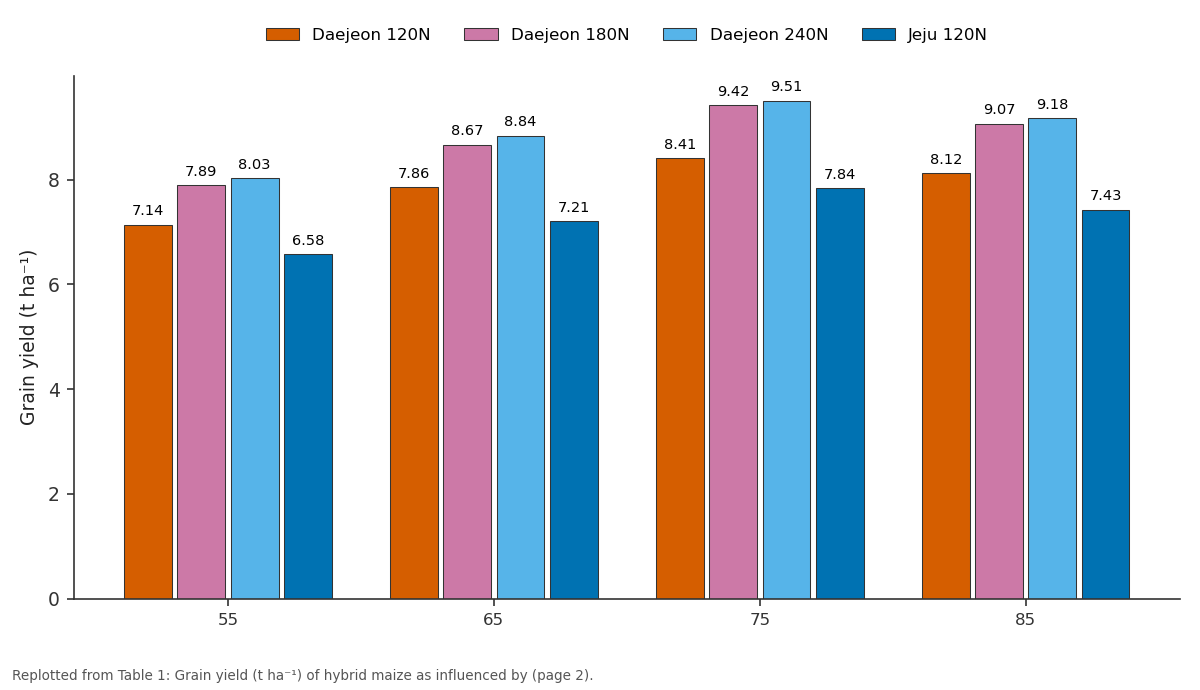
Daejeon 120N and Daejeon 180N and more: 55 vs 65 vs 75 vs 85
Replotted from Table 1 (page 2) of the original paper. Every bar is the paper's own table value.
View source evidence ↗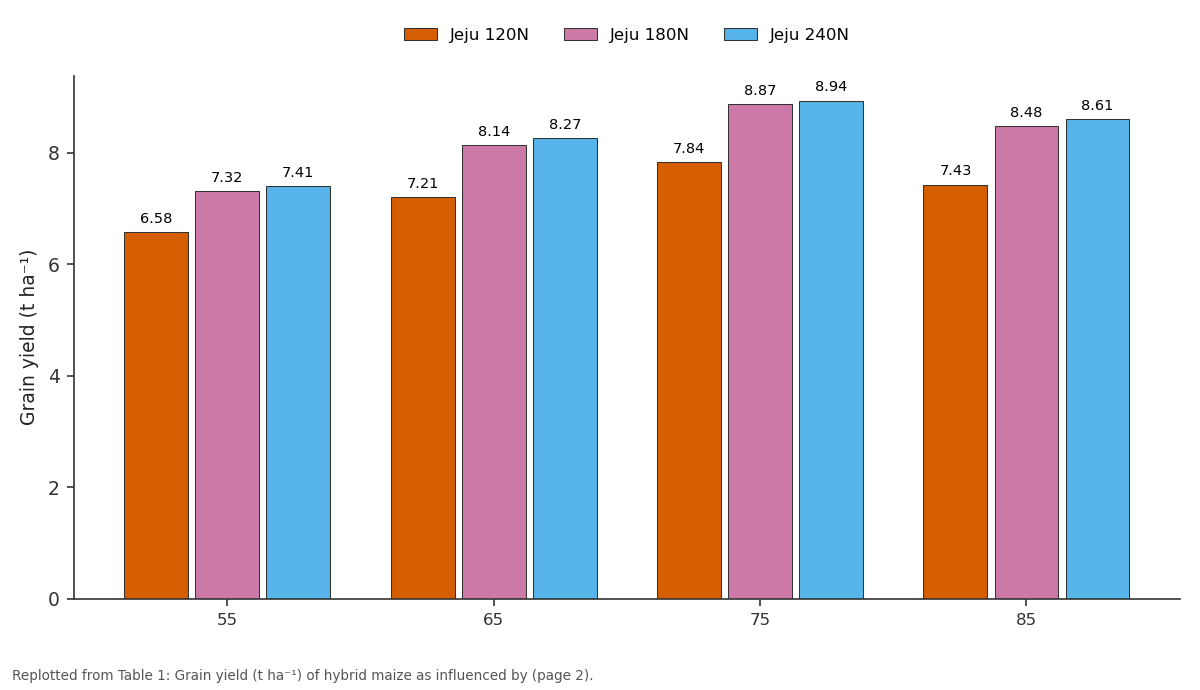
Jeju 120N and Jeju 180N and more: 55 vs 65 vs 75 vs 85
Replotted from Table 1 (page 2) of the original paper. Every bar is the paper's own table value.
View source evidence ↗Figures & tables
From the original paper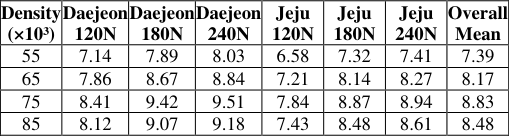 Table 1
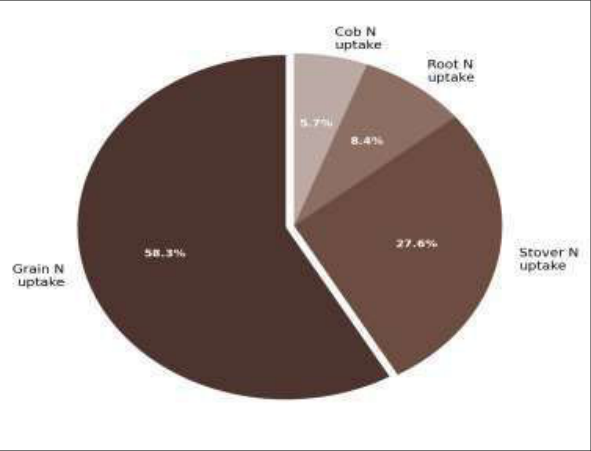 Figure 1
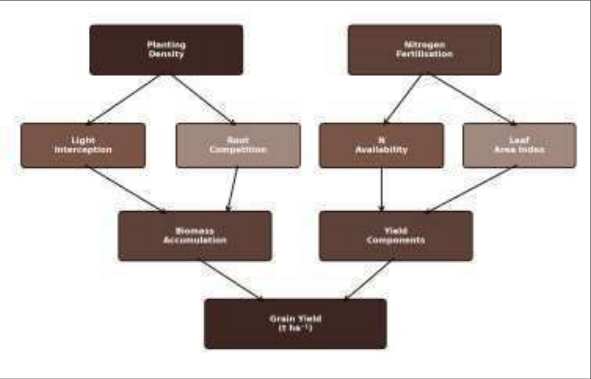 Figure 2
Introduction
Low planting density wastes incoming radiation. Maize is a C4 crop that converts sunlight into dry matter more efficiently than most cereals, but only when the canopy closes early enough to intercept nearly all photosynthetically active radiation by silking [3] . At 55,000 plants ha⁻¹, canopy closure may not occur until well after V12, leaving weeks of radiation underused. Raising the population brings the canopy together sooner, but it also intensifies below-ground competition for water and nitrogen [4] . That is where nitrogen rate comes in. Higher populations need more total N to maintain the same per-plant supply. If N is limiting, dense stands produce small, barren ears that drag down per-hectare yield rather than lifting it [5] . The practical question is whether the density-N interaction observed in US and Chinese Corn Belt conditions also holds on the volcanic soils of Jeju and the alluvial lowlands around Daejeontwo contrasting environments that together represent a good cross-section of Korean maize land.
Field Experimental Design
Trials were established at two sites: the Chungnam Agricultural University farm, Daejeon (36°22′N, 127°21′E; 68 m elevation, alluvial silty clay loam, pH 6.3) and the Jeju College research station (33°27′N, 126°34′E; 290 m elevation, volcanic Andosol, pH 5.8). A splitplot design was used with planting density as the main plot (four levels: 55, 65, 75, 85 thousand plants ha⁻¹) and nitrogen rate as the subplot (120, 180, 240 kg N ha⁻¹), replicated three times at each location. Individual plots measured 6 m × 4.2 m. The hybrid Kwangpyeongok (115-day maturity) was sown on 25 April 2023 at both sites.
Crop Growth Stage Documentation
Emergence occurred 8-10 DAS at Daejeon and 10-12 DAS at Jeju (cooler). V6 was reached 32-35 DAS; topdress N was applied at this stage. Tasseling began 58-62 DAS and silking followed 2-4 days later. Physiological maturity (black layer) was recorded 112-118 DAS depending on site and density. Higher densities delayed silking by 1-2 days, consistent with shading-mediated slower ear development [6] .
Material and Methods
Material and Methods
Material
Nitrogen was applied as urea (46% N), with 40% broadcast at sowing and 60% side-dressed at V6. Basal phosphorus (60 kg P₂O₅ ha⁻¹ as fused superphosphate) and potassium (60 kg K₂O ha⁻¹ as KCl) were applied uniformly at sowing.
Planting was done by hand-dibbling at the target inter-row and intra-row spacing to achieve the desired population. Irrigation was supplementary, applied by sprinkler only during prolonged dry spells (>10 consecutive rainless days) at Jeju; Daejeon relied on rainfall.
Methods
Five consecutive plants were tagged per plot for growth measurements: plant height, ear height, stem diameter at the second internode, and leaf area index (LAI) at silking. Grain yield was harvested from the net plot area (4.8 m × 2.8 m), adjusted to 14% moisture. Yield componentsears per plant, kernel rows per ear, kernels per row, and 1000-kernel weightwere recorded. Nitrogen use efficiency (NUE) was calculated as grain yield per unit of N applied. Data were analysed as a combined split-plot ANOVA over locations using SAS 9.4 [7] , with means separated by Duncan's multiple range test at p = 0.05.
Results
Results
Comprehensive Interpretation
The 75,000 plants ha⁻¹ × 180 kg N ha⁻¹ combination produced the best yield at both sites. Going from 55k to 75k plants lifted yield by 17-20% at the 180 N rate because more plants intercepted more light and set more ears per unit area. But at 85k, yield dipped by 4-7% as increased barrenness (0.92 ears per plant vs 1.04 at 75k) and lighter kernels (278 g vs 312 g per 1000) offset the extra population. The jump from 180 to 240 kg N produced only 1-2% additional yield and lowered NUE from 49.3 to 37.1 kg grain per kg N.
Discussion
The density optimum near 75,000 plants ha⁻¹ agrees with results from Ciampitti and Vyn [8] , who showed that modern temperate hybrids tolerate crowding better than older cultivars but still hit diminishing returns above 80,000 plants ha⁻¹. The 85k density probably crossed the threshold where intra-plant competition for assimilates delays silk emergence relative to pollen shed, increasing the anthesissilking interval and reducing kernel set [9] . The flat yield response from 180 to 240 kg N suggests that 180 kg N ha⁻¹ was already meeting crop demand at these densities. The Jeju Andosol, with its high allophane content, immobilises some applied N in organo-mineral complexes, which may explain the slightly lower yields there despite adequate fertilisation [10] . Daejeon's alluvial soil released more mineralised N from its higher organic-matter reserve, giving an additional background supply. For Korean farmers currently planting at 55-60k, raising density to 75k and applying 180 kg N ha⁻¹ offers a realistic path to 9+ t ha⁻¹ yields. The additional seed cost is trivial, and the N rate is actually below the 200 kg ha⁻¹ many farmers already apply.
Conclusion
Planting density of 75,000 plants ha⁻¹ with 180 kg N ha⁻¹ maximised hybrid maize grain yield at both Daejeon (9.42 t ha⁻¹) and Jeju (8.87 t ha⁻¹). Higher density (85k) and higher nitrogen (240 kg) did not improve yield and reduced nitrogen use efficiency. Moderate increases in planting population, combined with judicious nitrogen management, can close the productivity gap in Korean maize farming without additional input cost.
Figures and tables from the paper
| Density (×10³) | Daejeon 120N | Daejeon 180N | Daejeon 240N | Jeju 120N | Jeju 180N | Jeju 240N | Overall Mean |
|---|---|---|---|---|---|---|---|
| 55 | 7.14 | 7.89 | 8.03 | 6.58 | 7.32 | 7.41 | 7.39 |
| 65 | 7.86 | 8.67 | 8.84 | 7.21 | 8.14 | 8.27 | 8.17 |
| 75 | 8.41 | 9.42 | 9.51 | 7.84 | 8.87 | 8.94 | 8.83 |
| 85 | 8.12 | 9.07 | 9.18 | 7.43 | 8.48 | 8.61 | 8.48 |
Table text extracted from the original PDF; superscript letters are shown inline. The original table image is below.
View original table image
References
20 in the original paper- FAOSTAT. Crop production statistics 2022. Rome: Food and Agriculture Organization; 2023.
- Tollenaar M, Lee EA. Yield potential, yield stability and stress tolerance in maize. Field Crops Res. 2002;75(2-3):161-169.
- Lindquist JL, Arkebauer TJ, Walters DT, Cassman KG, Dobermann A. Maize radiation use efficiency under optimal growth conditions. Agron J. 2005;97(1):72-78.
- Tokatlidis IS, Koutroubas SD. A review of maize hybrids dependence on high plant populations and its implications for crop yield stability. Field Crops Res. 2004;88(2-3):103-114.
- Boomsma CR, Santini JB, Tollenaar M, Vyn TJ. Maize morphophysiological responses to intense crowding and low nitrogen availability. Agron J. 2009;101(6):14261452.
- Sangoi L. Understanding plant density effects on maize growth and development: an important issue to maximise grain yield. Cienc Rural. 2001;31(1):159168.
- SAS Institute. SAS/STAT user's guide, version 9.4. Cary: SAS Institute Inc.; 2018.
- Ciampitti IA, Vyn TJ. A comprehensive study of plant density consequences on nitrogen uptake dynamics of maize plants from vegetative to reproductive stages. Field Crops Res. 2011;121(1):2-18.
- Edmeades GO, Bolanos J, Elings A, Ribaut JM, Banziger M, Westgate ME. The role and regulation of the anthesis-silking interval in maize. CSSA Spec Publ. 2000;29:43-73.
- Takahashi T, Dahlgren RA. Nature, properties and function of aluminum-humus complexes in volcanic soils. Geoderma. 2016;263:110-121.
- Hashemi AM, Herbert SJ, Putnam DH. Yield response of corn to crowding stress. Agron J. 2005;97(3):839846.
- Moser SB, Feil B, Jampatong S, Stamp P. Effects of pre-anthesis drought, nitrogen fertilizer rate, and variety on grain yield, yield components, and harvest index of tropical maize. Agric Water Manag. 2006;81(1-2):4158.
- Moll RH, Kamprath EJ, Jackson WA. Analysis and interpretation of factors which contribute to efficiency of nitrogen utilization. Agron J. 1982;74(3):562-564.
- Borrás L, Slafer GA, Otegui ME. Seed dry weight response to source-sink manipulations in wheat, maize and soybean: a quantitative reappraisal. Field Crops Res. 2004;86(2-3):131-146.
- Kim SH, Lee JH, Park YJ. Maize production and breeding trends in the Republic of Korea. Korean J Crop Sci. 2019;64(3):213-224.
- Duvick DN. The contribution of breeding to yield advances in maize. Adv Agron. 2005;86:83-145.
- Sinclair TR, Muchow RC. Radiation use efficiency. Adv Agron. 1999;65:215-265.
- Andrade FH, Vega CR, Uhart S, Cirilo AG, Cantarero M, Valentinuz O. Kernel number determination in maize. Crop Sci. 1999;39(2):453-459.
- Subedi KD, Ma BL. Nitrogen uptake and partitioning in stay-green and leafy maize hybrids. Crop Sci. 2005;45(2):740-747.
- Lee EA, Tollenaar M. Physiological basis of successful breeding strategies for maize grain yield. Crop Sci. 2007;47(S3):202-215.