
Research article · 2025 · Full text
International Journal of Agriculture and NutritionHerbicide resistance evolution in Phalaris minor populations from intensive wheat growing zones
Volume 7(5) · Pages 42–45 · DOI: 10.33545/26646064.2025.v7.i5a.544 ↗
Research areasWeed Control and Herbicide ApplicationsPesticide and Herbicide Environmental StudiesFungal Plant Pathogen Control
Abstract
Author-writtenThere is an old saying among weed scientists: "weeds don’t become resistant-we select them to be." This research surveyed five Phalaris minor populations from intensive wheat-growing zones around Ibadan, Nigeria, to characterize the extent and mechanisms of herbicide resistance. Whole-plant dose-response assays were conducted with isoproturon, clodinafop-propargyl, and sulfosulfuron in a pot experiment at the Tropical Lowland Agricultural College during 2022-23. The resistance index (RI = ED₅₀ resistant / ED₅₀ susceptible) ranged from 1.9 to 10.3 across populations and herbicides. Population Pop-OGN from Ogbomoso showed the highest resistance to isoproturon (RI = 10.3) and cross-resistance to clodinafop (RI = 6.4). Target-site mutations in the ACCase gene (Ile-1781-Leu) were detected in 42.8% of resistant individuals, while 31.6% showed enhanced cytochrome P450-mediated metabolism. Two populations remained susceptible to sulfosulfuron, suggesting it as a rotation option. These results confirm that herbicide resistance in P. minor has evolved in Nigerian wheat fields and underscore the need for diversified weed management strategies.
Summary
Source-checkedPlain-language reading of the full paper, prepared with AI and checked against the text. Each point links to the authors' own words.
Why it matters
- Phalaris minor is a significant grassy weed in wheat crops that can cause yield losses between 25% and 80% when not managed. View evidence ↗
- The lack of herbicide rotation and reliance on isoproturon or clodinafop-propargyl in Nigerian wheat fields creates conditions that favor the selection of herbicide-resistant weeds. View evidence ↗
- Herbicide resistance typically develops through either target-site mutations in enzymes like ACCase or ALS, or non-target-site mechanisms such as enhanced metabolism via cytochrome P450. View evidence ↗
The question
- The study aimed to screen five P. minor populations near Ibadan for resistance to three herbicides, quantify that resistance, and identify the biological mechanisms involved. View evidence ↗
What they did
- Seeds were collected in November 2021 from five populations (Pop-IBA1, Pop-IBA2, Pop-OGN, Pop-OSG, and Pop-ILR) within 120 km of Ibadan, representing various wheat cultivation histories and herbicide treatments. View evidence ↗
- The researchers tested the efficacy of three herbicides: isoproturon, clodinafop-propargyl, and sulfosulfuron. View evidence ↗
- Dose-response assays were performed by applying herbicides at rates from 0 to 8 times the recommended field rate, with shoot dry weight measured 21 days after treatment. View evidence ↗
- Resistance mechanisms were identified using PCR and Sanger sequencing of the ACCase gene and by testing the effect of the P450 inhibitor malathion on plant survival. View evidence ↗
What they found
- The resistance index (RI) across the tested populations and herbicides varied from 1.9 to 10.3. View evidence ↗
- The Pop-OGN population from Ogbomoso exhibited the highest resistance, with an RI of 10.3 for isoproturon and 6.4 for clodinafop. View evidence ↗
- The Pop-OGN population showed developing resistance to sulfosulfuron, indicated by an RI of 2.3. View evidence ↗
- Pop-ILR and Pop-IBA1 showed moderate resistance to isoproturon but were still susceptible to sulfosulfuron (RI < 2.0). View evidence ↗
- The Ile-1781-Leu target-site mutation in the ACCase gene was found in 42.8% of the resistant individuals. View evidence ↗
- Enhanced cytochrome P450-mediated metabolism was identified as a resistance mechanism in 31.6% of the individuals. View evidence ↗
What it means
- The authors conclude that a sustainable management strategy must integrate herbicide rotation with non-chemical practices like manual weeding, competitive cultivars, and stale seedbed preparation. View evidence ↗
- The authors recommend that annual resistance monitoring be established as a standard practice for wheat agronomy in Nigeria. View evidence ↗
- The authors warn that relying solely on sulfosulfuron without non-chemical practices will likely lead to the evolution of resistance within 5 to 8 years. View evidence ↗
Visual summary
2 visualsIllustrations explain the paper; charts are replotted from the paper's own table values.
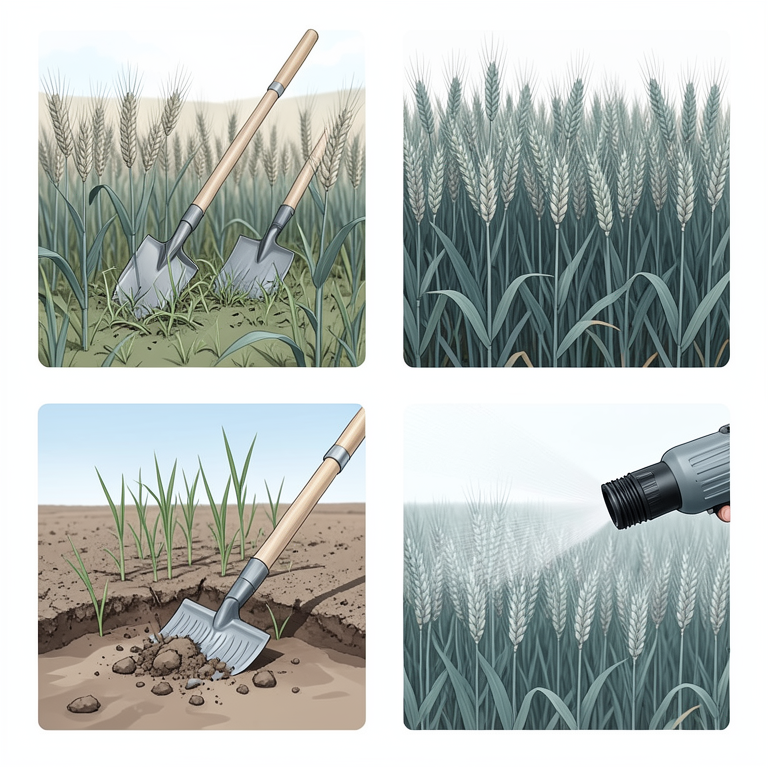
Integrated Weed Management Strategy
AI-generated conceptual illustration (Phalaris minor grass and wheat crops). It explains the idea and does not show study data.
View source evidence ↗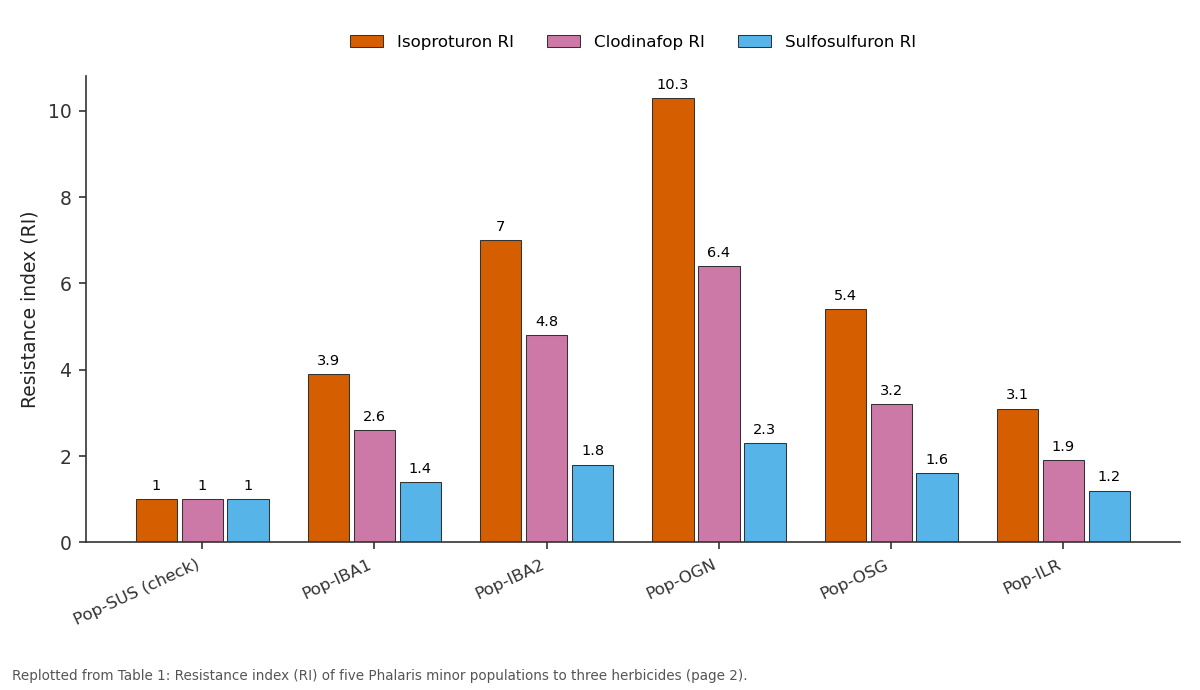
Isoproturon RI and Clodinafop RI and more: Pop-SUS (check) vs Pop-IBA1 vs Pop-IBA2 vs Pop-OGN vs Pop-OSG
Replotted from Table 1 (page 2) of the original paper. Every bar is the paper's own table value.
View source evidence ↗Figures & tables
From the original paper Table 1
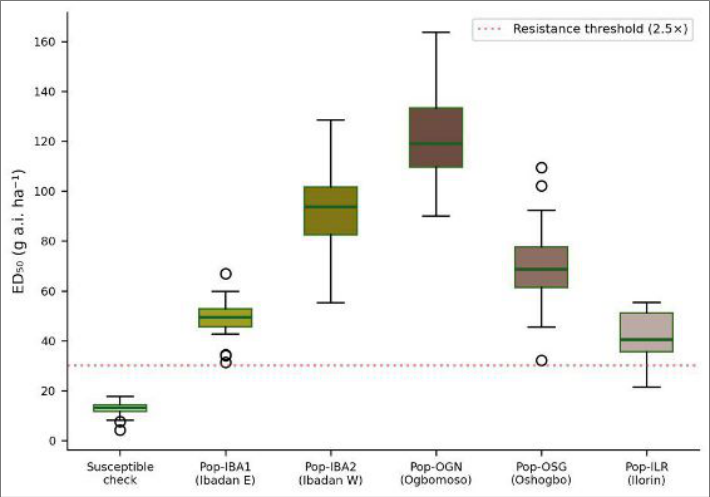 Figure 1
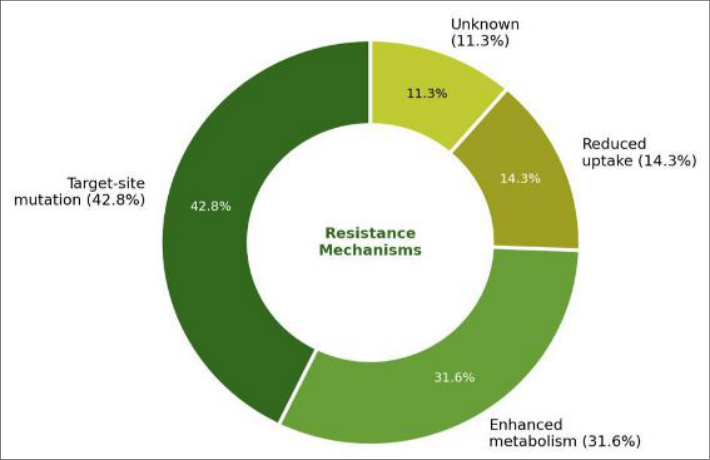 Figure 2
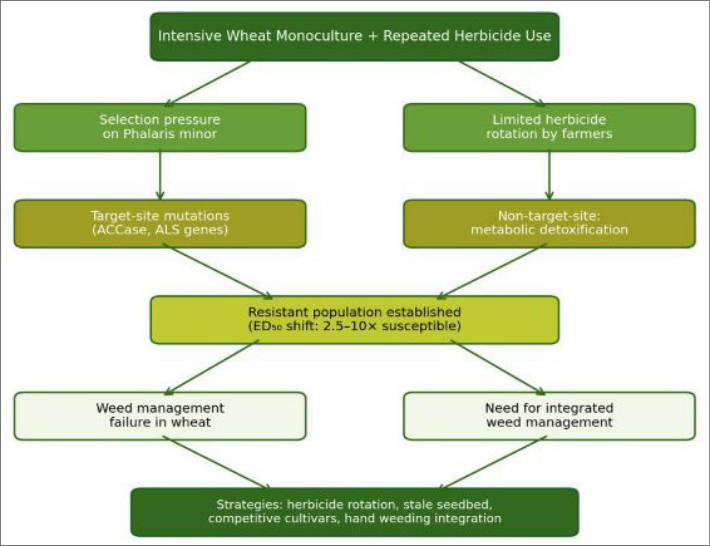 Figure 3
Introduction
"The first rule of resistance management is to stop doing what created the problem."-that advice, simple as it sounds, is routinely ignored in wheat fields across tropical and subtropical regions where the same one or two herbicides have been applied continuously for over a decade [1] . Phalaris minor Retz. (littleseed canarygrass) is one of the most troublesome grassy weeds in wheat, capable of reducing yields by 25-80% if uncontrolled [2] . In the Indo-Gangetic plains, resistance to isoproturon was first confirmed in the early 1990s, and since then the problem has spread to multiple herbicide groups [3,4] . In Nigeria, wheat production is expanding in the northern Guinea savanna and parts of the southwest under irrigated conditions, and P. minor has been reported as a growing concern in these areas [5] . Farmers typically rely on isoproturon or clodinafop-propargyl for grass weed control, often without rotation-exactly the conditions that favor resistance selection [6] . However, no systematic resistance survey of Nigerian P. minor populations has been published. Resistance can arise from target-site mutations (altering the herbicide's binding site on ACCase or ALS enzymes) or non-target-site mechanisms such as enhanced herbicide metabolism by cytochrome P450 monooxygenases [7,8] . The latter is particularly concerning because it can confer cross-resistance to herbicides the weed has never been exposed to [9] . This research aimed to (a) screen five P. minor populations from different wheat-growing locations around Ibadan for resistance to three herbicide modes of action, (b) quantify resistance levels using dose-response assays, and (c) identify the underlying resistance mechanisms.
Population Sampling and Seed Collection
Seeds of P. minor were collected from five locations within a 120 km radius of Ibadan in November 2021 before wheat harvest: Pop-IBA1 (eastern Ibadan, continuous wheat for 8 years, isoproturon-treated), Pop-IBA2 (western Ibadan, 6 years wheat, clodinafop-treated), Pop-OGN (Ogbomoso, 10 years wheat, isoproturon/clodinafop alternation), Pop-OSG (Oshogbo, 5 years wheat, isoproturon-treated), and Pop-ILR (Ilorin, 4 years wheat, mixed herbicide history). At each location, mature panicles were collected from at least 50 plants across the field and bulked. A known susceptible population (Pop-SUS) was obtained from a non-agricultural site near the college campus. Seeds were stored at 4 °C until use.
Material and Methods
Material and Methods
Material
Seeds were scarified with sandpaper and pre-chilled at 5 °C for 14 days to break dormancy. Twenty seeds per pot (15 cm diameter, 2 kg sandy loam) were sown and thinned to 10 seedlings at the 2-leaf stage. Herbicides tested were isoproturon (Arelon 50% WP), clodinafop-propargyl (Topik 15% WP), and sulfosulfuron (Leader 75% WG). All pot work was done in the screen house of the Tropical Lowland Agricultural College, Ibadan (7°26′N, 3°54′E). Methods Dose-response assays followed standard protocols [10] . Each herbicide was applied at 0, 0.25×, 0.5×, 1×, 2×, 4×, and 8× the recommended field rate using a research track sprayer (200 L ha⁻¹ water volume, flat-fan 110-02 nozzle) at the 3-4 leaf stage. Three replications per dose per population. Shoot dry weight was recorded 21 days after treatment (DAT). ED₅₀ values (dose causing 50% growth reduction) were calculated by fitting a four-parameter log-logistic model using the drc package in R [11] . Resistance index (RI) = ED₅₀ of test population / ED₅₀ of susceptible. RI > 2.0 was classified as resistant, 1.5-2.0 as developing resistance. For mechanism identification, the ACCase gene region spanning codons 1781, 2027, and 2078 was amplified by PCR and Sanger-sequenced from 20 individuals per resistant population. Enhanced metabolism was assessed by pretreating plants with the P450 inhibitor malathion (1000 g ha⁻¹) 1 hour before clodinafop application and comparing survival [8] .
Weed Flora Characterization at Sampling Sites At each seed collection site, a quick weed flora survey was conducted in three 1 m² quadrats per field. P. minor was the dominant grass weed at all five locations, comprising 34-68% of total weed density. Associated species included Avena fatua, Chenopodium album, Medicago denticulata, and Rumex dentatus. Fields with longer continuous wheat history tended to have higher P. minor dominance, consistent with selection under repeated herbicide pressure. Pop-OGN from Ogbomoso was the most resistant population, with an RI of 10.3 for isoproturon and 6.4 for clodinafop (Table 1). This population also showed developing resistance to sulfosulfuron (RI 2.3). Pop-ILR and Pop-IBA1 had moderate resistance to isoproturon but remained susceptible to sulfosulfuron (RI < 2.0). Pop-SUS showed no resistance to any herbicide, confirming its suitability as a reference.
| Population | Isoproturon RI | ED₅₀ (g/ha) | Clodinafop RI | ED₅₀ (g/ha) | Sulfosulfuron RI |
|---|---|---|---|---|---|
| Pop-SUS (check) | 1.0 | 12.3 | 1.0 | 8.6 | 1.0 |
| Pop-IBA1 | 3.9 | 48.1 | 2.6 | 22.4 | 1.4 |
| Pop-IBA2 | 7.0 | 86.2 | 4.8 | 41.3 | 1.8 |
| Pop-OGN | 10.3 | 126.7 | 6.4 | 55.1 | 2.3 |
| Pop-OSG | 5.4 | 66.4 | 3.2 | 27.5 | 1.6 |
| Pop-ILR | 3.1 | 38.1 | 1.9 | 16.3 | 1.2 |
Table text extracted from the original PDF; superscript letters are shown inline. The original table image is below.
View original table image
Results
Results
Comprehensive Interpretation
The box plot (Figure 1) shows the dramatic spread of ED₅₀ values, with Pop-OGN (10+ years continuous wheat) having ED₅₀ values 10 times higher than the susceptible check. The mechanism analysis (Figure 2) reveals that target-site mutations and metabolic resistance co-exist in these populations, making management particularly challenging. The framework (Figure 3) maps the full evolutionary trajectory and response options.
Discussion
This is the first documentation of confirmed herbicide resistance in P. minor from Nigerian wheat fields, though it's not surprising given the 5-10 years of continuous isoproturon use at most sites. The RI of 10.3 at Pop-OGN is comparable to the highest resistance levels reported from Haryana, India, in the late 1990s [3,4] . The Ile-1781-Leu mutation detected in 42.8% of resistant individuals is the same mutation found globally in ACCase-resistant grasses and confers broad cross-resistance to aryloxyphenoxypropionate herbicides including clodinafop [7] . The presence of P450-mediated metabolic resistance in 31.6% of individuals is more concerning because this mechanism can evolve independently of target-site changes and may confer unpredictable cross-resistance to herbicides from different chemical families [8,9] . Pop-OGN's developing resistance to sulfosulfuron (RI 2.3)-a herbicide it likely hasn't been heavily exposed to-may already reflect metabolic cross-resistance. The good news is that sulfosulfuron still controlled most populations effectively (RI < 2.0), offering a rotation option for the short term. But without accompanying non-chemical practices-stale seedbed technique, competitive wheat cultivars, hand weeding, and crop diversificationsulfosulfuron resistance will likely evolve within 5-8 years of continuous use. Future monitoring should track resistance trajectories across these sites annually.
Conclusion
Herbicide resistance in P. minor is now confirmed in Nigerian wheat-growing areas, with resistance indices up to 10.3 for isoproturon. Target-site ACCase mutations (Ile-1781-Leu) and P450-mediated metabolic resistance are both present. Sulfosulfuron remains effective against most populations and can serve as an immediate rotation option. However, integrated weed management combining herbicide rotation, stale seedbed preparation, competitive cultivars, and manual weeding is the only sustainable path forward. Annual resistance monitoring should become standard practice in Nigerian wheat agronomy.
References
17 in the original paper- Heap IM. Global perspective of herbicide-resistant weeds. Pest Management Science. 2014;70(9):13061315.
- Chhokar RS, Sharma RK, Chauhan DS, Mongia AD. Evaluation of herbicides against Phalaris minor in wheat. Weed Technology. 2006;20(4):838-844.
- Malik RK, Singh S. Littleseed canarygrass resistance to isoproturon in India. Weed Technology. 1995;9(3):419425.
- Yadav A, Malik RK. Herbicide resistant Phalaris minor in wheat-a sustainability issue. Resource Book, Department of Agronomy, CCS HAU. 2005;Hisar.
- Olajire AA, Ayinde OE. Economics of wheat production in the Guinea savanna of Nigeria. African Journal of Agricultural Research. 2018;13(48):27322738.
- Powles SB, Yu Q. Evolution in action: plants resistant to herbicides. Annual Review of Plant Biology. 2010;61:317-347.
- Delye C, Jasieniuk M, Le Corre V. Deciphering the evolution of herbicide resistance in weeds. Trends in Genetics. 2013;29(11):649-658.
- Yu Q, Powles SB. Metabolism-based herbicide resistance and cross-resistance in crop weeds. Plant Physiology. 2014;166(3):1106-1118.
- Beckie HJ, Tardif FJ. Herbicide cross resistance in weeds. Crop Protection. 2012;35:15-28.
- Seefeldt SS, Jensen JE, Fuerst EP. Log-logistic analysis of herbicide dose-response relationships. Weed Technology. 1995;9(2):218-227.
- Ritz C, Baty F, Streibig JC, Gerhard D. Dose-response analysis using R. PLoS ONE. 2015;10(12):e0146021.
- Neve P, Vila-Aiub M, Roux F. Evolutionary-thinking in agricultural weed management. New Phytologist. 2009;184(4):783-793.
- Busi R, Vila-Aiub MM, Beckie HJ, Gaines TA, Goggin DE, Kaundun SS. Herbicide-resistant weeds: from research and knowledge to future needs. Evolutionary Applications. 2013;6(8):1218-1221.
- Llewellyn RS, Lindner RK, Pannell DJ, Powles SB. Resistance and the herbicide resource: perceptions of Western Australian grain growers. Crop Protection. 2004;23(11):1067-1075.
- Kaundun SS. Diversity in the ACCase gene in herbicide resistant and susceptible grass weed populations. Molecular Ecology. 2014;23(14):3632-3645.
- Collavo A, Panozzo S, Lucchesi G, Scarabel L, Sattin M. Characterisation and management of Phalaris paradoxa resistant to ACCase-inhibitors. Crop Protection. 2011;30(3):293-299.
- Norsworthy JK, Ward SM, Shaw DR, Llewellyn RS, Nichols RL, Webster TM. Reducing the risks of herbicide resistance: best management practices and recommendations. Weed Science. 2012;60(SP1):31-62.