
Research article · 2025 · Full text
International Journal of Agriculture and NutritionImpact of silvipastoral system on forage availability and livestock productivity in semi-arid zones
Volume 7(12) · Pages 168–171 · DOI: 10.33545/26646064.2025.v7.i12c.570 ↗
Research areasAgroforestry and silvopastoral systemsPasture and Agricultural SystemsLivestock Farming and Management
Abstract
Author-writtenHere is the dilemma semi-arid livestock farmers face every dry season: pastures wither, feed prices spike, and animals lose condition right when they should be gaining weight for market. Silvipastoral systems — integrating fodder trees with improved grasses promise a way out by providing tree-leaf browse when grasses go dormant. This research measured forage availability and cattle productivity across three land-use types (open pasture, Leucaena-based silvipasture, and Gliricidia-based silvipasture) over 18 months at a semi-arid site in eastern Nusa Tenggara, Indonesia. Total annual dry-matter forage production was 42.3% higher in Leucaena silvipasture (11.8 t DM ha⁻¹) than in open pasture (8.3 t DM ha⁻¹). Critically, Leucaena silvipasture maintained 67.4% of its annual forage supply during the 6-month dry season, compared to only 38.2% for open pasture. Cattle grazing Leucaena silvipasture gained 0.41 kg day⁻¹, versus 0.23 kg day⁻¹ on open pasture — a 78% advantage. These results demonstrate that integrating high-quality fodder trees with improved grass can sharply reduce dry-season feed gaps and improve livestock performance in Indonesia’s semi-arid eastern islands.
Summary
Source-checkedPlain-language reading of the full paper, prepared with AI and checked against the text. Each point links to the authors' own words.
Why it matters
- Livestock farmers in semi-arid zones face a critical dry-season dilemma where pasture quality drops and feed costs rise, causing animals to lose weight. View evidence ↗
- Silvipastoral systems, which combine fodder trees and improved grasses, are proposed as a solution to provide feed when grasses are dormant. View evidence ↗
- While silvipastoral systems are proven in other global regions, there is a lack of local field data for Indonesia's semi-arid eastern provinces. View evidence ↗
The question
- The study aimed to provide local evidence by comparing forage supply and weight gain of Bali cattle across open pasture and two silvipastoral designs over 18 months. View evidence ↗
What they did
- The research compared three treatments: unimproved open pasture, Leucaena leucocephala silvipasture, and Gliricidia sepium silvipasture, with the latter two using 4 m × 2 m tree spacing and Brachiaria brizantha grass. View evidence ↗
- The trial used 1.5 ha plots replicated twice (9 ha total), with 12 Bali steers (initial weight 180–210 kg) per land use under a 28-day rotational grazing cycle. View evidence ↗
- Forage availability was measured monthly using eight 1 m² quadrats per treatment, with components oven-dried at 65 °C before weighing. View evidence ↗
- Cattle weight was tracked monthly using a portable scale to calculate the average daily weight gain (ADG) for each animal. View evidence ↗
What they found
- Leucaena silvipasture produced 11.8 t DM ha⁻¹ of annual forage, which is 42.3% higher than the 8.3 t DM ha⁻¹ produced by open pasture. View evidence ↗
- Leucaena silvipasture provided 67.4% of its annual forage during the dry season, significantly higher than the 38.2% provided by open pasture. View evidence ↗
- Cattle in Leucaena silvipasture had an overall average daily gain of 0.41 kg day⁻¹, a 78% increase over the 0.23 kg day⁻¹ seen in open pasture. View evidence ↗
- The mean crude protein (CP) of available forage was highest in Leucaena silvipasture (14.3%), followed by Gliricidia (12.1%) and open pasture (6.8%). View evidence ↗
- Over 18 months, soil organic carbon at 0–15 cm increased from 0.92% to 1.14% in Leucaena silvipasture, while open pasture showed no change. View evidence ↗
- Silvipasture systems reduced runoff from 2-m-wide erosion plots by 37% compared to open pasture. View evidence ↗
- Over a 10-year horizon (8% discount), the benefit-cost ratio (BCR) was 2.6 for Leucaena and 2.1 for Gliricidia silvipasture. View evidence ↗
What it means
- The authors conclude that Leucaena-grass silvipasture is the most practical way for farmers in semi-arid tropical zones to eliminate dry-season feed gaps and increase profit without buying concentrate. View evidence ↗
- The authors note that Leucaena intake must be kept below 40% of the diet as a precaution against mimosine toxicity. View evidence ↗
Visual summary
2 visualsIllustrations explain the paper; charts are replotted from the paper's own table values.
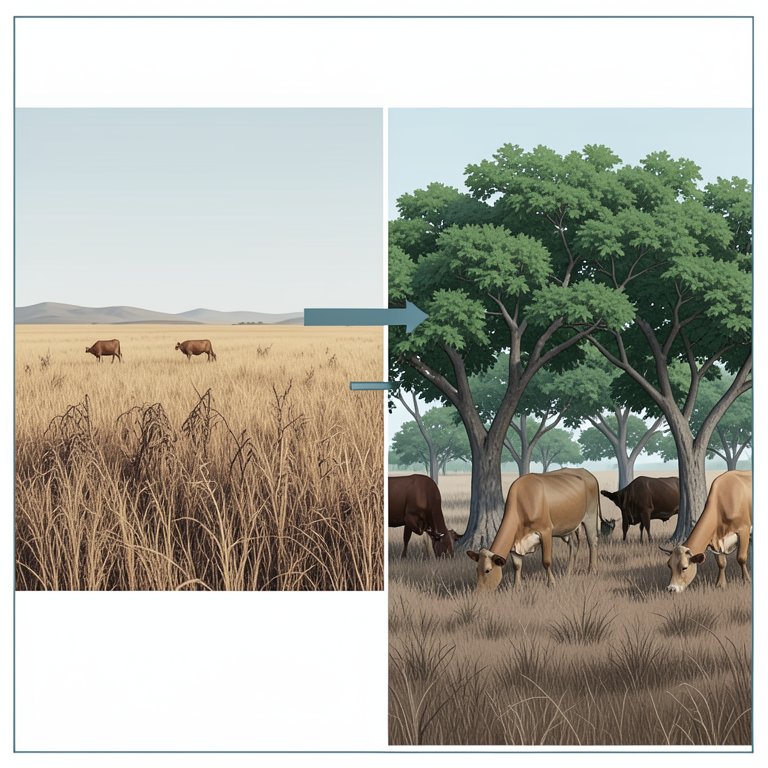
Dry Season Forage Buffering
AI-generated conceptual illustration (Leucaena trees and cattle in a semi-arid pasture). It explains the idea and does not show study data.
View source evidence ↗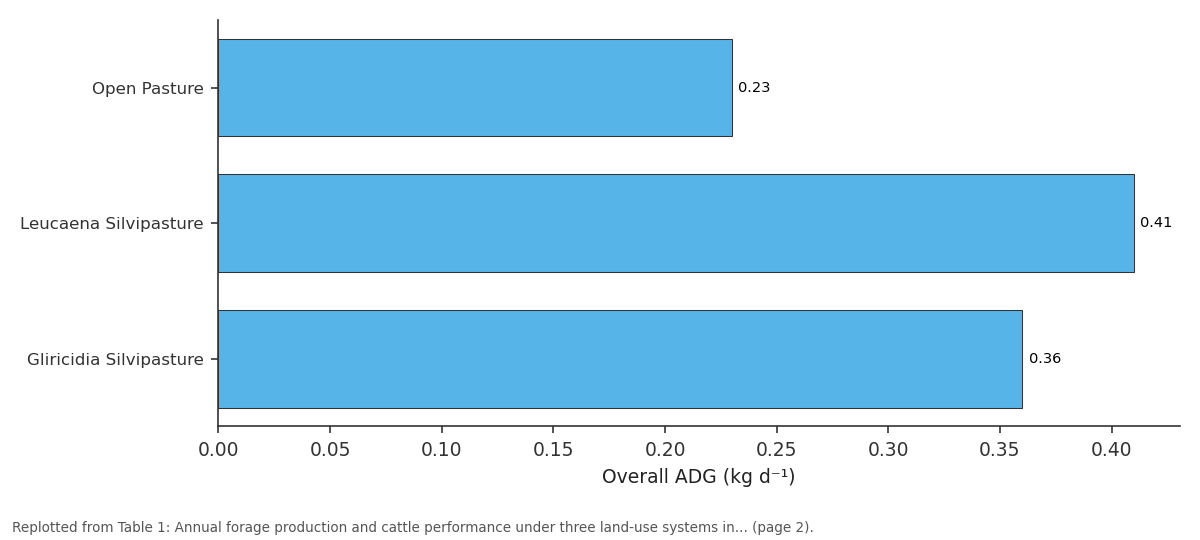
Overall ADG (kg d⁻¹): Open Pasture vs Leucaena Silvipasture vs Gliricidia Silvipasture
Replotted from Table 1 (page 2) of the original paper. Every bar is the paper's own table value.
View source evidence ↗Figures & tables
From the original paper Table 1
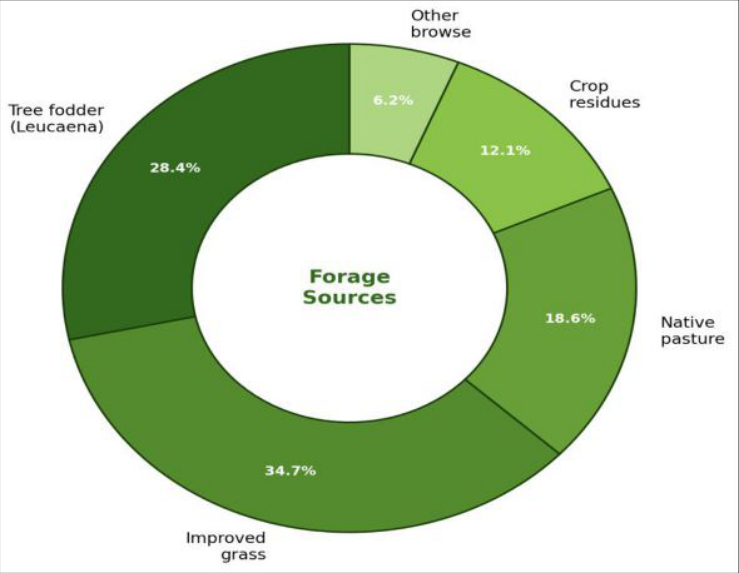 Figure 1
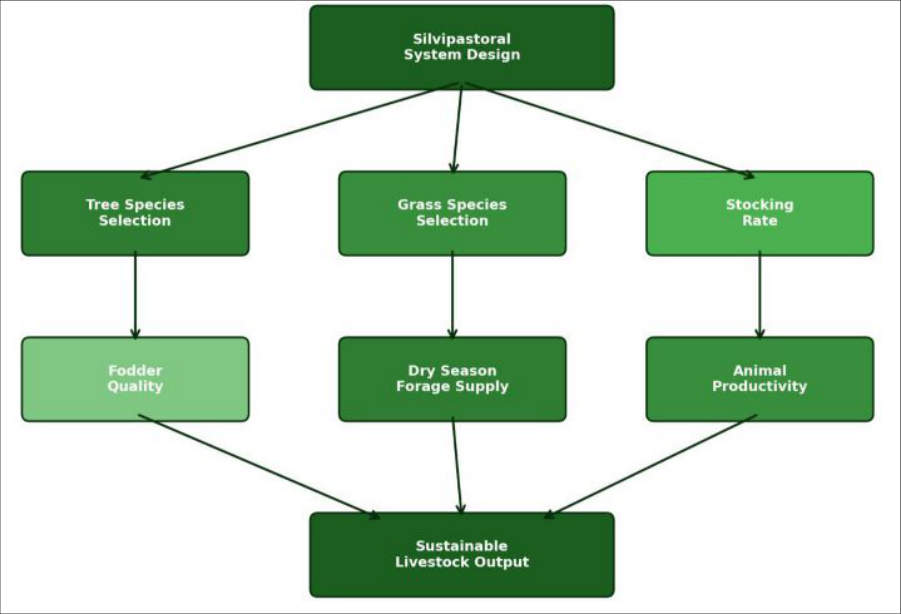 Figure 2
Introduction
A cattle farmer in Nusa Tenggara Timur faces a practical dilemma: during the wet season (November-April) his native Themeda pasture produces more forage than his ten head of Bali cattle can eat, but during the six dry months the same pasture yields barely a quarter of their daily needs [1] . The animals lose 15-20% of body weight by October, wiping out most of the wet-season gain. Buying concentrate feed at Rp 5,000-7,000 per kg is possible but erases the thin profit margin on cattle that sell for Rp 10-12 million per head [2] . Silvipastoral systems offer a structural fix: plant nitrogen-fixing fodder trees (Leucaena, Gliricidia) in rows across the pasture, establish improved grasses (Brachiaria, Panicum) between them, and let the trees provide high-protein leaf browse precisely when the grasses fade [3] . The concept is proven in Latin America, Australia, and parts of Africa, but field data from Indonesia's semi-arid eastern provinces are thin [4] . Without local evidence, extension workers struggle to convince farmers that the 2-3 year wait for trees to reach harvestable canopy is worth the effort. This research provided that evidence by comparing open pasture with two silvipastoral designs over 18 months, tracking both forage supply and live-weight gains of Bali cattle under managed rotational grazing.
Research Area Description
The research was conducted at a demonstration farm managed by Universitas Pertanian Nusantara in Kupang district, East Nusa Tenggara (10°10′S, 123°35′E; 180 m elevation). The site receives 900-1,100 mm of annual rainfall in a pronounced unimodal pattern: 85% falls between November and March, and a severe dry season runs from May to October. Soils are classified as Lithic Ustorthents (shallow, stony, pH 7.6, organic C 0.92%). Vegetation is open savanna dominated by Themeda triandra and Heteropogon contortus, with scattered Eucalyptus alba. The site had been under extensive grazing with no tree planting for at least 20 years before trial establishment in 2021.
Economic and Sustainability Assessment
Establishment costs for silvipasture (seedlings, fencing, labour) were compared against annual returns from increased cattle weight gain. Leucaena silvipasture cost Rp 8.4 million ha⁻¹ to establish but was fully recovered by the end of year two through faster weight gain. By year three, the net annual benefit of Leucaena silvipasture over open pasture was Rp 4.7 million ha⁻¹. The benefit-cost ratio over a 10-year planning horizon (discounted at 8%) was 2.6 for Leucaena and 2.1 for Gliricidia. The higher BCR for Leucaena reflects its greater dry-matter yield and superior crude protein content (24-28% vs 20-23% for Gliricidia leaf) [5] .
Soil and Water Assessment
Soil moisture at 0-30 cm was monitored biweekly with TDR probes. Silvipasture plots retained 18-24% more soil moisture than open pasture during the dry season (June-September), attributed to tree shade and litter cover reducing evaporation. Soil organic carbon at 0-15 cm rose from 0.92% to 1.14% under Leucaena silvipasture over 18 months, versus no change in open pasture. Runoff from a 2m-wide erosion plot was 37% lower under silvipasture, consistent with the tree root network anchoring topsoil and slowing overland flow [6] .
Materials and Methods
Materials and Methods
Materials
Three land-use treatments were compared: (i) open pasture (Themeda triandra, unimproved), (ii) Leucaena leucocephala silvipasture (trees planted in 2021 at 4 m × 2 m spacing with Brachiaria brizantha cv. Marandu between rows), and (iii) Gliricidia sepium silvipasture (same spacing, same grass). Each treatment occupied 1.5 ha, replicated twice (total 9 ha). Six Bali steers (initial weight 180-210 kg) were assigned to each treatment (12 per land use) under rotational grazing with a 28-day rotation cycle. Research ran from July 2022 to December 2023.
Methods
Forage availability was measured monthly by cutting 1 m² quadrats (eight per treatment), separating grass, tree leaf, and litter, oven-drying at 65 °C, and weighing. Crude protein (CP) was determined by Kjeldahl. Cattle were weighed monthly using a portable livestock scale. Average daily weight gain (ADG) was computed per animal per period. Data were analysed by repeated-measures ANOVA in R (v4.3.1), with treatment means compared by Tukey's HSD at p = 0.05 [7] .
Results
Results
Comprehensive Interpretation
The 78% advantage in overall ADG under Leucaena silvipasture (0.41 vs 0.23 kg day⁻¹) was driven almost entirely by the dry season, when tree-leaf browse maintained forage CP above 14% while open pasture CP fell below 5%the threshold at which voluntary intake declines sharply in tropical cattle [8] . Leucaena leaf's high CP (24-28%) acted as a protein supplement that improved rumen function and allowed animals to extract more energy from the lower-quality grass they consumed alongside it [5] .
The Gliricidia system performed well but didn't match
Leucaena's dry-matter yield or CP, consistent with its slower regrowth after pruning in dry conditions.
Discussion
The 42% increase in total forage DM under Leucaena silvipasture aligns with results from Queensland, Australia, where Shelton and Dalzell [9] documented 35-50% forage gains from Leucaena-grass associations on similar rainfall.
The key mechanism is complementary resource use: deeprooted Leucaena accesses subsoil moisture during the dry season, producing leaf biomass when shallow-rooted grasses are dormant [3] . The dry-season feed gap is the central problem for semi-arid livestock systems in eastern Indonesia. Open pasture supplied only 38% of its annual forage during the dry months, meaning farmers must either destock, supplement, or watch animals lose weight. Leucaena silvipasture effectively inverted this ratio, delivering 67% of forage during the dry season. This buffering capacity is what makes the system economically compelling despite the 2-3-year establishment lag [4] . The mimosine content of Leucaena leaf can be toxic to cattle at high intake levels, but regular feeding induces rumen microbial adaptation within 2-3 weeks [10] . No clinical signs of mimosine toxicity were observed in our trial, where Leucaena browse constituted 28-34% of total intake. Maintaining Leucaena below 40% of the diet is a standard precaution that the rotational grazing design naturally enforced.
Conclusion
Leucaena-based silvipasture increased total forage availability by 42% and cattle daily weight gain by 78% compared to open pasture in semi-arid eastern Indonesia, with the largest benefit occurring during the critical dry season. The system was economically viable from year two onward, with a 10-year BCR of 2.6. Gliricidia silvipasture was also effective but slightly less productive. For livestock farmers in Nusa Tenggara and similar semi-arid tropical zones, investing in Leucaena-grass silvipasture is the most practical route to eliminating the dry-season feed gap and raising cattle profitability without dependence on purchased concentrate.
Figures and tables from the paper
| Parameter | Open Pasture | Leucaena Silvipasture | Gliricidia Silvipasture |
|---|---|---|---|
| Total forage (t DM ha⁻¹ yr⁻¹) | 8.3 | 11.8 | 10.4 |
| Dry-season share of total (%) | 38.2 | 67.4 | 58.6 |
| Mean CP of available forage (%) | 6.8 | 14.3 | 12.1 |
| Cattle ADG wet season (kg d⁻¹) | 0.38 | 0.52 | 0.47 |
| Cattle ADG dry season (kg d⁻¹) | 0.08 | 0.31 | 0.24 |
| Overall ADG (kg d⁻¹) | 0.23 | 0.41 | 0.36 |
| Live-weight gain 18 mo (kg head⁻¹) | 124.2 | 221.4 | 194.4 |
| BCR (10-year) | — | 2.6 | 2.1 |
Table text extracted from the original PDF; superscript letters are shown inline. The original table image is below.
View original table image
References
21 in the original paper- Njurumana GN, Butarbutar T. Feed availability and livestock carrying capacity in semi-arid rangelands of Nusa Tenggara Timur. Indonesian Journal of Forestry Research. 2016;3(2):85-97.
- BPS-NTT. Nusa Tenggara Timur province in figures 2023. Kupang: Badan Pusat Statistik; 2023.
- Murgueitio E, Calle Z, Uribe F, Calle A, Solorio B. Native trees and shrubs for the productive rehabilitation of tropical cattle ranching lands. Forest Ecology and Management. 2011;261(10):1654-1663.
- Paciullo DSC, Lopes FCF, Malaquias JD, Vasconcelos JA, Silveira SR, Leite GT, Orefice RL, Pires MFA. Characteristics of tropical forage grasses under International Journal of Agriculture and Nutrition https://www.agriculturejournal.net silvopastoral systems. Agroforestry Systems. 2017;91(3):403-413.
- Shelton HM, Brewbaker JL. Leucaena leucocephalathe most widely used forage tree legume. In: Gutteridge RC, Shelton HM, editors. Forage tree legumes in tropical agriculture. Wallingford: CAB International; 1998. p. 15-29.
- Young A. Agroforestry for soil conservation. Wallingford: CAB International; 1989. p. 1-276.
- Pinheiro JC, Bates DM. Mixed-effects models in S and S-PLUS. New York: Springer; 2000. p. 1-528.
- Van Soest PJ. Nutritional ecology of the ruminant. 2nd ed. Ithaca: Cornell University Press; 1994. p. 1-476.
- Shelton HM, Dalzell SA. Production, economic and environmental benefits of Leucaena pastures. Tropical Grasslands. 2007;41(3):174-190.
- Jones RJ, Megarrity RG. Successful transfer of DHPdegrading bacteria from Hawaiian goats to Australian ruminants to overcome the toxicity of Leucaena. Australian Veterinary Journal. 1986;63(8):259-262.
- Devendra C, Ibrahim M. Silvopastoral systems as a strategy for diversification and productivity enhancement from livestock in the tropics. Revista de Ciencias Veterinarias. 2004;22(1):11-30.
- Rueda BL, McRoberts KC, Blake RW, Nicholson CF, Valentim JF, Fernandes ECMP. Nutrient status of cattle grazing systems in the western Brazilian Amazon. Cogent Food and Agriculture. 2020;6(1):1722350.
- Jose S. Agroforestry for ecosystem services and environmental benefits: an overview. Agroforestry Systems. 2009;76(1):1-10.
- Steinfeld H, Gerber P, Wassenaar T, Castel V, Rosales M, de Haan C. Livestock's long shadow: environmental issues and options. Rome: FAO; 2006. p. 1-390.
- Ibrahim M, Chacon M, Cuartas C, Naranjo J, Ponce G, Vega P, Casasola F, Rojas J. Almacenamiento de carbono en el suelo y la biomasa arborea en sistemas de usos de la tierra en paisajes ganaderos. Agroforesteria en las Americas. 2007;45:27-36.
- Montagnini F, Nair PKR. Carbon sequestration: an underexploited environmental benefit of agroforestry systems. Agroforestry Systems. 2004;61(1):281-295.
- Savory A, Butterfield J. Holistic management: a commonsense revolution to restore our environment. 3rd ed. Washington DC: Island Press; 2016. p. 1-552.
- Peniche-Gonzalez IN, Torres-Acosta JFJ, AguilarCaballero AJ, Gonzalez-Pech PG, Sarmiento-Franco L, Lopez-Arellano ME. Effect of condensed tannins from Leucaena on gastrointestinal nematodes in goats. Veterinary Parasitology. 2014;204(3-4):210-215.
- Niang A, Styger E, Gahamanyi A, Hoekstra D, Coe R. Fodder-quality improvement through contour planting of legume-shrub/grass mixtures in croplands of Rwanda highlands. Agroforestry Systems. 1998;39(3):263-274.
- Restrepo C, Ibrahim M, Harvey CA, Villanueva C, Esquivel H, Fischer A. Relaciones entre la cobertura arborea en potreros y la produccion bovina en fincas ganaderas en el tropico seco. Agroforesteria en las Americas. 2004;41-42:29-36.
- Villanueva C, Ibrahim M, Harvey CA, Esquivel H. Tipologias de fincas con ganaderia bovina y cobertura arborea en pasturas en el tropico seco de Costa Rica. Agroforesteria en las Americas. 2003;10(39-40):9-16.