
Research article · 2025 · Full text
International Journal of Agriculture and NutritionImpact of farmer field schools on knowledge and adoption of integrated pest management practices
Volume 7(11) · Pages 176–179 · DOI: 10.33545/26646064.2025.v7.i11c.500 ↗
Research areasAgricultural Innovations and PracticesAgricultural Development and ManagementInsect Pest Control Strategies
Abstract
Author-writtenDespite decades of promotion, integrated pest management adoption among Indian smallholders remains stubbornly low, rarely exceeding 30% for any single practice. This research assessed the impact of Farmer Field Schools (FFS) on knowledge gain and adoption of IPM practices among vegetable growers in the Garo Hills region of Meghalaya, India, during 2022-2023. A quasi-experimental before-and-after design with a comparison group was used, covering 120 FFS participants and 80 non-participants across eight villages. Knowledge scores for six IPM domains were measured using structured tests before and after a season-long FFS programme. Overall knowledge increased from 29.8% to 73.5% among participants (43.8 percentage point gain), compared to 34.6% in non-participants. Cultural practices and chemical safety showed the highest adoption rates at 71.6% and 68.4%. FFS participants reduced pesticide sprays from an average of 6.8 to 3.2 per season while maintaining higher yields (18.4 vs. 16.7 q/ha) and net income (₹34,680 vs. ₹28,420 per hectare). These findings confirm that participatory, season-long FFS training is effective at building both knowledge and practice change in IPM among smallholder vegetable growers.
Summary
Source-checkedPlain-language reading of the full paper, prepared with AI and checked against the text. Each point links to the authors' own words.
Why it matters
- Adoption of integrated pest management (IPM) among smallholder farmers in India is generally low, with single practices rarely adopted by more than 30% of farmers. View evidence ↗
- Traditional top-down agricultural extension methods have been ineffective in changing how farmers manage pests. View evidence ↗
- Farmer Field Schools (FFS) aim to bridge the gap in IPM adoption by providing hands-on, season-long learning directly in the farmers' fields. View evidence ↗
The question
- The study aimed to evaluate how FFS affected the knowledge and adoption of IPM practices among vegetable growers in Meghalaya's Garo Hills from 2022 to 2023. View evidence ↗
What they did
- The researchers used a quasi-experimental design involving 120 FFS participants and 80 non-participants from eight villages. View evidence ↗
- The FFS program consisted of 14 weekly sessions that spanned the entire growth cycle of tomato and cabbage crops. View evidence ↗
- Knowledge was measured across six IPM domains using pre- and post-tests, while adoption was assessed via interviews six months after the program. View evidence ↗
What they found
- FFS participants saw their overall IPM knowledge rise from 29.8% to 73.5%, a gain of 43.8 percentage points, whereas non-participants scored 34.6%. View evidence ↗
- Among the IPM practices, cultural practices were the most adopted (71.6%), while record keeping was the least adopted (42.6%). View evidence ↗
- FFS participants reduced their pesticide use to an average of 3.2 sprays per season, compared to 6.8 sprays by non-participants. View evidence ↗
- FFS participation was the most significant predictor of IPM adoption, followed by the farmer's education level and their contact with extension agents. View evidence ↗
What it means
- The authors recommend that extension agencies in northeast India expand FFS programs for vegetable crops using culturally appropriate methods. View evidence ↗
- The authors note that ongoing follow-up support is necessary to ensure that the benefits of the FFS program last beyond the initial season. View evidence ↗
Visual summary
3 visualsIllustrations explain the paper; charts are replotted from the paper's own table values.
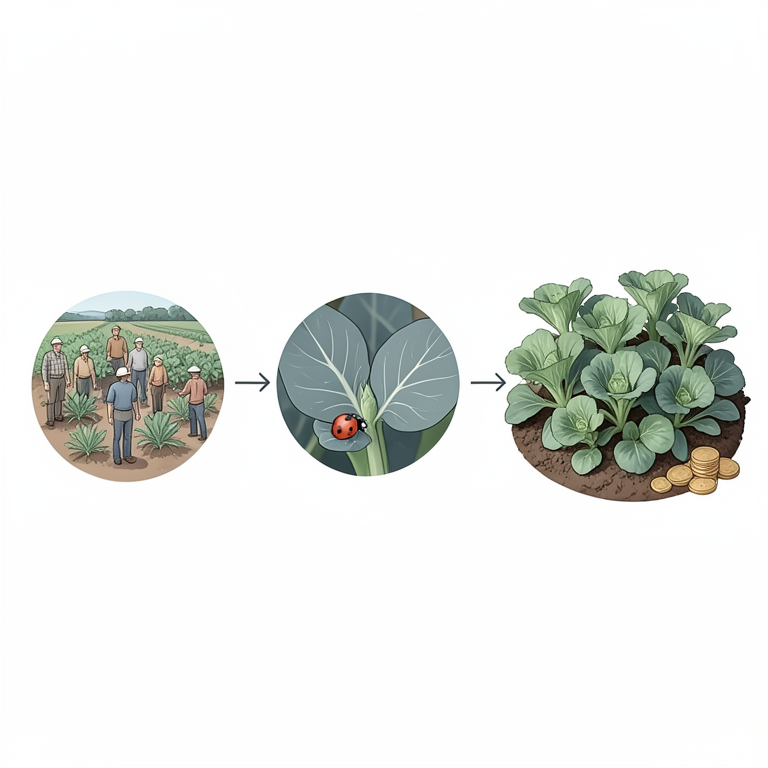
FFS Impact Flow
AI-generated conceptual illustration (vegetable plants in a field). It explains the idea and does not show study data.
View source evidence ↗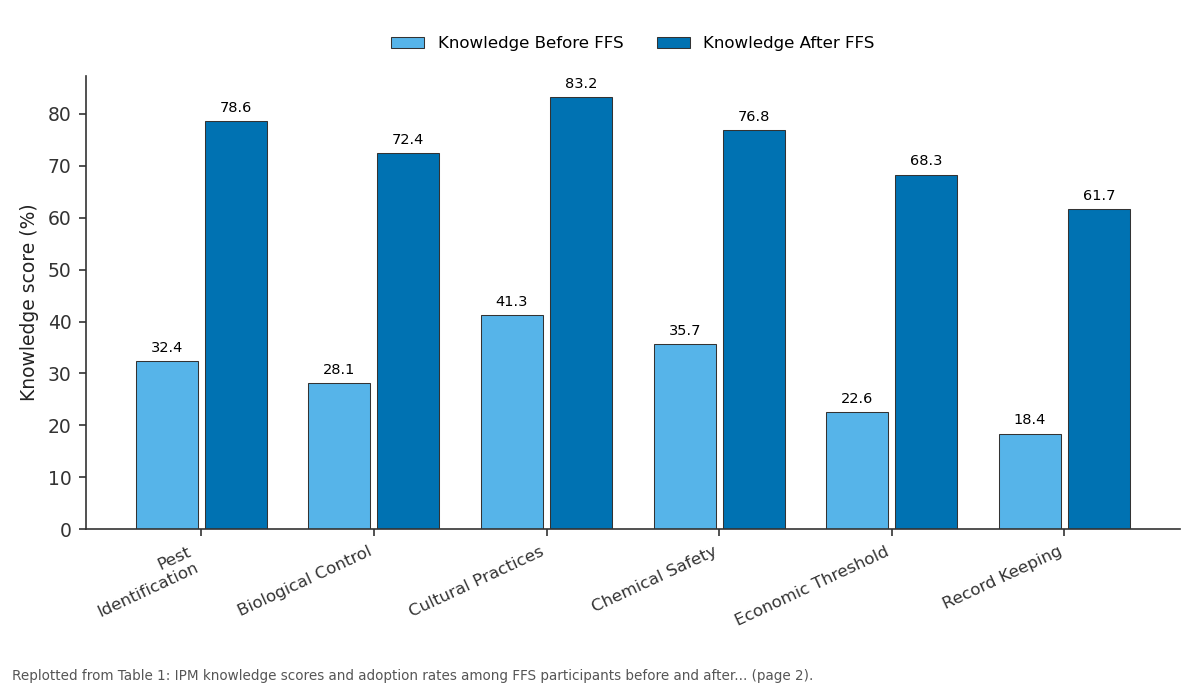
Knowledge Before FFS and Knowledge After FFS: Pest Identification vs Biological Control vs Cultural Practices vs Chemical Safety vs Economic Threshold
Replotted from Table 1 (page 2) of the original paper. Every bar is the paper's own table value.
View source evidence ↗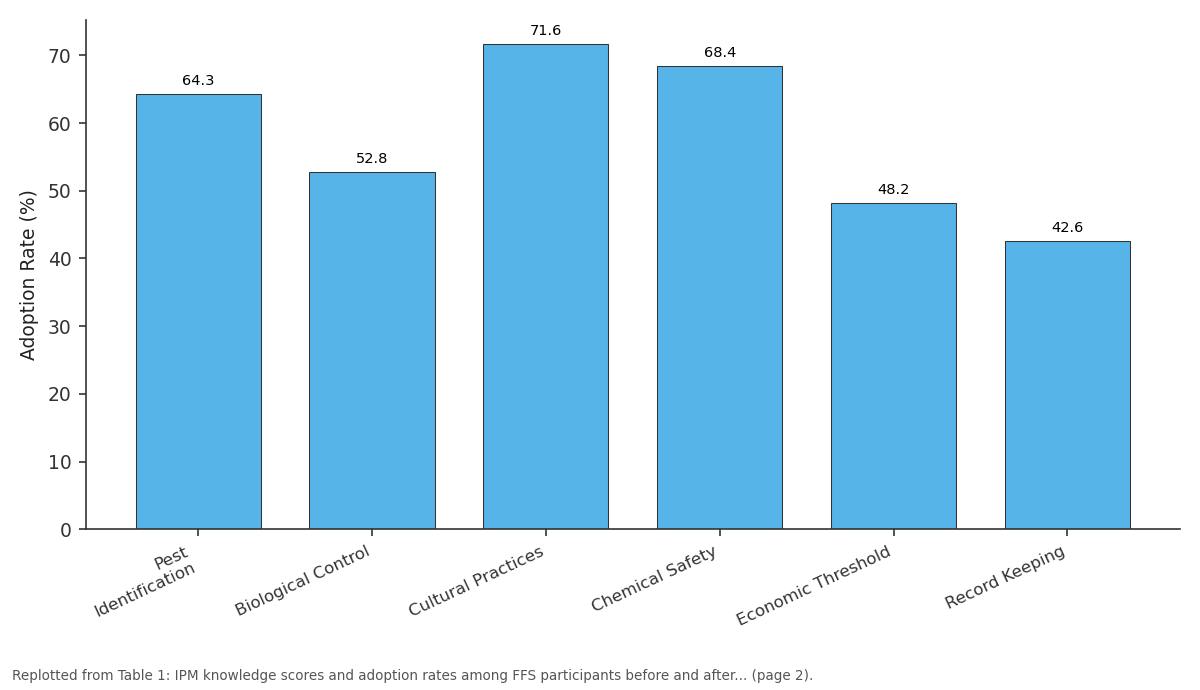
Adoption Rate (%): Pest Identification vs Biological Control vs Cultural Practices vs Chemical Safety vs Economic Threshold
Replotted from Table 1 (page 2) of the original paper. Every bar is the paper's own table value.
View source evidence ↗Figures & tables
From the original paper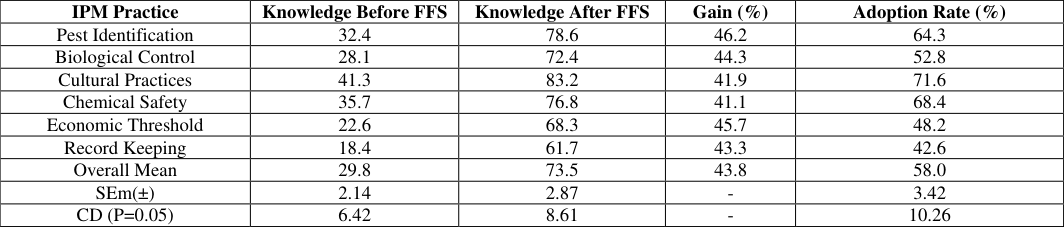 Table 1
 Table 2
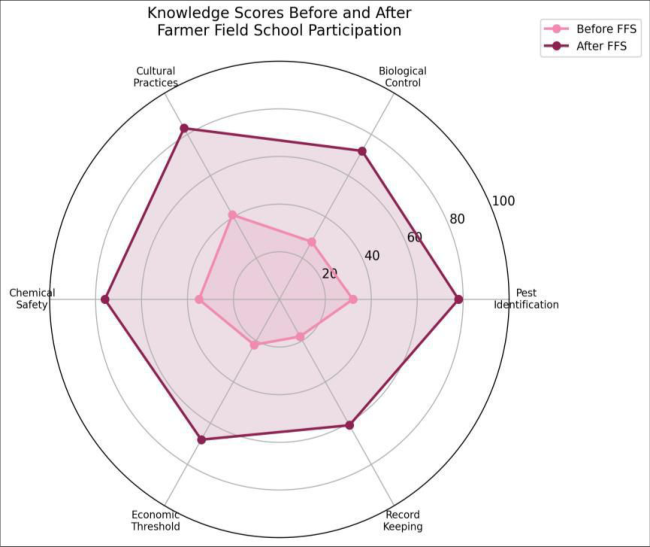 Figure 1
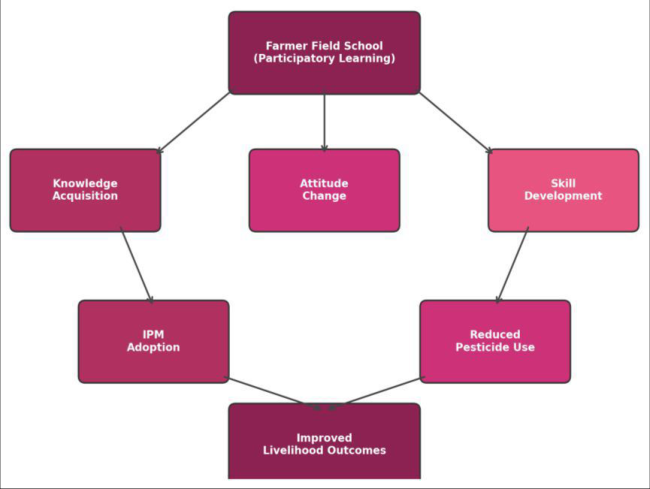 Figure 2
Introduction
Consider a typical vegetable farmer in northeast India: they grow cabbage, tomato, and beans on less than a hectare, face insect and disease problems they can't always identify, and rely almost entirely on pesticide dealers for crop protection advice. This scenario captures the reality facing millions of smallholders for whom conventional top-down extension methods have failed to deliver meaningful changes in pest management behavior [1] . The Farmer Field School approach, developed originally by FAO for rice IPM in Southeast Asia during the late 1980s, was designed specifically to address this gap by giving farmers direct experience with IPM concepts through hands-on, season-long learning in their own fields [2] . The FFS model centers on weekly group meetings where 25-30 farmers conduct agroecosystem analysis, compare IPM and conventional plots side by side, and make management decisions based on their own observations rather than prescriptive recommendations [3] . Meta-analyses of FFS programmes across Asia have shown average pesticide use reductions of 40-60% and knowledge gains of 30-50 percentage points [4] . However, results from northeast India, where tribal farming communities have distinct cultural contexts and cropping patterns, remain sparse [5] . This research assessed the impact of FFS on IPM knowledge and adoption among vegetable growers in Meghalaya's Garo Hills, examining whether the gains observed elsewhere translate to this specific setting.
Instrument Development
A structured knowledge test covering six IPM domains (pest identification, biological control, cultural practices, chemical safety, economic threshold concept, and record keeping) was developed through a multi-step process. An initial pool of 48 items was drafted based on the IPM training curriculum and reviewed by a panel of five extension specialists from Meghalaya Agricultural University. Items were scored on relevance (1-5 scale) and only those rated 4 or above by at least four panelists were retained. The revised 36-item test was pilot-tested on 30 farmers from a non-sample village. Item difficulty (0.25-0.75) and discrimination (>0.30) indices were used to finalize 30 items. The Cronbach's alpha reliability coefficient was 0.84, indicating good internal consistency [6] . An adoption index was constructed by scoring each of ten IPM practices on a three-point scale (0 = not adopted, 1 = partial, 2 = full) and dividing by the maximum possible score.
Material and Methods
Material and Methods
Material
The research was conducted during the kharif 2022 and rabi 2022-23 vegetable growing seasons in eight villages of West Garo Hills district, Meghalaya (25.52° N, 90.22° E). Four villages were selected for FFS implementation and four served as comparison sites. In each FFS village, 30 farmers were enrolled (total n = 120). From the comparison villages, 20 farmers per village were sampled (total n = 80) using stratified random sampling based on landholding size. The FFS curriculum ran for 14 weekly sessions covering the full crop cycle of cabbage and tomato, conducted by trained facilitators from the Krishi Vigyan Kendra [7] . Sessions included field scouting, insect zoo exercises, economic analysis of spray decisions, and group presentations.
Methods
The knowledge test was administered to FFS participants at the beginning and end of the programme. Non-participants were tested once at the season's end. Adoption was measured through structured interviews six months after FFS completion. Pesticide use data were collected from farmer records and recall for the three most recent spray seasons. Yield and income data were obtained from harvest records. Pre-post differences were tested by paired t-test.
Between-group differences were analyzed by independent ttest. Multiple regression was used to identify factors influencing adoption, with adoption index as the dependent variable and age, education, landholding, FFS participation, contact with extension, and mass media exposure as predictors [8] . All analyses used SPSS version 26 at P = 0.05. Knowledge increased significantly across all six domains (Table 1). The largest gains were in pest identification (+46.2 points) and economic threshold concept (+45.7 points). Cultural practices had the highest post-FFS adoption rate at 71.6%, while record keeping lagged at 42.6%. FFS participants applied significantly fewer sprays (3.2 vs. 6.8) and spent less on pesticides (₹2,840 vs. ₹6,720 per hectare) while achieving higher yields and net income (Table 2). All differences were statistically significant at P < 0.05 or P < 0.01.
| Parameter | FFS Participants (n=120) | Non-Participants (n=80) | t-value |
|---|---|---|---|
| Pesticide sprays/season | 3.2 | 6.8 | 8.47** |
| Pesticide cost (₹/ha) | 2,840 | 6,720 | 11.23** |
| Yield (q/ha) | 18.4 | 16.7 | 2.84* |
| Net income (₹/ha) | 34,680 | 28,420 | 4.12** |
| Knowledge score (%) | 73.5 | 34.6 | 16.78** |
| Adoption index | 0.68 | 0.31 | 12.41** |
Table text extracted from the original PDF; superscript letters are shown inline. The original table image is below.
View original table image
| IPM Practice | Knowledge Before FFS | Knowledge After FFS | Gain (%) | Adoption Rate (%) |
|---|---|---|---|---|
| Pest Identification | 32.4 | 78.6 | 46.2 | 64.3 |
| Biological Control | 28.1 | 72.4 | 44.3 | 52.8 |
| Cultural Practices | 41.3 | 83.2 | 41.9 | 71.6 |
| Chemical Safety | 35.7 | 76.8 | 41.1 | 68.4 |
| Economic Threshold | 22.6 | 68.3 | 45.7 | 48.2 |
| Record Keeping | 18.4 | 61.7 | 43.3 | 42.6 |
| Overall Mean | 29.8 | 73.5 | 43.8 | 58.0 |
| SEm(±) | 2.14 | 2.87 | - | 3.42 |
| CD (P=0.05) | 6.42 | 8.61 | - | 10.26 |
Table text extracted from the original PDF; superscript letters are shown inline. The original table image is below.
View original table image
Results
Results
Comprehensive Interpretation
Multiple regression analysis showed that FFS participation was the strongest predictor of adoption (β = 0.47, P < 0.001), followed by education level (β = 0.22) and contact with extension agents (β = 0.18). Together these variables explained 64.3% of the variance in the adoption index. Age and landholding size were not significant predictors.
Discussion
The 43.8 percentage point gain in overall knowledge is comparable to FFS outcomes reported from rice IPM programmes in Indonesia and Vietnam, suggesting that the model transfers well to vegetable systems in tribal communities [3,4] . The strong performance in cultural practices adoption (71.6%) likely reflects the lower cost and complexity of practices like crop rotation, sanitation, and trap cropping compared to biological control or economic threshold-based spraying. Record keeping had the lowest adoption, which is a common finding linked to literacy barriers and the perceived administrative burden of maintaining written records [5] . The 53% reduction in pesticide sprays without yield loss is the most practically significant finding. It demonstrates that a large share of the sprays applied by non-participants were unnecessary or mistimed, a conclusion supported by the FFS field comparison plots. The net income advantage of ₹6,260 per hectare for FFS farmers translates to meaningful economic benefit at the household level and could serve as a powerful motivator for farmer-to-farmer diffusion of IPM practices [1] .
Figures and tables from the paper
References
18 in the original paper- Morse S, Buhler W. Integrated pest management: ideals and realities in developing countries. Lynne Rienner Publishers. 2005;1:1-320.
- Kenmore PE. Indonesia's integrated pest management: a model for Asia. FAO Rice IPM Programme. 1991;1:156.
- van den Berg H, Jiggins J. Investing in farmers: the impacts of farmer field schools. World Development. 2007;35(4):663-686.
- Waddington H, Snilstveit B, Hombrados J. Farmer field schools for improving farming practices and farmer outcomes. Campbell Systematic Reviews. 2014;10(1):1-335.
- Mancini F, Jiggins J. Appraisal of methods to evaluate farmer field schools. Development in Practice. 2008;18(4-5):539-550.
- Cronbach LJ. Coefficient alpha and the internal structure of tests. Psychometrika. 1951;16(3):297-334.
- Vyas VS. India's agrarian structure, economic policies and sustainable development. Academic Foundation. 2003;1:1-312.
- Kerlinger FN, Lee HB. Foundations of behavioral research. Harcourt College Publishers. 2000;4:1-890.
- Tripp R, Wijeratne M, Piyadasa VH. What should we expect from farmer field schools? World Development. 2005;33(10):1705-1720.
- Rola AC, Jamias SB, Quizon JB. Do farmer field school graduates retain and share what they learn? Journal of International Agricultural and Extension Education. 2002;9(1):65-76.
- Godtland EM, Sadoulet E, de Janvry A. The impact of farmer field schools on knowledge and productivity. Journal of Development Economics. 2004;74(1):287307.
- Luther GC, Harris C, Sherwood S. Developments and innovations in farmer field schools and training of trainers. Springer. 2005;1:159-190.
- Davis K, Nkonya E, Kato E. Impact of farmer field schools on agricultural productivity. World Development. 2012;40(2):402-413.
- Feder G, Murgai R, Quizon JB. The acquisition and diffusion of knowledge: the case of pest management training in farmer field schools. Journal of Agricultural Economics. 2004;55(2):221-243.
- Anderson JR, Feder G. Agricultural extension: good intentions and hard realities. World Bank Research Observer. 2004;19(1):41-60.
- Braun AR, Duveskog D. The Farmer Field School approach: history, global assessment and new developments. FAO Background Paper. 2011;1:1-44.
- Pontius J, Dilts R, Bartlett A. Ten years of IPM training in Asia: from farmer field school to community IPM. FAO Community IPM Programme. 2002;1:1-106.
- Pretty J, Bharucha ZP. Integrated pest management for sustainable intensification of agriculture. Sustainability. 2015;7(4):3799-3831.