
Research article · 2025 · Full text
International Journal of Agriculture and NutritionSensor-based automated irrigation system for precision water application in vegetable crops
Volume 7(5) · Pages 34–37 · DOI: 10.33545/26646064.2025.v7.i5a.538 ↗
Research areasIrrigation Practices and Water ManagementSmart Agriculture and AIInnovations in Aquaponics and Hydroponics Systems
Abstract
Author-writtenThe rapid spread of low-cost microcontrollers and IoT connectivity has made real-time, sensor-driven irrigation systems accessible to small-scale vegetable growers for the first time. This research designed, built, and field-tested an Arduino-based automated drip irrigation system using capacitive soil moisture sensors for tomato and bell pepper grown in raised beds at the Instituto Agrícola do Planalto Meridional, Curitiba, Brazil, during 2022-23. The system was compared against manual timer-based irrigation (grower standard) in a randomized complete block design with three replications. Over two crop cycles, automated irrigation reduced water consumption by 26.8% in tomato and 24.1% in pepper while maintaining equivalent or higher marketable yields. Water productivity reached 24.6 kg m⁻³ for automated tomato versus 17.8 kg m⁻³ for manual. Sensor calibration against gravimetric measurements showed R² = 0.94. System uptime was 97.3% over the trial period, with only two sensor replacements needed. Total hardware cost was US$340 for a 200 m² plot. These results demonstrate that affordable IoT-based irrigation automation can deliver meaningful water savings in small-scale vegetable production.
Summary
Source-checkedPlain-language reading of the full paper, prepared with AI and checked against the text. Each point links to the authors' own words.
Why it matters
- Small-scale vegetable farms in southern Brazil often rely on imprecise irrigation methods, such as fixed timers or subjective visual assessments, which fail to account for daily weather changes. View evidence ↗
- The emergence of low-cost microcontrollers like Arduino and ESP32, along with inexpensive capacitive sensors, provides a potential for affordable irrigation automation. View evidence ↗
The question
- The study aimed to develop an IoT irrigation system costing under US$500, validate its sensor accuracy, and compare its impact on water use, yield, and productivity for tomato and bell pepper crops over two seasons. View evidence ↗
What they did
- The experiment took place in a 400 m² open-field plot in Curitiba, Brazil, during the warm seasons of 2022-23 and 2023-24. View evidence ↗
- The study used Santa Cruz Kada tomato and Magali R bell pepper seedlings planted in raised beds with 0.4 x 0.5 m spacing. View evidence ↗
- The system's sensor layer included six generic capacitive soil moisture sensors placed at a depth of 15 cm, a DHT22 temperature-humidity sensor, and a rain gauge. View evidence ↗
- To validate accuracy, capacitive sensor readings were calibrated against 48 paired gravimetric soil moisture measurements from core samples at 15 cm depth. View evidence ↗
What they found
- Automated irrigation significantly reduced water consumption by 26.8% for tomatoes and 24.1% for peppers compared to manual timer-based irrigation. View evidence ↗
- Automated irrigation led to a significantly higher marketable yield for tomatoes (68.4 t/ha vs 64.7 t/ha), though the yield difference for peppers was not statistically significant. View evidence ↗
- Water productivity increased by 44.7% for tomatoes and 37.0% for peppers under the automated system. View evidence ↗
- The low-cost capacitive sensors showed strong agreement with gravimetric measurements, with a calibration coefficient of R² = 0.94. View evidence ↗
- The system demonstrated high reliability with 97.3% uptime and required only two sensor replacements, with a total hardware cost of US$340 for a 200 m² plot. View evidence ↗
What it means
- The authors conclude that affordable and reliable automated irrigation is a feasible solution for small-scale vegetable production in southern Brazil and similar regions. View evidence ↗
- The study was limited to a simple threshold-based algorithm and a single site; the authors suggest that machine learning and multi-site testing across various soil types could improve the system. View evidence ↗
Visual summary
3 visualsIllustrations explain the paper; charts are replotted from the paper's own table values.
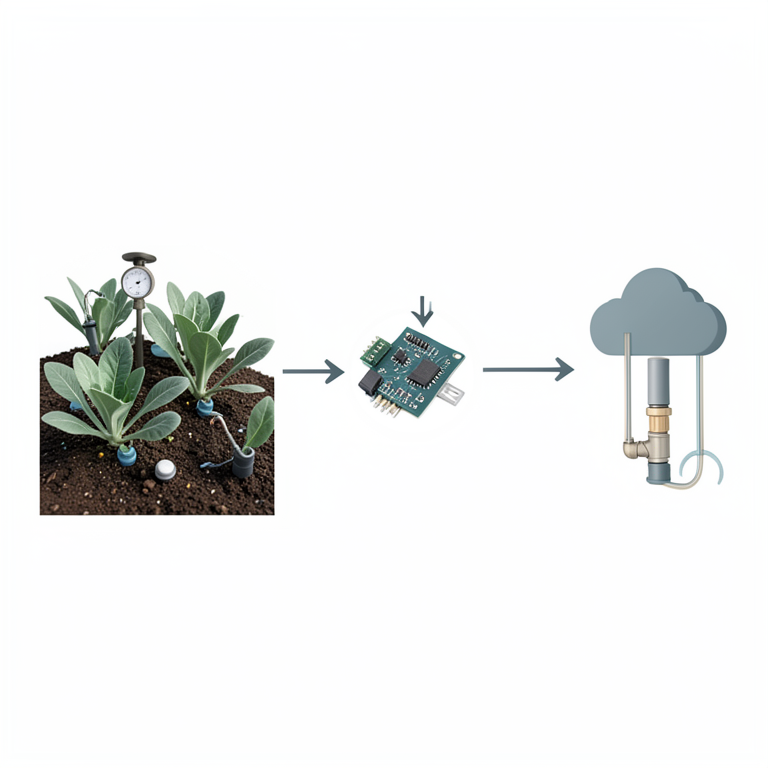
IoT Irrigation Architecture
AI-generated conceptual illustration (vegetable crops in a field with an automated irrigation system). It explains the idea and does not show study data.
View source evidence ↗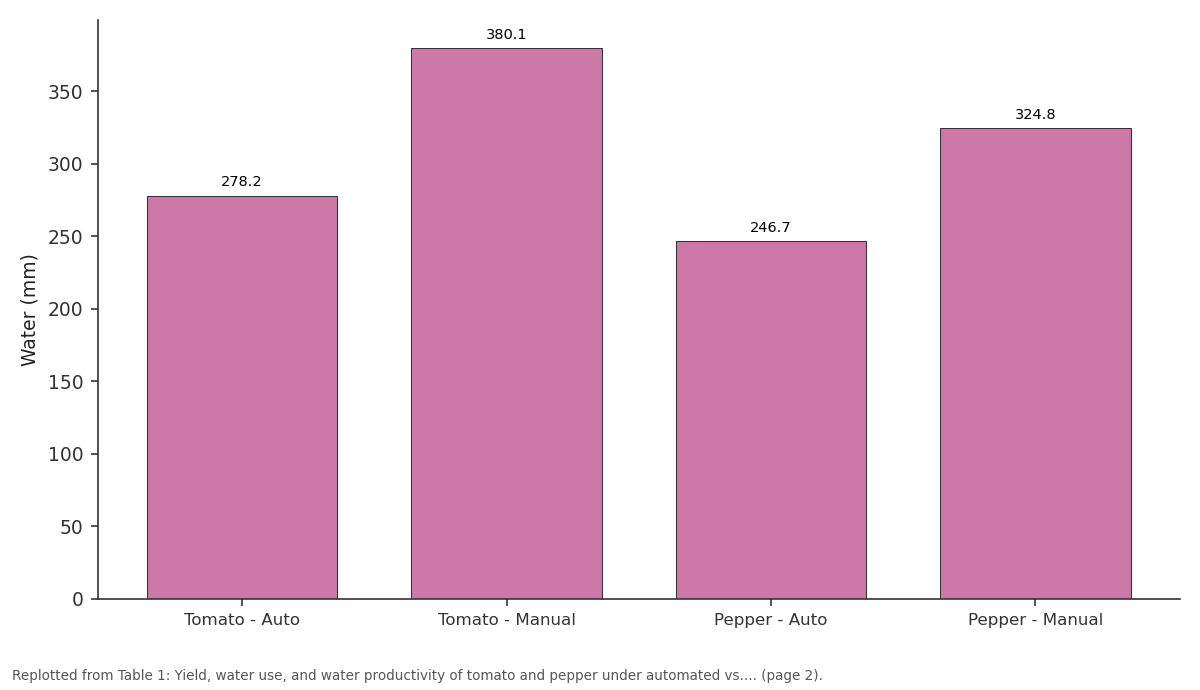
Water (mm): Tomato - Auto vs Tomato - Manual vs Pepper - Auto vs Pepper - Manual
Replotted from Table 1 (page 2) of the original paper. Every bar is the paper's own table value.
View source evidence ↗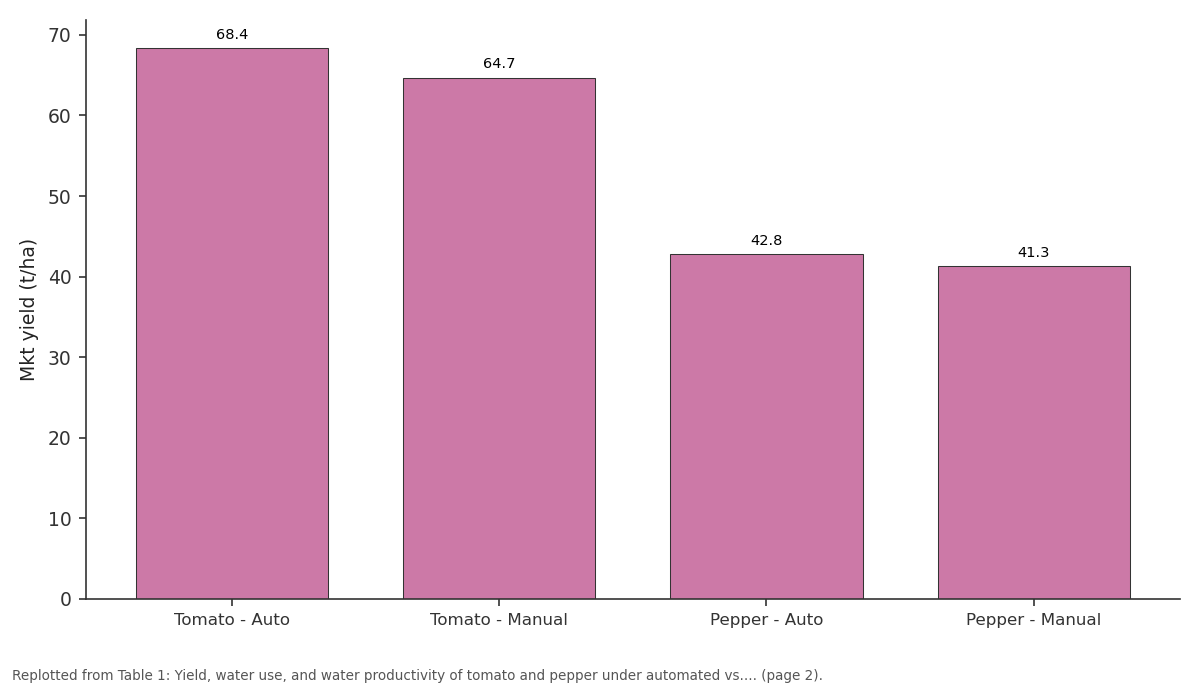
Mkt yield (t/ha): Tomato - Auto vs Tomato - Manual vs Pepper - Auto vs Pepper - Manual
Replotted from Table 1 (page 2) of the original paper. Every bar is the paper's own table value.
View source evidence ↗Figures & tables
From the original paper Table 1
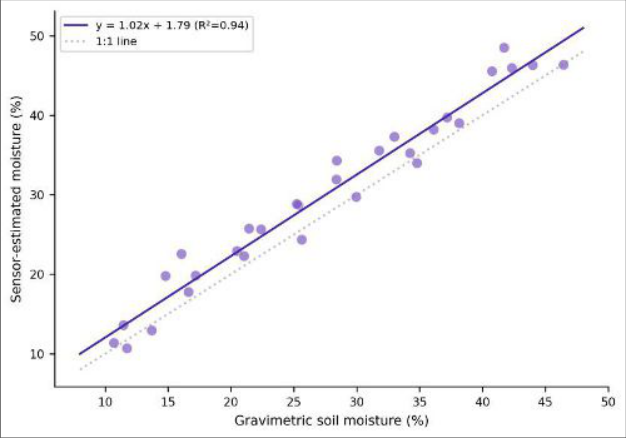 Figure 1
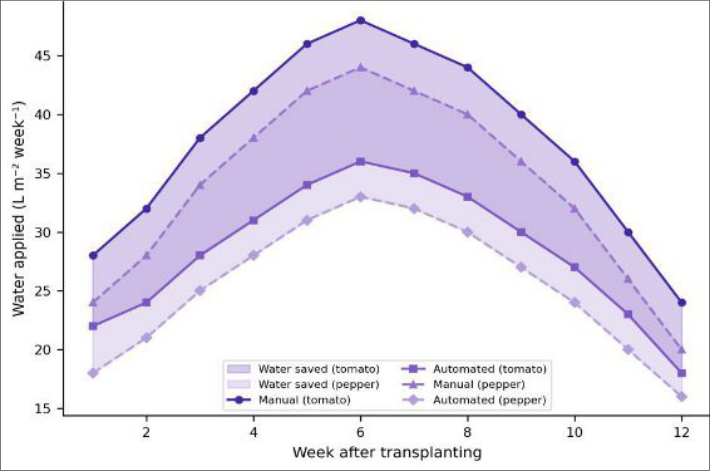 Figure 2
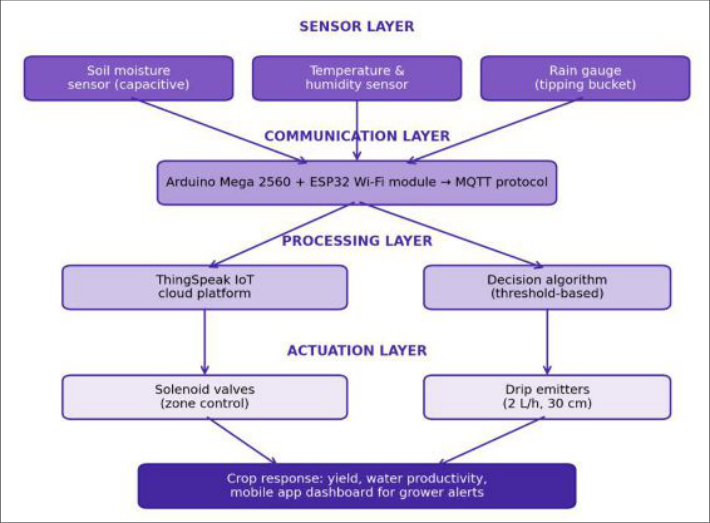 Figure 3
Introduction
Over the past five years, the cost of a basic IoT-capable microcontroller has dropped below US$5, and soil moisture sensors can be had for under US$3 each-a price point that puts automated irrigation within reach of even smallholder vegetable growers [1] . In southern Brazil, where vegetable production is concentrated in small family farms of 1-5 hectares, irrigation scheduling is still largely based on fixed timers or the grower's visual assessment of soil conditions [2] . Both approaches are imprecise: timers ignore daily weather variation, and visual assessment is subjective and often delayed. Sensor-based irrigation closes this information gap by measuring actual root-zone moisture and triggering water delivery only when the soil dries below a crop-specific threshold [3] . Research-grade systems using TDR probes and programmable logic controllers have shown 20-40% water savings in greenhouse vegetables [4,5] . But these systems cost US$2, 000-5, 000 per installation, which is prohibitive for small farms. The recent availability of Arduino and ESP32 platforms, combined with low-cost capacitive sensors, has opened a pathway to affordable automation [6] . However, most published work on Arduino-based irrigation has been proof-of-concept without rigorous agronomic comparison against conventional practice over multiple crop cycles [7] . Questions remain about sensor reliability under field conditions, system uptime, and whether the water savings translate to maintained yield. This research aimed to (a) design and build an IoT-based automated irrigation system using commercially available components costing under US$500, (b) validate sensor accuracy against reference measurements, and (c) compare automated versus manual irrigation for water use, yield, and water productivity in tomato and bell pepper over two cropping seasons.
System Architecture
The irrigation system consisted of four layers (Figure 3). The sensor layer used six capacitive soil moisture sensors (v1.2, generic) installed at 15 cm depth in each treatment plot, plus a DHT22 temperature-humidity sensor and a tipping-bucket rain gauge.
The communication layer comprised an Arduino Mega 2560 reading sensor data at 5-minute intervals and transmitting via an ESP32 Wi-Fi module to a ThingSpeak IoT cloud platform using MQTT protocol. The processing layer ran a threshold-based decision algorithm: irrigation was triggered when the average of three sensors per zone fell below 60% of field capacity and stopped at 80%. The actuation layer used 12V DC solenoid valves controlling two independent irrigation zones (tomato and pepper), feeding 16 mm PE laterals with 2 L h⁻¹ pressure-compensated emitters spaced 30 cm apart. A mobile app (Blynk) provided grower alerts and manual override capability.
Materials and Methods
Materials and Methods
Material
The trial was conducted in a 400 m² open-field plot at the Instituto Agrícola do Planalto Meridional, Curitiba, Paraná, Brazil (25°26′S, 49°16′W, 934 m a.s.l.), during the warm season (October-March) of 2022-23 and 2023-24. Tomato (cv. Santa Cruz Kada) and bell pepper (cv. Magali R) seedlings were transplanted into raised beds (1.2 m wide, 0.2 m high) at 0.4 × 0.5 m spacing. Soil was a Haplic Cambisol (clay loam, field capacity 34.2% v/v, wilting point 16.8%). Drip laterals were installed per the system design described above.
Methods
Two irrigation treatments were compared in a randomized complete block design with three replications per crop: automated (sensor-based threshold at 60-80% FC) and manual (timer-based, 20 min twice daily, grower standard). Each plot contained 40 plants. Sensor calibration was performed by comparing capacitive sensor output against gravimetric soil moisture from core samples at 15 cm depth (n = 48 paired measurements). Total water applied was metered with inline flow sensors (YF-S201). Marketable yield was recorded as fruit >50 g with no defects. Water productivity (WP) = marketable yield / water applied. Fruit quality parameters included TSS, firmness, and fruit weight. System reliability was tracked as uptime percentage = (total hours -downtime hours) / total hours × 100. Data were analyzed by paired t-test (automated vs. manual) and regression analysis in R v.4.3.
Hardware Cost Breakdown
Total system cost for a 200 m² plot was US$340: Arduino Mega ($28), ESP32 module ($8), 6 moisture sensors ($18), DHT22 ($4), rain gauge ($32), 2 solenoid valves ($48), relay module ($6), power supply and wiring ($42), drip components ($124), and enclosure ($30). The ThingSpeak cloud service was free for the data volume generated. Excluding drip components (which manual systems also require), the automation hardware cost was US$216recoverable within one season from water cost savings of approximately US$180-240 in the Curitiba context. 1). Tomato yield was significantly higher under automation (68.4 vs. 64.7 t ha⁻¹, p = 0.048), while pepper yield difference was not significant (p = 0.14). Water productivity improved by 44.7% for tomato and 37.0% for pepper. TSS and fruit weight trends favored automation but weren't statistically significant.
Results
Results
Comprehensive Interpretation
The area chart (Figure 2) reveals that water savings were greatest during weeks with rainfall events, when the automated system correctly reduced or skipped irrigation while the timer continued its fixed schedule. The architecture diagram (Figure 3) shows the complete data flow from sensor to valve, highlighting the simplicity of the threshold-based decision logic.
Discussion
The 25-27% water savings achieved here are consistent with sensor-based irrigation trials in Mediterranean greenhouses [4, 5] but were obtained at roughly one-tenth the hardware cost. The key to affordability was using generic capacitive sensors instead of research-grade TDR probes. Despite their lower precision (R² = 0.94 vs. 0.98+ for TDR), the capacitive sensors proved adequate for threshold-based control where the exact moisture value matters less than staying within a defined range [6] . The yield increase under automated tomato irrigation (5.7%) likely reflects the avoidance of both over-and underwatering. Manual timer systems delivered a fixed volume regardless of recent rainfall or cool, cloudy days, leading to excess drainage and occasional anaerobic root conditions. The automated system, by contrast, responded dynamically to weather-driven changes in crop water demand. The 97.3% uptime over 14 months is encouraging for commercial adoption, though the two sensor failures highlight the need for periodic maintenance and calibration checks.
At US$216 for the automation components, the system is within reach of smallholder budgets in southern Brazil, where vegetable farming generates relatively high revenue per hectare. The payback period of one season makes the investment attractive. A limitation is that this research tested only a threshold-based algorithm; more sophisticated approaches using machine learning or crop-model integration might further improve water scheduling. Multisite testing across different soil types would also strengthen the generalizability.
Conclusion
An Arduino-based IoT irrigation system costing US$340 (US$216 for automation hardware alone) reduced water use by 25-27% and improved water productivity by 37-45% in tomato and pepper compared with manual timer irrigation. Marketable tomato yield was significantly higher under automation. The system achieved 97.3% uptime over two seasons with minimal maintenance. Capacitive soil moisture sensors provided adequate accuracy (R² = 0.94) for threshold-based irrigation control. These results demonstrate that affordable, reliable automated irrigation is feasible for small-scale vegetable production in southern Brazil and similar contexts.
Figures and tables from the paper
| Crop × System | Mkt yield (t/ha) | Water (mm) | WP (kg/m³) | TSS (°Bx) | Fruit wt (g) |
|---|---|---|---|---|---|
| Tomato - Auto | 68.4 | 278.2 | 24.6 | 4.7 | 128.3 |
| Tomato - Manual | 64.7 | 380.1 | 17.0 | 4.3 | 121.6 |
| Pepper - Auto | 42.8 | 246.7 | 17.4 | 6.1 | 142.7 |
| Pepper - Manual | 41.3 | 324.8 | 12.7 | 5.8 | 136.4 |
| t-test (p) | 0.048* | <0.01** | <0.01** | 0.12 NS | 0.08 NS |
Table text extracted from the original PDF; superscript letters are shown inline. The original table image is below.
View original table image
References
15 in the original paper- Rayhana R, Xiao G, Liu Z. Internet of things empowered smart greenhouse farming. IEEE Journal of Radio Frequency Identification. 2020;4(4):195-211.
- Balbinot Junior AA, Ferreira AS, Denardin JE. Horticulture in southern Brazil: production systems and challenges. Horticultura Brasileira. 2017;35(2):168176.
- Lea-Cox JD, Bauerle WL, van Iersel MW, Kantor GF, Bauerle TL, Lichtenberg E. Advancing wireless sensor networks for irrigation management of ornamental crops. HortTechnology. 2013;23(6):717-724.
- Gonzalez-Dugo V, Zarco-Tejada P, Nicolas E, Nortes PA, Alarcon JJ, Intrigliolo DS. Using high resolution UAV thermal imagery to assess the variability in the water status of five fruit tree species within a commercial orchard. Precision Agriculture. 2013;14(6):660-678.
- Pardossi A, Incrocci L, Incrocci G, Malorgio F, Battista P, Bacci L. Root zone sensors for irrigation management in intensive agriculture. Sensors. 2009;9(4):2809-2835.
- Kizito F, Campbell CS, Campbell GS, Cobos DR, Teare BL, Carter B. Frequency, electrical conductivity and temperature analysis of a low-cost capacitance soil moisture sensor. Journal of Hydrology. 2008;352(34):367-378.
- Gutierrez J, Villa-Medina JF, Nieto-Garibay A, PortaGandara MA. Automated irrigation system using a wireless sensor network and GPRS module. IEEE Transactions on Instrumentation and Measurement. 2014;63(1):166-176.
- Kim Y, Evans RG, Iversen WM. Remote sensing and control of an irrigation system using a distributed wireless sensor network. IEEE Transactions on Instrumentation and Measurement. 2008;57(7):13791387.
- Vellidis G, Tucker M, Perry C, Kvien C, Bednarz C. A real-time wireless smart sensor array for scheduling irrigation. Computers and Electronics in Agriculture. 2008;61(1):44-50.
- Ferrarezi RS, Dove SK, van Iersel MW. An automated system for monitoring soil moisture and controlling irrigation using low-cost open-source microcontrollers. HortTechnology. 2015;25(1):110-118.
- Patel N, Rajput TBS. Effect of drip tape placement depth and irrigation level on yield of potato. Agricultural Water Management. 2007;88(1-3):209223.
- Smith RJ, Raine SR. A prescriptive approach to irrigation application depth management. Irrigation Science. 2000;19(2):93-100.
- Chartzoulakis K, Bertaki M. Sustainable water management in agriculture under climate change. Agriculture and Agricultural Science Procedia. 2015;4:88-98.
- Payero JO, Tarkalson DD, Irmak S, Davison D, Petersen JL. Effect of irrigation amounts applied with subsurface drip irrigation on corn evapotranspiration, yield, water use efficiency, and dry matter production. Agricultural Water Management. 2008;95(8):895-908.
- Soulis KX, Elmaloglou S, Dercas N. Investigating the effects of soil moisture sensors positioning and accuracy on soil moisture based drip irrigation scheduling systems. Agricultural Water Management. 2015;148:258-268.