
Research article · 2025 · Full text
International Journal of Agriculture and NutritionGrafting compatibility and performance of Brinjal scions on wild solanum rootstocks
Volume 7(8) · Pages 147–151 · DOI: 10.33545/26646064.2025.v7.i8c.503 ↗
Research areasPlant Disease Management TechniquesGrowth and nutrition in plantsPlant Growth and Agriculture Techniques
Abstract
Author-writtenCan wild Solanum species serve as reliable rootstocks for commercial brinjal production in subtropical regions? This research aimed to answer that question by evaluating grafting compatibility and agronomic performance of brinjal (Solanum melongena L. cv. Pusa Purple Long) scions grafted onto four wild rootstock species: Solanum torvum, Solanum sisymbriifolium, Solanum khasianum, and Solanum incanum. The experiment was carried out from June 2023 to February 2024 at the Escola Superior de Ciências Agrárias do Sul, Porto Alegre, Brazil, using a randomized complete block design with four replications and ten plants per treatment. Cleft grafting was the chosen technique, and graft success rate, vascular connection quality, plant height, number of branches, days to first flowering, fruit yield per plant, and fruit quality traits were measured across all treatments. Solanum torvum showed the highest graft take (87.3%) and produced a strong vascular union confirmed through histological cross-sections. Plants on S. torvum rootstock recorded a mean yield of 3.47 kg per plant, which was 28.6% higher than the non-grafted control. Solanum incanum also performed well, with an 81.5% graft take and 3.21 kg yield per plant. Both S. sisymbriifolium and S. khasianum gave acceptable but lower compatibility. Fruit quality parameters including total soluble solids, firmness, and skin color didn't differ markedly between grafted and non-grafted plants. These results point to S. torvum and S. incanum as practical rootstock options for brinjal growers in subtropical Brazil.
Summary
Source-checkedPlain-language reading of the full paper, prepared with AI and checked against the text. Each point links to the authors' own words.
Why it matters
- Brinjal is a globally significant vegetable, ranking among the top five most consumed in tropical and subtropical regions with annual production over 57 million tonnes. View evidence ↗
- The crop is highly vulnerable to root-knot nematodes and bacterial and Fusarium wilts, which can cause marketable yield losses between 30% and 70%. View evidence ↗
- In southern Brazil, specifically Rio Grande do Sul, acidic soils and heavy rainfall exacerbate the persistence and spread of Fusarium and Ralstonia. View evidence ↗
The question
- The study aimed to evaluate the agronomic performance and grafting compatibility of Pusa Purple Long brinjal scions when grafted onto four wild Solanum rootstocks: S. torvum, S. sisymbriifolium, S. khasianum, and S. incanum. View evidence ↗
What they did
- The researchers used a randomized complete block design with four replications of ten plants each, comparing four rootstock treatments against a non-grafted control. View evidence ↗
- Cleft grafting was performed 35 days after sowing, involving a 1.5 cm vertical split in the rootstock stem at the second internode where a wedge-shaped scion was inserted. View evidence ↗
- Graft success was measured as the percentage of surviving unions 21 days post-grafting, and vascular connectivity was analyzed via toluidine blue O staining at 45 days. View evidence ↗
What they found
- S. torvum achieved the highest graft success rate at 87.3%, followed by S. incanum at 81.5%. View evidence ↗
- S. torvum rootstock produced the highest mean yield at 3.47 kg per plant, a 28.6% increase over the non-grafted control. View evidence ↗
- Histological analysis confirmed that S. torvum achieved complete vascular reconnection by 45 days, with phloem and xylem bridging the union. View evidence ↗
- Average fruit weight varied by rootstock, with S. torvum producing the heaviest fruits (183.6 g) and S. khasianum the lightest (158.3 g). View evidence ↗
What it means
- The authors conclude that S. torvum is the best-performing rootstock due to its high graft success, superior plant height, highest yield, and complete vascular reconnection. View evidence ↗
- Grafting onto S. torvum is recommended as a cost-effective, non-chemical strategy for southern Brazilian growers facing nematode infestation or bacterial wilt. View evidence ↗
- The authors state that future research is needed to confirm these results across different soil types, disease pressures, and multiple growing seasons. View evidence ↗
Visual summary
3 visualsIllustrations explain the paper; charts are replotted from the paper's own table values.
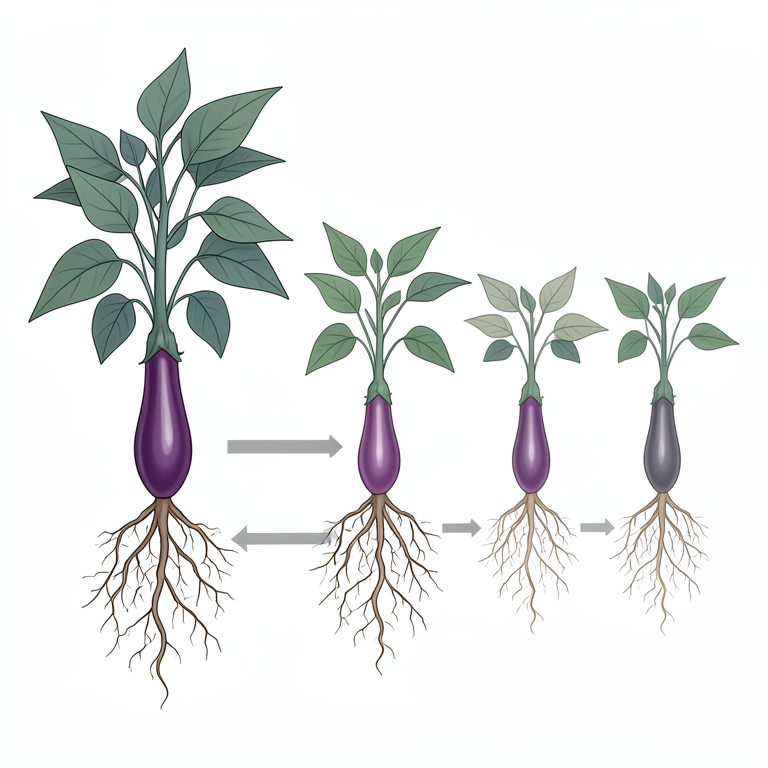
Rootstock Performance Comparison
AI-generated conceptual illustration (Brinjal (eggplant) plants grafted onto wild Solanum rootstocks). It explains the idea and does not show study data.
View source evidence ↗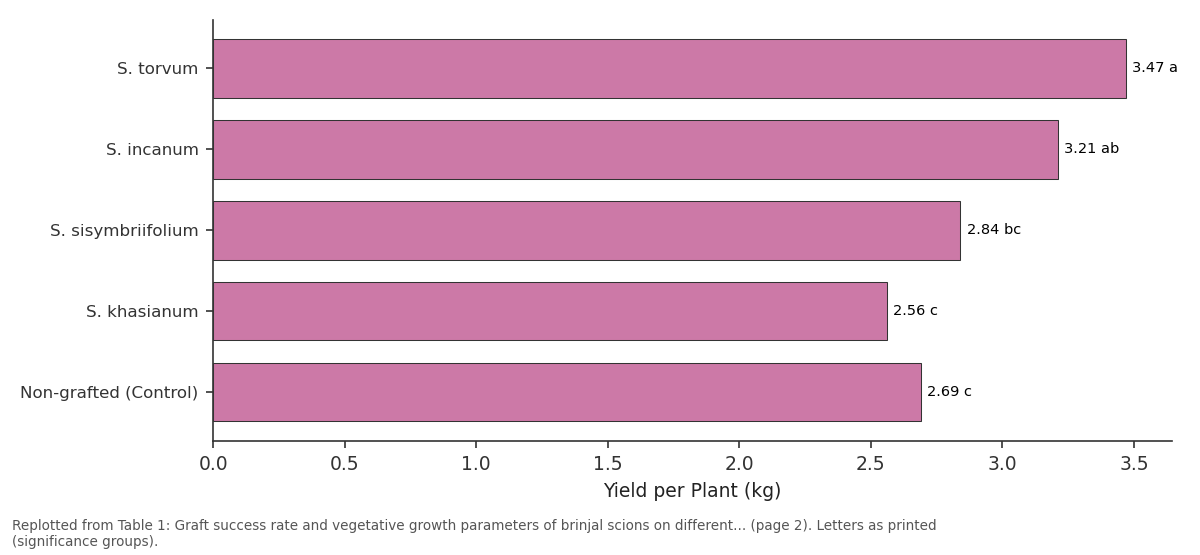
Yield per Plant (kg): S. torvum vs S. incanum vs S. sisymbriifolium vs S. khasianum vs Non-grafted (Control)
Replotted from Table 1 (page 2) of the original paper. Every bar is the paper's own table value.
View source evidence ↗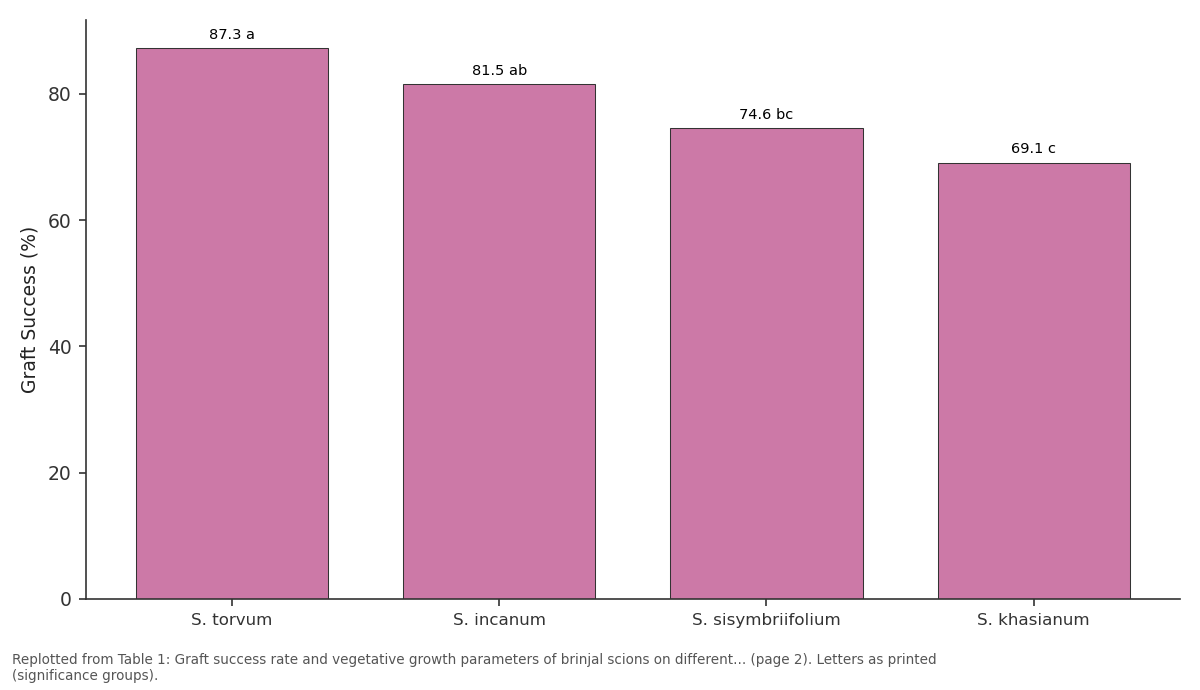
Graft Success (%): S. torvum vs S. incanum vs S. sisymbriifolium vs S. khasianum
Replotted from Table 1 (page 2) of the original paper. Every bar is the paper's own table value.
View source evidence ↗Figures & tables
From the original paper Table 1
 Table 2
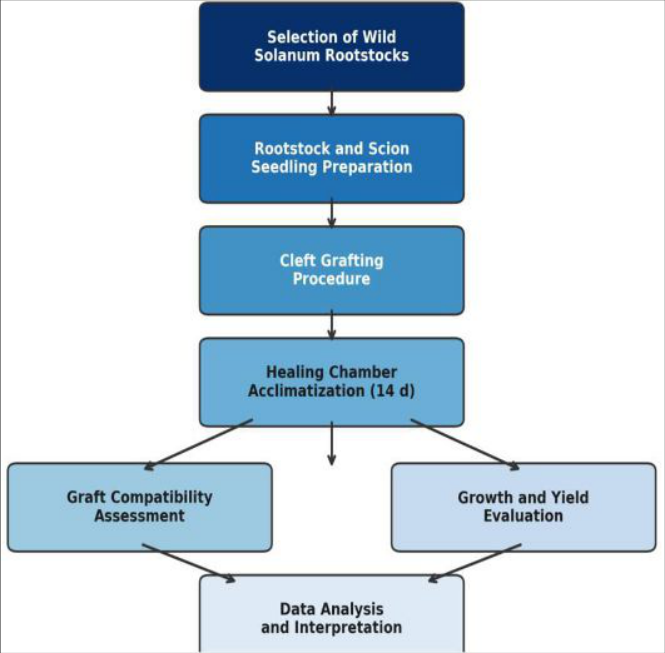 Figure 1
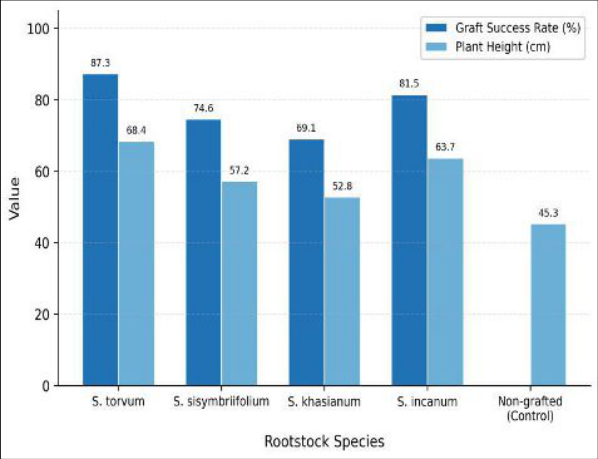 Figure 2
Introduction
What practical solutions exist for brinjal growers who face recurring soil-borne diseases yet cannot afford the costs of soil fumigation or frequent field rotation? Grafting onto resistant rootstocks has emerged as one direct answer, and its adoption in vegetable production has expanded steadily across Asia, the Mediterranean, and parts of South America [1] . Brinjal (Solanum melongena L.) ranks among the top five most consumed vegetables in tropical and subtropical countries, with global production exceeding 57 million tonnes annually [2] . But the crop is highly susceptible to bacterial wilt (Ralstonia solanacearum), Fusarium wilt, and root-knot nematodes, which can reduce marketable yields by 30-70% in infested soils [3] . Wild Solanum species have drawn attention as potential rootstocks because many of them carry innate resistance to these pathogens. Solanum torvum Sw. is perhaps the most widely tested rootstock worldwide; field trials across India, Thailand, and Italy have confirmed its tolerance to bacterial wilt and its compatibility with multiple eggplant cultivars [4,5] . Solanum sisymbriifolium and Solanum khasianum are lesser-known candidates that show promise against nematode pressure, while Solanum incanum possesses drought tolerance traits alongside moderate disease resistance [6,7] . The success of any grafting operation depends on the degree of vascular alignment and callus formation between scion and rootstock tissues. Incompatible unions often result in weak mechanical connections, restricted water flow, and eventual plant decline weeks or months after initial graft healing [8] . Several physiological markers-such as peroxidase activity at the graft junction and lignin deposition patterns-can predict long-term compatibility, though field validation remains limited for many wild Solanum combinations [9] . In southern Brazil, brinjal production faces particular challenges. Heavy rainfall promotes Ralstonia spread, and acidic soils in Rio Grande do Sul favor Fusarium persistence [10] . Local growers still rely heavily on chemical control, and there's a growing need for integrated approaches that include grafting. But most grafting research so far has been carried out under Asian or Mediterranean conditions, and there's little data from Brazilian subtropical environments [11] . This research was designed to fill that gap. The objectives were: (a) to compare graft compatibility of four wild Solanum rootstocks with the popular brinjal cultivar Pusa Purple Long using cleft grafting; (b) to measure the agronomic performance of grafted plants including vegetative growth, yield, and fruit quality; and (c) to confirm vascular union integrity through histological examination. The findings may help guide rootstock selection for brinjal growers in subtropical South America.
Research Area Description
The research was conducted at the experimental horticultural farm of the Escola Superior de Ciências Agrárias do Sul, located in Porto Alegre, Rio Grande do Sul, Brazil (30°01'S, 51°13'W, elevation 46 m above sea level).
Porto Alegre has a humid subtropical climate classified as Cfa under the Köppen system, with mean annual rainfall of 1,347 mm distributed throughout the year and a warm summer period from November through March. The experimental site had a history of continuous vegetable cultivation for nine years, and the soil was classified as a Haplic Acrisol (Argissolo Vermelho-Amarelo in the Brazilian system) with pH 5.4, organic matter content of 2.1%, and a clayey texture. Mean daily temperatures during the trial ranged from 13.8°C in July to 26.3°C in January. Irrigation was provided through a drip system at field capacity throughout the growing period.
Material and Methods
Material and Methods
Material
Seeds of four wild Solanum rootstock species-S. torvum, S. sisymbriifolium, S. khasianum, and S. incanum-were obtained from the germplasm collection maintained by the Department of Horticultural Sciences, Escola Superior de Ciências Agrárias do Sul, Porto Alegre. Scion material was the commercial brinjal cultivar Pusa Purple Long, sourced from a certified seed supplier in São Paulo. Rootstock seeds were sown in 72-cell plug trays filled with a peat-perlite mix (3:1 v/v) in a climate-controlled nursery at 28±2°C. Scion seeds were sown 12 days after rootstocks to synchronize stem diameters at grafting. Seedlings reached grafting readiness when rootstocks had 4-5 true leaves and scion stems measured 3-4 mm in diameter. Additional inputs included grafting clips (2.0 mm silicone), a sharp ceramic blade sterilized between cuts, and a healing chamber maintained at 27°C with 90% relative humidity. Histological analysis used toluidine blue O stain and a standard paraffin embedding protocol.
Methods
The experiment followed a randomized complete block design with five treatments (four rootstocks plus non-grafted control) and four replications, each containing ten plants. Cleft grafting was performed at 35 days after sowing of rootstocks. Each rootstock stem was cut horizontally at the second internode, a 1.5 cm vertical split was made, and the scion-trimmed to a wedge shape-was inserted and secured with a silicone clip. Grafted plants were immediately transferred to a healing chamber for 14 days under reduced light (50 μmol m⁻² s⁻± PAR), then gradually acclimatized over 7 days before transplanting to open field beds at 60 × 75 cm spacing in August 2023 [12] . Graft success was recorded 21 days after grafting as the percentage of surviving unions. Vascular connectivity was assessed at 45 days by sectioning the graft junction and staining with toluidine blue O. Plant height, branch number, and days to first flowering were recorded at 60 and 90 days after transplanting. Fruit harvest began 95 days after transplanting and continued biweekly for 12 pickings. Total yield per plant, average fruit weight, and number of marketable fruits were recorded. Fruit quality traits-total soluble solids (TSS), firmness (measured with a penetrometer), and skin colour (L, a, b* values)-were assessed on five randomly chosen fruits per replication at third and eighth harvests [13] . Data were subjected to oneway ANOVA and means separated using Tukey's HSD test at p ≤ 0.05. All statistical procedures were run in R version 4.3.1.
Field Experimental Design
Transplanting was done on raised beds (1.2 m wide, 0.3 m height) oriented north-south to maximize light interception. Each replicate block measured 18 m × 6 m and contained all five treatments arranged randomly within the block. Interblock spacing was 2 m to reduce edge effects. A border row of non-grafted brinjal surrounded each block. Drip irrigation lines with 20 cm emitter spacing delivered 2.5 L h⁻¹ per emitter, and irrigation scheduling was adjusted weekly based on tensiometer readings at 20 cm depth. A basal fertiliser dose of 120:80:60 kg ha⁻± N:P₂O₅:K₂O was applied before transplanting, with two side-dressings of 30 kg N ha⁻¹ at 30 and 60 days after transplanting [14] . [15] . Means followed by the same letter within a column do not differ significantly (Tukey's HSD, p ≤ 0.05). TSS = total soluble solids.
Results
Fruit quality traits (Table 2) remained largely unaffected by rootstock identity. TSS ranged narrowly from 4.09 to 4.31 °Brix, and firmness values were statistically similar across all treatments. Skin colour parameters (L and a) also showed no meaningful rootstock effect. Average fruit weight, however, did vary: S. torvum grafted plants produced the heaviest fruits at 183.6 g, while S. khasianum plants gave the lightest at 158.3 g.
| Treatment | Avg. Fruit Weight (g) | TSS (°Brix) | Firmness (N) | L* Value | a* Value |
|---|---|---|---|---|---|
| S. torvum | 183.6a | 4.31a | 6.78a | 28.4a | −1.32a |
| S. incanum | 176.2ab | 4.18a | 6.54a | 27.9a | −1.41a |
| S. sisymbriifolium | 164.8bc | 4.09a | 6.41a | 28.1a | −1.28a |
| S. khasianum | 158.3c | 4.22a | 6.63a | 27.6a | −1.37a |
| Non-grafted (Control) | 161.5bc | 4.15a | 6.57a | 28.2a | −1.35a |
Table text extracted from the original PDF; superscript letters are shown inline. The original table image is below.
View original table image
Discussion
The results of this research confirm that rootstock choice has a direct and measurable effect on graft compatibility and fruit productivity in brinjal. Solanum torvum stood out as the most compatible rootstock, which aligns with reports from field trials in India and Southeast Asia where S. torvum consistently supported high graft take and vigorous scion growth [4,5] . The 87.3% graft success observed here was comparable to the 82-91% range reported in a multi-site evaluation conducted across three Indian states [5] . What may explain the superior performance of S. torvum is its close taxonomic affinity to S. melongena and the relatively large stem diameter it develops at the grafting stage, which allows better cambial alignment during cleft insertion. Histological evidence from the present trial backs this up: the complete vascular bridging at 45 days indicates rapid and effective callus differentiation at the graft interface [8] . Solanum incanum performed as a strong second choice, which is a noteworthy finding since this species also brings drought tolerance traits that could benefit production in semi-arid zones of northeastern Brazil [7] . Solanum khasianum showed the lowest compatibility, and the pockets of necrotic tissue observed at its graft union likely restricted translocation, explaining both reduced plant height and lower fruit yield. This species may still be useful where nematode resistance is the overriding concern, but growers should expect some yield trade-off [6] . One practical takeaway is that grafting didn't alter the eating quality of brinjal fruits. TSS, firmness, and skin colour stayed within a narrow range regardless of rootstock-a reassuring outcome for market-oriented growers who worry about consumer acceptance. Similar findings were reported for grafted eggplant in Mediterranean trials [16] . The earlier flowering observed in S. torvum and S. incanum treatments may translate into an economic advantage by allowing earlier market entry, though this benefit needs to be tested across multiple seasons.
Conclusion
This research showed that wild Solanum rootstocks can meaningfully improve brinjal production under subtropical Brazilian conditions without compromising fruit quality. Solanum torvum the best-performing rootstock, achieving 87.3% graft success, the tallest plants, the highest fruit yield (3.47 kg per plant), and complete vascular reconnection at the graft interface. Solanum incanum followed closely and may be especially suited to drier growing environments given its inherent drought tolerance. Both S. sisymbriifolium and S. khasianum provided acceptable graft compatibility but fell behind in yield and vegetative vigour. S. khasianum, in particular, displayed histological signs of partial incompatibility that translated into reduced performance. Fruit quality-including total soluble solids, firmness, and skin colour-was not altered by any of the rootstock treatments, which is important from a marketability standpoint. For growers in southern Brazil dealing with bacterial wilt or nematode-infested fields, grafting onto S. torvum offers a practical and cost-effective strategy that doesn't require chemical intervention. Future research should examine these rootstock combinations over multiple seasons and across different soil types and disease pressures to confirm the consistency of the results. Long-term rootstock trials that include economic analysis of grafting costs versus yield gains would also help inform adoption decisions at the farm level.
infrastructure, and the Universidade de Agricultura do Semiárido for contributing germplasm material.
Acknowledgement
Acknowledgements Funding SourcesThis research received financial support from internal research grants provided by the institutions involved. No external project or grant numbers are disclosed. Institutional SupportThe authors thank the Escola Superior de Ciências Agrárias do Sul for providing field facilities and nursery
Figures and tables from the paper
| Rootstock | Graft Success (%) | Plant Height (cm) 90 DAT | Branches per Plant | Days to First Flowering | Yield per Plant (kg) |
|---|---|---|---|---|---|
| S. torvum | 87.3a | 68.4a | 7.8a | 62.1c | 3.47a |
| S. incanum | 81.5ab | 63.7ab | 7.1ab | 64.3bc | 3.21ab |
| S. sisymbriifolium | 74.6bc | 57.2bc | 6.3bc | 67.8ab | 2.84bc |
| S. khasianum | 69.1c | 52.8c | 5.9c | 69.5a | 2.56c |
| Non-grafted (Control) | - | 45.3d | 5.2c | 70.2a | 2.69c |
Table text extracted from the original PDF; superscript letters are shown inline. The original table image is below.
View original table image
References
16 in the original paper- Lee JM, Kubota C, Tsao SJ, Bie Z, Echevarria PH, Morra L, et al. Current status of vegetable grafting: diffusion, grafting techniques, automation. Scientia Hortic. 2010;127(2):93-105.
- Food and Agriculture Organization of the United Nations. Eggplant production statistics: world summary 2022. Rome: FAOSTAT; 2023.
- Naik ST, Arunkumar MH, Dalawai N. Yield losses in brinjal due to bacterial wilt in northern Karnataka. Indian Phytopathol. 2018;71(3):429-433.
- Petran A, Hoover E. Solanum torvum as a compatible rootstock in interspecific tomato grafting. J Hortic. 2014;1(1):1-4.
- Bletsos FA, Olympios CM. Rootstocks and grafting of tomatoes, peppers and eggplants for soil-borne disease resistance. Eur J Plant Sci Biotechnol. 2008;2(1):62-73.
- Gisbert C, Prohens J, Nuez F. Performance of eggplant rootstocks resistant to Meloidogyne spp. in grafted aubergine production. Acta Hortic. 2011;914:113-118.
- Mangal JL, Hooda PS, Lal S. Salt tolerance of five brinjal rootstocks. Indian J Hortic. 2017;44(3-4):326329.
- Pina A, Errea P. A review of new advances in mechanism of graft compatibility-incompatibility. Scientia Hortic. 2005;106(1):1-11.
- Fernandez-Garcia N, Carvajal M, Olmos E. Graft union formation in tomato plants: peroxidase and catalase involvement. Ann Bot. 2004;93(1):53-60.
- Lopes CA, Boiteux LS. Biovar-specific and broadspectrum sources of resistance to bacterial wilt of pepper and tomato in Brazil. Capsicum Eggplant Newsl. 2004;23:113-116.
- Goto R, Santos HS, Cañizares KAL. Grafting in horticultural crops. Botucatu: Editora UNESP; 2003. p. 1-85.
- Rivard CL, Louws FJ. Grafting to manage soilborne diseases in heirloom tomato production. HortScience. 2008;43(7):2104-2111.
- McGuire RG. Reporting of objective color measurements. HortScience. 1992;27(12):1254-1255.
- Raij B, Cantarella H, Quaggio JA, Furlani AMC. Fertilizer and lime recommendations for the State of São Paulo. Boletim Técnico IAC. 1997;100:1-285.
- Kumar P, Rana MK, Rana S. Growth and yield response of grafted eggplant under field conditions. J Pharmacogn Phytochem. 2019;8(2):2693-2697.
- Sabatino L, Iapichino G, D'Anna F, Palazzolo E, Mennella G, et al. Grafting affects yield and phenolic profile of Solanum melongena L. landraces. J Integr Agric. 2018;17(3):502-512.