
Research article · 2025 · Full text
International Journal of Agriculture and NutritionCultural and mechanical weed management options for organic wheat production
Volume 7(12) · Pages 161–163 · DOI: 10.33545/26646064.2025.v7.i12c.559 ↗
Research areasWeed Control and Herbicide ApplicationsAllelopathy and phytotoxic interactionsPlant and soil sciences
Abstract
Author-writtenOrganic wheat growers across India face the same bottleneck: weeds. Without herbicides, yield losses of 25–45% are common unless non-chemical alternatives are timed well. This research compared six cultural and mechanical weed management options — stale seedbed, hand weeding twice, mechanical hoe twice, wheat-straw mulch at 5 t ha⁻¹, inter-row cultivation with a wheel hoe, and untreated control in organic wheat (cv. NIAW-301) at Rahuri, Maharashtra, during rabi 2022–23. Hand weeding at 25 and 45 DAS gave the highest grain yield (3.67 t ha⁻¹), but mechanical hoeing came close (3.51 t ha⁻¹) at half the labour cost. Stale seedbed reduced weed density by 42% before sowing but didn’t fully control late-emerging species. Straw mulch suppressed weeds by 38% and conserved soil moisture but depressed yield slightly (3.28 t ha⁻¹) due to temporary N immobilisation. These findings give organic wheat farmers in Maharashtra a menu of practical, chemical-free weed control tactics ranked by effectiveness and cost.
Summary
Source-checkedPlain-language reading of the full paper, prepared with AI and checked against the text. Each point links to the authors' own words.
Why it matters
- Weed management is a critical bottleneck for organic wheat growers in India, where the absence of herbicides can lead to yield losses between 25% and 45%. View evidence ↗
- The area dedicated to organic wheat in Maharashtra has doubled since 2018, incentivized by premium prices ranging from ₹3,500 to ₹4,000 per quintal. View evidence ↗
- Weed populations in Rahuri's rabi wheat are composed of various grassy and broadleaf species, primarily Phalaris minor, Chenopodium album, and Melilotus indica, which are difficult to control with a single non-chemical method. View evidence ↗
The question
- The research aims to determine which non-chemical weed management tactics provide the most efficient yield protection relative to labor and financial costs. View evidence ↗
What they did
- The study was conducted at the MPKV research block in Rahuri on medium-black Vertisol soil with a pH of 8.1. View evidence ↗
- Researchers used a randomized block design with four replications, planting wheat variety NIAW-301 in 5 m × 4 m plots with 22.5 cm row spacing. View evidence ↗
- Six treatments were compared: stale seedbed, double hand weeding, double mechanical hoeing, wheat-straw mulch (5 t ha⁻¹), inter-row cultivation with a wheel hoe, and an untreated control. View evidence ↗
- The study measured weed density and biomass at 30, 60, and 90 days after sowing (DAS), and recorded grain yield from a 4 m × 3 m net plot adjusted to 12% moisture. View evidence ↗
What they found
- While straw mulch increased soil moisture conservation by 8–12%, it reduced tillering vigour in the first 30 days due to the immobilization of mineral nitrogen. View evidence ↗
What it means
- The authors conclude that mechanical hoeing provides the optimal balance between weed control effectiveness and cost. View evidence ↗
- The authors recommend an integrated strategy combining a pre-sowing stale seedbed with one in-season mechanical hoe pass for organic wheat in western Maharashtra. View evidence ↗
- The authors suggest that future trials should test applying mulch two weeks before sowing to avoid nitrogen immobilization during the tillering stage. View evidence ↗
Visual summary
3 visualsIllustrations explain the paper; charts are replotted from the paper's own table values.
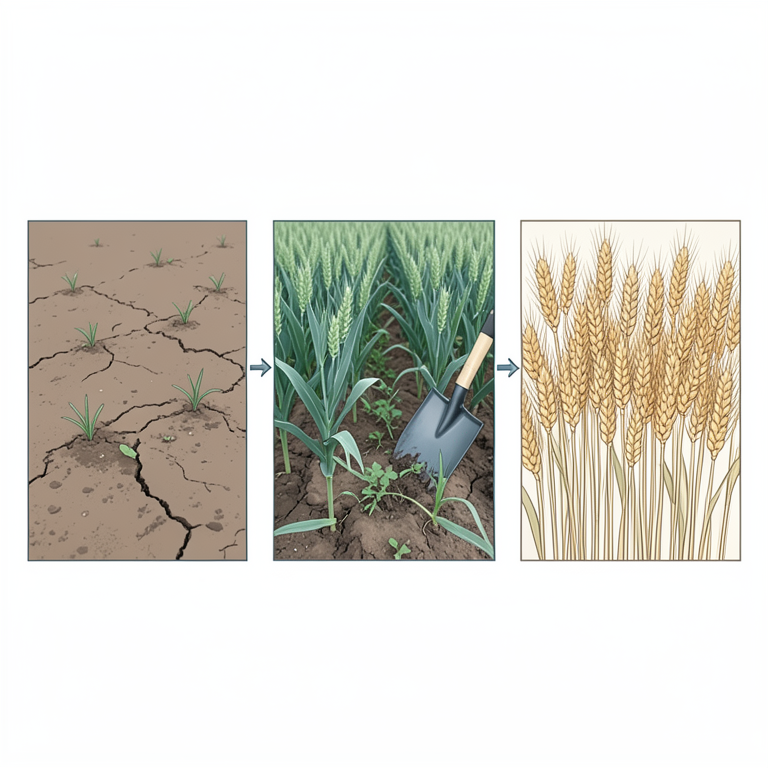
Recommended Integrated Weed Management Workflow
AI-generated conceptual illustration (wheat plants in a field). It explains the idea and does not show study data.
View source evidence ↗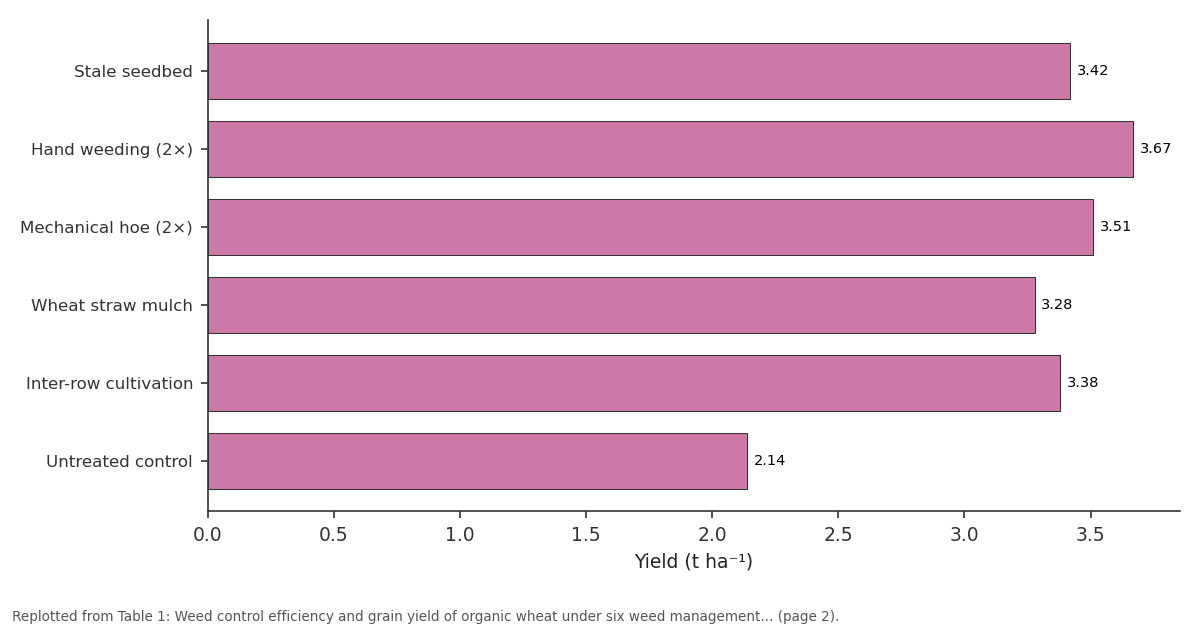
Yield (t ha⁻¹): Stale seedbed vs Hand weeding (2×) vs Mechanical hoe (2×) vs Wheat straw mulch vs Inter-row cultivation
Replotted from Table 1 (page 2) of the original paper. Every bar is the paper's own table value.
View source evidence ↗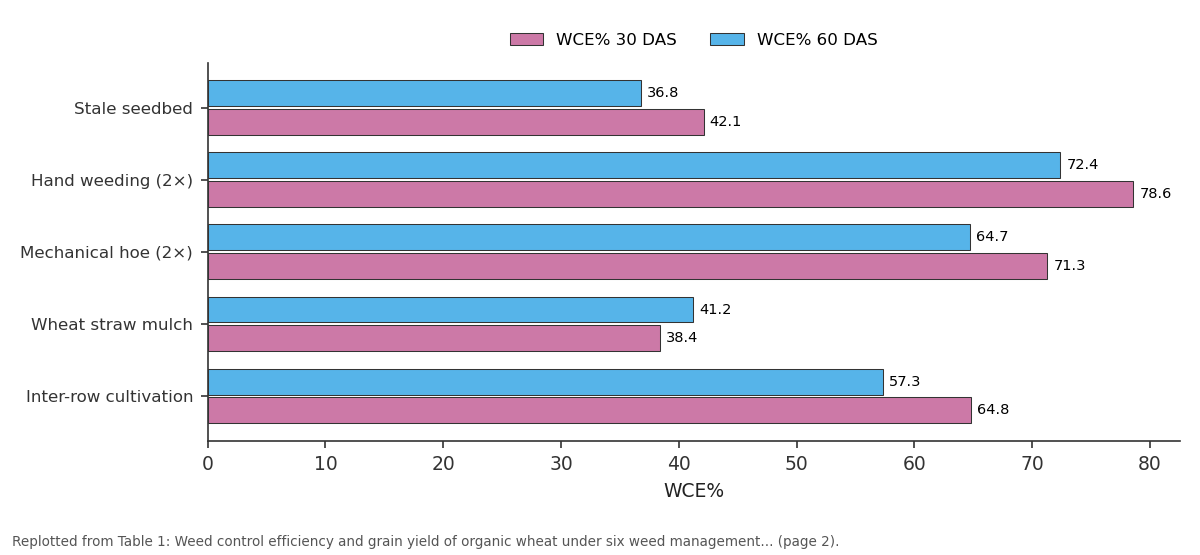
WCE% 30 DAS and WCE% 60 DAS: Stale seedbed vs Hand weeding (2×) vs Mechanical hoe (2×) vs Wheat straw mulch vs Inter-row cultivation
Replotted from Table 1 (page 2) of the original paper. Every bar is the paper's own table value.
View source evidence ↗Figures & tables
From the original paper Table 1
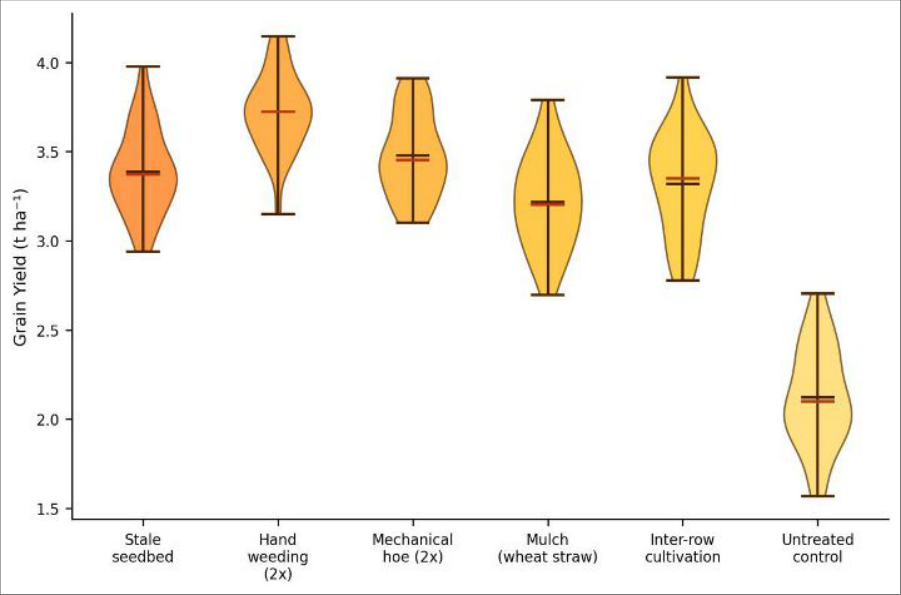 Figure 1
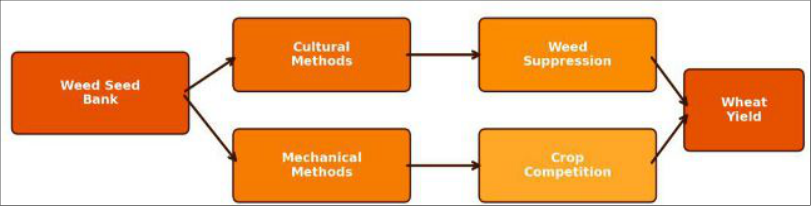 Figure 2
Introduction
In conventional wheat, one pre-emergence herbicide and one post-emergence follow-up typically keep weeds in check for less than ₹2,000 per hectare. Organic wheat doesn't have that luxury. With herbicides off the table, weed management depends entirely on physical and biological suppression methods that are often labour-intensive, weather-dependent, and inconsistent across seasons [1] . The question for organic farmers isn't whether to control weeds, but which combination of non-chemical tactics gives the best yield protection per rupee and per hour of labour. Maharashtra's organic wheat area has doubled since 2018, driven by premium prices of ₹3,500-4,000 per quintal versus ₹2,100-2,300 for conventional [2] . But weed-related yield losses remain the main reason many conventional growers hesitate to convert. The weedy flora in rabi wheat at Rahuri is dominated by Phalaris minor, Chenopodium album, and Melilotus indica a mix of grassy and broadleaf species that no single non-chemical tactic controls well on its own [3] . This research tested six standalone options under field conditions, measured their weed suppression and grain yield effects, and calculated the labour and material cost of each. The intent was to produce a decision guide that ranks the options by both agronomic performance and economic feasibility.
Weed Flora Biodiversity Assessment
A pre-treatment weed survey (quadrat method, ten 0.25 m² frames per plot) recorded 14 weed species across the experimental area. The five most abundant were Phalaris minor (31.4% of total density), Chenopodium album (22.7%), Melilotus indica (14.8%), Anagallis arvensis (11.2%), and Rumex dentatus (7.3%). Shannon-Wiener diversity index (H′) averaged 1.92 across the site, indicating moderate species diversity. By harvest, untreated control plots had shifted toward Phalaris dominance (41.6%), while managed plots retained a more even weed community, suggesting that non-chemical methods distribute competitive pressure more evenly across species than herbicide-based approaches that often select for resistant biotypes [4] .
Methods
Weed density and dry biomass were recorded at 30, 60, and 90 DAS from two random 0.25 m² quadrats per plot. Weed control efficiency (WCE) was calculated as: WCE = [(weed biomass in controlweed biomass in treatment) / weed biomass in control] × 100. Grain yield was harvested from the net plot (4 m × 3 m) and adjusted to 12% moisture. Labour hours per hectare were recorded for each treatment. Cost of weed management was computed at the prevailing daily wage rate of ₹350 per person-day [5] . Data were analysed by ANOVA in R (v4.3.1) with DMRT at p = 0.05.
Results
Results
Comprehensive Interpretation
Hand weeding was the most effective single treatment (WCE 72-79%) but its labour cost (₹12,000 ha⁻¹) makes it impractical on larger holdings. Mechanical hoeing achieved 65-71% WCE at one-third the labour cost, making it the best value proposition for organic wheat farms above 1 hectare. Stale seedbed was useful as a pre-sowing measure but needed to be paired with in-season weeding to maintain control. Straw mulch conserved 8-12% more soil moisture than unmulched treatments but tied up mineral N during decomposition, reducing tillering vigour in the first 30 days.
Discussion
The mechanical hoe's near-parity with hand weeding in yield terms (3.51 vs 3.67 t ha⁻¹, non-significant difference) is encouraging and matches findings from European organic wheat systems, where inter-row hoeing is standard practice [6] . The key to its effectiveness was timing: hoeing at 25 DAS (4-leaf stage of Phalaris) and again at 45 DAS caught the main weed flush before it competed seriously with the crop [3] . Straw mulch's N-immobilisation effect is well documented [7] . Applying mulch two weeks before sowing (rather than at sowing) might allow the initial decomposition flush to pass before the wheat needs N for tillering. This timing adjustment deserves testing in future trials.
A combined approachstale seedbed before sowing followed by one mechanical hoe pass at 25 DASwould likely outperform any single treatment and keep costs below ₹6,000 ha⁻¹. This integrated strategy should be the focus of extension messages for organic wheat growers in Maharashtra.
Conclusion
Hand weeding and mechanical hoeing were the most effective standalone options for weed control in organic wheat at Rahuri, achieving 64-79% weed control efficiency and preserving yields of 3.51-3.67 t ha⁻¹. Mechanical hoeing offered the best balance of efficacy and affordability. Stale seedbed and straw mulch provided partial control and are best used as complements rather than standalone methods. Combining pre-sowing stale seedbed with one inseason mechanical hoe pass is recommended as a costeffective integrated approach for organic wheat production in western Maharashtra.
Figures and tables from the paper
| Treatment | WCE% 30 DAS | WCE% 60 DAS | Yield (t ha⁻¹) | Labour (hrs ha⁻¹) | Cost (₹ ha⁻¹) |
|---|---|---|---|---|---|
| Stale seedbed | 42.1 | 36.8 | 3.42 | 18 | 2,250 |
| Hand weeding (2×) | 78.6 | 72.4 | 3.67 | 96 | 12,000 |
| Mechanical hoe (2×) | 71.3 | 64.7 | 3.51 | 32 | 4,000 |
| Wheat straw mulch | 38.4 | 41.2 | 3.28 | 24 | 5,100 |
| Inter-row cultivation | 64.8 | 57.3 | 3.38 | 28 | 3,500 |
| Untreated control | — | — | 2.14 | — | — |
Table text extracted from the original PDF; superscript letters are shown inline. The original table image is below.
View original table image
References
18 in the original paper- Bond W, Grundy AC. Non-chemical weed management in organic farming systems. Weed Research. 2001;41(5):383-405.
- APEDA. Organic products export statistics 2022-23. New Delhi: Agricultural and Processed Food Products Export Development Authority; 2023.
- Rao VS. Principles of weed science. 2nd ed. New Delhi: Oxford and IBH Publishing; 2000. p. 1-555.
- Liebman M, Mohler CL, Staver CP. Ecological management of agricultural weeds. Cambridge: Cambridge University Press; 2001. p. 1-532.
- Labour Bureau. Indian labour statistics 2022. Shimla: Ministry of Labour and Employment; 2023.
- Rasmussen J, Ascard J. Weed control in organic farming systems. In: Hatcher PE, Melander B, editors. Weed research: expanding horizons. Chichester: John Wiley; 2003. p. 49-67.
- Teasdale JR, Mohler CL. The quantitative relationship between weed emergence and the physical properties of mulches. Weed Science. 2000;48(3):385-392.
- Mohler CL. Mechanical management of weeds. In: Liebman M, editor. Ecological management of agricultural weeds. Cambridge: Cambridge University Press; 2001. p. 139-209.
- Melander B, Rasmussen IA, Barberi P. Integrating physical and cultural methods of weed control. Weed Research. 2005;45(3):193-211.
- Buhler DD, Liebman M, Obrycki JJ. Theoretical and practical challenges to an IPM approach to weed management. Weed Science. 2000;48(3):274-280.
- Radosevich SR, Holt JS, Ghersa CM. Ecology of weeds and invasive plants. 3rd ed. Hoboken: John Wiley and Sons; 2007. p. 1-454.
- Peruzzi A, Ginanni M, Fontanelli M, Raffaelli M, Barberi P. Innovative strategies for on-farm weed management in organic carrots. Renewable Agriculture and Food Systems. 2007;22(4):246-259.
- van der Weide RY, Bleeker PO, Achten VTJM, Lotz LAP, Fogelberg F, Melander B. Innovation in mechanical weed control in crop rows. Weed Research. 2008;48(3):215-224.
- Zimdahl RL. Fundamentals of weed science. 4th ed. San Diego: Academic Press; 2013. p. 1-648.
- Chauhan BS, Singh RG, Mahajan G. Ecology and management of weeds under conservation agriculture: a review. Crop Protection. 2012;38:57-65.
- Swanton CJ, Weise SF. Integrated weed management: the rationale and approach. Weed Technology. 1991;5(3):657-663.
- Bastiaans L, Paolini R, Baumann DT. Focus on ecological weed management: what is hindering adoption? Weed Research. 2008;48(6):481-491.
- Gallandt ER. How can we target the weed seedbank? Weed Science. 2006;54(3):588-596.