
Research article · 2025 · Full text
International Journal of Agriculture and NutritionEvaluation of bio-stimulants on germination and early seedling vigor in soybean under stress
Volume 7(5) · Pages 103–106 · DOI: 10.33545/26646064.2025.v7.i5b.566 ↗
Research areasPlant Growth Enhancement TechniquesSeed Germination and PhysiologyPlant Stress Responses and Tolerance
Abstract
Author-writtenA recurring observation across soybean-growing regions is that early-season moisture stress during germination can reduce stand establishment by 20–40%, yet most seed treatment research focuses on fungicides rather than vigor enhancement. This research evaluated the effect of three bio-stimulants—humic acid (0.3%), seaweed extract (2%), and amino acid complex (0.2%)—applied individually and in combination as seed priming agents on germination, seedling vigor, and stress tolerance of soybean (cv. JS-335) under simulated moisture stress (−0.4 MPa PEG-6000) at Bidhan Chandra Krishi Viswavidyalaya, Mohanpur, West Bengal, during 2022–23. A completely randomized design with five treatments and four replications was used. The combination treatment (humic acid + seaweed + amino acid) produced the highest germination percentage (93.6%), root length (14.8 cm), shoot length (9.7 cm), and seedling vigor index (2294) under stress—representing 21.9%, 48.3%, 36.2%, and 68.4% improvement over the stressed control, respectively. Under non-stress conditions, the combination still outperformed the control by 12.4% in vigor index. These results show that multi-component bio-stimulant seed priming can meaningfully buffer soybean seedlings against early-season drought.
Summary
Source-checkedPlain-language reading of the full paper, prepared with AI and checked against the text. Each point links to the authors' own words.
Why it matters
- Early-season moisture stress during the germination phase can lead to a 20–40% reduction in soybean stand establishment. View evidence ↗
- Soybeans are highly sensitive to moisture deficits during imbibition and radicle emergence, which can cause permanent membrane damage. View evidence ↗
- Bio-stimulants like humic acids, seaweed extracts, and amino acid complexes are used to improve root elongation, protect membranes, and accelerate protein synthesis. View evidence ↗
The question
- The study aimed to evaluate the effects of three bio-stimulants, both individually and in combination, on soybean germination and vigor under optimal and simulated moisture stress. View evidence ↗
What they did
- The experiment used certified soybean seeds of cultivar JS-335 with a lot purity of 98.4% and initial germination of 86.2%. View evidence ↗
- Seeds were primed for 6 hours at 25 °C using five treatments: water control, 0.3% humic acid, 2% seaweed extract, 0.2% amino acid, and a combination of all three. View evidence ↗
- The study used a completely randomized design with four replications, testing 25 seeds per replicate under either distilled water or simulated moisture stress (−0.4 MPa PEG-6000). View evidence ↗
What they found
- Under moisture stress, the combination treatment achieved the highest germination rate of 93.6%, which is a 21.9% increase over the 76.8% seen in the water-primed control. View evidence ↗
- The combination treatment increased Vigor Index I by 68.4% compared to the control, largely due to a 48.3% increase in root length. View evidence ↗
- All bio-stimulant treatments significantly improved results over the control, with humic acid performing best among the single-component options. View evidence ↗
- The combination treatment accelerated germination, reaching the 50% mark by day 4, whereas the control took until day 5. View evidence ↗
- Root length was the primary contributor to seedling vigor at 38.2%, followed by shoot length at 26.7%. View evidence ↗
- The cost of combination priming is ₹10.24 per kg of seed, totaling approximately ₹820 per hectare at a seeding rate of 80 kg/ha. View evidence ↗
What it means
- The authors recommend using multi-component bio-stimulant priming in soybean seed treatments for regions prone to drought. View evidence ↗
- A limitation of the study is that PEG-simulated stress does not fully replicate the complex interactions of temperature, light, and soil properties found in actual field drought. View evidence ↗
Visual summary
3 visualsIllustrations explain the paper; charts are replotted from the paper's own table values.
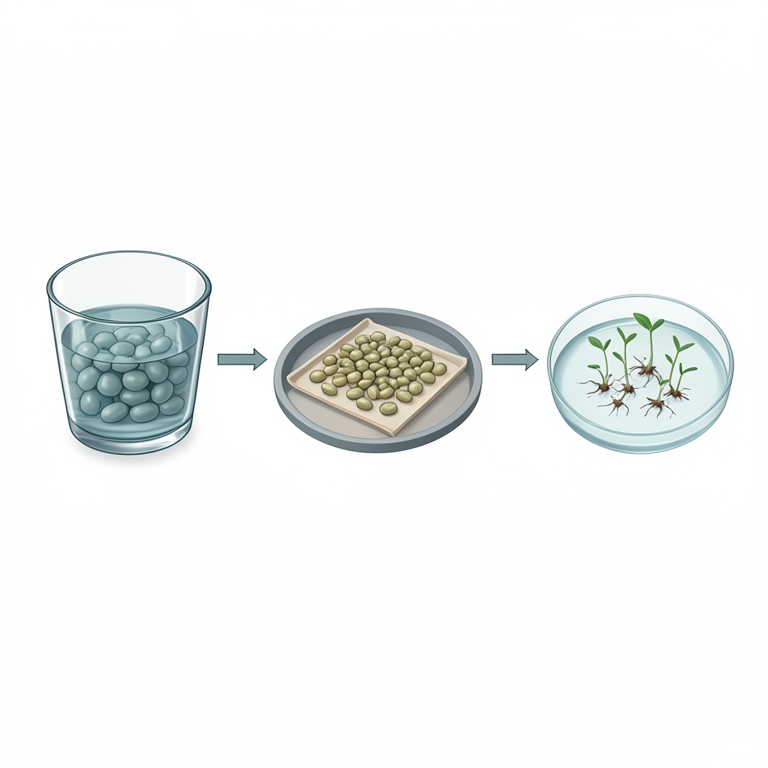
Seed Priming Workflow
AI-generated conceptual illustration (soybean seeds and seedlings). It explains the idea and does not show study data.
View source evidence ↗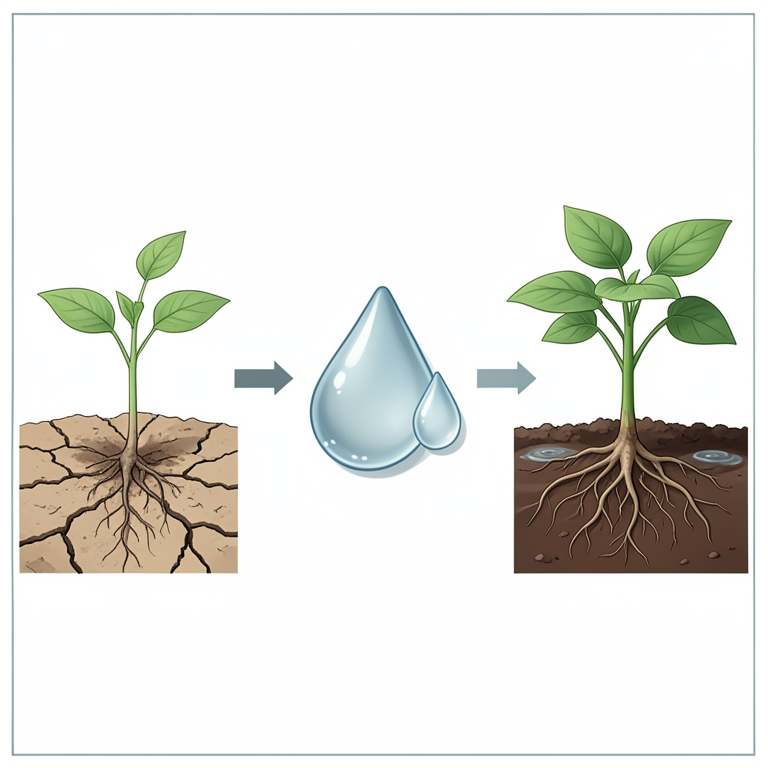
Synergistic Effect of Bio-stimulants
AI-generated conceptual illustration (soybean seedlings). It explains the idea and does not show study data.
View source evidence ↗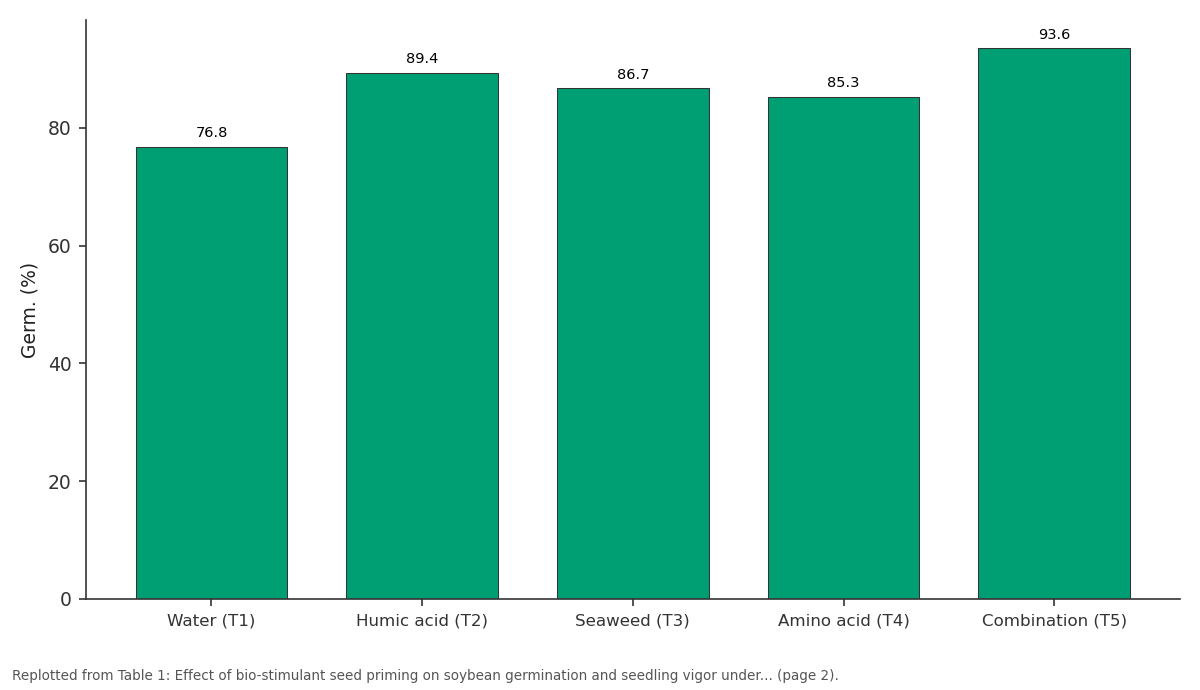
Germ. (%): Water (T1) vs Humic acid (T2) vs Seaweed (T3) vs Amino acid (T4) vs Combination (T5)
Replotted from Table 1 (page 2) of the original paper. Every bar is the paper's own table value.
View source evidence ↗Figures & tables
From the original paper Table 1
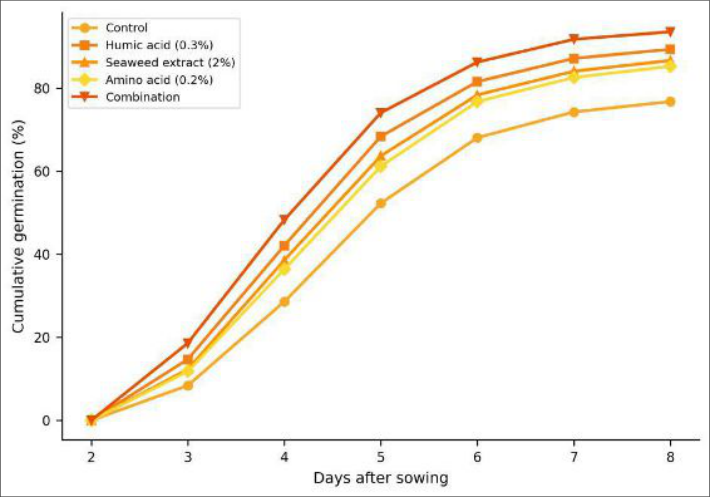 Figure 1
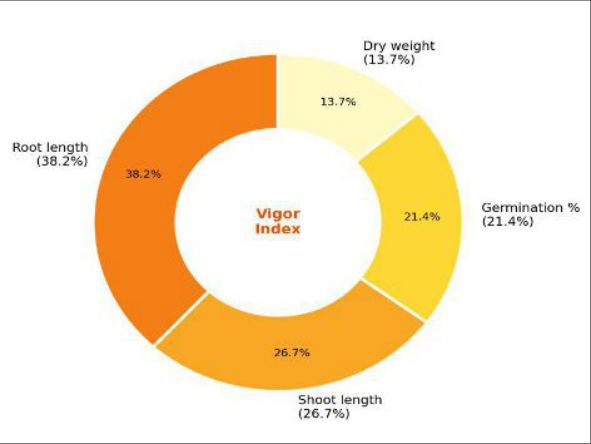 Figure 2
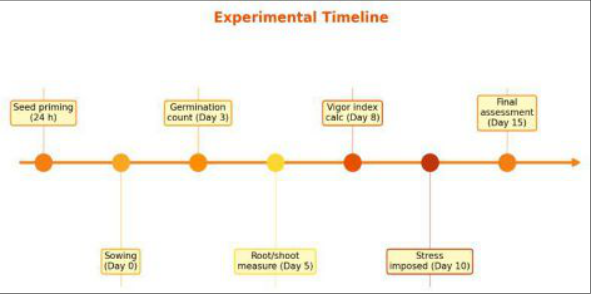 Figure 3
Introduction
Walk through any soybean field in eastern India during the first two weeks after sowing, and you'll notice patchy, uneven stands-a telltale sign that germination stress has already set the yield ceiling. Soybean (Glycine max L. Merrill) is particularly sensitive to soil moisture deficits during imbibition and radicle emergence, and even brief dry spells at this stage can cause irreversible membrane damage to the hydrating seed [1,2]. In West Bengal's new alluvial zone, where soybean area has expanded rapidly over the past decade, erratic earlymonsoon rainfall makes stand establishment a gamble each season [3] . Seed priming-controlled hydration followed by re-drying-is a well-established technique for improving germination speed and uniformity [4] . Bio-stimulant priming takes this further by delivering growth-promoting substances during the hydration phase. Humic acids improve root cell elongation and nutrient uptake [5] , seaweed extracts supply cytokinins and betaines that protect membranes under stress [6] , and amino acid complexes serve as metabolic precursors that accelerate protein synthesis in the germinating embryo [7] . Each product has shown positive effects in isolation, but whether combining them delivers synergistic benefits hasn't been tested in soybean. II = seedling dry weight × germination%. Relative stress tolerance was calculated as (value under stress / value under control) × 100.
Materials and Methods
Materials and Methods
Materials
Certified seeds of soybean cv. JS-335 (lot purity 98.4%, initial germination 86.2%) were obtained from the Pulse and Oilseed Research Station, Mohanpur. Bio-stimulants included commercial-grade potassium humate (Huminrich, 65% humic acid), a cold-processed Ascophyllum nodosum seaweed extract (Maxicrop Original), and a plant-derived Lamino acid complex (Amino Gold, 18% free amino acids). PEG-6000 (Merck) was used to prepare -0.4 MPa osmotic solutions following Michel and Kaufmann [9] . All laboratory work was conducted at the Seed Technology Laboratory, Department of Agronomy, BCKV, Mohanpur.
Methods
Seeds were surface-sterilized with 0.1% HgCl₂ (2 min), rinsed, and soaked in priming solutions for 6 hours at 25 °C: T 1 (water control), T 2 (humic acid 0.3%), T 3 (seaweed extract 2%), T 4 (amino acid 0.2%), T 5 (combination of T 2 +T 3 +T 4 After priming, seeds were shade-dried to original moisture content (~10%). Twenty-five seeds per replicate were placed on blotter paper in Petri dishes moistened with either distilled water (non-stress) or -0.4 MPa PEG-6000 (stress). Each treatment was replicated four times in a completely randomized design under controlled conditions (25±1 °C, 12 h light). Assessment was done per the protocol described above. Data were analyzed by twoway ANOVA (treatment × stress level) with DMRT at p ≤ 0.05 in SPSS v.26.
Cost of Bio-Stimulant Priming
The cost of bio-stimulant priming per kilogram of seed was calculated based on market prices of commercial products: humic acid ₹180 kg⁻¹ (at 0.3% = ₹0.54 per kg seed), seaweed extract ₹420 L⁻¹ (at 2% = ₹8.40 per kg seed), amino acid ₹650 L⁻¹ (at 0.2% = ₹1.30 per kg seed). The combination priming cost was ₹10.24 per kg seed, adding approximately ₹820 ha⁻¹ at the recommended 80 kg ha⁻¹ seeding rate-a marginal cost relative to the potential yield gain from improved stand establishment. The combination treatment (T 5 ) produced the highest values for all parameters under moisture stress (Table 1). Germination reached 93.6%-a 21.9% improvement over the water-primed control (76.8%). Vigor index I increased by 68.4%, driven primarily by root length gain (48.3%). All bio-stimulant treatments significantly outperformed the control (p < 0.05), with humic acid (T 2 ) being the best single-component treatment.
| Treatment | Germ. (%) | Root (cm) | Shoot (cm) | Dry wt (mg) | Vigor I | Vigor II |
|---|---|---|---|---|---|---|
| Water (T1) | 76.8 | 10.0 | 7.1 | 42.3 | 1362 | 3248 |
| Humic acid (T2) | 89.4 | 13.4 | 8.9 | 54.6 | 1994 | 4882 |
| Seaweed (T3) | 86.7 | 12.6 | 8.4 | 51.8 | 1822 | 4491 |
| Amino acid (T4) | 85.3 | 12.1 | 8.2 | 49.7 | 1732 | 4239 |
| Combination (T5) | 93.6 | 14.8 | 9.7 | 58.4 | 2294 | 5466 |
| CD (p=0.05) | 3.2 | 0.9 | 0.6 | 3.4 | 142 | 312 |
Table text extracted from the original PDF; superscript letters are shown inline. The original table image is below.
View original table image
Results
Results
Comprehensive Interpretation
The germination curves (Figure 1) show that bio-stimulant priming didn't just increase final germination-it accelerated the process. The combination treatment reached 50% germination by day 4 versus day 5 for the control. The donut chart (Figure 2) reveals that root length was the largest contributor to vigor (38.2%), followed by shoot length (26.7%), confirming that bio-stimulant effects were most pronounced on root development.
Discussion
The superior performance of the combination priming treatment is likely due to complementary modes of action: humic acid improves membrane permeability and root cell elongation [5] , seaweed extract provides osmoprotectants (betaines, proline precursors) that stabilize cellular structures under dehydration [6] , and amino acids supply ready-made metabolic building blocks that accelerate protein synthesis in the embryonic axis [7] . Together, these products appear to address multiple stress pathways simultaneously. The 48.3% root length improvement under stress is particularly relevant for field conditions, where deeper early roots can access residual subsoil moisture during dry spells. Root elongation has been identified as the single most responsive parameter to humic acid application in wheat and maize as well [5,10]. The germination speed advantage (one day earlier to 50%) may seem small in laboratory terms but translates to a meaningful head start under field conditions where the topsoil can dry rapidly. The cost analysis showed that combination priming adds only ₹820 ha⁻¹-less than 2% of total soybean production cost-making it highly cost-effective even if the yield benefit is modest. One limitation is that PEG-simulated stress doesn't perfectly replicate field drought, where temperature, light, and soil physical properties interact with moisture availability. Field validation trials across multiple soybean-growing regions would strengthen the recommendations.
Conclusion
Combination bio-stimulant seed priming with humic acid (0.3%) + seaweed extract (2%) + amino acid complex (0.2%) was the most effective treatment for improving soybean germination and seedling vigor under simulated moisture stress. The treatment increased germination by 21.9% and vigor index by 68.4% over the water-primed control. Humic acid alone was the best single-component option. Root length was the most responsive growth parameter. At ₹820 ha⁻¹, the priming cost is marginal relative to potential stand establishment benefits. These findings support the incorporation of multi-component biostimulant priming into soybean seed treatment protocols for drought-prone areas.
Acknowledgement
Acknowledgements Funding SourcesThis research was supported by the Department of Agronomy, Bidhan Chandra Krishi Viswavidyalaya, through the university's seed science research programme. Institutional SupportThe Seed Technology Laboratory at BCKV, Mohanpur, provided controlled environment facilities and analytical equipment.
Figures and tables from the paper
References
18 in the original paper- Heatherly LG, Elmore RW. Managing inputs for peak production. Soybeans: Improvement, Production, and Uses. 2004;ASA-CSSA-SSSA:451-536.
- Bewley JD, Bradford KJ, Hilhorst HWM, Nonogaki H. Seeds: physiology of development, germination and dormancy. Springer. 2013;3rd edition.
- Ghosh DC, Mondal SS. Effect of seed treatment and foliar spray of micronutrients on growth, yield and yield attributes of soybean. Indian Journal of Agronomy. 2006;51(3):233-235.
- Parera CA, Cantliffe DJ. Presowing seed priming. Horticultural Reviews. 1994;16:109-141.
- Canellas LP, Olivares FL, Okorokova-Facanha AL, Facanha AR. Humic acids isolated from earthworm compost enhance root elongation, lateral root emergence, and plasma membrane H+-ATPase activity in maize roots. Plant Physiology. 2002;130(4):19511957.
- Craigie JS. Seaweed extract stimuli in plant science and agriculture. Journal of Applied Phycology. 2011;23(3):371-393.
- Kowalczyk K, Zielony T. Effect of aminoplant and asahi on yield and quality of lettuce grown on rockwool. Conference on Biostimulators in Modern Agriculture. 2008;Warsaw:1-8.
- ISTA. International rules for seed testing. International Seed Testing Association. 2015;Bassersdorf, Switzerland.
- Michel BE, Kaufmann MR. The osmotic potential of polyethylene glycol 6000. Plant Physiology. 1973;51(5):914-916.
- Nardi S, Pizzeghello D, Muscolo A, Vianello A. Physiological effects of humic substances on higher plants. Soil Biology and Biochemistry. 2002;34(11):1527-1536.
- Jisha KC, Vijayakumari K, Puthur JT. Seed priming for abiotic stress tolerance: an overview. Acta Physiologiae Plantarum. 2013;35(5):1381-1396.
- Lutts S, Benincasa P, Wojtyla L, Kubala S, Pace R, Lechowska K. Seed priming: new comprehensive approaches for an old empirical technique. New Challenges in Seed Biology. 2016;InTech:1-46.
- Calvo P, Nelson L, Kloepper JW. Agricultural uses of plant biostimulants. Plant and Soil. 2014;383(1-2):3-41.
- Yakhin OI, Lubyanov AA, Yakhin IA, Brown PH. Biostimulants in plant science: a global perspective. Frontiers in Plant Science. 2017;7:2049.
- Battacharyya D, Babgohari MZ, Rathor P, Prithiviraj B. Seaweed extracts as biostimulants in horticulture. Scientia Horticulturae. 2015;196:39-48.
- Desoky ESM, Merwad ARM, Rady MM. Natural biostimulants improve saline soil characteristics and salt stressed sorghum performance. Communications in Soil Science and Plant Analysis. 2018;49(18):22412253.
- Basra SMA, Farooq M, Wahid A, Khan MB. Rice seed invigoration by hormonal and vitamin priming. Seed Science and Technology. 2006;34(3):753-758.
- Kaur S, Gupta AK, Kaur N. Seed priming increases crop yield possibly by modulating enzymes of sucrose metabolism in chickpea. Journal of Agronomy and Crop Science. 2005;191(2):81-87.