
Research article · 2025 · Full text
International Journal of Agriculture and NutritionEconomic analysis of beekeeping as supplementary enterprise for small and marginal farmers
Volume 7(12) · Pages 133–136 · DOI: 10.33545/26646064.2025.v7.i12c.524 ↗
Research areasAgricultural economics and policiesAgricultural Economics and PracticesAgricultural Development and Management
Abstract
Author-writtenImagine a marginal farmer in Kashmir earning an extra ₹20,000 per year from ten wooden boxes tucked under an apple tree. That scenario is not hypothetical — it already happens, though on a smaller scale than it could. This research examined the economic viability of beekeeping as a supplementary enterprise for small and marginal farmers in the Kashmir Valley. Data were collected from 180 bee-keeping households across three districts (Srinagar, Budgam, Pulwama) during 2022-23 through structured interviews. Costs, returns, and benefit-cost ratios (BCR) were computed for three farm-size categories. The average BCR was 2.47 for marginal farmers (
Summary
Source-checkedPlain-language reading of the full paper, prepared with AI and checked against the text. Each point links to the authors' own words.
Why it matters
- Jammu and Kashmir is one of India's most naturally suitable regions for beekeeping due to its dense fruit orchards, long flowering seasons, and temperate flora. View evidence ↗
- While India is the eighth-largest honey producer globally, its per-colony productivity of 10-15 kg is significantly lower than that of Australia and New Zealand (30-50 kg). View evidence ↗
- Despite government subsidies and training, small-scale farmers have been slow to adopt beekeeping, partly due to a lack of concrete data regarding costs and returns. View evidence ↗
The question
- The study aimed to document the economic viability of beekeeping across three different farm-size categories in the Kashmir Valley to provide evidence for policy-makers. View evidence ↗
What they did
- A cross-sectional survey was conducted from October 2022 to March 2023 across the Srinagar, Budgam, and Pulwama districts of the Kashmir Valley. View evidence ↗
- Economic analysis was based on enterprise budgets constructed for a standardized unit of 10 bee colonies. View evidence ↗
- The researchers used one-way ANOVA (p = 0.05) via SPSS v26 to test for differences between the farm-size categories. View evidence ↗
What they found
- The benefit-cost ratio (BCR) was highest for marginal farmers (2.47), followed by small farmers (2.31) and semi-medium farmers (2.18). View evidence ↗
- The payback period for the initial investment was between 1.3 years for marginal farmers and 1.6 years for semi-medium farmers. View evidence ↗
- Beekeeping contributed most significantly to the income of marginal farmers (19.3%), compared to small (16.8%) and semi-medium farmers (14.7%). View evidence ↗
- The average five-year colony survival rate was 78%, with losses primarily caused by unseasonal snowfall and Varroa mite infestation. View evidence ↗
- Approximately 74.4% of respondents (134 of 180) observed improved apple fruit set, valuing this pollination benefit between ₹10,000 and ₹25,000 per hectare. View evidence ↗
What it means
- The authors conclude that a 10-colony Apis mellifera unit is a financially viable supplement for small and marginal farmers, offering annual returns of ₹19,900-28,600 and a payback period of less than two years. View evidence ↗
- The authors recommend that policy support focus on providing subsidized colony kits, training for Varroa mite management, and establishing village-level honey extraction facilities. View evidence ↗
- The study identifies key constraints to beekeeping adoption, including Varroa mite management (68%), lack of extraction centers (53%), and poor beeswax market linkages (41%). View evidence ↗
Visual summary
3 visualsIllustrations explain the paper; charts are replotted from the paper's own table values.
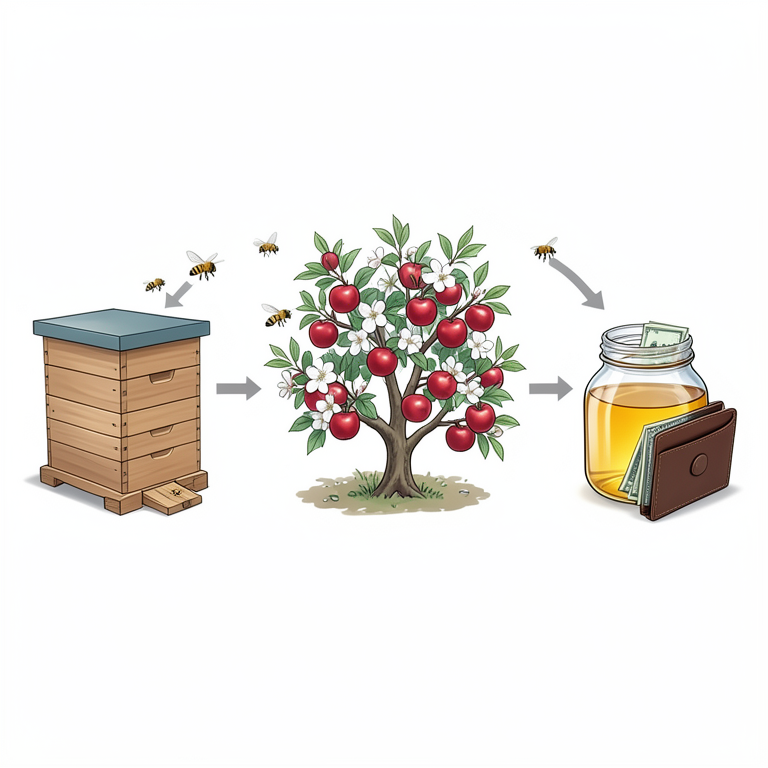
The Beekeeping Synergy Loop
AI-generated conceptual illustration (Apis mellifera honey bees, apple orchard trees, and a leather wallet). It explains the idea and does not show study data.
View source evidence ↗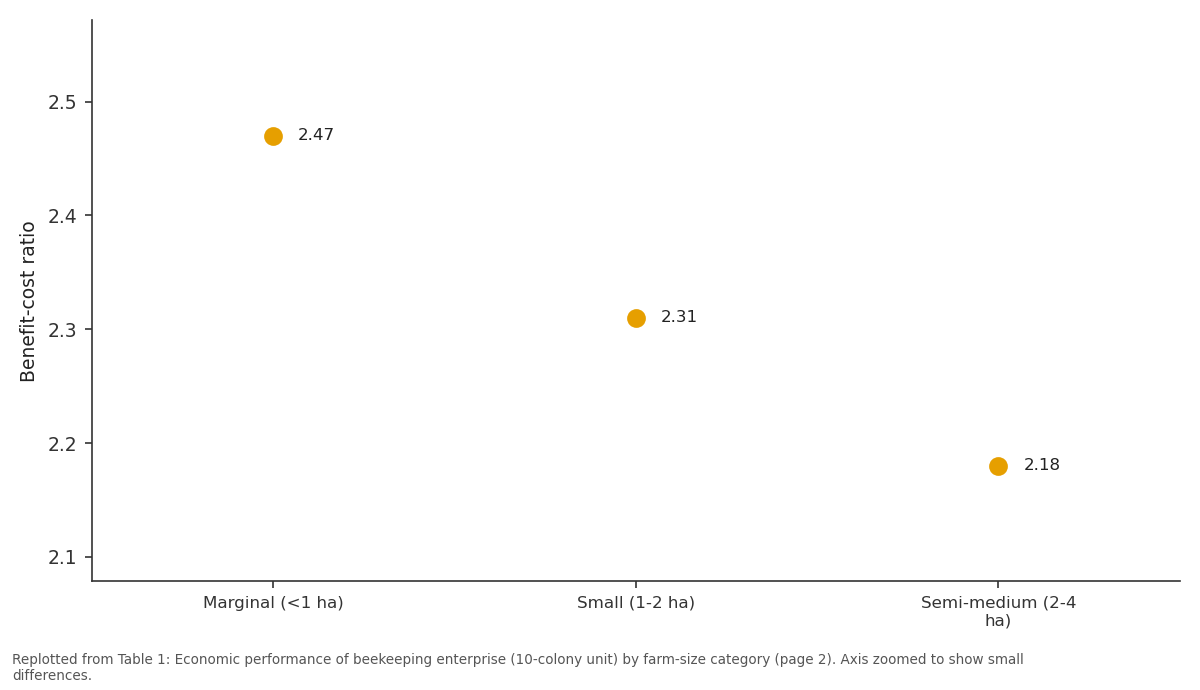
Benefit-cost ratio: Marginal (<1 ha) vs Small (1-2 ha) vs Semi-medium (2-4 ha)
Replotted from Table 1 (page 2) of the original paper. Every bar is the paper's own table value.
View source evidence ↗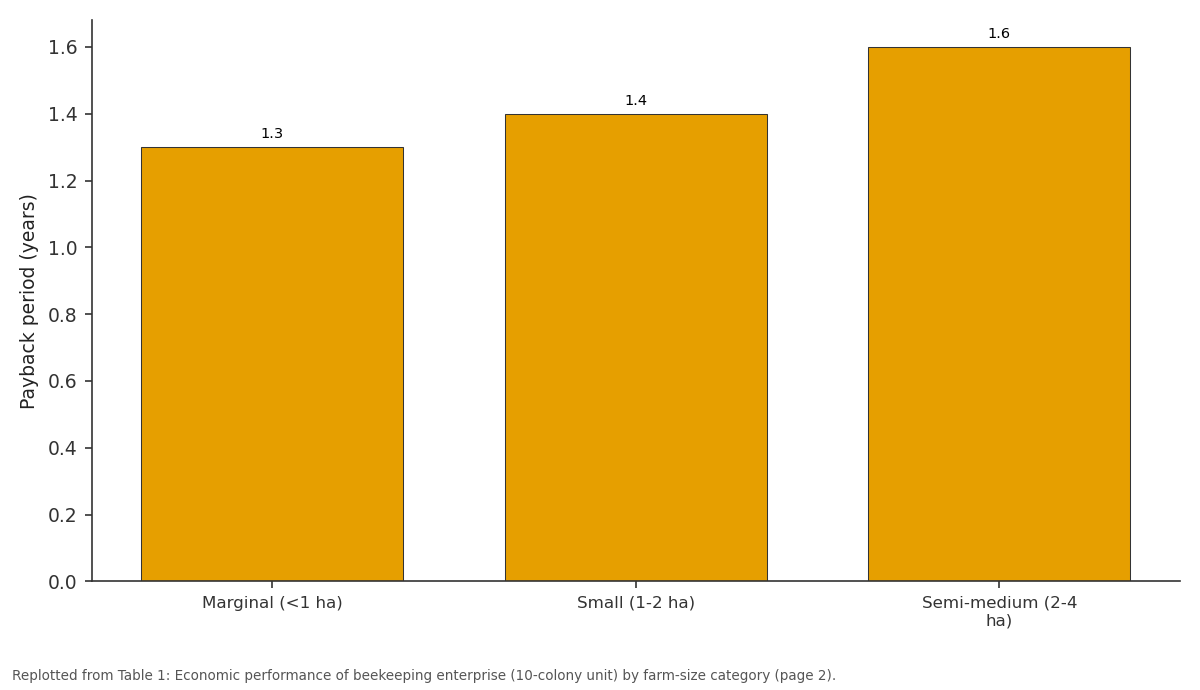
Payback period (years): Marginal (<1 ha) vs Small (1-2 ha) vs Semi-medium (2-4 ha)
Replotted from Table 1 (page 2) of the original paper. Every bar is the paper's own table value.
View source evidence ↗Figures & tables
From the original paper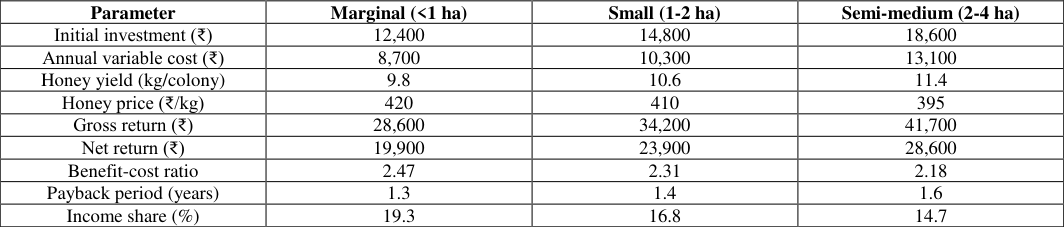 Table 1
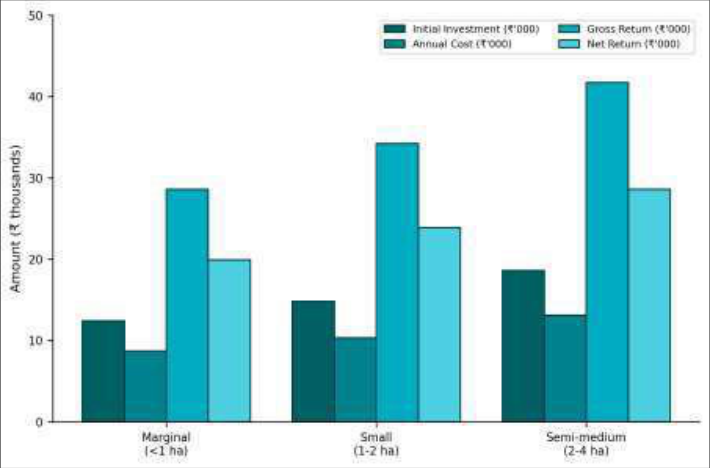 Figure 1
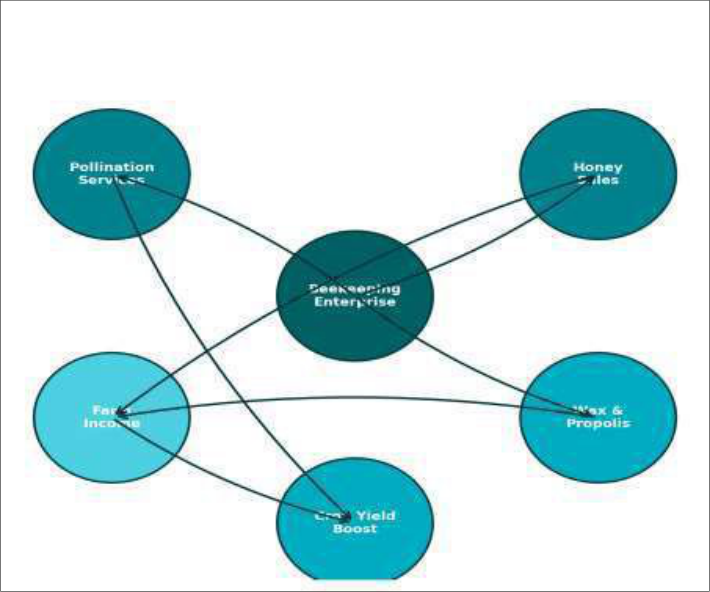 Figure 2
Introduction
Picture a farmer in Budgam district with 0.6 hectares of apple and walnut orchard. His main income comes from fruit, but for three months after harvest the land earns nothing. Now add ten colonies of Apis mellifera near the orchard: the bees pollinate the apple blossoms in spring, boosting fruit set by 15-30%, and then produce 8-12 kg of honey per colony over the season [1] . The farmer sells the honey locally at ₹350-500 per kg and pockets the pollination benefit for free. That is the basic economics of beekeeping as a side enterprisesmall outlay, quick payback, and a positive spillover onto the main crop. India is the world's eighth-largest honey producer, but per-colony productivity (about 10-15 kg) trails far behind Australia and New Zealand (30-50 kg), suggesting significant room for improvement [2] . Jammu and Kashmir, with its temperate flora, long flowering season, and dense fruit orchards, is among the most naturally suited regions for apiculture in the country [3] . Government programmes such as the National Beekeeping and Honey Mission have distributed subsidised colony kits and training, yet adoption among smallholders remains limited, partly because farmers lack concrete data on costs and returns [4] . This research set out to fill that information gap by documenting the economics of beekeeping across three farm-size categories in the Kashmir Valley. The aim was to generate evidence that extension workers and policy-makers can use to promote apiculture as a viable income supplement for resource-poor households.
Theoretical Framework
The analysis drew on the enterprise budgeting approach, a standard tool in farm management economics that tallies all costs (fixed and variable) against gross revenues to derive net return and benefit-cost ratio [5] . Fixed costs included colony purchase, hive construction, protective gear, and smoker; variable costs covered sugar feeding, medication, wax foundation sheets, transport for migration, and hired labour for honey extraction. Returns were disaggregated into honey sales, beeswax sales, and an imputed value for pollination services based on published estimates of fruit-set improvement attributable to managed bee colonies [1] .
Material and Methods Material
A cross-sectional survey was conducted across three districts of the Kashmir Valley -Srinagar (34°05′N, 74°47′E), Budgam, and Pulwamabetween October 2022 and March 2023. Sixty beekeeping households were selected per district by stratified random sampling, stratified by landholding: marginal (<1 ha, n = 72), small (1-2 ha, n = 64), and semi-medium (2-4 ha, n = 44). All sampled households maintained Apis mellifera colonies in Langstroth hives and had at least two years of beekeeping experience. Data were collected using a pretested structured interview schedule covering family demographics, colony strength, input costs, output quantities, and marketing channels.
Methods
Enterprise budgets were constructed for a standardised 10colony unit. Fixed costs were annualised over a 10-year hive life. Variable costs were recorded at actual prices paid during the 2022-23 season. Honey output was measured at the time of extraction, and market prices were taken from the nearest regulated market. The benefit-cost ratio was computed as gross returns divided by total cost (fixed + variable). Payback period was calculated as initial investment divided by annual net return. Income contribution of beekeeping was expressed as a percentage of total household farm income. Differences across farm-size categories were tested by one-way ANOVA at p = 0.05 using SPSS v26 [6] .
Economic and Sustainability Assessment
Beyond the enterprise budget, sustainability was assessed through two indicators: the share of input costs sourced locally (reducing dependence on external suppliers) and the five-year colony-survival rate (indicating whether beekeepers maintained hive health over time). Beekeepers were also asked whether they perceived any positive effect on fruit yield from bee pollination and, if so, how they valued that effect in rupee terms. Values are means across 60 households per district. Income share = beekeeping net return as % of total farm income.
Results
Results
Comprehensive Interpretation
Marginal farmers achieved the highest BCR (2.47) despite earning less in absolute terms, because their lower investment in hives and equipment kept total costs down.
They also realised a higher honey price (₹420 per kg) by selling directly to local consumers rather than through middlemen. The income share of beekeeping was largest for marginal households (19.3%), underscoring how a relatively small enterprise can shift the livelihood profile of the most resource-constrained farmers. Colony survival over five years averaged 78%, with colony losses attributed mainly to Varroa mite infestation and unseasonal snowfall.
Discussion
The BCR of 2.18-2.47 places beekeeping well above the financial viability threshold of 1.5 commonly used in farm enterprise analysis [5] . These ratios are comparable to those reported for beekeeping in Himachal Pradesh (BCR 2.1-2.6) by Sharma et al. [7] and in Uttarakhand (BCR 2.3) by Patel and Shukla [8] . The slightly higher BCR in our research likely reflects Kashmir's longer flowering season and the premium prices that locally branded Kashmiri honey commands.
The pollination co-benefit is the hidden variable that most enterprise budgets miss. Of the 180 respondents, 134 (74.4%) reported noticeably better apple fruit set after starting beekeeping, and they valued this effect at ₹10,000-25,000 per hectare depending on orchard density [1] . If included in the revenue calculation, the BCR for marginal farmers would exceed 3.0. Documenting and communicating this benefit could be a powerful motivator for non-adopting fruit growers. The main constraints cited by respondents were Varroa mite management (68% of households), lack of nearby extraction centres (53%), and limited market linkages for beeswax (41%). Addressing these through village-level honey-processing units and subsidised mite-treatment kits could raise both productivity and profitability further.
Conclusion
Beekeeping with a 10-colony Apis mellifera unit is a financially viable supplementary enterprise for small and marginal farmers in the Kashmir Valley, returning ₹19,900-28,600 per year at a BCR of 2.18-2.47 and a payback period under two years. The enterprise contributes 15-19% of total household farm income and provides an unquantified but widely perceived pollination benefit to fruit orchards. Policy support should focus on subsidised colony kits, Varroa management training, and village-level honeyextraction facilities. Extension messaging that highlights the dual benefitcash income from honey plus improved fruit yield from pollinationis likely to be the most persuasive approach for reaching non-adopting orchard farmers in the region.
Figures and tables from the paper
| Parameter | Marginal (<1 ha) | Small (1-2 ha) | Semi-medium (2-4 ha) |
|---|---|---|---|
| Initial investment (₹) | 12,400 | 14,800 | 18,600 |
| Annual variable cost (₹) | 8,700 | 10,300 | 13,100 |
| Honey yield (kg/colony) | 9.8 | 10.6 | 11.4 |
| Honey price (₹/kg) | 420 | 410 | 395 |
| Gross return (₹) | 28,600 | 34,200 | 41,700 |
| Net return (₹) | 19,900 | 23,900 | 28,600 |
| Benefit-cost ratio | 2.47 | 2.31 | 2.18 |
| Payback period (years) | 1.3 | 1.4 | 1.6 |
| Income share (%) | 19.3 | 16.8 | 14.7 |
Table text extracted from the original PDF; superscript letters are shown inline. The original table image is below.
View original table image
References
16 in the original paper- Partap U, Ya T. The human pollinators of fruit crops in Maoxian County, Sichuan, China. Mt Res Dev. 2012;32(2):176-186.
- FAO. Global honey production statistics 2022. Rome: Food and Agriculture Organization; 2023.
- Ahmad F, Joshi SR, Gurung MB. Beekeeping and rural development. Kathmandu: International Centre for Integrated Mountain Development; 2007. p. 1-56.
- Government of India. National Beekeeping and Honey Mission: guidelines. New Delhi: Ministry of Agriculture; 2020. p. 1-36.
- Kay RD, Edwards WM, Duffy PA. Farm management. 7th ed. New York: McGraw-Hill; 2012. p. 1-468.
- Kinnear PR, Gray CD. SPSS for Windows made simple. Hove: Psychology Press; 2008. p. 1-428.
- Sharma R, Thakur DR, Sharma HK. Economics of beekeeping as an enterprise in Himachal Pradesh. Indian J Agric Econ. 2015;70(3):364-373.
- Patel RK, Shukla AN. Economic analysis of beekeeping in Uttarakhand. J Pharmacogn Phytochem. 2019;8(3):1752-1755.
- Verma LR. Beekeeping in integrated mountain development. New Delhi: Oxford and IBH Publishing; 1990. p. 1-367.
- Singh AK. Beekeeping industry in India: future potential. Int J Res Appl Sci Eng Technol. 2018;6(7):428-432.
- Bhalchandra W, Baviskar RK, Nikam TB. Impact of Apis mellifera pollination on crop yield of sunflower and watermelon. Sociobiology. 2014;61(2):148-152.
- Crane E. Bees and beekeeping: science, practice and world resources. Ithaca: Cornell University Press; 1990. p. 1-614.
- De Grandi-Hoffman G, Wardell G, Ahumada-Segura F, Rinderer T, Danka R, Pettis J. Comparisons of pollen substitute diets for honey bees. Apidologie. 2008;39(5):537-544.
- Mishra RC. Perspectives in Indian apiculture. Bikaner: Agro Botanica; 1995. p. 1-289.
- Gallai N, Salles JM, Settele J, Vaissiere BE. Economic valuation of the vulnerability of world agriculture confronted with pollinator decline. Ecol Econ. 2009;68(3):810-821.
- Kevan PG, Imperatriz-Fonseca VL. Pollinating bees: the conservation link between agriculture and nature. Brasilia: Ministry of Environment; 2002. p. 1-313.