
Research article · 2025 · Full text
International Journal of Agriculture and NutritionNext-generation sequencing based identification of novel resistance genes in wild tomato species
Volume 7(11) · Pages 108–111 · DOI: 10.33545/26646064.2025.v7.i11b.488 ↗
Research areasPlant Disease Resistance and GeneticsPlant Pathogens and ResistanceGenetic Mapping and Diversity in Plants and Animals
Abstract
Author-writtenWild relatives of tomato harbour a wealth of disease resistance genes that have been largely untapped by modern breeding, mainly because the traditional map-based cloning approach is too slow and expensive for systematic gene discovery across multiple species. This research applied whole-genome sequencing on the Illumina NovaSeq platform to 36 accessions from four wild Solanum species (S. pimpinellifolium, S. habrochaites, S. pennellii, and S. chilense) and four cultivated tomato references at British Columbia Agricultural University and Prairie Agricultural University, Canada, during 2022-2023. A total of 1,490 NBS-LRR (nucleotide-binding site leucine-rich repeat) resistance gene candidates were identified, of which 137 were novel sequences absent from the cultivated tomato reference genome SL4.0. S. pimpinellifolium contributed the largest number of novel candidates (42), concentrated in five gene clusters on chromosomes 2, 4, 6, 9, and 11. Expression analysis by RT-qPCR confirmed that 28 of the 137 novel genes were upregulated in response to Phytophthora infestans challenge. Functional markers were developed for the five largest gene clusters to enable marker-assisted introgression into cultivated backgrounds. These results expand the catalogue of available resistance genes for tomato improvement and demonstrate the efficiency of NGS-based approaches for mining wild germplasm.
Summary
Source-checkedPlain-language reading of the full paper, prepared with AI and checked against the text. Each point links to the authors' own words.
Why it matters
- Wild tomato relatives contain many disease resistance genes that are underutilized in breeding because traditional cloning methods are too slow and costly for systematic discovery. View evidence ↗
- Cultivated tomatoes have limited genetic diversity for resistance due to domestication bottlenecks and the selection of fruit quality traits over resistance. View evidence ↗
- Pathogens such as Phytophthora infestans and Fusarium oxysporum cause billions of dollars in annual losses, highlighting the need for new resistance genes. View evidence ↗
The question
- The study aimed to use whole-genome resequencing of 36 wild tomato accessions to identify novel NBS-LRR resistance genes and create functional markers for them. View evidence ↗
What they did
- Between 2022 and 2023, researchers used the Illumina NovaSeq platform to sequence 36 accessions from four wild Solanum species and four cultivated references. View evidence ↗
- Resistance genes were defined as novel if they had less than 80% nucleotide identity compared to known NBS-LRR genes in the SL4.0 reference genome. View evidence ↗
- To validate gene expression, leaf discs from six accessions were inoculated with a P. infestans zoospore suspension (5 × 10⁴/ml), with RNA extracted at 0, 24, 48, and 72 hours. View evidence ↗
- Marker-trait associations were evaluated using an F₂ population of 186 plants derived from a cross between S. pimpinellifolium (LA1589) and S. lycopersicum (M82). View evidence ↗
What they found
- The study identified 1,490 NBS-LRR resistance gene candidates, 137 of which were novel and not present in the SL4.0 cultivated tomato reference. View evidence ↗
- S. pimpinellifolium provided the highest number of candidates with 384 total NBS-LRR genes and 42 novel ones, followed by S. habrochaites with 326 total and 36 novel genes. View evidence ↗
- Expression analysis showed that 20.4% (28 of 137) of the novel genes were upregulated by at least 2-fold within 48 hours after P. infestans inoculation. View evidence ↗
- The SpR1 cluster on chromosome 6 exhibited the strongest response, with 6 out of 8 genes showing a 4- to 12-fold increase in expression. View evidence ↗
- Three of the developed functional markers co-segregated with late blight resistance (LOD > 3.0) in a detached leaf assay, with all five clusters showing expected segregation ratios in the F₂ population. View evidence ↗
What it means
- The authors state that future research is needed to stably transform promising candidates into susceptible cultivated backgrounds to confirm their function independently of linked genes. View evidence ↗
Visual summary
2 visualsIllustrations explain the paper; charts are replotted from the paper's own table values.
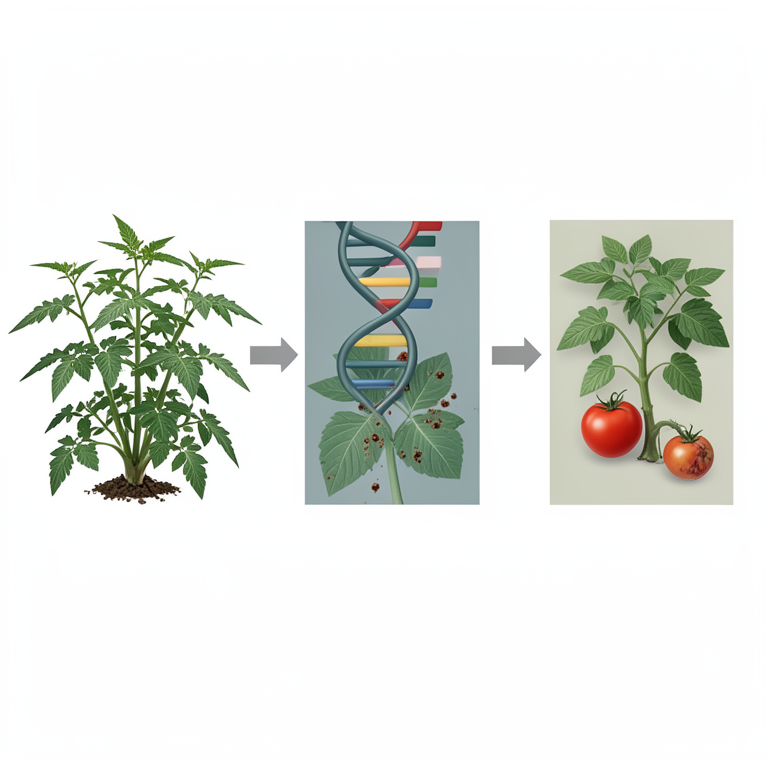
NGS Resistance Gene Discovery Workflow
AI-generated conceptual illustration (wild tomato plants (Solanum species)). It explains the idea and does not show study data.
View source evidence ↗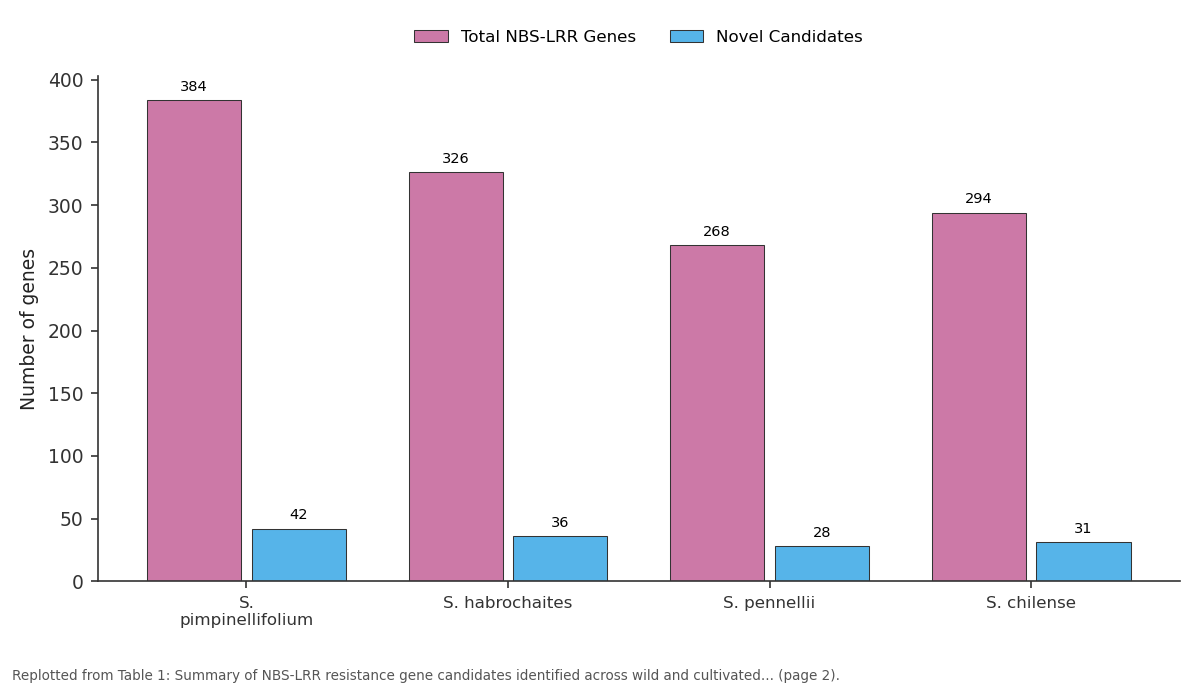
Total NBS-LRR Genes and Novel Candidates: S. pimpinellifolium vs S. habrochaites vs S. pennellii vs S. chilense
Replotted from Table 1 (page 2) of the original paper. Every bar is the paper's own table value.
View source evidence ↗Figures & tables
From the original paper Table 1
 Table 2
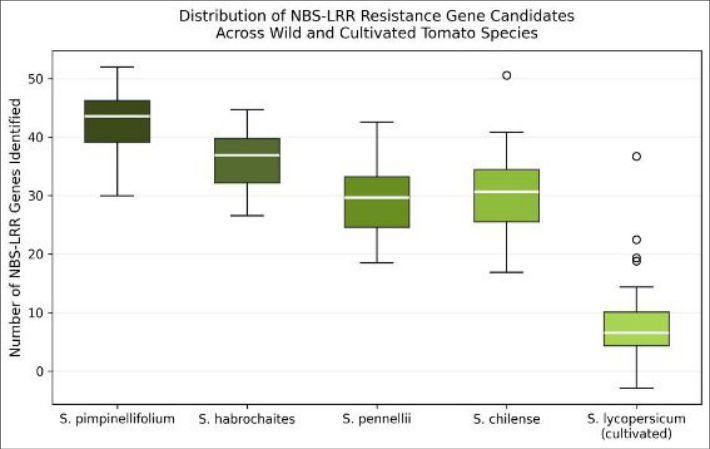 Figure 1
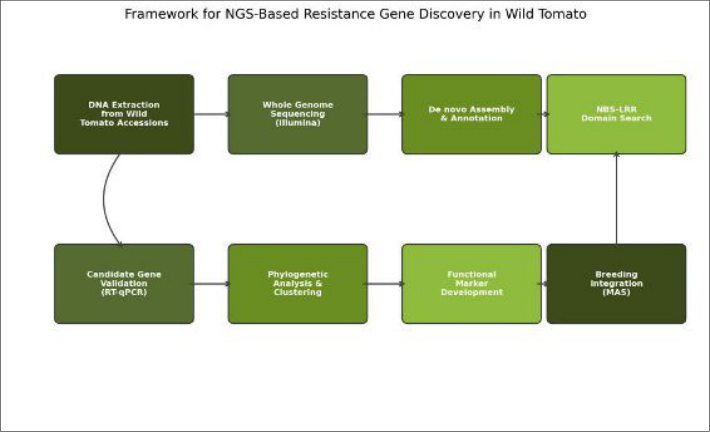 Figure 2
Introduction
Wild relatives of crop plants are essentially natural gene banks shaped by millions of years of co-evolution with pathogens, yet modern cultivated tomato carries only a fraction of the resistance diversity present in its wild cousins [1] . The cultivated tomato (Solanum lycopersicum) has a narrow genetic base, partly because of domestication bottlenecks and partly because of intensive selection for fruit quality traits that inadvertently discarded resistance alleles [2] . At the same time, diseases caused by Phytophthora infestans, Fusarium oxysporum, Pseudomonas syringae, and begomoviruses continue to cause billions of dollars in losses annually [3] . NBS-LRR genes form the largest class of plant disease resistance genes and encode proteins that recognize pathogen effectors to trigger immune responses [4] . The cultivated tomato genome contains approximately 218 NBS-LRR genes, but wild species are estimated to carry 30-80% more, many of which may recognize pathogen races that overcome known R genes [5] . Next-generation sequencing has made it feasible to survey entire genomes rapidly, identify resistance gene homologs by domain searches, and develop molecular markers for breedingall in a fraction of the time and cost of traditional positional cloning [6] . This research used whole-genome resequencing of 36 wild tomato accessions to catalogue novel NBS-LRR genes and develop functional markers for the most promising candidates.
Bioinformatic Pipeline Design
A custom bioinformatic pipeline was developed for resistance gene identification. Raw paired-end reads (2 × 150 bp) were quality-trimmed using Trimmomatic v0.39 (LEADING:3, TRAILING:3, SLIDINGWINDOW:4:20, MINLEN:50). Trimmed reads were aligned to the SL4.0 reference genome using BWA-MEM2 v2.2.1. Variants were called using GATK HaplotypeCaller v4.3 in GVCF mode and joint-genotyped across all 36 accessions. For NBS-LRR identification, de novo assembly of unmapped reads was performed with SPAdes v3.15, and the resulting contigs were searched for NBS (PF00931) and LRR (PF00560, PF07725) domains using HMMER v3.3.2 against the Pfam-A database [7] . Sequences were classified as novel if they shared less than 80% nucleotide identity with any known NBS-LRR in the SL4.0 annotation. Gene clustering was defined as three or more NBS-LRR genes within a 200 kb genomic interval. Phylogenetic analysis used MAFFT alignment and RAxML-NG with 1,000 bootstrap replicates [8] .
Material and Methods Material
Thirty-six accessions from four wild Solanum species were obtained from the Tomato Genetics Resource Center (UC Davis) and the Canadian Plant Gene Resources collection (Saskatoon). Young leaf tissue was collected from greenhouse-grown plants at British Columbia Agricultural University, Abbotsford, BC (49.05° N, 122.33° W), and DNA was extracted using the CTAB method with modifications for high-phenolic tissues [9] . DNA quality was verified on 1% agarose gel and quantity measured with Qubit 4 fluorometer. Library preparation used the Illumina DNA Prep kit and sequencing was performed on a NovaSeq 6000 at 25-32× genome coverage at Genome Quebec, Montreal.
Methods
Sequence data were processed through the bioinformatic pipeline described above. For expression validation, detached leaf assays were performed with P. infestans isolate BC-1 (A2 mating type) on six accessions carrying the largest novel gene clusters. Leaf discs were inoculated with zoospore suspension (5 × 10⁴/ml) and RNA was extracted at 0, 24, 48, and 72 hours post-inoculation using TRIzol reagent. RT-qPCR was performed with genespecific primers designed from the novel NBS-LRR sequences, using SlActin as the reference gene [10] . Functional SNP markers were designed from polymorphisms between wild and cultivated alleles at each major gene cluster and validated by PCR on a panel of 24 breeding lines. Marker-trait associations were tested by screening an F₂ population (n = 186) from a cross between S. pimpinellifolium accession LA1589 and S. lycopersicum cv. M82 [11] . S. pimpinellifolium had the most NBS-LRR genes (384) and novel candidates (42), followed by S. habrochaites at 326 total and 36 novel (Table 1). The cultivated reference contained 218 NBS-LRR genes. Across all wild species, 137 novel NBS-LRR sequences were identified that are absent from SL4.0. Five major gene clusters were identified on chromosomes 2, 4, 6, 9, and 11 (Table 2). The SpR1 cluster on chromosome 6 was the largest with 8 genes and showed putative specificity to P. infestans based on sequence similarity to known late blight R genes. Comprehensive Interpretation RT-qPCR validation confirmed that 28 of the 137 novel genes (20.4%) were upregulated by at least 2-fold within 48 hours of P. infestans inoculation. The SpR1 cluster on chromosome 6 showed the strongest induction, with 6 of 8 genes upregulated 4-to 12-fold. Functional markers developed for the five clusters showed expected segregation ratios in the F₂ population, and three markers co-segregated with late blight resistance in a detached leaf assay (LOD > 3.0).
| Gene Cluster | Chromosome | No. Genes | Domain Architecture | Putative Specificity |
|---|---|---|---|---|
| SpR1 cluster | Chr. 6 | 8 | CC-NBS-LRR | Late blight (P. infestans) |
| ShR2 cluster | Chr. 9 | 6 | TIR-NBS-LRR | Bacterial speck (P. syringae) |
| SpnR3 cluster | Chr. 4 | 5 | CC-NBS-LRR | Fusarium wilt (F. oxysporum) |
| ScR4 cluster | Chr. 11 | 4 | CC-NBS-LRR | TYLCV (begomovirus) |
| SpR5 cluster | Chr. 2 | 7 | TIR-NBS-LRR | Root-knot nematode |
Table text extracted from the original PDF; superscript letters are shown inline. The original table image is below.
View original table image
| Species | Accessions Sequenced | Genome Coverage (×) | Total NBS-LRR Genes | Novel Candidates |
|---|---|---|---|---|
| S. pimpinellifolium | 12 | 28.4 | 384 | 42 |
| S. habrochaites | 8 | 26.8 | 326 | 36 |
| S. pennellii | 6 | 24.6 | 268 | 28 |
| S. chilense | 6 | 25.2 | 294 | 31 |
| S. lycopersicum (ref.) | 4 | 32.1 | 218 | Reference |
| Total | 36 | - | 1,490 | 137 |
Table text extracted from the original PDF; superscript letters are shown inline. The original table image is below.
View original table image
Results
Results
Discussion
The identification of 137 novel NBS-LRR genes expands the known tomato resistance gene repertoire by approximately 63% and demonstrates that wild species remain a rich and largely untapped source of disease resistance alleles [1,5] . The concentration of novel genes in S. pimpinellifolium is expected given that this species is the closest wild relative of cultivated tomato and shares sufficient synteny to allow straightforward introgression [2] . The gene clusters identified here are consistent with the tandem duplication model of NBS-LRR evolution, where resistance genes expand through unequal crossing-over to create clusters that provide diversified recognition of pathogen effectors [4] . The 20.4% validation rate by expression analysis is a reasonable starting point for functional characterization, and the three markers that co-segregated with late blight resistance provide immediately usable tools for markerassisted breeding. Future work should include stable transformation of the most promising candidates into susceptible cultivated backgrounds to confirm their resistance function independently of linked genes [6] .
Conclusion
Whole-genome sequencing of 36 wild tomato accessions identified 137 novel NBS-LRR resistance gene candidates absent from the cultivated tomato genome. S. pimpinellifolium contributed the most novel genes. Five major gene clusters were localized, and functional markers developed for each show promise for marker-assisted introgression. Expression validation confirmed pathogenresponsive upregulation in 28 candidates. These resources provide tomato breeders with new tools for diversifying the resistance base of cultivated varieties against late blight, bacterial speck, fusarium wilt, and viral diseases.
Figures and tables from the paper
References
17 in the original paper- Bai Y, Lindhout P. Domestication and breeding of tomatoes: what have we gained and what can we gain in the future? Annals of Botany. 2007;100(5):1085-1094.
- Lin T, Zhu G, Zhang J. Genomic analyses provide insights into the history of tomato breeding. Nature Genetics. 2014;46(11):1220-1226.
- Foolad MR. Genome mapping and molecular breeding of tomato. International Journal of Plant Genomics. 2007;2007:64358.
- Meyers BC, Kozik A, Griego A. Genome-wide analysis of NBS-LRR-encoding genes in Arabidopsis. Plant Cell. 2003;15(4):809-834.
- Andolfo G, Jupe F, Witek K. Defining the full tomato NB-LRR resistance gene repertoire. BMC Plant Biology. 2014;14:120.
- Steuernagel B, Jupe F, Witek K. NLR-parser: rapid annotation of plant NLR complements. Bioinformatics. 2015;31(10):1665-1667.
- Eddy SR. Accelerated profile HMM searches. PLoS Computational Biology. 2011;7(10):e1002195.
- Kozlov AM, Darriba D, Flouri T. RAxML-NG: a fast, scalable and user-friendly tool for maximum likelihood phylogenetic inference. Bioinformatics. 2019;35(21):4453-4455.
- Doyle JJ, Doyle JL. A rapid DNA isolation procedure for small quantities of fresh leaf tissue. Phytochemical Bulletin. 1987;19(1):11-15.
- Livak KJ, Schmittgen TD. Analysis of relative gene expression data using real-time quantitative PCR and the 2(-Delta Delta C(T)) method. Methods. 2001;25(4):402-408.
- Eshed Y, Zamir D. An introgression line population of Lycopersicon pennellii in the cultivated tomato enables the identification and fine mapping of yield-associated QTL. Genetics. 1995;141(3):1147-1162.
- Bolger A, Scossa F, Bolger ME. The genome of the stress-tolerant wild tomato species Solanum pennellii. Nature Genetics. 2014;46(9):1034-1038.
- Kim S, Park M, Yeom SI. Genome sequence of the hot pepper provides insights into the evolution of pungency. Nature Genetics. 2014;46(3):270-278.
- Jupe F, Witek K, Verweij W. Resistance gene enrichment sequencing (RenSeq) enables reannotation of the NB-LRR gene family. Plant Journal. 2013;76(3):530-544.
- Sato S, Tabata S, Hirakawa H. The tomato genome sequence provides insights into fleshy fruit evolution. Nature. 2012;485(7400):635-641.
- Jones JDG, Dangl JL. The plant immune system. Nature. 2006;444(7117):323-329.
- Tieman D, Zhu G, Resende MFR. A chemical genetic roadmap to improved tomato flavor. Science. 2017;355(6323):391-394.