
Research article · 2025 · Full text
International Journal of Agriculture and NutritionCRISPR-Cas9 mediated genome editing for developing herbicide-tolerant rice lines
Volume 7(5) · Pages 79–82 · DOI: 10.33545/26646064.2025.v7.i5b.550 ↗
Research areasCRISPR and Genetic EngineeringGenetically Modified Organisms ResearchWeed Control and Herbicide Applications
Abstract
Author-writtenCRISPR-Cas9 is a programmable nuclease system that enables precise, targeted modifications in plant genomes without introducing foreign DNA into the final product. This research applied CRISPR-Cas9 to edit three herbicide-target genes—ALS, ACCase, and EPSPS—in indica rice (cv. Pusa Basmati 1) to develop lines tolerant to imazethapyr, quizalofop, and glyphosate, respectively. Four sgRNA constructs were designed, cloned into pCas9 vectors, and delivered via Agrobacterium-mediated transformation at the Chandra Shekhar Azad University of Agriculture, Kanpur, India, during 2021–23. Regeneration efficiency ranged from 26.4% (pCas9-EPSPS) to 34.2% (pCas9-ALS1). Among 186 T0 plants screened, 47 carried confirmed edits at the target loci. T1 segregation analysis identified 12 homozygous edited lines. Herbicide tolerance assays in T1 showed that edited line CR-15 (ALS double mutant) tolerated imazethapyr at 4× the field rate without visible injury, scoring 4.8 on a 5-point tolerance scale versus 1.8 for the wild type. No off-target mutations were detected at the top five predicted sites. Agronomic performance of the best edited lines was statistically equivalent to the parent variety. These results demonstrate that CRISPR-based point mutations in herbicide-target genes can produce non-transgenic, herbicide-tolerant rice suitable for direct-seeded cultivation systems.
Summary
Source-checkedPlain-language reading of the full paper, prepared with AI and checked against the text. Each point links to the authors' own words.
Why it matters
- Direct-seeded rice (DSR) is becoming more common in South and Southeast Asia because it saves labor and water, but its success is hindered by weed competition and the crop's own sensitivity to herbicides. View evidence ↗
- Existing herbicide-tolerant rice varieties, such as Clearfield®, are limited to japonica backgrounds, making them unavailable for indica-growing areas like the Indo-Gangetic plains. View evidence ↗
- CRISPR-Cas9 allows for the creation of non-transgenic herbicide-tolerant indica rice by introducing point mutations in specific genes, which may simplify regulatory approval compared to GMOs. View evidence ↗
The question
- The study aimed to create herbicide-tolerant Pusa Basmati 1 rice by editing three target genes, testing the tolerance of homozygous T1 lines at various doses, and checking for off-target mutations. View evidence ↗
What they did
- The researchers targeted the ALS, ACCase, and EPSPS genes in Pusa Basmati 1 rice to induce tolerance to imazethapyr, quizalofop, and glyphosate. View evidence ↗
- Twelve homozygous T1 lines, wild-type rice, and a Clearfield check were tested in pots; tolerance was scored on a 1–5 scale 14 days after spraying herbicides at the 3–4 leaf stage. View evidence ↗
What they found
- The efficiency of plant regeneration from callus varied by construct, ranging from 26.4% for pCas9-EPSPS to 34.2% for pCas9-ALS1. View evidence ↗
- The efficiency of genome editing at the target loci was found to be between 30.3% and 44.4%. View evidence ↗
- Out of 186 T0 plants screened, 47 had confirmed edits, and subsequent analysis of the T1 generation identified 12 homozygous edited lines. View evidence ↗
- No off-target mutations were found at the five most likely predicted sites. View evidence ↗
- The best edited lines showed agronomic performance that was statistically the same as the original parent variety. View evidence ↗
What it means
- The authors conclude that CRISPR-based point mutations can create non-transgenic, herbicide-tolerant rice suitable for use in direct-seeded cultivation. View evidence ↗
Visual summary
3 visualsIllustrations explain the paper; charts are replotted from the paper's own table values.
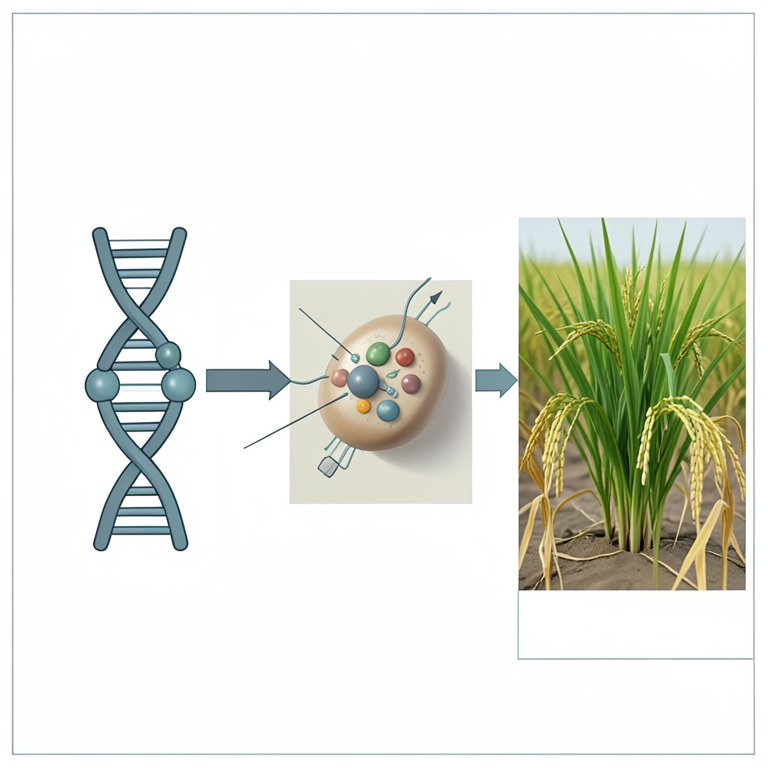
CRISPR-Cas9 Workflow for Herbicide Tolerance
AI-generated conceptual illustration (Oryza sativa (rice plants)). It explains the idea and does not show study data.
View source evidence ↗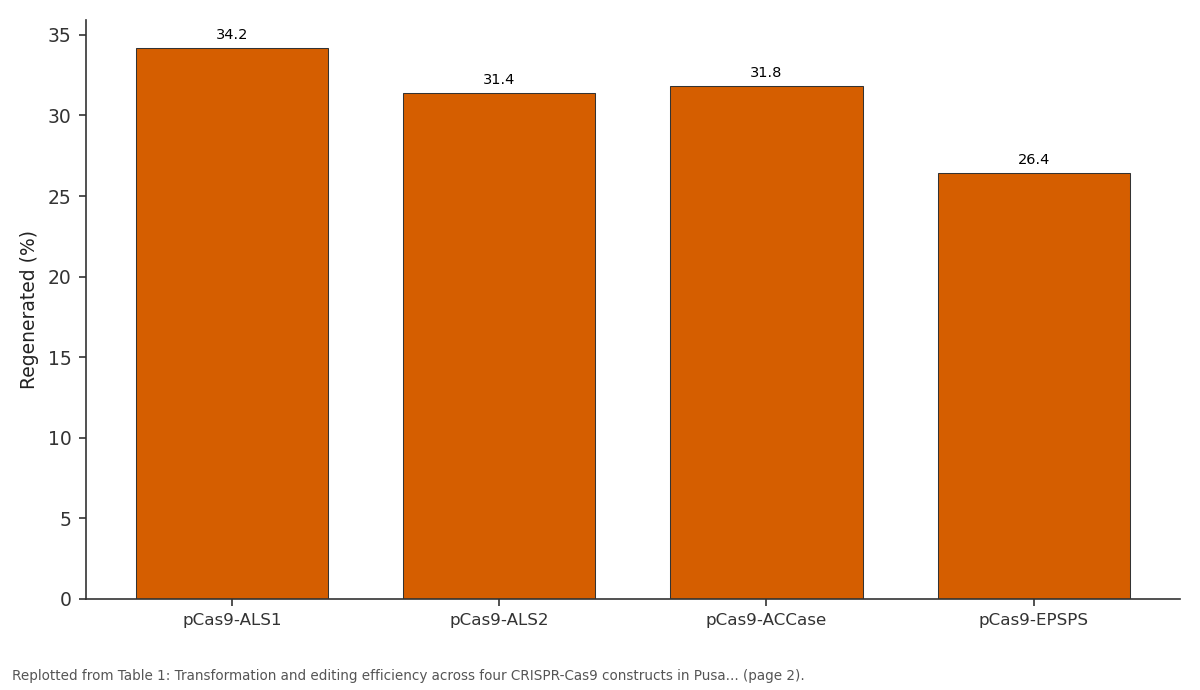
Regenerated (%): pCas9-ALS1 vs pCas9-ALS2 vs pCas9-ACCase vs pCas9-EPSPS
Replotted from Table 1 (page 2) of the original paper. Every bar is the paper's own table value.
View source evidence ↗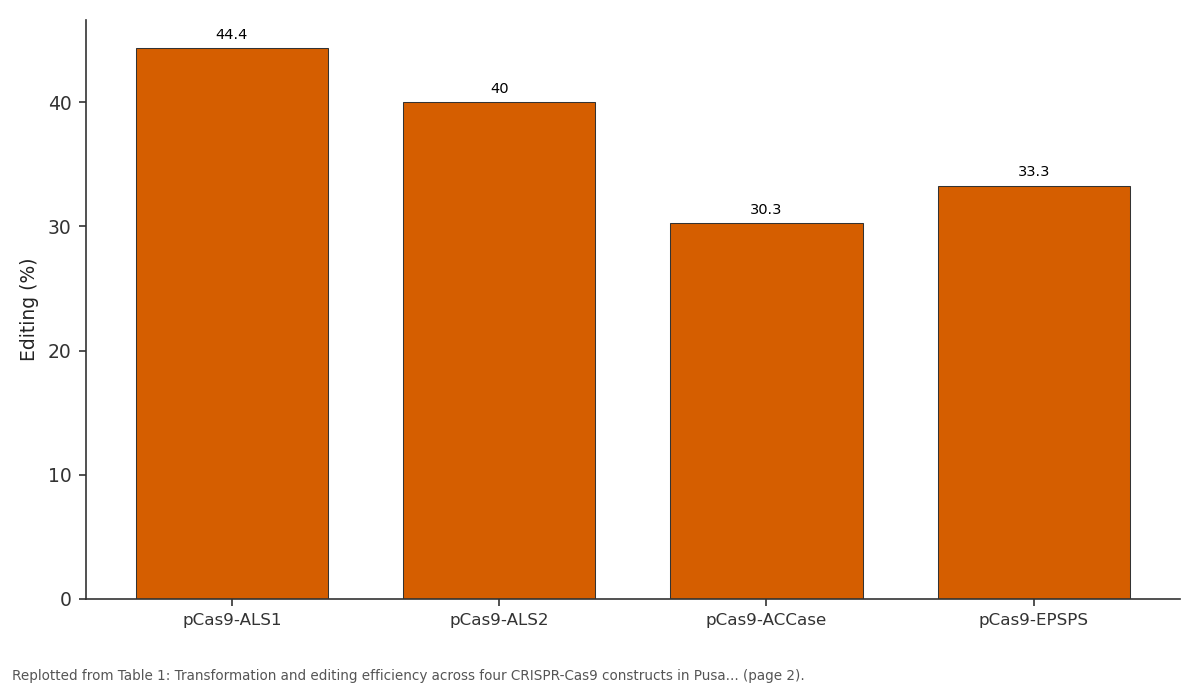
Editing (%): pCas9-ALS1 vs pCas9-ALS2 vs pCas9-ACCase vs pCas9-EPSPS
Replotted from Table 1 (page 2) of the original paper. Every bar is the paper's own table value.
View source evidence ↗Figures & tables
From the original paper Table 1
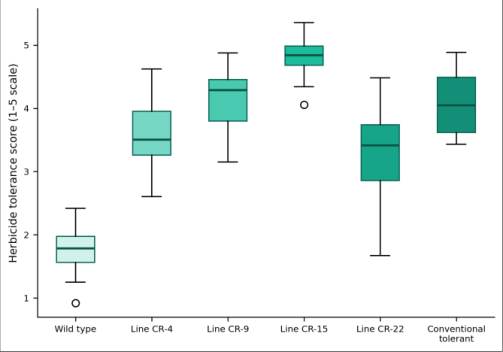 Figure 1
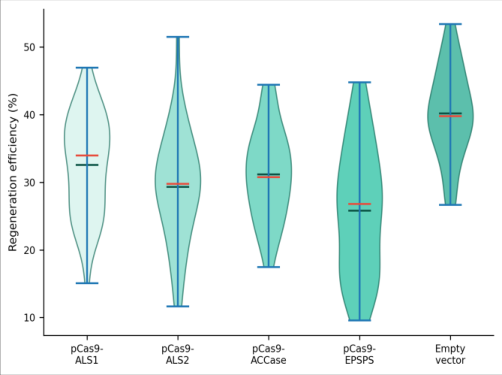 Figure 2
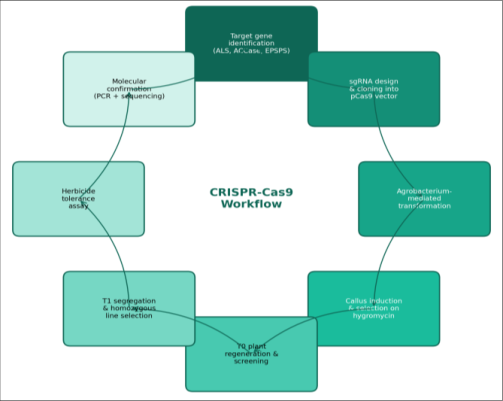 Figure 3
Introduction
Genome editing, at its simplest, means rewriting specific DNA letters in a living organism's genetic code with surgical precision. The CRISPR-Cas9 system, adapted from a bacterial immune mechanism, has transformed plant breeding by enabling targeted mutagenesis at costs and timescales far below those of conventional transgenic approaches [1,2] . In rice, CRISPR has been used to modify traits ranging from grain quality and disease resistance to nutrient content [3] . One application with large practical impact is herbicide tolerance. Direct-seeded rice (DSR), which avoids transplanting and saves water and labor, is expanding across South and Southeast Asia. But DSR suffers from intense weed competition, and effective herbicide use is often limited by the crop's own sensitivity [4] . Conventional herbicide-tolerant rice varieties (e.g., Clearfield®) carry naturally occurring ALS mutations but are available only in japonica backgrounds, limiting their use in indica-growing regions like the Indo-Gangetic plains [5] . CRISPR-Cas9 can introduce the same or novel point mutations in ALS, ACCase, and EPSPS genes of elite indica cultivars, producing herbicide-tolerant lines without foreign DNA insertion-these are technically non-transgenic and may face fewer regulatory hurdles than conventional GMOs [6,7] . However, challenges remain: editing efficiency varies by target site, regeneration from rice callus can be genotype-dependent, and off-target effects must be rigorously assessed [8] . This research aimed to develop herbicide-tolerant lines of Pusa Basmati 1 by editing three herbicide-target genes using CRISPR-Cas9, evaluate T 1 homozygous lines for herbicide tolerance at multiple dose levels, and confirm the absence of off-target mutations.
Reagents and Molecular Tools
Four single-guide RNAs (sgRNAs) targeting conserved regions of OsALS1 (LOC_ Os02g30630, exon 5), OsALS2 (LOC_Os06g51280, exon 4), OsACCase (LOC_Os05g22940, exon 18), and OsEPSPS (LOC_Os06g04280, exon 2) were designed using CRISPR-P 2.0 and CRISPRscan tools. Each sgRNA was cloned into the pRGEB32 vector backbone carrying the Cas9 gene driven by the OsUBQ promoter and the sgRNA under the OsU6 promoter. Binary vectors were introduced into Agrobacterium tumefaciens strain EHA105. Hygromycin B (50 mg L⁻¹) was used for callus selection. Herbicides tested were imazethapyr (Pursuit 10% SL), quizalofop-p-ethyl (Targa Super 5% EC), and glyphosate (Roundup 41% SL), all sourced from authorized agrochemical distributors.
Materials and Methods
Materials and Methods
Materials
Mature seeds of Pusa Basmati 1 (an elite aromatic indica rice cultivar) were surface-sterilized with 70% ethanol (1 min) and 2.5% sodium hypochlorite (20 min), rinsed three times with sterile distilled water, and plated on N6 callus induction medium supplemented with 2 mg L⁻¹ 2, 4-D.
Callus was maintained at 28 °C in darkness for 21 days before transformation. All tissue culture work was conducted in the Plant Biotechnology Laboratory, Department of Genetic Engineering, CSAUA, Kanpur.
Methods
Agrobacterium-mediated transformation followed a modified protocol [8] . Embryogenic calli were co-cultivated with Agrobacterium suspension (OD₆₀₀ = 0.5) for 20 min, blotted dry, and incubated on co-cultivation medium at 25 °C for 3 days. Calli were then transferred to selection medium containing 50 mg L⁻¹ hygromycin B and 250 mg L⁻¹ cefotaxime, subcultured every 14 days for two rounds. Surviving calli were moved to regeneration medium (MS + 2 mg L⁻¹ BAP + 0.5 mg L⁻¹ NAA). Regenerated T 0 plantlets were hardened and transferred to the greenhouse. Editing was confirmed by Sanger sequencing of PCR amplicons spanning target sites. T 1 seeds were harvested and screened for segregation by genotyping. Homozygous edited lines were subjected to herbicide tolerance bioassays at 1×, 2×, and 4× field recommended doses. Off-target analysis was performed by sequencing the top five predicted off-target sites per construct.
Herbicide Tolerance Bioassay
Twelve homozygous T 1 lines (4 per target gene) along with wild-type Pusa Basmati 1 and a conventional tolerant check (Clearfield variety) were grown in pots (5 plants per pot, 3 reps per dose) in the greenhouse. Herbicides were sprayed at the 3-4 leaf stage using a laboratory boom sprayer calibrated to deliver 500 L ha⁻¹. Tolerance was scored on a 1-5 scale (1 = dead, 5 = no visible injury) at 14 days after spraying. Plant height, tiller number, and biomass were recorded at 21 days. Regeneration efficiency was highest for the pCas9-ALS1 construct (34.2%) and lowest for pCas9-EPSPS (26.4%), likely reflecting differences in callus growth under selection pressure (Table 1). Editing efficiency at target loci ranged from 30.3% to 44.4%. A total of 23 T 0 plants carried edits in the two ALS targets, while ACCase and EPSPS constructs yielded 5 and 4 edited plants respectively. Comprehensive Interpretation ALS gene editing proved most efficient both in terms of transformation recovery and herbicide tolerance outcome.
| Construct | Calli treated | Regenerated (%) | T0 with edits | Editing (%) |
|---|---|---|---|---|
| pCas9-ALS1 | 54 | 34.2 | 8 | 44.4 |
| pCas9-ALS2 | 48 | 31.4 | 6 | 40.0 |
| pCas9-ACCase | 52 | 31.8 | 5 | 30.3 |
| pCas9-EPSPS | 46 | 26.4 | 4 | 33.3 |
| Empty vector | 40 | 38.1 | 0 | 0.0 |
Table text extracted from the original PDF; superscript letters are shown inline. The original table image is below.
View original table image
Results
The dual ALS mutation strategy (targeting both ALS1 and ALS2 paralogs) was clearly superior to single-gene edits, achieving near-complete tolerance at a dose that killed the wild type. No off-target mutations were detected at any of the 20 predicted sites across all four constructs.
Discussion
The editing efficiencies observed here (30-44%) are within the range reported for indica rice using similar vector systems [2,8] . The lower efficiency for EPSPS editing may reflect the essential nature of this gene-cells carrying biallelic knockouts at EPSPS may not survive selection, while the desired point mutations that confer tolerance without loss of function are rarer events [7] . The ALS genes, in contrast, tolerate specific amino acid substitutions at known positions that simultaneously confer herbicide tolerance and maintain enzymatic function [5] . The superior performance of the dual ALS mutant (CR-15) over single-gene edits and the conventional check suggests that stacking mutations in paralogous genes provides stronger tolerance. This makes biological sense: indica rice has two functional ALS copies, and herbicide can still inhibit the unedited paralog in single-gene mutants [5,6] . Line CR-15 effectively blocked herbicide binding at both copies. The absence of off-target mutations is encouraging but not surprising, given the strict 20-nt seed region matching used in sgRNA design [1] . However, whole-genome sequencing of lead lines would provide more definitive assurance before field-level deployment. The agronomic equivalence of edited lines to the parent variety is a practical requirement for farmer adoption-any yield drag from editing would undermine the commercial case. Future work should include multi-location field trials under direct-seeded conditions and regulatory pathway assessment for CRISPR-edited crops in India.
Conclusion
This research demonstrated that CRISPR-Cas9 can effectively introduce herbicide-tolerance mutations in the elite indica rice cultivar Pusa Basmati 1. The dual ALS gene editing strategy produced the best tolerant line (CR-15), which withstood 4× field-rate imazethapyr with no visible injury. Editing efficiency was highest for ALS constructs and lowest for EPSPS. No off-target effects were detected, and the best edited lines maintained agronomic performance equivalent to the parent variety. These non-transgenic edited lines are candidates for herbicide-tolerant direct-seeded rice systems across the Indo-Gangetic plains, subject to regulatory approval.
Acknowledgement
Acknowledgements
Figures and tables from the paper
References
15 in the original paper- Jinek M, Chylinski K, Fonfara I, Hauer M, Doudna JA, Charpentier E. A programmable dual-RNA-guided DNA endonuclease in adaptive bacterial immunity. Science. 2012;337(6096):816-821.
- Miao J, Guo D, Zhang J, Huang Q, Qin G, Zhang X. Targeted mutagenesis in rice using CRISPR-Cas system. Cell Research. 2013;23(10):1233-1236.
- Li M, Li X, Zhou Z, Wu P, Fang M, Pan X. Reassessment of the four yield-related genes Gn1a, DEP1, GS3, and IPA1 in rice using a CRISPR/Cas9 system. Frontiers in Plant Science. 2016;7:377.
- Chauhan BS, Johnson DE. The role of seed ecology in improving weed management strategies in the tropics. Advances in Agronomy. 2010;105:221-262.
- Yu Q, Powles SB. Resistance to AHAS inhibitor herbicides: current understanding. Pest Management Science. 2014;70(9):1340-1350.
- Endo M, Mikami M, Toki S. Biallelic gene targeting in rice. Plant Physiology. 2016;170(2):667-677.
- Butt H, Jamil M, Wang JY, Al-Babili S, Mahfouz M. Engineering plant architecture via CRISPR/Cas9mediated alteration of strigolactone biosynthesis. BMC Plant Biology. 2018;18(1):174.
- Hiei Y, Ohta S, Komari T, Kumashiro T. Efficient transformation of rice mediated by Agrobacterium and sequence analysis of the boundaries of the T-DNA. Plant Journal. 1994;6(2):271-282.
- Zhang H, Zhang J, Wei P, Zhang B, Gou F, Feng Z. The CRISPR/Cas9 system produces specific and homozygous targeted gene editing in rice in one generation. Plant Biotechnology Journal. 2014;12(6):797-807.
- Sun Y, Zhang X, Wu C, He Y, Ma Y, Hou H. Engineering herbicide-resistant rice plants through CRISPR/Cas9-mediated homologous recombination of International Journal of Agriculture and Nutrition https://www.agriculturejournal.net acetolactate synthase. Molecular Plant. 2016;9(4):628631.
- Li J, Meng X, Zong Y, Chen K, Zhang H, Liu J. Gene replacements and insertions in rice by intron targeting using CRISPR-Cas9. Nature Plants. 2016;2:16139.
- Shimatani Z, Kashojiya S, Takayama M, Terada R, Arazoe T, Ishii H. Targeted base editing in rice and tomato using a CRISPR-Cas9 cytidine deaminase fusion. Nature Biotechnology. 2017;35(5):441-443.
- Kurowska M, Daszkowska-Golec A, Grber D, Szurman M, Szarejko I. TILLING: a shortcut in functional genomics. Journal of Applied Genetics. 2011;52(4):371-390.
- Svitashev S, Schwartz C, Lenderts B, Young JK, Cigan AM. Genome editing in maize directed by CRISPRCas9 ribonucleoprotein complexes. Nature Communications. 2016;7:13274.
- Tang X, Lowder LG, Zhang T, Malzahn AA, Zheng X, Voytas DF. A CRISPR-Cpf1 system for efficient genome editing and transcriptional repression in plants. Nature Plants. 2017;3:17018.