
Research article · 2025 · Full text
International Journal of Agriculture and NutritionInfluence of rootstock vigor on scion growth and fruit yield in citrus under saline conditions
Volume 7(11) · Pages 168–171 · DOI: 10.33545/26646064.2025.v7.i11c.498 ↗
Research areasPlant Physiology and Cultivation StudiesPlant Stress Responses and TolerancePlant Disease Management Techniques
Abstract
Author-writtenSoil salinity is one of the defining constraints for citrus cultivation in coastal and semi-arid tracts worldwide, and rootstock selection remains the most practical tool available to growers for managing its effects on tree performance. This research evaluated six commercially available rootstocks for their influence on scion growth, fruit yield, and quality of Mosambi sweet orange (Citrus sinensis Osbeck cv. Mosambi) under saline irrigation conditions at Kerala Agricultural University, Thrissur, during 2020-2023. Trees budded onto Rough Lemon produced the tallest canopy (284.6 cm), highest canopy volume (8.72 m³), and greatest fruit yield (48.2 kg/tree), while Cleopatra Mandarin gave the lowest yield at 28.3 kg/tree. Leaf sodium concentration was lowest in Rough Lemon (0.31%) and Volkamer Lemon (0.34%), with corresponding K⁺/Na⁺ ratios of 2.84 and 2.67. Juice quality parameters including TSS and vitamin C content followed the same ranking pattern. Vigorous rootstocks that restricted sodium translocation to the scion maintained better photosynthetic efficiency and higher yields under salinity stress of 4.2 dS/m irrigation water.
Summary
Source-checkedPlain-language reading of the full paper, prepared with AI and checked against the text. Each point links to the authors' own words.
Why it matters
- Soil salinity is a major limiting factor for citrus farming globally, making the choice of rootstock a critical tool for managing tree performance. View evidence ↗
- Citrus trees are sensitive to salt, with productivity declines starting at soil electrical conductivity levels as low as 1.7 dS/m. View evidence ↗
- Salinity damages citrus trees through leaf toxicity from sodium and chloride, osmotic stress that hinders water absorption, and nutrient imbalances. View evidence ↗
The question
- The study aimed to identify the best rootstocks for salt-affected orchards in Kerala by comparing six options' effects on growth, ion partitioning, yield, and fruit quality. View evidence ↗
What they did
- The experiment used Mosambi sweet orange grafted onto six different rootstocks: Rough Lemon, Rangpur Lime, Troyer Citrange, Sour Orange, Volkamer Lemon, and Cleopatra Mandarin. View evidence ↗
- Trees were irrigated during non-monsoon months with saline water having an electrical conductivity (EC) of 4.2 dS/m and a sodium adsorption ratio (SAR) of 6.8. View evidence ↗
- Researchers annually measured scion height, trunk girth, canopy spread, and volume, while recording per-tree fruit yield and analyzing leaf minerals from specific shoot positions. View evidence ↗
- Fruit quality was assessed using ten random fruits per tree, measuring juice percentage, total soluble solids (TSS), titratable acidity, and ascorbic acid. View evidence ↗
What they found
- Rough Lemon performed best in growth and productivity, producing the tallest scion (284.6 cm), largest canopy volume (8.72 m³), and highest fruit yield (48.2 kg/tree). View evidence ↗
- Cleopatra Mandarin showed the poorest performance, with the lowest fruit yield of 28.3 kg/tree and the shortest scion height of 198.3 cm. View evidence ↗
- There was a strong negative correlation (r = -0.93) between leaf sodium concentration and fruit yield, meaning higher sodium levels significantly reduced yield. View evidence ↗
- Rough Lemon maintained higher photosynthetic capacity with a leaf chlorophyll content of 2.18 mg/g, compared to 1.42 mg/g in Cleopatra Mandarin. View evidence ↗
What it means
- The authors conclude that Rough Lemon and Volkamer Lemon are the best rootstocks for Mosambi sweet orange under 4.2 dS/m salinity due to their growth vigor, sodium exclusion, and high yield/quality. View evidence ↗
- The authors recommend using the leaf K⁺/Na⁺ ratio as a reliable index for screening rootstocks for salt tolerance. View evidence ↗
Visual summary
2 visualsIllustrations explain the paper; charts are replotted from the paper's own table values.
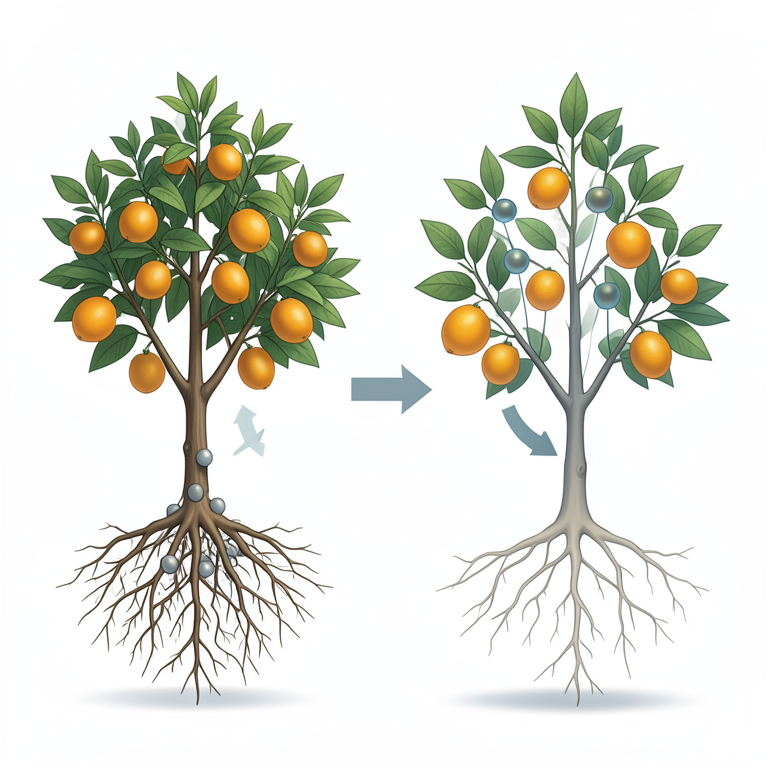
Sodium Exclusion Mechanism
AI-generated conceptual illustration (citrus trees with contrasting rootstocks). It explains the idea and does not show study data.
View source evidence ↗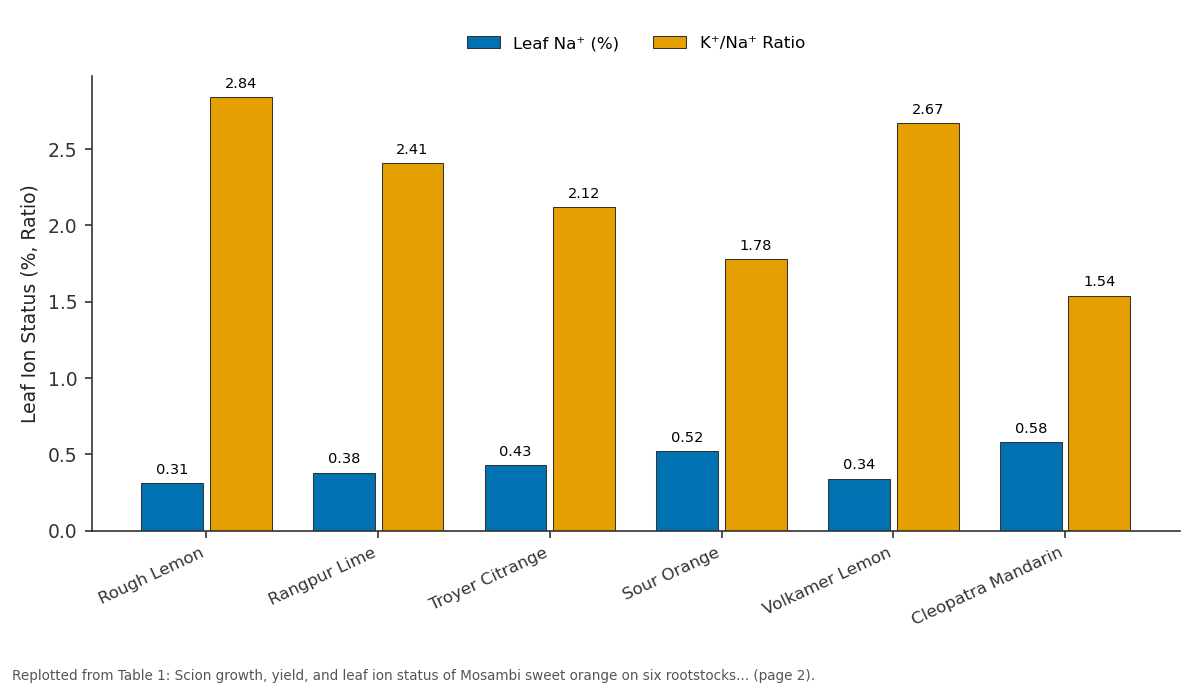
Leaf Na⁺ (%) and K⁺/Na⁺ Ratio: Rough Lemon vs Rangpur Lime vs Troyer Citrange vs Sour Orange vs Volkamer Lemon
Replotted from Table 1 (page 2) of the original paper. Every bar is the paper's own table value.
View source evidence ↗Figures & tables
From the original paper Table 1
 Table 2
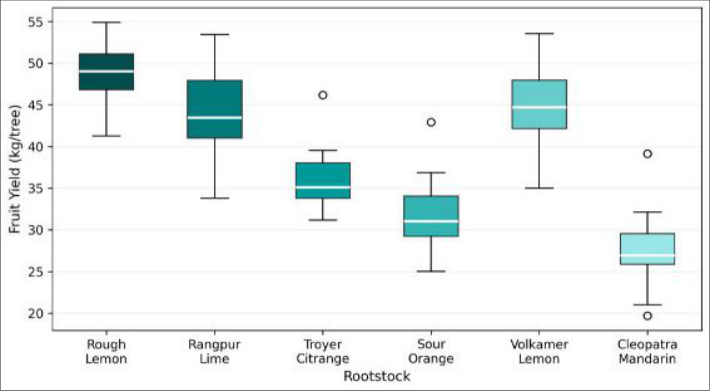 Figure 1
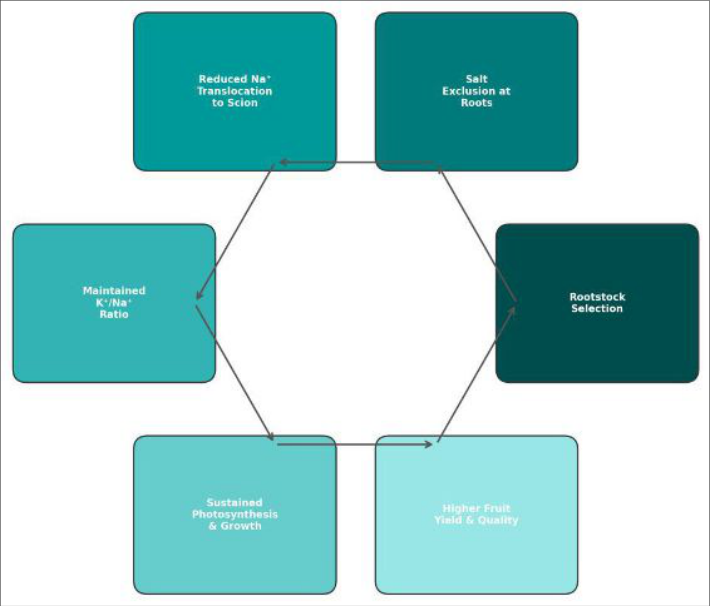 Figure 2
Introduction
Rootstock selection is, in practical terms, the single most effective decision a citrus grower can make to buffer against soil and water salinity. Citrus trees are classified as salt-sensitive, with yield reductions beginning at soil electrical conductivity levels as low as 1.7 dS/m [1] . In India, approximately 6.73 million hectares of agricultural land are affected by salinity, and citrus orchards in coastal Kerala, Gujarat, and Rajasthan frequently encounter irrigation water with EC values between 2 and 6 dS/m [2] . The damage from salinity in citrus occurs mainly through chloride and sodium toxicity to leaves, osmotic stress limiting water uptake, and nutritional imbalances caused by ion antagonism [3] . Rootstocks modulate the salt response of grafted trees by regulating the uptake and translocation of toxic ions from roots to the scion [4] . Vigorous rootstocks such as Rough Lemon and Volkamer Lemon tend to produce larger root systems with greater absorptive surface area, which may dilute ion concentrations and maintain favourable K⁺/Na⁺ ratios in the canopy [5] . But the relationship between rootstock vigor and salt tolerance isn't straightforward, because some dwarfing rootstocks show good sodium exclusion despite their smaller root volume [6] . This research aimed to compare six rootstocks for their effects on scion growth, ion partitioning, fruit yield, and quality under saline irrigation to identify the best options for salt-affected citrus orchards in Kerala.
Climatic Conditions During the Trial
The experimental orchard was located at the Instructional Farm of Kerala Agricultural University, Thrissur (10.52° N, 76.21° E, 22 m altitude). The region has a humid tropical climate with mean annual rainfall of 2,900 mm concentrated during the southwest monsoon (June-September). Mean maximum temperature ranged from 30.4°C to 36.1°C and minimum from 22.8°C to 25.6°C during the research period. Saline irrigation water (EC 4.2 dS/m, SAR 6.8) was drawn from a bore well and applied through basin irrigation at fortnightly intervals during non-monsoon months. Trees were eight years old at the start of observations and spaced at 6 m × 6 m. Saline irrigation had been applied for three consecutive years before data recording began in 2020 [7] . The experiment followed a randomized block design with four replications of three trees each.
Methods
Scion height, trunk girth, canopy spread, and canopy volume were measured annually. Fruit yield was recorded per tree at each harvest. Leaf samples from the fourth and fifth position on non-fruiting spring flush shoots were collected for mineral analysis. Sodium and potassium were determined by flame photometry; chloride by silver nitrate titration [8] . Juice percentage, TSS (digital refractometer), titratable acidity (NaOH titration), and ascorbic acid (DCPIP method) were measured on ten randomly selected fruits per tree per harvest [9] . Leaf chlorophyll was estimated by DMSO extraction and spectrophotometry. Data were pooled over three years (2020-2023) and analyzed by ANOVA at P = 0.05.
Results
Table Fruit quality mirrored the yield rankings (Table 2). Rough Lemon and Volkamer Lemon produced fruits with higher juice percentage, TSS, and vitamin C. Acidity was lowest in Rough Lemon fruits (0.82%) and highest in Cleopatra Mandarin (1.12%).
| Rootstock | Juice (%) | TSS (°Brix) | Acidity (%) | Vit. C (mg/100ml) |
|---|---|---|---|---|
| Rough Lemon | 46.8 | 10.4 | 0.82 | 42.3 |
| Rangpur Lime | 44.2 | 10.1 | 0.91 | 39.8 |
| Troyer Citrange | 41.7 | 9.6 | 0.97 | 36.4 |
| Sour Orange | 40.3 | 9.2 | 1.04 | 34.1 |
| Volkamer Lemon | 45.6 | 10.3 | 0.86 | 41.2 |
| Cleopatra Mandarin | 38.4 | 8.8 | 1.12 | 31.6 |
| SEm(±) | 1.23 | 0.28 | 0.04 | 1.47 |
| CD (P=0.05) | 3.69 | 0.84 | 0.12 | 4.41 |
Table text extracted from the original PDF; superscript letters are shown inline. The original table image is below.
View original table image
Comprehensive Interpretation
A strong negative correlation was observed between leaf Na⁺ concentration and fruit yield (r = -0.93, P < 0.01). Leaf chlorophyll content followed the same pattern, with Rough Lemon maintaining 2.18 mg/g compared to 1.42 mg/g in Cleopatra Mandarin. This confirms that rootstocks restricting sodium translocation preserve photosynthetic capacity and support higher carbon assimilation for fruit development.
Discussion
The superior performance of Rough Lemon and Volkamer Lemon under saline conditions aligns with earlier reports from semi-arid regions of India and the Mediterranean basin [4, 5] . Both rootstocks are known for vigorous root systems that maintain a larger soil exploration volume, which appears to aid in sodium dilution within the xylem sap. The poor showing of Cleopatra Mandarin is notable because this rootstock is sometimes recommended for salt tolerance based on greenhouse screening data, yet under prolonged field salinity its small root system may not sustain the exclusion mechanism effectively [6] .
The clear association between K⁺/Na⁺ ratio and yield (r = 0.91) underscores potassium's role in maintaining stomatal function, enzyme activation, and osmotic balance under salt stress [3] .
Figures and tables from the paper
| Rootstock | Scion Height (cm) | Canopy Vol. (m³) | Fruit Yield (kg/tree) | Leaf Na⁺ (%) | K⁺/Na⁺ Ratio |
|---|---|---|---|---|---|
| Rough Lemon | 284.6 | 8.72 | 48.2 | 0.31 | 2.84 |
| Rangpur Lime | 261.3 | 7.84 | 42.7 | 0.38 | 2.41 |
| Troyer Citrange | 228.4 | 6.13 | 35.4 | 0.43 | 2.12 |
| Sour Orange | 214.7 | 5.68 | 31.8 | 0.52 | 1.78 |
| Volkamer Lemon | 272.8 | 8.21 | 44.6 | 0.34 | 2.67 |
| Cleopatra Mandarin | 198.3 | 4.92 | 28.3 | 0.58 | 1.54 |
| SEm(±) | 8.42 | 0.37 | 2.16 | 0.03 | 0.14 |
| CD (P=0.05) | 25.26 | 1.11 | 6.48 | 0.09 | 0.42 |
Table text extracted from the original PDF; superscript letters are shown inline. The original table image is below.
View original table image
References
14 in the original paper- Maas EV. Salinity and citriculture. Tree Physiology. 1993;12(2):195-216.
- Sharma DK, Singh A. Salinity research in India: achievements, challenges and future prospects. Water and Energy International. 2015;58(6):35-45.
- Grattan SR, Grieve CM. Salinity-mineral nutrient relations in horticultural crops. Scientia Horticulturae. 1999;78(1-4):127-157.
- Levy Y, Syvertsen JP. Irrigation water quality and salinity effects in citrus trees. Horticultural Reviews. 2004;30:37-82.
- Storey R, Walker RR. Citrus and salinity. Scientia Horticulturae. 1999;78(1-4):39-81.
- Srivastava AK, Singh S. Citrus decline: soil fertility and plant nutrition. Journal of Plant Nutrition. 2009;32(2):197-245.
- Chapman HD. The mineral nutrition of citrus. In: The citrus industry. University of California Press. 1968;2:127-289.
- Ranganna S. Handbook of analysis and quality control for fruit and vegetable products. Tata McGraw-Hill. 1986;2:1-1112.
- Syvertsen JP, Garcia-Sanchez F. Multiple abiotic stresses occurring with salinity stress in citrus. Environmental and Experimental Botany. 2014;103:128-137. International Journal of Agriculture and Nutrition https://www.agriculturejournal.net
- Hussain S, Luro F, Costantino G. Physiological analysis of salt stress behaviour of citrus species and genera. South African Journal of Botany. 2012;81:81-94.
- Bañuls J, Primo-Millo E. Effects of salinity on some citrus scion-rootstock combinations. Annals of Botany. 1995;76(1):97-102.
- Garcia-Sanchez F, Perez-Perez JG, Botia P. The response of young mandarin trees grown under saline conditions depends on the rootstock. European Journal of Agronomy. 2006;24(2):129-139.
- Gimeno V, Syvertsen JP, Nieves M. Additional nitrogen fertilization affects salt tolerance of lemon trees on different rootstocks. Scientia Horticulturae. 2009;121(3):298-305.
- Raveh E, Levy Y. Analysis of xylem water as an indicator of current cleaf chloride accumulation. Scientia Horticulturae. 2005;103(3):317-327.