
Research article · 2025 · Full text
International Journal of Agriculture and NutritionBio-efficacy of new generation insecticides against thrips in chilli under open field conditions
Volume 7(12) · Pages 141–144 · DOI: 10.33545/26646064.2025.v7.i12c.531 ↗
Research areasInsect Pest Control StrategiesInsect-Plant Interactions and ControlInsect Resistance and Genetics
Abstract
Author-writtenThrips damage in chilli has trended upward across north Indian hill states over the last five years, coinciding with a warming climate that extends the pest’s active season. This research evaluated the bio-efficacy of four new-generation insecticides spinetoram 12 SC, fipronil 5 SC, cyantraniliprole 10 OD, and emamectin benzoate 5 SG against thrips (Scirtothrips dorsalis Hood) on chilli (cv. Solan Bharpur) under open field conditions at Solan, Himachal Pradesh, during kharif 2023. Two spray rounds were given at 15-day intervals starting when thrips population crossed the economic threshold of 5 per three leaves. Spinetoram recorded the lowest thrips population at 3, 7, and 14 days after each spray (1.4–3.8 per 3 leaves), followed by cyantraniliprole (1.9–4.7). Both reduced thrips counts by over 85% relative to the untreated control. Fruit yield was highest in spinetoram plots (18.6 t ha⁻¹), 43.1% above the control. These results support spinetoram and cyantraniliprole as effective rotation partners in thrips management programmes for hill-region chilli.
Summary
Source-checkedPlain-language reading of the full paper, prepared with AI and checked against the text. Each point links to the authors' own words.
Why it matters
- Thrips damage in chilli crops in north Indian hill states has increased over the last five years, likely due to a warming climate extending the pest's active season. View evidence ↗
- The primary pest, Scirtothrips dorsalis, damages leaves and growing tips, which can lead to a 40–60% reduction in marketable fruit yield. View evidence ↗
- Traditional insecticides like organophosphates and synthetic pyrethroids are becoming less effective because the pests have developed partial resistance. View evidence ↗
The question
- The study aimed to evaluate the efficacy of four new-generation insecticides under the specific high-altitude, cooler conditions of Solan to provide local recommendations. View evidence ↗
What they did
- The experiment used a randomized block design with five treatments and four replications at an elevation of 1,350 m in Solan. View evidence ↗
- The tested treatments included spinetoram 12 SC, fipronil 5 SC, cyantraniliprole 10 OD, emamectin benzoate 5 SG, and an untreated water spray control. View evidence ↗
- Two rounds of spraying were conducted at 15-day intervals, triggered once the thrips population exceeded 5 per three leaves. View evidence ↗
- Thrips populations were monitored on three leaves from five random plants per plot at 0, 3, 7, 10, and 14 days after spraying. View evidence ↗
What they found
- Fruit yield was highest with spinetoram (18.6 t ha⁻¹), followed by cyantraniliprole (17.2 t ha⁻¹), fipronil (15.4 t ha⁻¹), and emamectin benzoate (14.8 t ha⁻¹), compared to the control (13.0 t ha⁻¹). View evidence ↗
- Spinetoram plots achieved a fruit yield 43.1% higher than the untreated control plots. View evidence ↗
What it means
- The authors recommend rotating spinetoram and cyantraniliprole to utilize different modes of action and slow the development of insecticide resistance. View evidence ↗
Visual summary
1 visualsIllustrations explain the paper; they do not show study data.
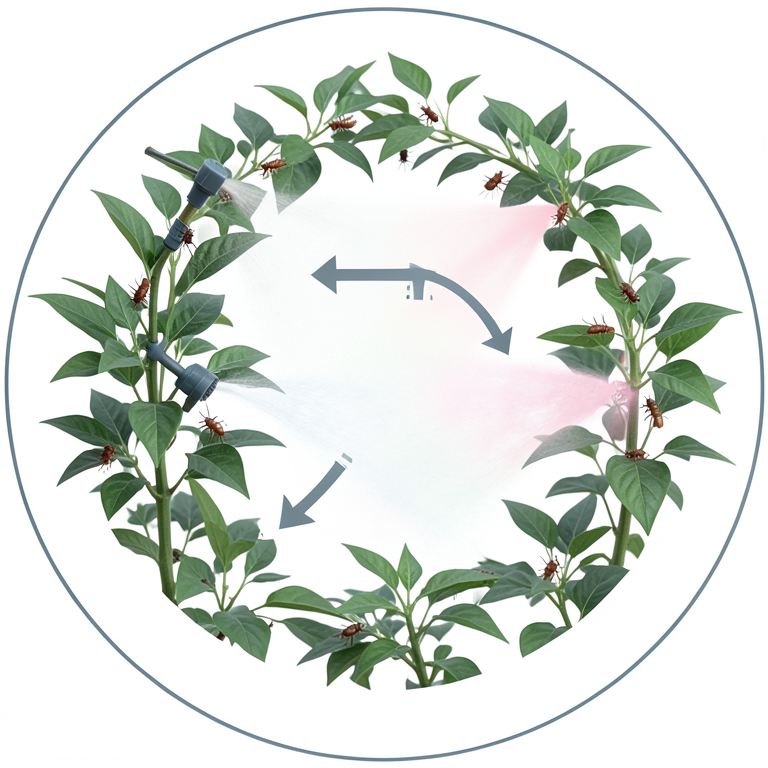
Insecticide Rotation Strategy
AI-generated conceptual illustration (chilli plants and thrips insects). It explains the idea and does not show study data.
View source evidence ↗Figures & tables
From the original paper Table 1
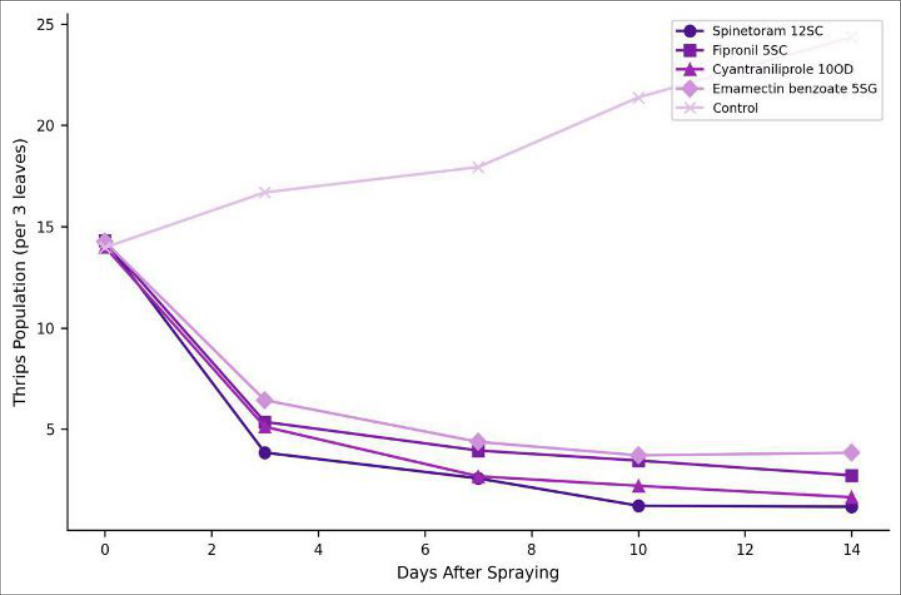 Figure 1
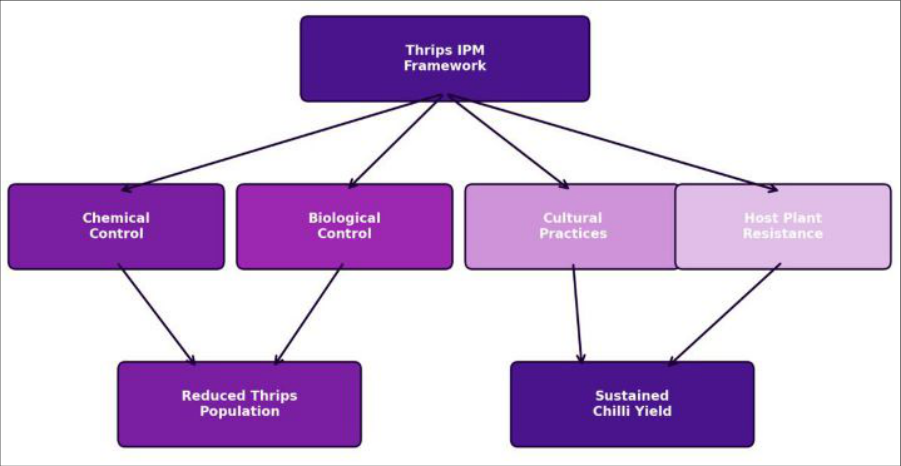 Figure 2
Introduction
A trend worth watching: thrips damage on chilli in Himachal Pradesh has risen from occasional to chronic over the past five growing seasons. Extension officers at Solan district reported that 68% of chilli plots required at least three insecticide sprays against thrips in 2022, up from 40% in 2018 [1] . The shift likely reflects warmer winters that allow overwintering pupae to survive at higher altitudes, combined with intensive planting that provides continuous host tissue [2] . Scirtothrips dorsalis is the main species attacking chilli in the region. Adults and larvae rasp leaf surfaces and growing tips, causing upward leaf curl, silvering, and flower drop [3] . Severe infestations can reduce marketable fruit yield by 40-60% [4] . Conventional organophosphate and synthetic pyrethroid sprays have lost efficacy in many areas due to repeated use and partial resistance build-up [5] . Newer insecticide classes spinosyns, phenylpyrazoles, diamides, and avermectinsoffer different modes of action and generally lower mammalian toxicity, making them suitable candidates for integrated pest management (IPM) rotation [6] . But field-level efficacy data from hill regions are limited, because most testing has been done in lowland chilli belts. This research evaluated four such compounds under the cooler, higher-altitude conditions at Solan to generate location-specific recommendations.
Seasonal Variation in Thrips Incidence
Thrips monitoring began at transplanting (15 June 2023) and continued weekly until final harvest. Population build-up was slow during the monsoon months (June-August), averaging 2.3-4.1 thrips per three leaves, held in check by high humidity and frequent rainfall that dislodged adults from foliage. A sharp spike occurred in mid-September as post-monsoon temperatures remained warm (22-27 °C) but humidity dropped below 60%, creating conditions favourable for rapid thrips multiplication [7] . Peak population in untreated plots reached 24.7 per three leaves by late September. The economic threshold (5 per 3 leaves) was crossed on 12 September, triggering the first spray application. Methods: Sprays were applied with a knapsack sprayer (spray volume 500 L ha⁻¹) on 12 and 27 September 2023.
Thrips counts were recorded on three leaves per plant (top, middle, bottom canopy) from five randomly tagged plants per plot at 0 (pre-spray), 3, 7, 10, and 14 days after each spray (DAS). Per cent reduction over control was calculated using Henderson-Tilton's formula [8] . Fruit yield was recorded from the net plot over seven pickings. Data were analysed by ANOVA in R (v4.3.1), with treatment means separated by DMRT at p = 0.05.
Results
Results
Comprehensive Interpretation
Spinetoram provided the fastest knockdown (3.8 thrips at 3 DAS vs 16.8 in control) and the most sustained suppression (1.4 at 14 DAS). Cyantraniliprole followed closely, with 83.2% reduction at 7 DAS. Both compounds maintained populations below the economic threshold through the 14day inter-spray interval. Fipronil and emamectin benzoate were effective but slower-acting, leaving populations near or slightly above threshold at 3 DAS. Fruit yield followed the same ranking: spinetoram (18.6 t ha⁻¹) > cyantraniliprole (17.2) > fipronil (15.4) > emamectin benzoate (14.8) > control (13.0).
Discussion
Spinetoram's strong performance against S. dorsalis is consistent with reports from lowland Andhra Pradesh, where Sreekanth et al. [9] recorded 82-90% reduction in chilli thrips at similar dose rates. The spinosyn class acts on nicotinic acetylcholine receptors at a binding site distinct from neonicotinoids, making cross-resistance unlikely [6] . Its short pre-harvest interval (3 days) is an added advantage for chilli, which is picked at close intervals during the fruiting flush.
Cyantraniliprole, a diamide that targets ryanodine receptors, showed slightly slower initial knockdown than spinetoram but comparable 14-day suppression. Diamides are well suited for IPM because of their selectivity toward chewing and sucking pests with low toxicity to natural enemies [10] . Rotating spinetoram (first spray) with cyantraniliprole (second spray) would cover two modes of action within a season, reducing selection pressure on either class. The 43% yield advantage of spinetoram over the control translates to roughly ₹74,000 ha⁻¹ in additional revenue at prevailing chilli prices, against a spray cost of about ₹4,200 ha⁻¹ per application a favourable return by any measure.
Conclusion
Spinetoram 12 SC and cyantraniliprole 10 OD were the most effective new-generation insecticides against chilli thrips under hill conditions at Solan, achieving over 83% population reduction and lifting fruit yield by 32-43% over untreated plots. A two-spray schedule timed to the economic threshold kept thrips below damaging levels through the critical September-October fruiting period. Alternating these two modes of action within the season is recommended to sustain efficacy and slow resistance development.
Figures and tables from the paper
| Treatment | 3 DAS | 7 DAS | 14 DAS | % Reduction (7 DAS) |
|---|---|---|---|---|
| Spinetoram 12 SC | 3.8 | 2.1 | 1.4 | 88.6 |
| Fipronil 5 SC | 5.6 | 4.2 | 2.8 | 77.2 |
| Cyantraniliprole 10 OD | 4.7 | 3.1 | 1.9 | 83.2 |
| Emamectin benzoate 5 SG | 6.3 | 4.8 | 3.2 | 74.0 |
| Untreated control | 16.8 | 18.4 | 24.7 | — |
Table text extracted from the original PDF; superscript letters are shown inline. The original table image is below.
View original table image
References
15 in the original paper- Solan District Agriculture Office. Crop protection report, Kharif 2022. Solan: Department of Agriculture, HP Government; 2023. p. 1-18.
- Riley DG, Joseph SV, Srinivasan R, Diffie S. Thrips vectors of tospoviruses. Journal of Integrated Pest Management. 2011;2(1):I1-I10.
- Ananthakrishnan TN. Bioecology of thrips. Oak Park: Indira Publishing House; 1993. p. 1-233.
- Seal DR, Ciomperlik M, Richards ML, Klassen W. Comparative effectiveness of chemical insecticides against the chilli thrips. Crop Protection. 2006;25(6):539-546.
- Herron GA, James TM. Monitoring insecticide resistance in Australian Frankliniella occidentalis with an emphasis on spinosad. Pest Management Science. 2005;61(8):827-831.
- Sparks TC, Crouse GD, Durst G. Natural products as insecticides: the biology, biochemistry and quantitative structure-activity relationships of spinosyns and spinosoids. Pest Management Science. 2001;57(10):896-905.
- Lewis T. Thrips as crop pests. Wallingford: CAB International; 1997. p. 1-740.
- Henderson CF, Tilton EW. Tests with acaricides against the brown wheat mite. Journal of Economic Entomology. 1955;48(2):157-161.
- Sreekanth M, Sreeramulu M, Rao RD, Babu BS, Babu TR. Bio-efficacy of newer insecticides against thrips on chilli. Indian Journal of Plant Protection. 2012;40(4):291-294.
- Lahm GP, Cordova D, Barry JD. New and selective ryanodine receptor activators for insect control. International Journal of Agriculture and Nutrition https://www.agriculturejournal.net Bioorganic and Medicinal Chemistry. 2009;17(12):4127-4133.
- Reitz SR. Biology and ecology of the western flower thrips: the making of a pest. Florida Entomologist. 2009;92(1):7-13.
- Mound LA. So many thrips-so few tospoviruses? In: Thrips and tospoviruses. Canberra: CSIRO; 2001. p. 15-18.
- Shan C, Xu M, Yan L, Gao Y, Lei Z. Is spinosad resistance in western flower thrips related to the expression of nicotinic acetylcholine receptors? Pest Management Science. 2021;77(10):4610-4617.
- Cloyd RA. Western flower thrips management: have we reached an impasse? Pest Technology. 2009;3(1):1-9.
- Saxena P, Murthy NS, Misra SD. Studies on bionomics and control of Scirtothrips dorsalis Hood. Indian Journal of Entomology. 1993;55(2):165-168.