
Research article · 2025 · Full text
International Journal of Agriculture and NutritionEvaluation of entomopathogenic fungi against diamondback moth larvae in cabbage
Volume 7(11) · Pages 154–157 · DOI: 10.33545/26646064.2025.v7.i11c.494 ↗
Research areasEntomopathogenic Microorganisms in Pest ControlInsect Pest Control StrategiesInsect Resistance and Genetics
Abstract
Author-writtenGlobally, diamondback moth (Plutella xylostella L.) accounts for an estimated US $4-5 billion in annual losses to cruciferous crop production. This research assessed the pathogenicity of four entomopathogenic fungi against P. xylostella larvae on cabbage under laboratory and field settings at Narendra Deva University of Agriculture and Technology, Kumarganj, during rabi 2022 and 2023. Beauveria bassiana, Metarhizium anisopliae, Lecanicillium lecanii, and Isaria fumosorosea were evaluated at three spore concentrations in a completely randomized design for bioassays and a randomized block design for field trials. Under laboratory conditions, B. bassiana at 1×10⁸ conidia/ml caused 87.4% larval mortality at 72 hours. In field trials, B. bassiana reduced the larval population by 78.9% at seven days after treatment and produced 28.6 t/ha marketable yield, statistically comparable to spinosad 45 SC (30.2 t/ha). The LC₅₀ of B. bassiana was 2.8 × 10⁵ conidia/ml and its LT₅₀ was 38.6 hours. These results suggest B. bassiana and M. anisopliae are practical biocontrol candidates for diamondback moth management.
Summary
Source-checkedPlain-language reading of the full paper, prepared with AI and checked against the text. Each point links to the authors' own words.
Why it matters
- The diamondback moth is a major global pest of cruciferous crops, causing estimated annual losses of US $4-5 billion. View evidence ↗
- In the Indo-Gangetic plains, cabbage yields are reduced by 30-52% due to this pest, leading to heavy chemical use that causes insecticide resistance and environmental damage. View evidence ↗
- Entomopathogenic fungi are useful biocontrol agents because they infect pests through contact rather than needing to be ingested. View evidence ↗
The question
- The study aimed to identify the most effective fungal species and concentration for controlling diamondback moth to integrate them into pest management programs. View evidence ↗
What they did
- The researchers tested four fungal species: Beauveria bassiana, Metarhizium anisopliae, Lecanicillium lecanii, and Isaria fumosorosea. View evidence ↗
- The fungi were evaluated at three different spore concentrations: 1×10⁶, 1×10⁷, and 1×10⁸ conidia/ml. View evidence ↗
- Laboratory tests involved spraying third-instar larvae with 2 ml of suspension and recording mortality at 24, 48, and 72 hours. View evidence ↗
- Field trials used a randomized block design where sprays were applied when the pest threshold reached four larvae per plant, with counts taken at 3, 7, and 14 days post-treatment. View evidence ↗
What they found
- In the field, B. bassiana reduced the larval population by 78.9% after seven days, which was statistically comparable to the chemical control spinosad (84.6%). View evidence ↗
- B. bassiana was more efficient than M. anisopliae, requiring a lower lethal dose (LC₅₀ of 2.8 × 10⁵ vs 7.4 × 10⁵ conidia/ml) and acting faster (LT₅₀ of 38.6 vs 46.2 hours). View evidence ↗
What it means
- The authors conclude that B. bassiana at 1×10⁸ conidia/ml is the most effective biocontrol agent, performing similarly to spinosad, with M. anisopliae as a viable alternative. View evidence ↗
- The authors recommend applying B. bassiana in the late afternoon to avoid UV exposure and rotating it with selective chemicals to manage resistance and reduce environmental impact. View evidence ↗
Visual summary
3 visualsIllustrations explain the paper; charts are replotted from the paper's own table values.
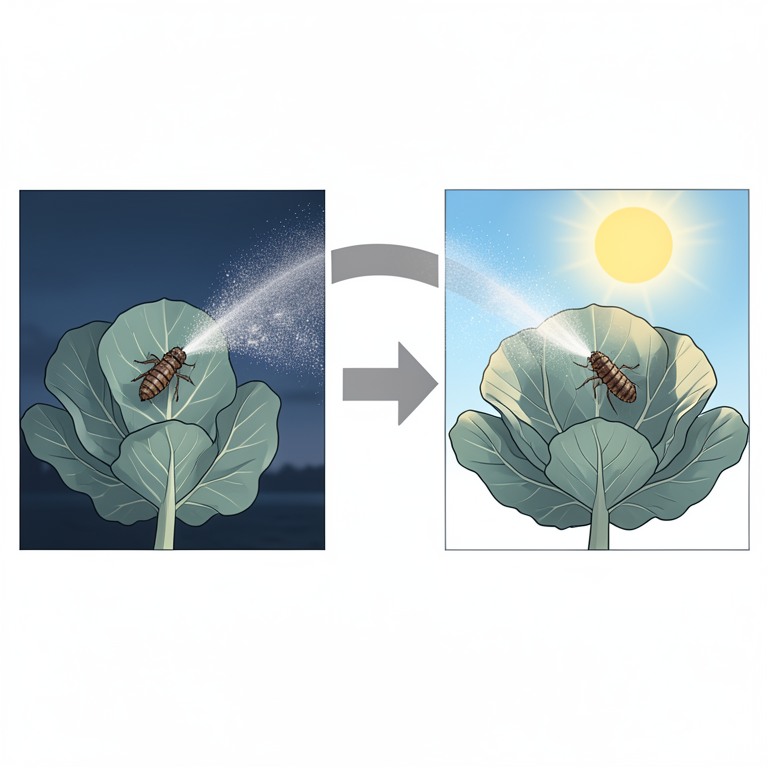
Integrated Pest Management Strategy
AI-generated conceptual illustration (Diamondback moth larvae on cabbage leaves). It explains the idea and does not show study data.
View source evidence ↗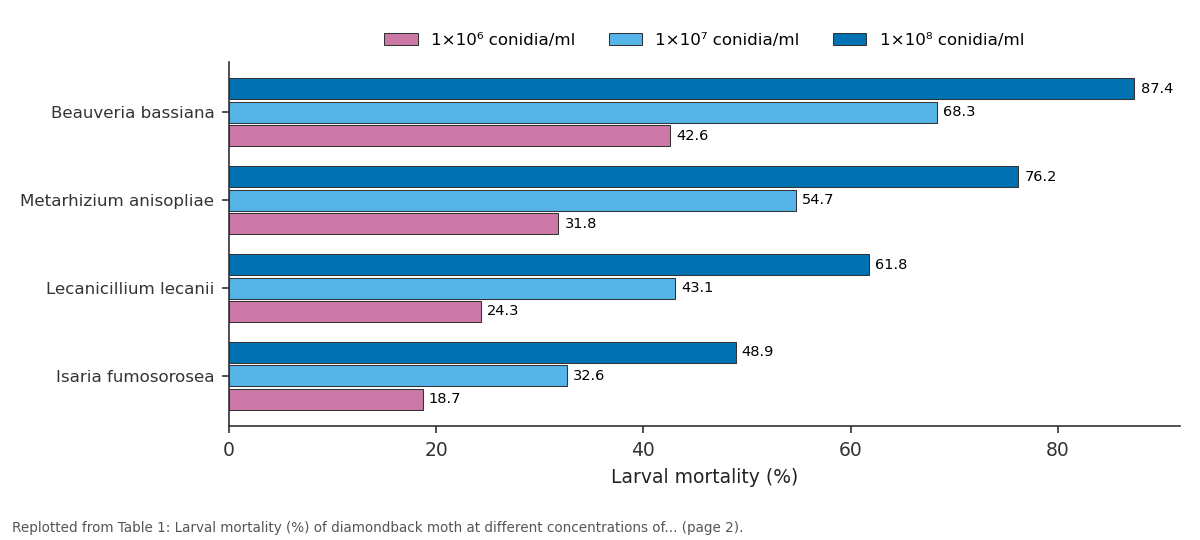
1×10⁶ conidia/ml and 1×10⁷ conidia/ml and more: Beauveria bassiana vs Metarhizium anisopliae vs Lecanicillium lecanii vs Isaria fumosorosea
Replotted from Table 1 (page 2) of the original paper. Every bar is the paper's own table value.
View source evidence ↗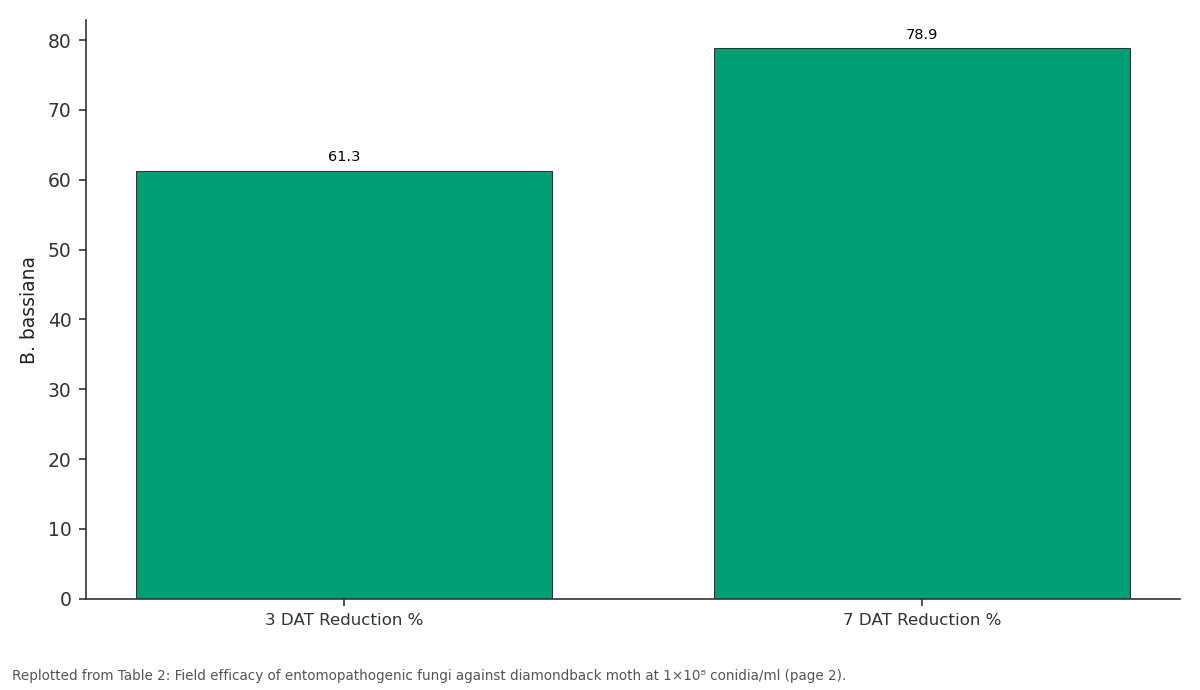
B. bassiana: 3 DAT Reduction % vs 7 DAT Reduction %
Replotted from Table 2 (page 2) of the original paper. Every bar is the paper's own table value.
View source evidence ↗Figures & tables
From the original paper Table 1
 Table 2
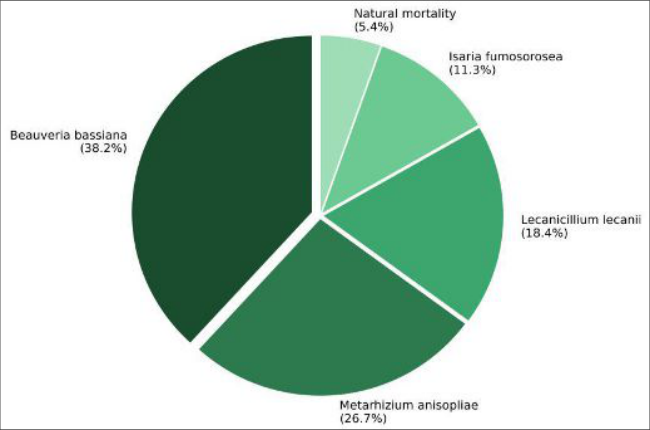 Figure 1
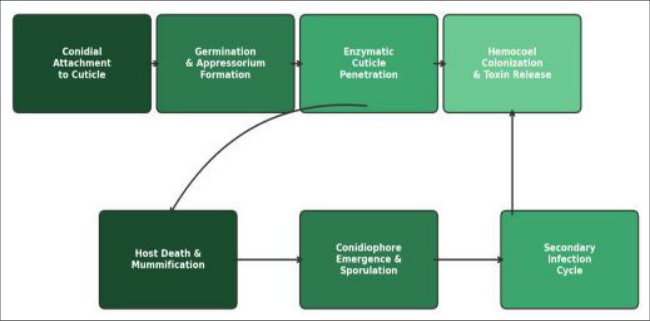 Figure 2
Introduction
Nearly 87% of cabbage-growing regions worldwide report diamondback moth infestation, making P. xylostella one of the most widespread pests of cruciferous vegetables [1] . It was also the first pest to develop field resistance to Bacillus thuringiensis toxins [2] . In the Indo-Gangetic plains, cabbage frequently suffers 30-52% yield reductions, and farmers often resort to five or more sprays per season [3] . This heavy chemical dependence has led to resistant populations, destruction of natural enemies, and unacceptable residues [4] . Entomopathogenic fungi act through contact infection rather than ingestion, giving them an advantage against diverse pest types [5] . Species such as B. bassiana and M. anisopliae have shown encouraging results against agricultural pests [6] . The infection begins with conidial attachment to the cuticle, followed by germination, penetration, hemocoel colonization, and host death through nutrient depletion and toxin production [7] . Despite the availability of commercial formulations, field performance can be inconsistent due to temperature and humidity sensitivity [8] . This research compared the virulence of four fungal species against diamondback moth to identify the most effective species and concentration for integration into pest management programmes.
Research Area Description
The field trials were carried out at the Vegetable Research Farm of Narendra Deva University of Agriculture and Technology, Kumarganj, Ayodhya district, Uttar Pradesh (26.47° N, 81.87° E, 113 m altitude). The region has a subtropical semi-arid climate with mean annual rainfall of 1,050 mm. Soils are alluvial (Typic Ustifluvents) with sandy loam texture and pH 7.6. Diamondback moth pressure is typically high from December through February.
Material and Methods Material
The research was conducted across two rabi seasons (October 2022 -February 2024) at the location described above. Four entomopathogenic fungi were obtained from NBAIR, Bengaluru: B. bassiana (NBAIR Bb-5a), M. anisopliae (NBAIR Ma-4), L. lecanii (NBAIR Vl-8), and I. fumosorosea (NBAIR If-2). Cultures were mass-produced on rice grain medium and conidia harvested into sterile 0.02% Tween-80 suspension [9] . Concentrations were adjusted to 1×10⁶, 1×10⁷, and 1×10⁸ conidia/ml. Cabbage variety Pride of India was transplanted at 60 × 45 cm in 5 m × 4 m plots [10] .
Methods
Laboratory bioassays followed a completely randomized design with five treatments at three concentrations and four replications. Third-instar larvae were sprayed with 2 ml suspension using a Potter's tower at 10 psi. Mortality was recorded at 24, 48, and 72 hours [11] . Field trials used a randomized block design with seven treatments and four replications. Sprays were applied at four larvae per plant threshold. Post-spray counts were made at 3, 7, and 14 days after treatment. Percent reduction was calculated using Henderson-Tilton's formula [12] . LC₅₀ and LT₅₀ were estimated by probit analysis [13] .
Results
Table Under field conditions, B. bassiana achieved 78.9% population reduction by seven days, statistically on par with spinosad at 84.6% (Table 2). Cabbage yields reflected pest control levels, with B. bassiana at 28.6 t/ha compared to 15.7 t/ha untreated. bassiana acts faster and requires a lower dose.
| Treatment | Pre-spray count | 3 DAT Reduction % | 7 DAT Reduction % | Yield (t/ha) |
|---|---|---|---|---|
| B. bassiana | 14.7 | 61.3 | 78.9 | 28.6 |
| M. anisopliae | 15.2 | 48.6 | 67.4 | 25.3 |
| L. lecanii | 14.1 | 37.8 | 54.2 | 22.8 |
| I. fumosorosea | 14.9 | 29.4 | 43.7 | 20.4 |
| Spinosad 45 SC | 15.3 | 72.1 | 84.6 | 30.2 |
| Untreated | 14.5 | 4.2 | 6.8 | 15.7 |
| SEm(±) | - | 2.38 | 3.12 | 1.24 |
| CD (P=0.05) | - | 7.14 | 9.36 | 3.72 |
Table text extracted from the original PDF; superscript letters are shown inline. The original table image is below.
View original table image
Discussion
The superiority of B. bassiana is consistent with literature spanning multiple insect orders [5,6] . A likely explanation is its broad enzymatic arsenal for cuticle degradation, particularly protease Pr1 and lipase activities [7] . Field performance, while lower than laboratory results, was still encouraging, with the gap smallest for B. bassiana (87.4% vs. 78.9%). The rapid decline in pest numbers between 3 and 7 days after treatment aligns with expected LT₅₀ values. That B. bassiana yields were not statistically different from spinosad makes a strong case for inclusion in resistance management programmes. Rotating B. bassiana with spinosad could slow resistance evolution. Biological agents also offer residual effects through secondary infection cycles, an advantage unavailable with synthetic products [14] .
Their compatibility with commonly used fungicides and herbicides has been established [15] , making them feasible components of integrated management.
Conclusion
B. bassiana at 1×10⁸ conidia/ml emerged as the top performer both in laboratory bioassays and field trials, with outcomes statistically comparable to spinosad. M. anisopliae is a viable alternative. Farmers should apply B. bassiana sprays in late afternoon when UV exposure is lower and target early larval instars. Integration with selective chemical insecticides in rotation can extend the useful life of both tools while reducing chemical burden on the crop and environment.
Acknowledgement
Acknowledgements Funding SourcesThis work was supported by routine departmental research funds. Institutional SupportThe authors acknowledge Narendra Deva University of Agriculture and Technology and CSK Himachal Pradesh Agricultural University for facilities. Contributions Not Qualifying for AuthorshipThanks to laboratory attendants for assistance with culture maintenance and bioassay setup.
Figures and tables from the paper
| Fungal Species | 1×10⁶ conidia/ml | 1×10⁷ conidia/ml | 1×10⁸ conidia/ml | Mean |
|---|---|---|---|---|
| Beauveria bassiana | 42.6 | 68.3 | 87.4 | 66.1 |
| Metarhizium anisopliae | 31.8 | 54.7 | 76.2 | 54.2 |
| Lecanicillium lecanii | 24.3 | 43.1 | 61.8 | 43.1 |
| Isaria fumosorosea | 18.7 | 32.6 | 48.9 | 33.4 |
| Untreated Control | 5.4 | 5.4 | 5.4 | 5.4 |
| SEm(±) | 1.83 | 2.14 | 2.67 | - |
| CD (P=0.05) | 5.49 | 6.42 | 8.01 | - |
Table text extracted from the original PDF; superscript letters are shown inline. The original table image is below.
View original table image
References
19 in the original paper- Furlong MJ, Wright DJ, Dosdall LM. Diamondback moth ecology and management. Annual Review of Entomology. 2013;58:517-541.
- Tabashnik BE. Evolution of resistance to Bacillus thuringiensis. Annual Review of Entomology. 1994;39:47-79.
- Gautam MP, Singh H, Kumar S. Diamondback moth population and estimated economic losses. Journal of Entomology and Zoology Studies. 2018;6(2):626-631.
- Sarfraz M, Dosdall LM, Keddie BA. Diamondback moth-host plant interactions. Crop Protection. 2006;25(7):625-639.
- Lacey LA, Grzywacz D, Shapiro-Ilan DI. Insect pathogens as biological control agents. Journal of Invertebrate Pathology. 2015;132:1-41.
- Shah PA, Pell JK. Entomopathogenic fungi as biological control agents. Applied Microbiology and Biotechnology. 2003;61(5):413-423.
- Vega FE, Goettel MS, Blackwell M. Fungal entomopathogens: new insights on their ecology. Fungal Ecology. 2009;2(4):149-159.
- Jaronski ST. Ecological factors in the inundative use of fungal entomopathogens. BioControl. 2010;55(1):159185.
- Goettel MS, Inglis GD. Fungi: hyphomycetes. In: Manual of techniques in insect pathology. Academic Press. 1997;1:213-249.
- Singh BK, Singh BN, Singh RN. Cabbage production technology in Eastern UP. Vegetable Science. 2007;34(1):82-84.
- Humber RA. Identification of entomopathogenic fungi. Academic Press. 2012;2:151-187.
- Henderson CF, Tilton EW. Tests with acaricides against the brown wheat mite. Journal of Economic Entomology. 1955;48(2):157-161.
- Finney DJ. Probit analysis. Cambridge University Press. 1971;3:1-333.
- Butt TM, Jackson C, Magan N. Fungi as biocontrol agents. CABI Publishing. 2001;1-390.
- Neves PMOJ, Hirose E, Tchujo PT. Compatibility of entomopathogenic fungi with neonicotinoid insecticides. BioControl. 2001;46(3):361-378. International Journal of Agriculture and Nutrition https://www.agriculturejournal.net
- Wraight SP, Ramos ME, Avery PB. Comparative virulence of Beauveria bassiana isolates. Journal of Invertebrate Pathology. 2010;103(3):186-199.
- Talekar NS, Shelton AM. Biology, ecology, and management of the diamondback moth. Annual Review of Entomology. 1993;38:275-301.
- Batta YA. Biocontrol of almond bark beetle by Beauveria bassiana. Crop Protection. 2007;26(11):1521-1525.
- Joia BS, Udeaan AS, Chawla RP. Insecticide resistance in diamondback moth in Punjab. Pesticide Research Journal. 2003;15(1):72-76.