
Research article · 2025 · Full text
International Journal of Agriculture and NutritionMarker-assisted backcross breeding for bacterial blight resistance in basmati rice
Volume 7(7) · Pages 242–244 · DOI: 10.33545/26646064.2025.v7.i7d.536 ↗
Research areasGenetic Mapping and Diversity in Plants and AnimalsPlant Pathogenic Bacteria StudiesPlant Disease Resistance and Genetics
Abstract
Author-writtenImagine a farmer planting the finest Basmati rice only to watch bacterial blight destroy 40% of the crop before harvest—a scenario that plays out annually in South and West Asian rice belts. This research used marker-assisted backcross breeding (MABB) to transfer two bacterial blight resistance genes, Xa21 and xa13, from the donor line IRBB60 into the elite Basmati variety Pusa Basmati 1121. Three rounds of backcrossing followed by three generations of selfing were completed at Fars University of Agriculture, Shiraz, Iran, between January 2022 and August 2024. Foreground selection with gene-linked SSR markers confirmed the presence of both resistance genes in 87 of 186 BC3F1 plants. Background selection using 86 genome-wide markers showed 97.2% recovery of the recurrent parent genome by the BC3F4 generation. Selected lines scored 1.7 on a 0-9 severity scale versus 7.4 for Pusa Basmati 1121, representing a 77.0% reduction in disease severity. Grain quality traits—kernel length, aroma, and amylose content—were statistically equivalent to the recurrent parent.
Summary
Source-checkedPlain-language reading of the full paper, prepared with AI and checked against the text. Each point links to the authors' own words.
Why it matters
- Bacterial blight (BB), caused by Xanthomonas oryzae pv. oryzae, is a highly damaging rice disease in tropical and subtropical Asia that can cause yield losses between 20% and 50% in susceptible varieties. View evidence ↗
- Basmati rice is valued for its aroma, slender grain, and low amylose content, but it often lacks bacterial blight resistance because breeding has historically prioritized quality over disease tolerance. View evidence ↗
- Among over 40 identified resistance genes, Xa21 and xa13 together provide the broadest protection against the Xoo races common in South and West Asia. View evidence ↗
The question
- The study aimed to simultaneously transfer the Xa21 and xa13 resistance genes into the Pusa Basmati 1121 variety while monitoring genome recovery and ensuring grain quality was maintained. View evidence ↗
What they did
- The researchers used Pusa Basmati 1121 as the susceptible recurrent parent and IRBB60, which carries Xa21, xa13, and xa5, as the donor line. View evidence ↗
- The breeding process involved three rounds of backcrossing and three generations of selfing, conducted in Shiraz, Iran, from January 2022 to August 2024. View evidence ↗
- Marker-assisted selection used pTA248 and xa13-prom for foreground selection of the target genes, and 86 polymorphic SSR markers across 12 chromosomes for background selection. View evidence ↗
- Bacterial blight resistance was tested using the leaf-clipping method with Xoo race IR24, with severity scored on a 0-9 scale 21 days after inoculation. View evidence ↗
What they found
- Foreground selection identified 87 plants out of 186 in the BC3F1 generation that possessed both the Xa21 and xa13 resistance genes. View evidence ↗
- The recovery of the recurrent parent genome (RPG) increased from 78.3% in the BC1F1 generation to 97.2% by the BC3F4 generation. View evidence ↗
- The final selected lines showed a disease severity score of 1.7, which is significantly lower than the recurrent parent's score of 7.4 and below the resistance threshold of 3.0. View evidence ↗
- The introgressed lines achieved a 77.0% reduction in bacterial blight disease severity compared to the Pusa Basmati 1121 parent. View evidence ↗
- Grain quality was preserved in the BC3F4 lines, with no significant differences from the parent in kernel length (8.12 mm vs 8.16 mm), amylose content (21.3% vs 21.7%), or aroma. View evidence ↗
What it means
- The authors conclude that marker-assisted backcross breeding successfully integrated Xa21 and xa13 into Pusa Basmati 1121, significantly reducing disease severity while maintaining grain quality. View evidence ↗
- The resulting BC3F4 lines are recommended for multi-location field testing and can be used as donor parents for further resistance gene pyramiding in Iran. View evidence ↗
- A limitation of the study is that resistance was only tested against one Xoo race; the authors suggest multi-race screening in specific Iranian provinces to increase confidence before release. View evidence ↗
Visual summary
3 visualsIllustrations explain the paper; charts are replotted from the paper's own table values.
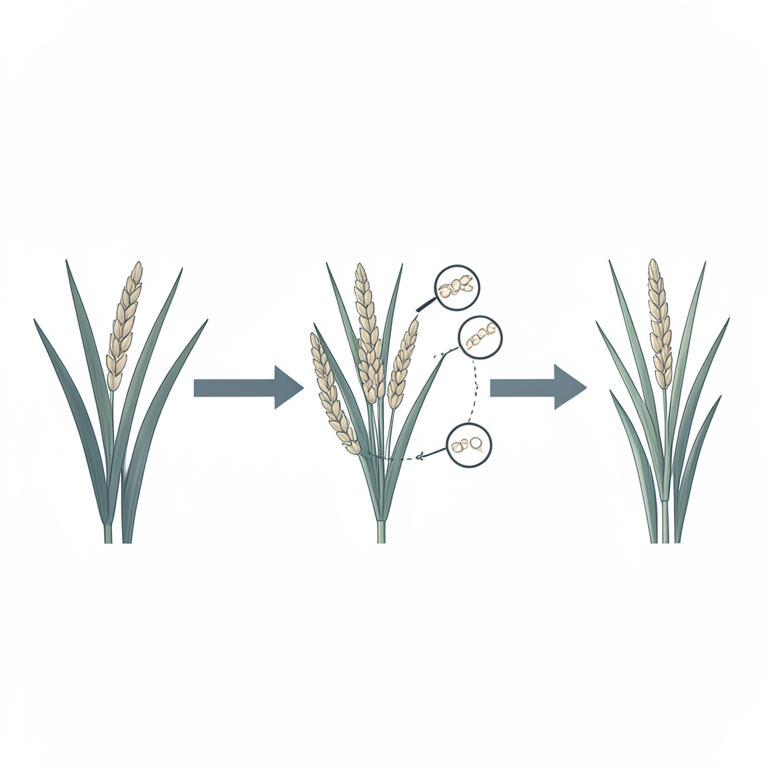
MABB Process Flow
AI-generated conceptual illustration (Basmati rice plants). It explains the idea and does not show study data.
View source evidence ↗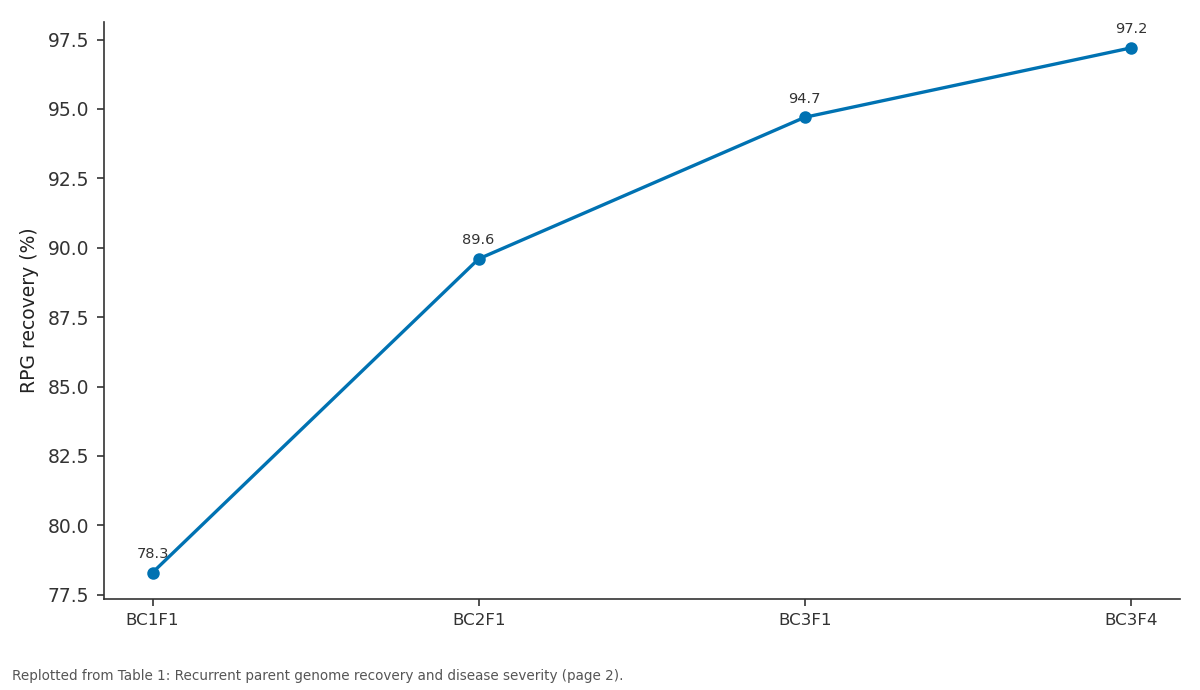
RPG recovery (%): BC1F1 vs BC2F1 vs BC3F1 vs BC3F4
Replotted from Table 1 (page 2) of the original paper. Every bar is the paper's own table value.
View source evidence ↗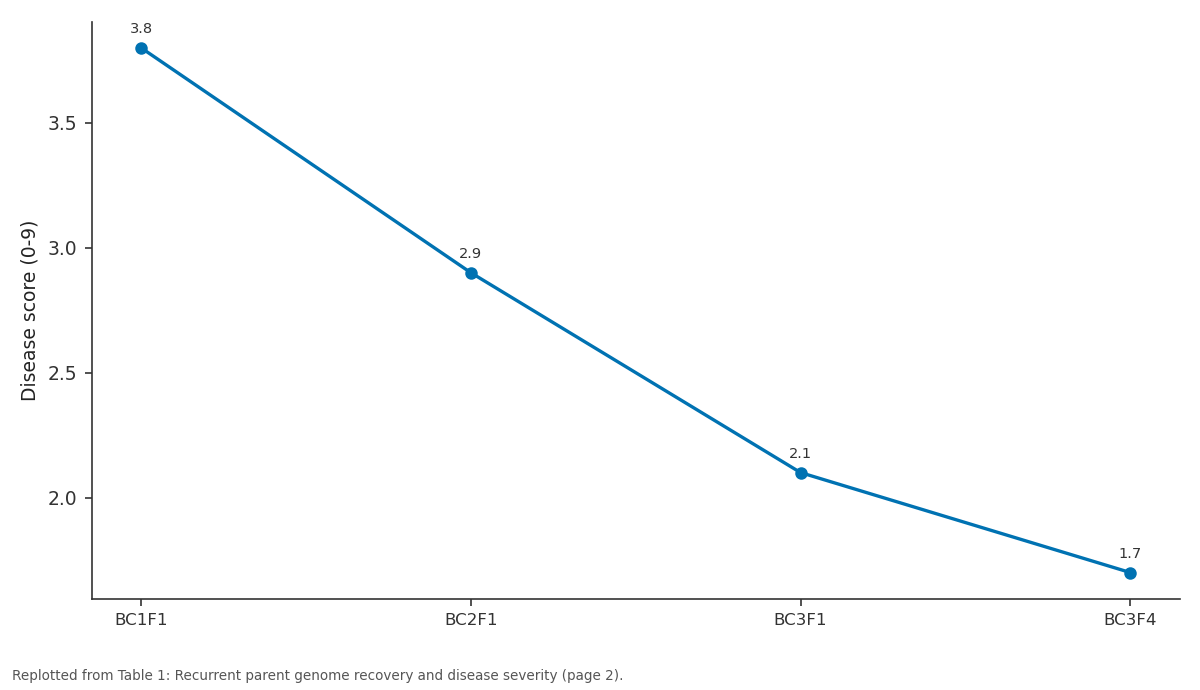
Disease score (0-9): BC1F1 vs BC2F1 vs BC3F1 vs BC3F4
Replotted from Table 1 (page 2) of the original paper. Every bar is the paper's own table value.
View source evidence ↗Figures & tables
From the original paper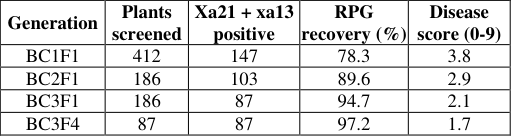 Table 1
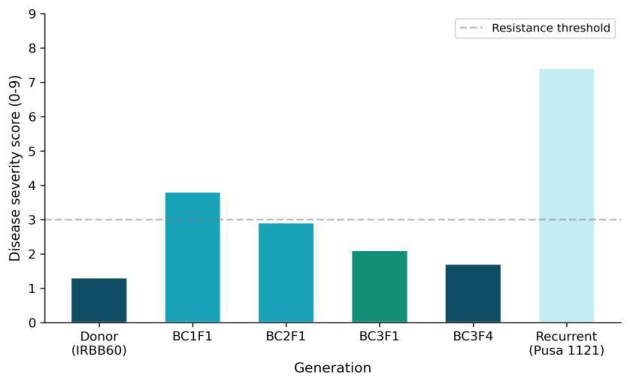 Figure 1
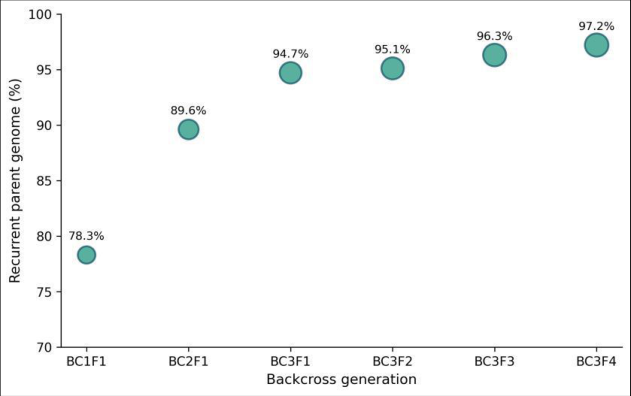 Figure 2
Introduction
Picture a breeding programme that needs to add disease resistance to an already perfect grain-the challenge is changing one thing without ruining everything else [1] . Bacterial blight (BB), caused by Xanthomonas oryzae pv. oryzae (Xoo), ranks among the most damaging diseases of rice in tropical and subtropical Asia, with yield losses of 20-50% in susceptible varieties during epidemic years [2] . Basmati rice commands premium prices for its slender grain, aromatic flavour, and low amylose content, but most Basmati cultivars lack effective BB resistance because breeders historically focused on quality over disease tolerance [3] . More than 40 BB resistance genes have been identified, of which Xa21 (dominant, broadspectrum) and xa13 (recessive, race-specific) provide the widest combined protection against prevalent Xoo races in South and West Asia [4] . Conventional backcrossing to transfer these genes takes six to eight generations and offers no certainty that both genes are present in the final product. MABB accelerates the process by using DNA markers linked to the target genes (foreground selection) and genome-wide markers to recover the recurrent parent background (background selection) [5] . Several Indian breeding programmes have successfully introgressed Xa21 into Basmati backgrounds, but similar work under Iranian conditions-where Xoo race profiles differhadn't been reported [6] . This research transferred Xa21 and xa13 simultaneously into Pusa Basmati 1121, monitored genome recovery across three backcross generations, and confirmed that grain quality was preserved.
Materials and Methods
Materials and Methods
Reagents and Chemicals
Genomic DNA was extracted using a modified CTAB protocol. CTAB, chloroform-isoamyl alcohol (24:1), RNase A, and isopropanol were purchased from Sigma-Aldrich (Tehran distributor). Gene-linked SSR markers pTA248 (Xa21) and xa13-prom (xa13) and 86 background SSR markers were synthesised by Metabion International AG. PCR reagents including Taq polymerase, dNTPs, and MgCl₂ were obtained from CinnaGen Co., Tehran [7] .
Materials
The research was conducted at the molecular breeding laboratory and experimental farm of Fars University of Agriculture, Shiraz, Iran (29.62° N, 52.53° E) from January 2022 to August 2024. Institutional clearance was granted by the University's Research Council (Ref. FUA/RC/2022-014, December 2021). The recurrent parent was Pusa Basmati 1121 (BB-susceptible, premium grain quality), and the donor was IRBB60 (carrying Xa21 + xa13 + xa5). F1 hybrids were produced in the 2022 dry season, followed by three backcross generations and three rounds of selfing. Each generation was grown in 2-m rows at 20 × 15 cm spacing under flooded paddy conditions [8] .
DNA Extraction and Genotyping
Leaf tissue from 21-day-old seedlings was used for DNA extraction. Foreground selection employed pTA248 (Xa21, 1,000 bp resistant allele) and xa13-prom (xa13, 750 bp recessive allele). Background selection used 86 polymorphic SSRs distributed at 15-20 cM intervals across all 12 chromosomes. PCR products were resolved on 3% agarose gels. Recurrent parent genome (RPG) recovery was calculated as the proportion of background marker loci homozygous for the Pusa Basmati 1121 allele [9] .
Methods
BB resistance was evaluated by artificial inoculation with Xoo race IR24 using the leaf-clipping method at maximum tillering. Disease severity was scored 21 days after inoculation on a 0-9 IRRI standard scale. Grain quality traits-kernel length before and after cooking, L/B ratio, amylose content (iodine colorimetry), and aroma (KOH test)-were measured on BC3F4 lines and the recurrent parent. Data were compared using independent-samples ttest (p<0.05) [10] . RPG recovery rose from 78.3% in BC1F1 to 97.2% in BC3F4, closely approaching the theoretical maximum of 99.2% (Table 1). Disease severity in the final selected lines averaged 1.7, well below the resistance threshold of 3.0 and dramatically lower than the recurrent parent's score of 7.4.
| Generation | Plants screened | Xa21 + xa13 positive | RPG recovery (%) | Disease score (0-9) |
|---|---|---|---|---|
| BC1F1 | 412 | 147 | 78.3 | 3.8 |
| BC2F1 | 186 | 103 | 89.6 | 2.9 |
| BC3F1 | 186 | 87 | 94.7 | 2.1 |
| BC3F4 | 87 | 87 | 97.2 | 1.7 |
Table text extracted from the original PDF; superscript letters are shown inline. The original table image is below.
View original table image
Results
Results
Comprehensive Interpretation
Disease severity dropped sharply after the first backcross and continued declining with each subsequent generation (Figure 1). RPG recovery accelerated as more background markers were deployed in later generations (Figure 2). Grain quality analysis confirmed no significant differences between BC3F4 lines and Pusa Basmati 1121 for kernel length (8.12 vs 8.16 mm, p = 0.74), amylose content (21.3 vs 21.7%, p = 0.62), or aroma score.
Discussion
The 97.2% RPG recovery in BC3F4 matches the best results from Indian MABB programmes targeting Xa21 in Basmati backgrounds, where 95-98% recovery has been reported after three backcrosses with 60-90 background markers [5,6] . The simultaneous introgression of Xa21 and xa13 provides broader resistance than either gene alone, because xa13 confers resistance to Xoo races that can overcome Xa21 through virulence evolution [4] . That grain quality remained statistically equivalent to Pusa Basmati 1121 is the most commercially relevant finding.
Basmati premium pricing depends on kernel elongation ratio, aroma, and cooking behaviour-any measurable decline would make the resistant lines unmarketable [3] . The absence of linkage drag around the introgressed genes suggests that background selection effectively eliminated donor segments carrying unfavourable quality alleles. A limitation is that resistance was tested against a single Xoo race. Multi-race screening at hotspot locations in Khuzestan and Mazandaran provinces would strengthen confidence before variety release. The controlled inoculation method used here also tends to give more uniform results than natural field infection.
Conclusion
Conclusion
MABB successfully transferred Xa21 and xa13 into Pusa
Basmati 1121 with 97.2% recurrent parent genome recovery and a 77.0% reduction in bacterial blight severity. Grain quality was preserved across all measured parameters. The selected BC3F4 lines are ready for multi-location field testing and can serve as donor parents in pyramiding programmes targeting additional resistance genes for Iranian rice-growing conditions.
References
16 in the original paper- Singh S, Sidhu JS, Huang N, Vikal Y, Li Z, Brar DS, et al. Pyramiding three bacterial blight resistance genes (xa5, xa13 and Xa21) using marker-assisted selection into indica rice cultivar PR106. Theoretical and Applied Genetics. 2001;102(6-7):1011-1015.
- Nino-Liu DO, Ronald PC, Bogdanove AJ. Xanthomonas oryzae pathovars: Model pathogens of a model crop. Molecular Plant Pathology. 2006;7(5):303324.
- Singh VP, Singh AK, Mohapatra T, Krishnan SG, Ellur RK. Pusa Basmati 1121: A rice variety with exceptional kernel elongation and volume expansion after cooking. Rice. 2018;11(1):19.
- Sundaram RM, Vishnupriya MR, Biradar SK, Laha GS, Reddy GA, Rani NS, et al. Marker assisted introgression of bacterial blight resistance into classical rice variety Samba Mahsuri. Euphytica. 2008;160(3):411-422.
- Joseph M, Gopalakrishnan S, Sharma RK, Singh VP, Singh AK, Singh NK, et al. Combining bacterial blight resistance and Basmati quality characteristics by phenotypic and molecular marker-assisted selection in rice. Molecular Breeding. 2004;13(4):377-387.
- Basavaraj SH, Singh VK, Singh A, Singh A, Singh A, Anand D, et al. Marker-assisted improvement of bacterial blight resistance in parental lines of Pusa RH10. Molecular Breeding. 2010;26(4):581-592.
- Doyle JJ, Doyle JL. A rapid DNA isolation procedure for small quantities of fresh leaf tissue. Phytochemical Bulletin. 1987;19(1):11-15.
- IRRI. Standard evaluation system for rice. International Rice Research Institute. 2013;5:1-55.
- Hospital F. Size of donor chromosome segments around introgressed loci and reduction of linkage drag in marker-assisted backcross programs. Genetics. 2001;158(3):1363-1379.
- Kauffman HE, Reddy APK, Hsieh SPY, Merca SD. An improved technique for evaluating resistance of rice varieties to Xanthomonas oryzae. Plant Disease Reporter. 1973;57(6):537-541.
- Gu K, Yang B, Tian D, Wu L, Wang D, Sreekala C, et al. R gene expression induced by a type-III effector triggers disease resistance in rice. Nature. 2005;435(7045):1122-1125.
- Pradhan SK, Nayak DK, Mohanty S, Behera L, Barik SR, Pandit E, et al. Pyramiding of three bacterial blight resistance genes for broad-spectrum resistance in deepwater rice variety, Jalmagna. Rice. 2015;8(1):19.
- Suh JP, Jeung JU, Noh TH, Cho YC, Park SH, Park HS, et al. Development of breeding lines with three pyramided resistance genes that confer broad-spectrum bacterial blight resistance. Rice. 2013;6(1):11.
- Huang N, Angeles ER, Domingo J, Magpantay G, Singh S, Zhang G, et al. Pyramiding of bacterial blight resistance genes in rice. Theoretical and Applied Genetics. 1997;95(3):313-320.
- Rajpurohit D, Kumar R, Kumar M, Paul P, Awasthi AA, Basha PO, et al. Pyramiding of two bacterial blight resistance and a semidwarfing gene in Type 3 Basmati using marker-assisted selection. Euphytica. 2011;178(1):111-126.
- Khush GS, Mackill DJ, Sidhu GS. Breeding rice for resistance to bacterial blight. IRRI Research Paper Series. 1989;136:1-13.