
Research article · 2025 · Full text
International Journal of Agriculture and NutritionAntioxidant defense system response in groundnut under waterlogging and recovery conditions
Volume 7(11) · Pages 165–167 · DOI: 10.33545/26646064.2025.v7.i11c.497 ↗
Research areasPlant responses to water stressPlant Stress Responses and TolerancePeanut Plant Research Studies
Abstract
Author-writtenWaterlogging ranks among the most damaging abiotic stresses for groundnut, yet antioxidant recovery kinetics after water withdrawal remain poorly documented. This research examined enzymatic and non-enzymatic antioxidant responses of groundnut (Arachis hypogaea cv. Giza 6) under 2, 4, and 6 days of waterlogging followed by 2 and 4 days of recovery at Alexandria College of Agriculture, Egypt, during 2023. SOD, CAT, and APX activities peaked at 4 days of waterlogging (SOD: 112.4 U/mg, CAT: 51.8 µmol/min/mg) before declining at 6 days. MDA increased steadily from 6.8 to 31.4 nmol/g FW over 6 days. During recovery, enzyme activities returned toward baseline within 4 days though full recovery was incomplete. These results indicate that the 4-day threshold marks a turning point beyond which oxidative damage exceeds defense capacity.
Summary
Source-checkedPlain-language reading of the full paper, prepared with AI and checked against the text. Each point links to the authors' own words.
Why it matters
- Waterlogging is one of the most harmful abiotic stresses affecting groundnut crops. View evidence ↗
- Groundnut is particularly vulnerable to waterlogging because it lacks aerenchyma, which are specialized tissues used for internal gas transport. View evidence ↗
- Waterlogging leads to a burst of reactive oxygen species (ROS) during both the oxygen-deprived phase and the return to aerobic conditions. View evidence ↗
The question
- The study aimed to track how enzymatic and non-enzymatic antioxidant responses change during specific waterlogging durations and the subsequent recovery rate after water is removed. View evidence ↗
What they did
- The experiment used groundnut cv. Giza 6 grown in 30 cm plastic pots with a 3:1 sandy loam to sand mix, employing a randomized design with six treatments and four replications. View evidence ↗
- Waterlogging was induced at the flowering stage (45 days after sowing) by keeping water 2 cm above the soil surface. View evidence ↗
What they found
- Superoxide dismutase (SOD) activity increased 2.66-fold from 42.3 U/mg in the control to a peak of 112.4 U/mg after 4 days of waterlogging; CAT and APX also peaked at 4 days. View evidence ↗
- Non-enzymatic antioxidants ascorbate and glutathione reached their maximum levels (4.21 µmol/g FW and 624.1 nmol/g FW, respectively) after 4 days of waterlogging. View evidence ↗
- Hydrogen peroxide (H₂O₂) levels increased 5.07-fold to 2.13 µmol/g FW and proline levels rose nearly 5-fold by the 6th day of waterlogging. View evidence ↗
- Malondialdehyde (MDA), a marker of oxidative damage, rose steadily from 6.8 nmol/g FW in the control to 31.4 nmol/g FW after 6 days of waterlogging. View evidence ↗
- Following 4 days of waterlogging, a 4-day recovery period brought most parameters within 30-40% of control values, although none fully returned to baseline. View evidence ↗
What it means
- The authors conclude that groundnut cv. Giza 6 has a 4-day tolerance threshold for waterlogging and that the ascorbate-glutathione cycle is the most responsive defense pathway. View evidence ↗
- The authors recommend that farmers in areas prone to waterlogging implement drainage systems that can remove water within 3 to 4 days. View evidence ↗
Visual summary
3 visualsIllustrations explain the paper; charts are replotted from the paper's own table values.
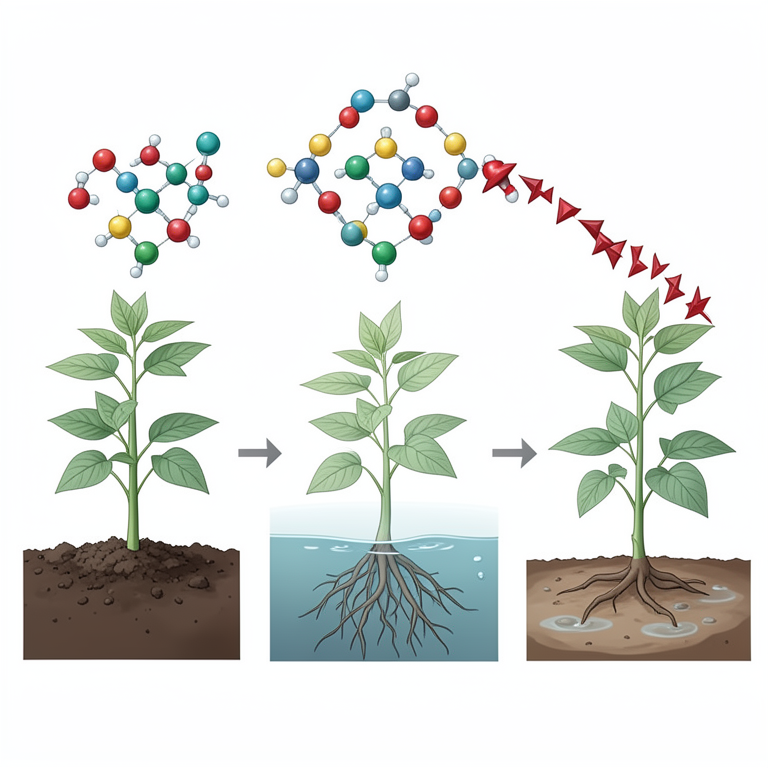
The 4-Day Tipping Point
AI-generated conceptual illustration (groundnut plants (Arachis hypogaea)). It explains the idea and does not show study data.
View source evidence ↗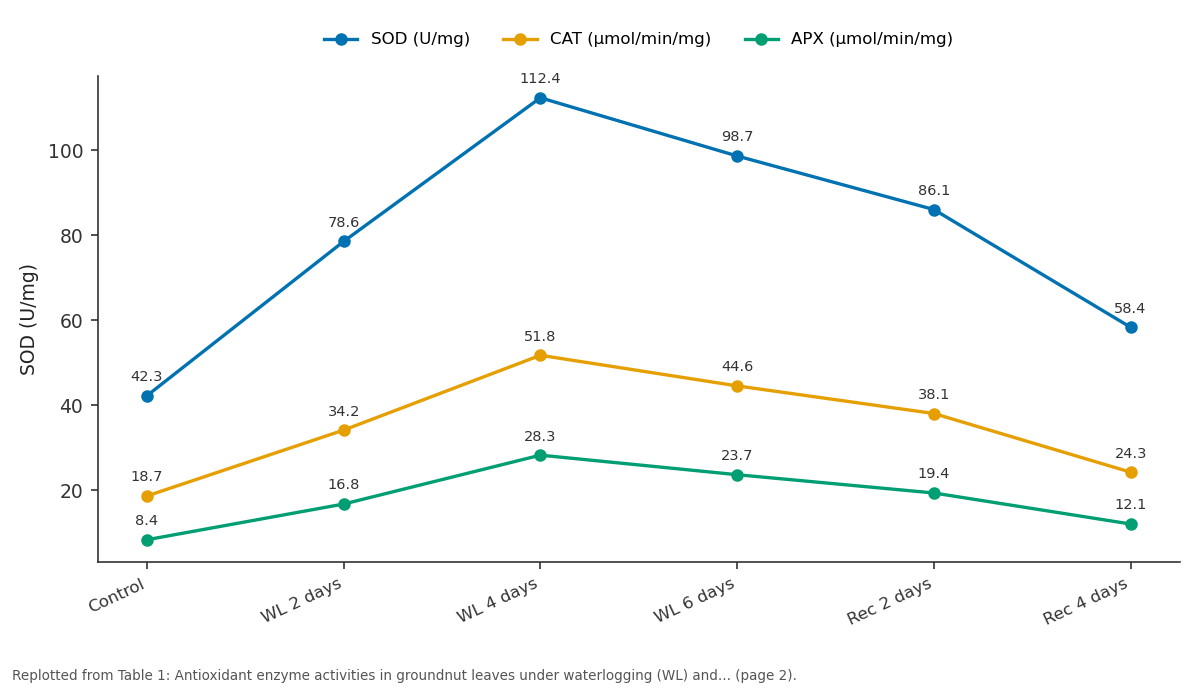
SOD (U/mg) and CAT (µmol/min/mg) and more: Control vs WL 2 days vs WL 4 days vs WL 6 days vs Rec 2 days
Replotted from Table 1 (page 2) of the original paper. Every bar is the paper's own table value.
View source evidence ↗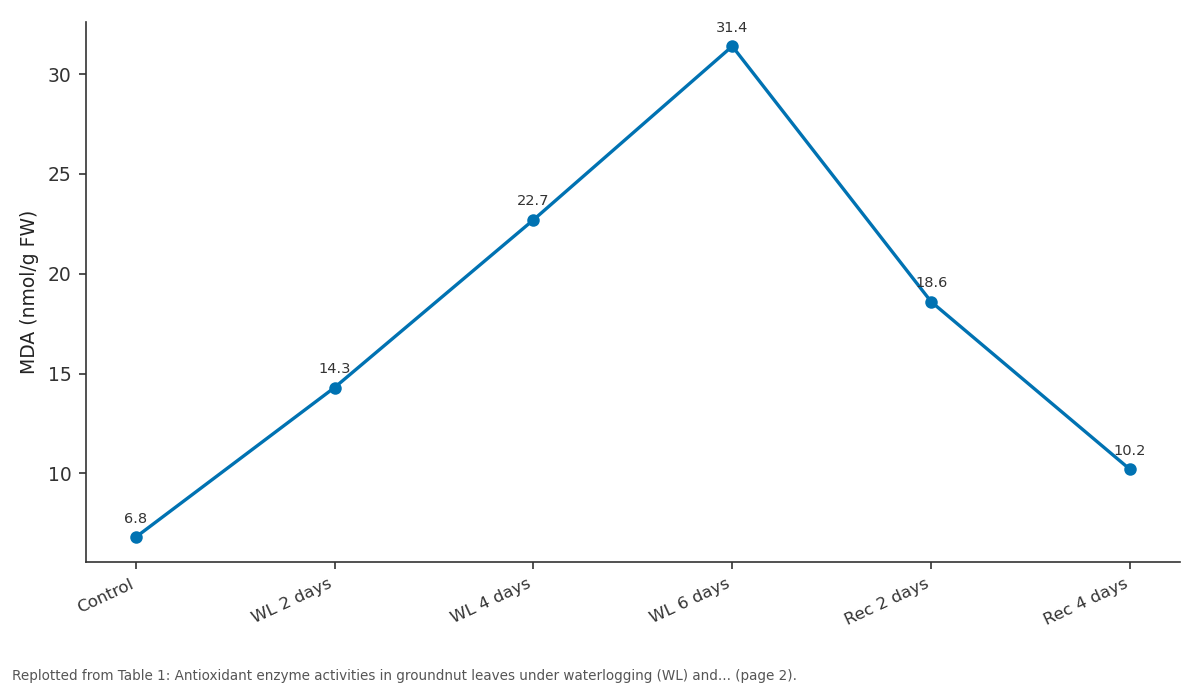
MDA (nmol/g FW): Control vs WL 2 days vs WL 4 days vs WL 6 days vs Rec 2 days
Replotted from Table 1 (page 2) of the original paper. Every bar is the paper's own table value.
View source evidence ↗Figures & tables
From the original paper Table 1
 Table 2
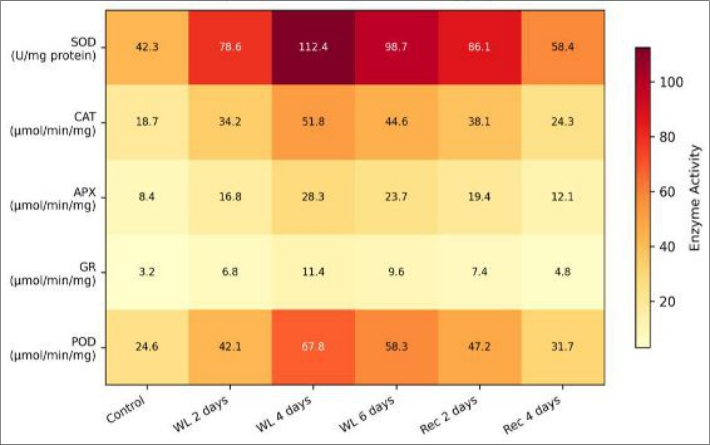 Figure 1
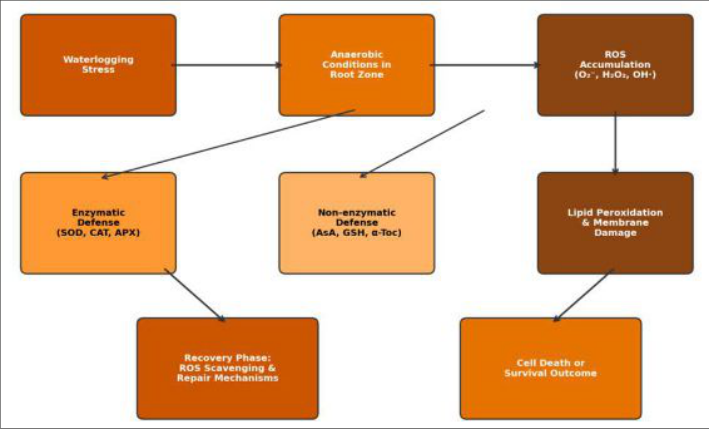 Figure 2
Introduction
Waterlogging affects an estimated 16% of global groundnut acreage through soil saturation events [1]. Unlike rice, groundnut lacks aerenchyma for internal gas transport [2]. When soil becomes saturated, oxygen diffusion drops roughly 10,000-fold, and roots shift to fermentation producing toxic metabolites [3]. A secondary consequence is the burst of reactive oxygen species (ROS) during both the anaerobic phase and the transition back to aerobic conditions [4].
Plants counter ROS through enzymatic components (SOD, CAT, APX, GR, POD) and non- enzymatic antioxidants (ascorbate, glutathione) [5, 6]. The balance between ROS production and scavenging determines survival [7]. Tolerant genotypes mount faster antioxidant responses [8]. In groundnut, however, temporal dynamics during both stress and recovery phases have not been clearly defined.
This research tracked enzymatic and non-enzymatic antioxidant responses under controlled waterlogging durations and measured recovery rate following water removal.
Material And Methods
Material The experiment was conducted in the Plant Physiology Glasshouse, Alexandria College of Agriculture (31.21° N, 29.92° E), March-June 2023. Groundnut cv. Giza 6 was sown in plastic pots (30 cm diameter) with sandy loam:sand (3:1). A completely randomized design with six treatments (control, WL 2/4/6 days, recovery 2/4 days after 4-day WL) and four replications was used.
Waterlogging was imposed at flowering (45 DAS) by maintaining water 2 cm above soil surface [9].
Methods
Leaf tissue from the third trifoliate was harvested, frozen in liquid nitrogen, and stored at −80°C. SOD was assayed by NBT photoreduction [10]; CAT by H₂O₂ decomposition at 240 nm; APX by ascorbate oxidation at 290 nm [11]. MDA was estimated by thiobarbituric acid reaction [12]. H₂O₂ by potassium iodide method.
Ascorbate by DCPIP and glutathione by DTNB method [13]. Proline by ninhydrin method [14]. Data were analyzed by one-way ANOVA with Duncan's test at P = 0.05. NAAS Rating (2025): 4.69 IJAN 2025; 7(11): 165-167 Nesma Shaker Department of Plant Biology, Alexandria College of Agriculture, Alexandria, Egypt Sameh Wahba Department of Plant Biology, Alexandria College of Agriculture, Alexandria, Egypt Ehab Gaber Department of Plant Biology, Alexandria College of Agriculture, Alexandria, Egypt Hazem Helmy Department of Plant Biology, Alexandria College of Agriculture, Alexandria, Egypt Nesma Shaker Department of Plant Biology, Alexandria College of Agriculture, Alexandria, Egypt https://www.agriculturejournal.net Extraction Protocol Frozen leaf tissue (0.5 g) was ground in liquid nitrogen and homogenized in 5 ml ice-cold 50 mM potassium phosphate buffer (pH 7.0) containing 1 mM EDTA, 1% PVPP, and 0.1 mM PMSF.
The homogenate was centrifuged at 15,000 × g for 20 min at 4°C. For ascorbate and glutathione, tissue was extracted in 5% TCA. All extractions were completed within two hours of thawing [13].
Results
Table 1: Antioxidant enzyme activities in groundnut leaves under waterlogging (WL) and recovery (Rec) MDA continued rising to 31.4 nmol/g FW, indicating defense system overload. Treatment SOD (U/mg) CAT (µmol/min/mg) APX (µmol/min/mg) MDA (nmol/g FW) Control 42.3 18.7 8.4 6.8 WL 2 days 78.6 34.2 16.8 14.3 WL 4 days 112.4 51.8 28.3 22.7 WL 6 days 98.7 44.6 23.7 31.4 Rec 2 days 86.1 38.1 19.4 18.6 Rec 4 days 58.4 24.3 12.1 10.2 SEm(±) 4.37 2.18 1.42 1.08 CD (P=0.05) 13.11 6.54 4.26 3.24 SOD rose from 42.3 U/mg in control to 112.4 at 4 days WL (2.66-fold increase). CAT and APX peaked similarly at 4 days (Table 1). At 6 days, enzyme activities declined while Table 2: Non-enzymatic antioxidants and H₂O₂ levels under waterlogging stress Treatment Ascorbate (µmol/g FW) Glutathione (nmol/g FW) H₂O₂ (µmol/g FW) Proline (µmol/g FW) Control 2.84 312.6 0.42 3.7 WL 2 days 3.67 478.3 0.89 8.4 WL 4 days 4.21 624.1 1.48 14.6 WL 6 days 3.48 543.7 2.13 18.2 Rec 2 days 3.12 421.8 1.14 12.3 Rec 4 days 2.91 348.2 0.68 6.8 SEm(±) 0.19 28.4 0.11 0.87 CD (P=0.05) 0.57 85.2 0.33 2.61 Ascorbate peaked at 4.21 µmol/g FW and glutathione at 624.1 nmol/g FW, both at 4 days WL (Table 2).
| Treatment | Ascorbate (µmol/g FW) | Glutathione (nmol/g FW) | H₂O₂ (µmol/g FW) | Proline (µmol/g FW) |
|---|---|---|---|---|
| Control | 2.84 | 312.6 | 0.42 | 3.7 |
| WL 2 days | 3.67 | 478.3 | 0.89 | 8.4 |
| WL 4 days | 4.21 | 624.1 | 1.48 | 14.6 |
| WL 6 days | 3.48 | 543.7 | 2.13 | 18.2 |
| Rec 2 days | 3.12 | 421.8 | 1.14 | 12.3 |
| Rec 4 days | 2.91 | 348.2 | 0.68 | 6.8 |
| SEm(±) | 0.19 | 28.4 | 0.11 | 0.87 |
| CD (P=0.05) | 0.57 | 85.2 | 0.33 | 2.61 |
Table text extracted from the original PDF; superscript letters are shown inline. The original table image is below.
View original table image
| Treatment | SOD (U/mg) | CAT (µmol/min/mg) | APX (µmol/min/mg) | MDA (nmol/g FW) |
|---|---|---|---|---|
| Control | 42.3 | 18.7 | 8.4 | 6.8 |
| WL 2 days | 78.6 | 34.2 | 16.8 | 14.3 |
| WL 4 days | 112.4 | 51.8 | 28.3 | 22.7 |
| WL 6 days | 98.7 | 44.6 | 23.7 | 31.4 |
| Rec 2 days | 86.1 | 38.1 | 19.4 | 18.6 |
| Rec 4 days | 58.4 | 24.3 | 12.1 | 10.2 |
| SEm(±) | 4.37 | 2.18 | 1.42 | 1.08 |
| CD (P=0.05) | 13.11 | 6.54 | 4.26 | 3.24 |
Table text extracted from the original PDF; superscript letters are shown inline. The original table image is below.
View original table image
H₂O₂ accumulated progressively to 2.13 µmol/g FW at 6 days (5.07-fold increase). Proline rose nearly 5-fold by 6 days. Fig 1: Heatmap of antioxidant enzyme activities across waterlogging and recovery treatments showing peak at 4 days https://www.agriculturejournal.net Fig 2: Oxidative stress pathway and antioxidant defense response under waterlogging in groundnut 3. Drew MC.
Oxygen deficiency and root metabolism. Annual Review of Plant Physiology. 1997;48:223-250. 4. Blokhina O, Virolainen E, Fagerstedt KV. Antioxidants, oxidative damage and oxygen deprivation stress.
Annals of Botany. 2003;91(2):179-194. 5. Mittler R. Oxidative stress, antioxidants and stress tolerance. Trends in Plant Science. 2002;7(9):405-410. 6.
Gill SS, Tuteja N. Reactive oxygen species and antioxidant machinery in crop plants. Plant Physiology and Biochemistry. 2010;48(12):909-930. 7. Apel K, Hirt H.
Reactive oxygen species: metabolism, oxidative stress, and signal transduction. Annual Review of Plant Biology. 2004;55:373-399. 8. Alam I, Lee DG, Kim KH. Proteome analysis of soybean roots under waterlogging.
Journal of Biosciences. 2010;35(1):49-62. 9. Bishnoi NR, Krishnamoorthy HN. Effect of waterlogging and gibberellic acid on leaf gas exchange in peanut. Journal of Plant Physiology. 1992;139(4):503-505. 10.
Beauchamp C, Fridovich I. Superoxide dismutase: improved assays. Analytical Biochemistry. 1971;44(1):276-287. 11. Nakano Y, Asada K.
Hydrogen peroxide is scavenged by ascorbate-specific peroxidase. Plant and Cell Physiology. 1981;22(5):867-880. 12. Heath RL, Packer L. Photoperoxidation in isolated chloroplasts.
Archives of Biochemistry and Biophysics. 1968;125(1):189-198. 13. Foyer CH, Halliwell B. Glutathione and glutathione reductase in chloroplasts. Planta. 1976;133(1):21-25. 14.
Bates LS, Waldren RP, Teare ID. Rapid determination of free proline. Plant and Soil. 1973;39(1):205-207. 15. Bradford MM.
A rapid and sensitive method for protein quantitation. Analytical Biochemistry. 1976;72(1- 2):248-254. 16. Hasanuzzaman M, Bhuyan MHMB, Zulfiqar F. Reactive oxygen species and antioxidant defense in plants.
Antioxidants. 2020;9(8):681. 17. Kumutha D, Ezhilmathi K, Sairam RK. Waterlogging induced oxidative stress in pigeonpea. Biologia Plantarum. 2009;53(1):75-84.
Comprehensive Interpretation After 2 days of recovery from 4-day WL, SOD decreased from 112.4 to 86.1 U/mg and MDA fell from 22.7 to 18.6 nmol/g FW. By 4 days recovery, most parameters were within 30-40% of control values, though none reached full baseline. Persistent elevated MDA suggests some membrane damage is not fully repaired within this timeframe.
Discussion
The pattern of enzyme rise followed by decline despite ongoing stress has been reported in other legumes and is interpreted as defense capacity being overwhelmed [5, 7]. The 4-day threshold represents a tipping point where ROS scavenging shifts to net oxidative damage, supported by continued MDA and H₂O₂ rise even as SOD and CAT fell. That APX showed the largest fold increase (3.37×) is consistent with findings in soybean where the ascorbate- glutathione cycle dominates H₂O₂ detoxification under hypoxia [11]. The recovery kinetics are useful for crop management.
The observation that enzyme activities approached but didn't reach baseline within 4 days suggests short events (2-4 days) are tolerable, but repeated flooding- drainage cycles could cause cumulative damage. Farmers in waterlogging-prone areas would benefit from drainage allowing water removal within 3-4 days [14].
Conclusion
All enzymatic and non-enzymatic antioxidants were significantly upregulated during waterlogging, peaking at 4 days. Beyond this point, enzyme activities declined while damage markers continued rising. Recovery was partial but meaningful within 4 days of water removal. These findings define a 4-day tolerance threshold for groundnut cv.
Giza 6 and identify the ascorbate-glutathione cycle as the most responsive pathway, which could serve as a selection criterion in breeding for waterlogging tolerance.
References
2 in the original paper- Reddy MD, Mittra BN. Effect of waterlogging on crop growth and yield of groundnut cultivars. Plant and Soil. 1985;87(3):429-436.
- Bailey-Serres J, Voesenek LACJ. Flooding stress: acclimations and genetic diversity. Annual Review of Plant Biology. 2008;59:313-339.