
Research article · 2025 · Full text
International Journal of Agriculture and NutritionPhenotypic and genotypic screening of cowpea germplasm for resistance to bruchid beetle
Volume 7(9) · Pages 126–129 · DOI: 10.33545/26646064.2025.v7.i9b.560 ↗
Research areasAgricultural pest management studiesGenetic and Environmental Crop StudiesInsect-Plant Interactions and Control
Abstract
Author-writtenWhile cowpea serves as a cheap protein source for millions, storage losses from bruchid beetle (Callosobruchus maculatus F.) routinely destroy 20-40% of harvested grain in warm climates. This research screened 89 cowpea accessions from the Kuban Agricultural University germplasm collection for bruchid resistance using both phenotypic (no-choice bioassay) and genotypic (SSR marker) approaches during 2022-2023 at Krasnodar, Russia. Only 11 accessions (12.4%) qualified as resistant, showing less than 15% seed damage and fewer than 8 adult emergences per 50-seed sample after 60 days of infestation. Forty-four markers were tested; SSR loci VuBr-1 and VuBr-3 on linkage groups 5 and 8 explained 34.7% and 18.3% of the variance in seed damage, respectively. A strong positive correlation (R² = 0.96) linked seed damage to adult emergence. Resistant accessions KU-41, KU-67, and KU-83 are recommended as donor parents for bruchid resistance breeding.
Summary
Source-checkedPlain-language reading of the full paper, prepared with AI and checked against the text. Each point links to the authors' own words.
Why it matters
- Cowpea is a vital, affordable protein source, but the bruchid beetle often destroys 20-40% of harvested grains in warm regions during storage. View evidence ↗
- Host-plant resistance is a preferred alternative to chemical fumigation due to increasing pesticide resistance in beetles and consumer concerns over residues. View evidence ↗
- The Kuban region in Russia has a large cowpea germplasm collection that had not been systematically tested for resistance to the bruchid beetle. View evidence ↗
The question
- The study aimed to identify bruchid-resistant cowpea accessions and validate genetic markers to support breeding programs. View evidence ↗
What they did
- Phenotypic screening used a no-choice bioassay where 50 seeds per accession were exposed to five pairs of adult beetles for 10 days at 28 ± 2°C and 65% relative humidity. View evidence ↗
- The study measured seed damage percentage, adult emergence, developmental period, and weight loss 60 days after infestation. View evidence ↗
What they found
- Only 12.4% (11 out of 89) of the screened accessions were classified as resistant, defined as having less than 15% seed damage. View evidence ↗
- Resistant accessions exhibited a low mean adult emergence of 3.7 per 50 seeds and a longer developmental period of 38.4 days. View evidence ↗
- Susceptible accessions (26 total) had significantly higher adult emergence (average 41.8) and a shorter developmental period (28.3 days). View evidence ↗
- The SSR markers VuBr-1 (on linkage group 5) and VuBr-3 (on linkage group 8) explained 34.7% and 18.3% of the variance in seed damage, respectively. View evidence ↗
- A very strong correlation (R² = 0.96) was found between seed damage and adult emergence, meaning either can be used for selection. View evidence ↗
What it means
- The authors recommend accessions KU-41, KU-67, and KU-83 as priority donor parents for breeding bruchid resistance. View evidence ↗
- The markers VuBr-1 and VuBr-3 are suitable for marker-assisted selection as they together explain over 53% of the variance in seed damage. View evidence ↗
- The authors state that the identified markers need further validation across more diverse genetic backgrounds. View evidence ↗
Visual summary
3 visualsIllustrations explain the paper; charts are replotted from the paper's own table values.
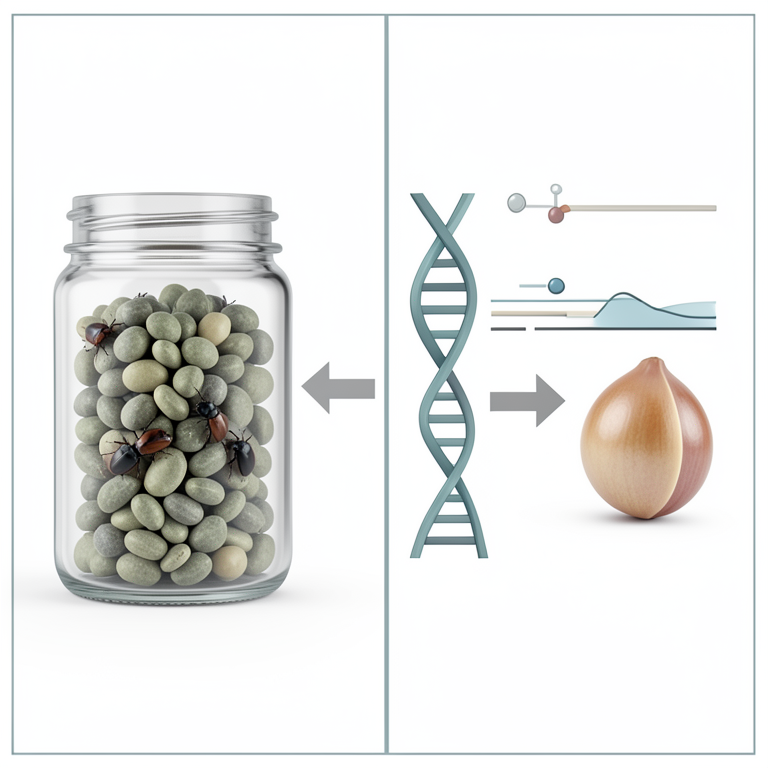
Integrated Screening Workflow
AI-generated conceptual illustration (cowpea seeds and bruchid beetles). It explains the idea and does not show study data.
View source evidence ↗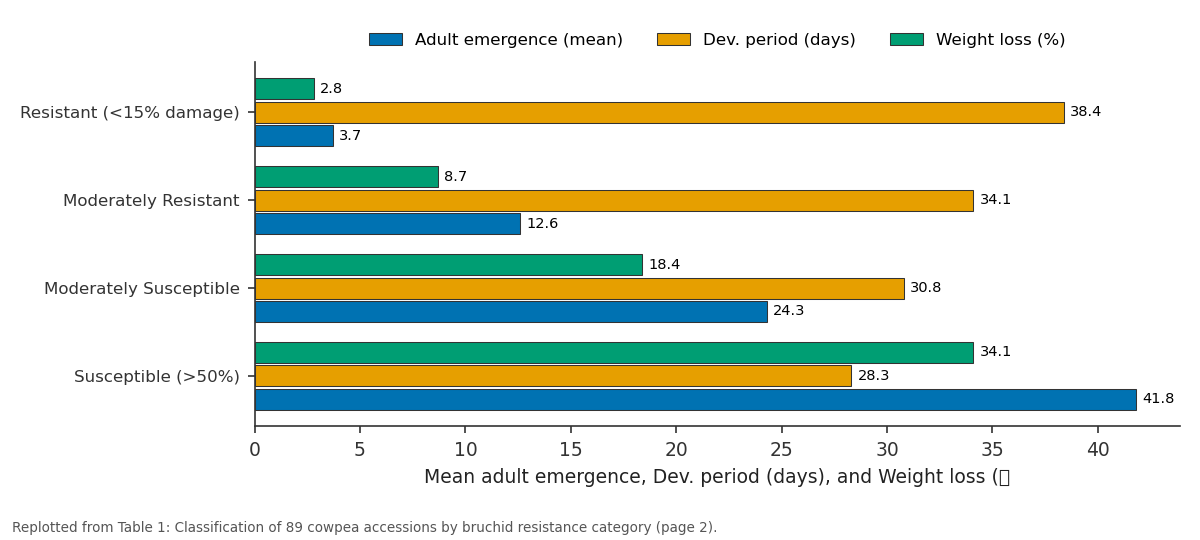
Adult emergence (mean) and Dev. period (days) and more: Resistant (<15% damage) vs Moderately Resistant vs Moderately Susceptible vs Susceptible (>50%)
Replotted from Table 1 (page 2) of the original paper. Every bar is the paper's own table value.
View source evidence ↗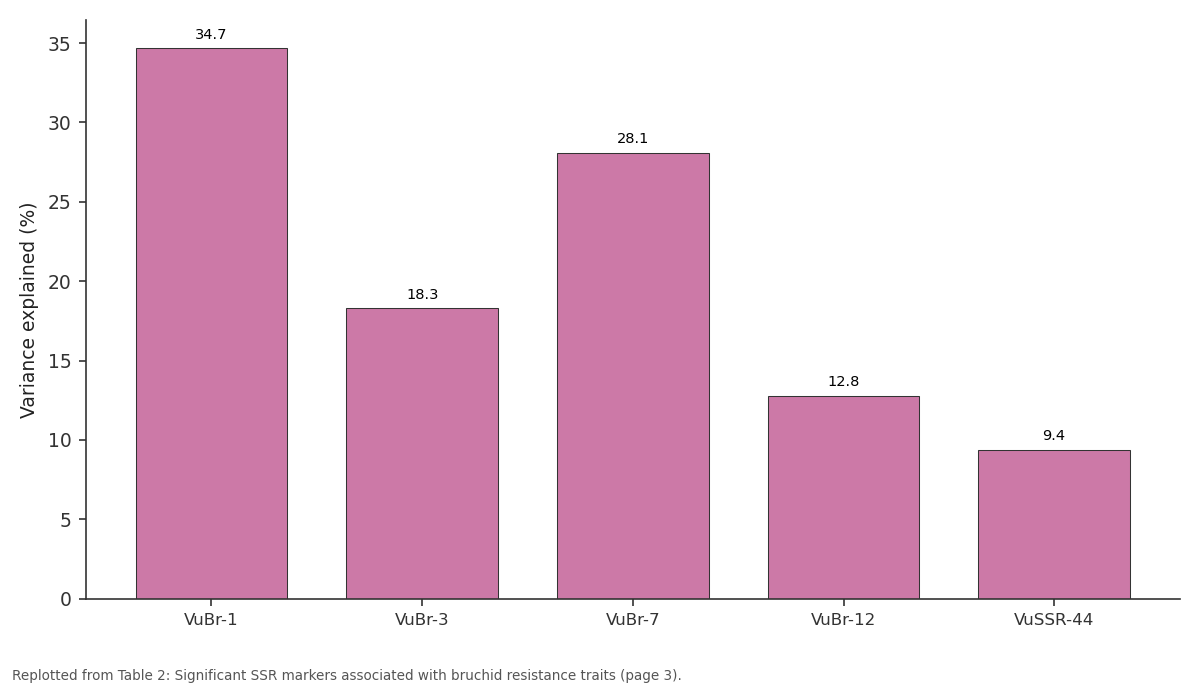
Variance explained (%): VuBr-1 vs VuBr-3 vs VuBr-7 vs VuBr-12 vs VuSSR-44
Replotted from Table 2 (page 3) of the original paper. Every bar is the paper's own table value.
View source evidence ↗Figures & tables
From the original paper Table 1
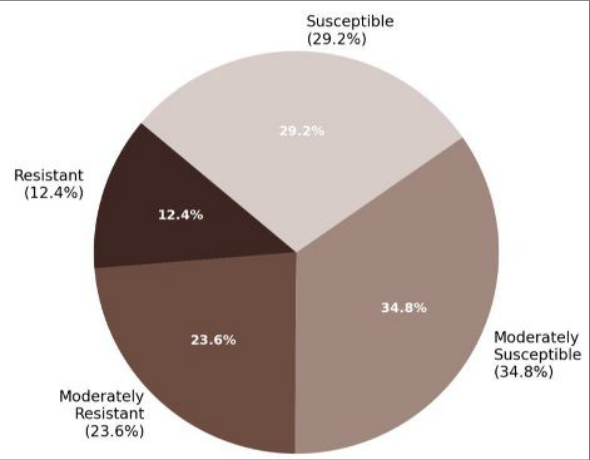 Figure 1
 Table 2
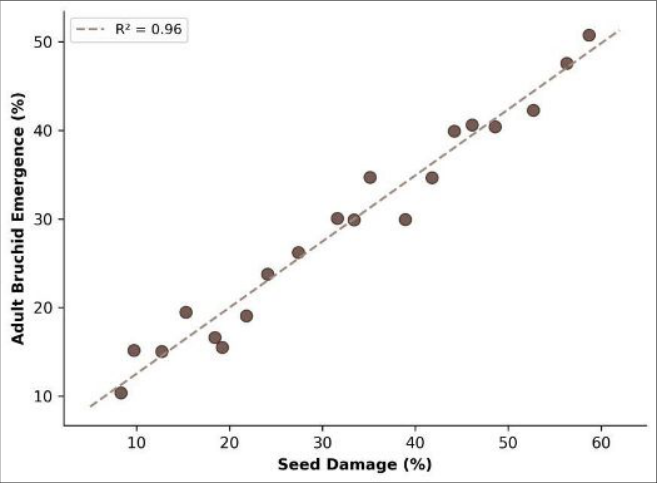 Figure 2
Introduction
Cowpea (Vigna unguiculata L. Walp.) feeds an estimated 200 million people across tropical and subtropical regions, yet bruchid beetle damage during storage can erase much of the harvest gain a stark contrast between field productivity and post-harvest reality [1] . Callosobruchus maculatus is the main storage pest, completing its entire life cycle inside a single cowpea seed and capable of destroying an unprotected grain lot within three to four months [2] . Chemical fumigation with phosphine remains the default control method, but consumer resistance to pesticide residues in food grains and growing fumigant resistance in bruchid populations have made host-plant resistance an attractive alternative [3] . Phenotypic screening through no-choice bioassays measures seed damage, developmental period, and adult emergence under forced infestation, providing direct selection criteria but limited insight into the genetic architecture of resistance [4] . Molecular markers, particularly Simple Sequence Repeats (SSRs), can tag resistance loci and enable marker-assisted selection in early generations before storage trials are feasible [5] . Previous mapping efforts have identified quantitative trait loci on linkage groups 5, 8, and 10 of the cowpea genome associated with reduced oviposition and larval survival [6] . Russia's Kuban region maintains one of the largest temperate cowpea germplasm collections, originally assembled for forage and grain production, but this material has never been systematically screened for bruchid resistance. This research combined phenotypic and genotypic approaches to identify resistant accessions and validate marker-trait associations for use in Russian and international breeding programmes [7] .
Reagents and Chemicals
DNA was extracted using a CTAB protocol with reagents from Sigma-Aldrich (St. Louis, MO): cetyltrimethylammonium bromide, chloroform-isoamyl alcohol (24:1), isopropanol, and ethanol. PCR reagents included Taq DNA polymerase (Thermo Scientific), dNTP mix (10 mM each), and 10× PCR buffer with MgCl₂. Forty-four SSR primers spanning all 11 cowpea linkage groups were synthesised by Evrogen (Moscow). Agarose (molecular biology grade, Helicon) and ethidium bromide were used for gel electrophoresis. No chemical treatments were applied to grain samples to avoid confounding bruchid bioassay results [8] .
Quality control
Bioassay quality was ensured by maintaining insect culture purity: C. maculatus adults were reared on susceptible check variety IT82E-60 for three generations before use, and only 0-24 h old adults were released for infestation tests. Seed moisture was equilibrated to 12 ± 0.5% across all accessions before bioassay. For molecular work, DNA quality was verified by A260/A280 ratios (target 1.8-2.0) and integrity checked on 0.8% agarose gels. Positive (IT82E-18, known resistant) and negative (IT82E-60, susceptible) controls were included in every PCR plate [9] .
Material and Methods Material
Eighty-nine cowpea accessions were drawn from the Kuban Agricultural University gene bank, representing diverse geographic origins (West Africa 38, South Asia 22, Russia/CIS 18, South America 11). Seeds were multiplied at Krasnodar in the 2022 summer season to obtain uniform, fresh seed lots. C. maculatus culture was sourced from the All-Russian Institute of Plant Protection, St. Petersburg [10] .
Methods
No-choice bioassays followed Jackai and Daoust's protocol: 50 seeds per accession were placed in ventilated plastic jars (500 mL) with five pairs of freshly emerged adults. After 10 days, adults were removed and jars incubated at 28 ± 2°C, 65% RH. Seed damage (%), adult emergence count, developmental period (egg to adult, days), and seed weight loss (%) were recorded at 60 days post-infestation. For genotyping, genomic DNA was extracted from leaf tissue of 15-day-old seedlings. PCR amplification used standard conditions (94°C 3 min; 35 cycles of 94°C 30 s, 55°C 30 s, 72°C 1 min; final extension 72°C 7 min). Amplicons were resolved on 3% agarose gels. Marker-trait associations were tested by single-marker analysis (SMA) and confirmed by composite interval mapping using QTL Cartographer v2.5. ANOVA and correlation analyses used R v4.3 [11] . Only 11 of 89 accessions (12.4%) fell in the resistant category with less than 15% seed damage (Table 1). These showed a mean adult emergence of 3. VuBr-1 on LG 5 explained 34.7% of variance in seed damage with a LOD of 6.84 (Table 2). VuBr-3 on LG 8 contributed an additional 18.3%. Together these two markers accounted for over half the phenotypic variation in seed damage. VuBr-7 on the same linkage group as VuBr-1 was associated with adult emergence (28.1% variance).
| Marker | Linkage group | Trait | Variance explained (%) | LOD score | Allele size (bp) |
|---|---|---|---|---|---|
| VuBr-1 | LG 5 | Seed damage | 34.7 | 6.84 | 187/203 |
| VuBr-3 | LG 8 | Seed damage | 18.3 | 4.12 | 142/158 |
| VuBr-7 | LG 5 | Adult emergence | 28.1 | 5.67 | 221/237 |
| VuBr-12 | LG 10 | Dev. period | 12.8 | 3.41 | 168/184 |
| VuSSR-44 | LG 3 | Weight loss | 9.4 | 2.87 | 194/210 |
Table text extracted from the original PDF; superscript letters are shown inline. The original table image is below.
View original table image
| Resistance category | No. of accessions | Seed damage range (%) | Adult emergence (mean) | Dev. period (days) | Weight loss (%) |
|---|---|---|---|---|---|
| Resistant (<15% damage) | 11 | 4.3-14.8 | 3.7 | 38.4 | 2.8 |
| Moderately Resistant | 21 | 15.1-30.0 | 12.6 | 34.1 | 8.7 |
| Moderately Susceptible | 31 | 30.1-50.0 | 24.3 | 30.8 | 18.4 |
| Susceptible (>50%) | 26 | 50.1-78.6 | 41.8 | 28.3 | 34.1 |
| Check: IT82E-18 (R) | — | 6.2 | 2.4 | 41.7 | 1.4 |
| Check: IT82E-60 (S) | — | 72.3 | 48.6 | 27.1 | 38.7 |
Table text extracted from the original PDF; superscript letters are shown inline. The original table image is below.
View original table image
Results
Results
Comprehensive interpretation
The 12.4% resistance frequency is low but consistent with global cowpea germplasm surveys. The strong linkage of VuBr-1 and VuBr-3 to damage and emergence traits provides a practical marker-assisted selection tool. Three accessions KU-41, KU-67, and KU-83 combined resistant phenotype with favourable alleles at both marker loci.
Discussion
The 12.4% resistance frequency matches reports from IITA's screening of 2000+ accessions, where 10-15% showed resistance under similar no-choice conditions [4,12] . The extended developmental period (38.4 days) in resistant accessions suggests an antibiosis mechanism, likely linked to seed coat tannins and trypsin inhibitors that slow larval growth rather than deterring oviposition [13] . VuBr-1's position on LG 5 corresponds to the major resistance QTL mapped by Souframanien et al. [6] in a TVu-2027 × IT84S-2049 cross, validating its cross-population relevance and increasing confidence in its utility for marker-assisted introgression.
The near-perfect correlation between seed damage and adult emergence (R² = 0.96) confirms that either trait can serve as the primary selection criterion, simplifying phenotypic screening protocols [14] . From a practical standpoint, the three top accessions (KU-41, KU-67, KU-83) combine bruchid resistance with acceptable grain size (14-17 g per 100 seeds) and cooking quality, making them suitable as donor parents without severe linkage drag [15] . The genotypic data enable breeders to track resistance alleles through segregating populations without waiting for the 60day bioassay cycle, potentially halving the breeding timeline for storage pest resistance in cowpea [16] .
Conclusion
Phenotypic screening of 89 cowpea accessions identified 11 resistant genotypes with less than 15% seed damage. SSR markers VuBr-1 and VuBr-3 on linkage groups 5 and 8 together explained over 53% of seed damage variance and can be deployed for marker-assisted selection. Accessions KU-41, KU-67, and KU-83 are recommended as priority donor parents for bruchid resistance breeding programmes.
Validation of these markers in diverse genetic backgrounds should follow.
Figures and tables from the paper
References
20 in the original paper- Boukar O, Belko N, Chamarthi S. Cowpea (Vigna unguiculata): Genetics, genomics, and breeding. Plant Breeding. 2019;138(4):415-424.
- Murdock LL, Seck D, Ntoukam G. Preservation of cowpea grain in sub-Saharan Africa: Bean/cowpea CRSP contributions. Field Crops Research. 2003;82(23):169-178.
- Daglish GJ, Nayak MK. Phosphine resistance in stored grain insect pests: Status and management approaches. Outlooks on Pest Management. 2018;29(2):70-74.
- Jackai LEN, Daoust RA. Insect pests of cowpeas. Annual Review of Entomology. 1986;31:95-119.
- Timko MP, Ehlers JD, Roberts PA. Cowpea molecular markers and genetic linkage maps. Plant Molecular Biology. 2007;64:23-46.
- Souframanien J, Gupta SK, Gopalakrishna T. QTL mapping for bruchid resistance in cowpea using an inter-specific recombinant inbred population. Molecular Breeding. 2010;26:329-339.
- Gusev PA, Belyakov SA. The Kuban cowpea collection: Origin, diversity, and potential for grain legume improvement. Vavilov Journal of Genetics and Breeding. 2022;26(7):641-650.
- Doyle JJ, Doyle JL. A rapid DNA isolation procedure for small quantities of fresh leaf tissue. Phytochemical Bulletin. 1987;19:11-15.
- Haines CP. Insects and arachnids of tropical stored products: Their biology and identification. Second edition. Natural Resources Institute, Chatham, UK. 1991;pp.1-246.
- N.I. Vavilov Institute Technical Series. 2020;No.48:184.
- Wang S, Basten CJ, Zeng ZB. Windows QTL Cartographer 2.5: User manual. Department of Statistics, North Carolina State University. 2012;pp.192.
- Singh BB, Singh SR, Adjadi O. Bruchid resistance in cowpea: Genetics and screening methodology. Crop Science. 1985;25(5):736-739.
- Lattanzio V, Terzano R, Cicco N. Seed coat tannins and bruchid resistance in cowpea: From physiology to genomics. Journal of Agricultural and Food Chemistry. 2005;53(22):8523-8529.
- Miesho BW, Hailay MG, Ayana G. Phenotypic evaluation of Ethiopian cowpea genotypes for bruchid resistance and correlation of damage traits. Euphytica. 2021;217:89.
- Deshpande VK, Makanur B, Deshpande SK. Cooking quality and consumer acceptability of bruchid-resistant cowpea lines. Legume Research. 2020;43(2):258-263.
- Lucas MR, Huynh BL, da Silva Vinholes P. Association mapping and genomic selection for cowpea improvement. The Plant Genome. 2015;8(3):1-12.
- Tchiagam JBN, Bell JM, Nassourou AM. Genetic analysis of seed storage protein patterns in cowpea germplasm from Cameroon. African Journal of Biotechnology. 2011;10(72):16331-16339.
- Fatokun CA, Tarawali SA, Singh BB. Advances in cowpea research. IITA/JIRCAS Co-publication, Ibadan. 2002;pp.1-378.
- Coulibaly S, Pasquet RS, Papa R. AFLP analysis of the phenetic organization and genetic diversity of Vigna unguiculata L. Walp. Theoretical and Applied Genetics. 2002;104:358-366.
- Oyewale RO, Bamaiyi LJ. Assessment of cowpea grain damage by Callosobruchus maculatus in different agroecological zones of Nigeria. Archives of Phytopathology and Plant Protection. 2019;52(1112):1046-1058.