
Research article · 2025 · Full text
International Journal of Agriculture and NutritionGrowth performance and carbon sequestration of poplar-based agroforestry systems in temperate plains
Volume 7(11) · Pages 119–122 · DOI: 10.33545/26646064.2025.v7.i11b.491 ↗
Research areasAgroforestry and silvopastoral systemsBioenergy crop production and managementAgronomic Practices and Intercropping Systems
Abstract
Author-writtenAgroforestry systems that pair fast-growing tree species with seasonal crops offer a dual benefit that neither monoculture farming nor pure forestry can match on its own: agricultural income and carbon storage operating on the same piece of land. This research quantified the growth performance, biomass production, and carbon sequestration potential of seven-year-old poplar (Populus deltoides) plantations intercropped with wheat, mustard, and turmeric at the Agriculture Campus of IGNTU, Amarkantak, Madhya Pradesh, during 2021-2023. Sole poplar accumulated the highest tree biomass at 124.6 t/ha and total carbon stock of 58.7 t/ha. However, the poplar-wheat combination achieved the highest total system carbon sequestration rate of 10.24 t CO₂/ha/yr and a land equivalent ratio (LER) of 1.32, indicating 32% greater land-use efficiency than growing trees and crops separately. Soil organic carbon in the top 30 cm was also highest under poplar-wheat (38.6 t/ha) compared to sole crops (22.4 t/ha). These results position poplar-based agroforestry as an effective land use strategy for combining food production with climate change mitigation in the temperate plains of central India.
Summary
Source-checkedPlain-language reading of the full paper, prepared with AI and checked against the text. Each point links to the authors' own words.
Why it matters
- Agroforestry systems combining fast-growing trees and seasonal crops provide simultaneous agricultural income and carbon storage, offering advantages over monoculture farming or pure forestry. View evidence ↗
- Poplar (Populus deltoides) is a preferred species for agroforestry due to its rapid growth, straight trunk, market demand, and deciduous nature, which permits winter light to reach crops. View evidence ↗
- In these systems, tree biomass serves as a long-term carbon sink, and root turnover and litter inputs increase soil organic carbon more effectively than annual crops alone. View evidence ↗
The question
- The study aimed to identify the most productive and carbon-efficient land use configuration by comparing biomass accumulation, carbon partitioning, and sequestration rates across four poplar-based systems. View evidence ↗
What they did
- The research was carried out at the IGNTU Agriculture Campus in Amarkantak, Madhya Pradesh, India. View evidence ↗
- The study evaluated four systems: sole poplar (8m x 3m spacing), poplar intercropped with wheat, mustard, or turmeric, and a sole crop rotation of wheat-mustard as a control. View evidence ↗
- Measurements were taken on seven-year-old trees across four replicate plots of 0.1 hectares each, using a randomized block design. View evidence ↗
- Total system carbon stock was calculated by summing above-ground biomass (tree and crop), below-ground biomass (estimated at 26% of above-ground tree biomass), litter carbon, and soil organic carbon up to 30 cm depth. View evidence ↗
What they found
- Sole poplar plantations achieved the highest tree biomass at 124.6 t/ha and the highest carbon stock at 58.7 t/ha. View evidence ↗
- Intercropping reduced tree biomass by 21-37% compared to sole poplar, which the authors attribute to competition for resources below ground. View evidence ↗
- Soil organic carbon (SOC) was highest in the poplar-wheat system at 38.6 t/ha, which was 3.8 t/ha more than in sole poplar plantations. View evidence ↗
- The poplar-wheat system demonstrated the highest CO₂ sequestration rate at 10.24 t/ha/yr. View evidence ↗
- All agroforestry systems showed a land-use advantage (LER > 1.0), with the poplar-wheat system being the most efficient with an LER of 1.32. View evidence ↗
- Tree diameter at breast height (DBH) growth decreased from 12.4 cm/yr in sole plantations to 9.8 cm/yr in intercropped systems. View evidence ↗
What it means
- The authors conclude that the poplar-wheat combination is the best overall system for balancing food production and carbon storage. View evidence ↗
- The authors recommend that farmers in central India's temperate plains adopt poplar agroforestry, particularly on marginal lands, as a sustainable alternative to sole cropping. View evidence ↗
Visual summary
3 visualsIllustrations explain the paper; charts are replotted from the paper's own table values.
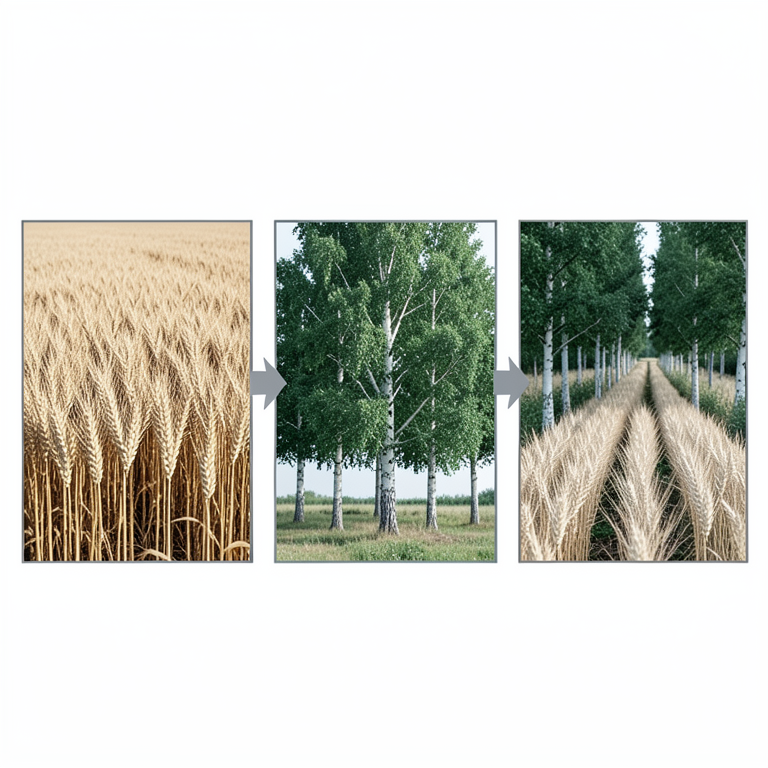
Agroforestry vs Monoculture Efficiency
AI-generated conceptual illustration (Poplar trees and wheat crops in a temperate plain). It explains the idea and does not show study data.
View source evidence ↗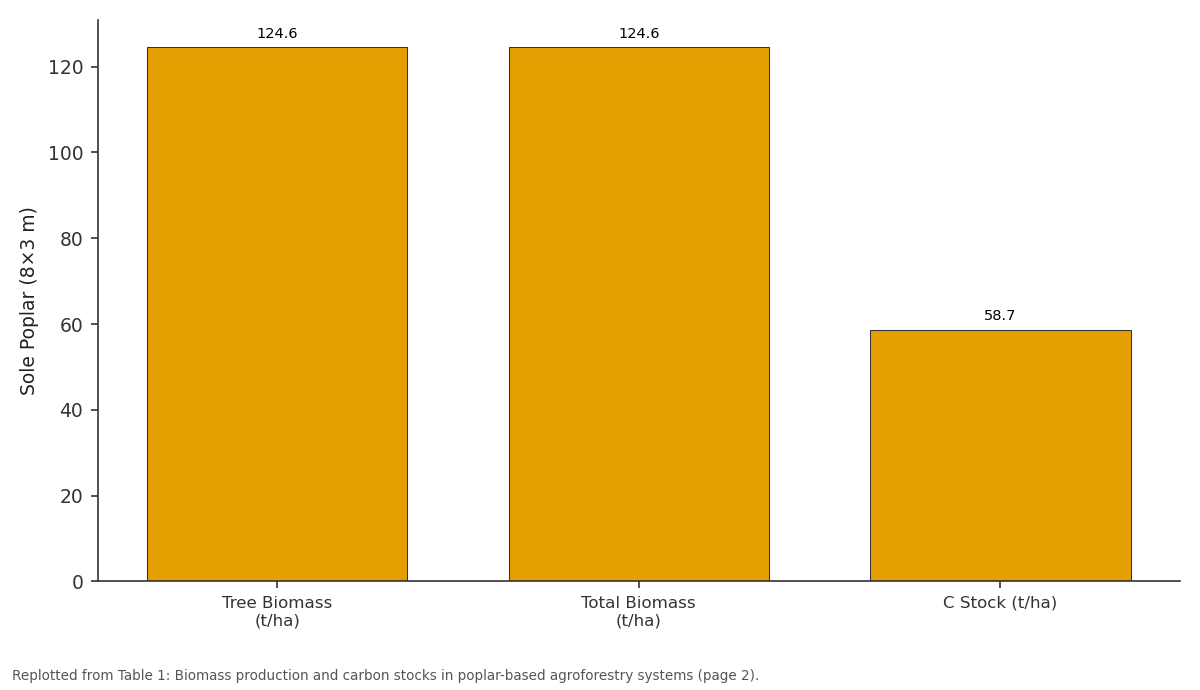
Sole Poplar (8×3 m): Tree Biomass (t/ha) vs Total Biomass (t/ha) vs C Stock (t/ha)
Replotted from Table 1 (page 2) of the original paper. Every bar is the paper's own table value.
View source evidence ↗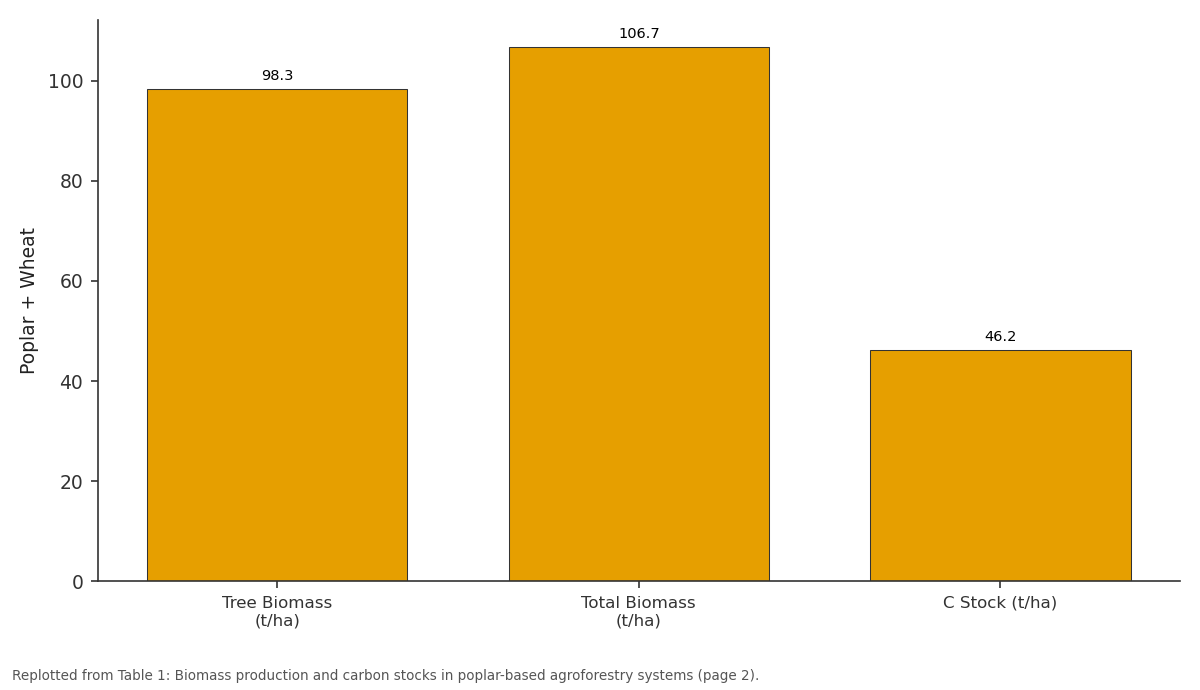
Poplar + Wheat: Tree Biomass (t/ha) vs Total Biomass (t/ha) vs C Stock (t/ha)
Replotted from Table 1 (page 2) of the original paper. Every bar is the paper's own table value.
View source evidence ↗Figures & tables
From the original paper Table 1
 Table 2
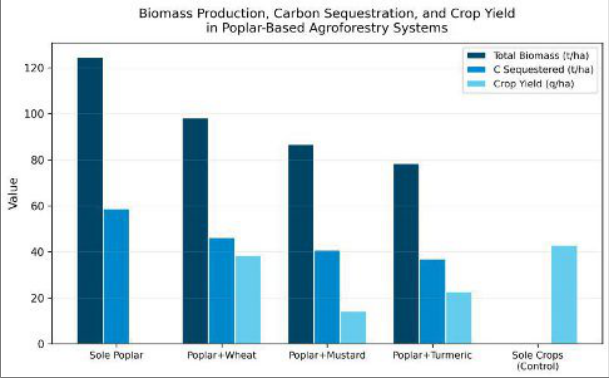 Figure 1
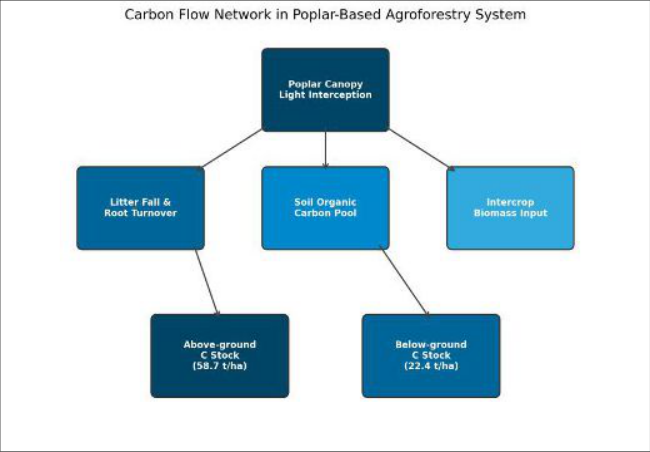 Figure 2
Introduction
Picture a farmer's field where rows of tall poplar trees stand above a carpet of ripening wheat, the two crops sharing sunlight, water, and soil nutrients in a system that produces timber, grain, and stored carbon all at once. This scenario describes poplar-based agroforestry, which has expanded rapidly across northern and central India over the past two decades [1] . Poplar (Populus deltoides) is favored because of its fast growth, straight bole, deciduous habit that allows winter light to reach intercrops, and strong market demand for plywood and packaging material [2] . Carbon sequestration by agroforestry systems is increasingly recognized in national greenhouse gas inventories and climate policy frameworks [3] . Tree biomass acts as a longterm carbon sink, while litter inputs and root turnover build soil organic carbon stocks beyond what annual crops can achieve alone [4] . Estimates suggest that agroforestry systems in India sequester 0.5-3.5 t C/ha/yr depending on species, density, and management [5] . But site-specific data from the temperate highland-plain transition zone of Madhya Pradesh remain thin. This research aimed to compare biomass accumulation, carbon partitioning, and system-level carbon sequestration rates across four poplar-based land use configurations to identify the most productive and carbon-efficient option for this region.
Carbon Accounting Methodology
Total system carbon stock was calculated as the sum of above-ground biomass carbon (tree + crop), below-ground biomass carbon (estimated as 26% of above-ground tree biomass using the root-shoot ratio of Cairns et al. [6] ), litter carbon, and soil organic carbon to 30 cm depth. Biomass was converted to carbon using a factor of 0.47 for woody tissues and 0.43 for herbaceous biomass. The annual CO₂ sequestration rate was derived by dividing the total carbon stock increment over the measurement period by the number of years and multiplying by 3.67 (the molecular weight ratio of CO₂ to C). These calculations follow IPCC Tier 2 guidelines for land use change reporting [7] .
Material and Methods Material
The research was conducted at the Agriculture Campus of Indira Gandhi National Tribal University, Amarkantak, Madhya Pradesh (22.67° N, 81.75° E, elevation 1,048 m).
The site has a subtropical highland climate with mean annual rainfall of 1,650 mm and mean temperature of 22.4 °C. Soil is red lateritic (Typic Haplustalfs) with clay loam texture, pH 5.8, and organic carbon 0.94%. Four land use systems were evaluated: sole poplar plantation (8 m × 3 m spacing), poplar + wheat (cv. GW-322), poplar + mustard (cv. Pusa Bold), poplar + turmeric (cv. Suroma), and sole crop rotation (wheat-mustard) as the control. Trees were seven years old at the start of measurements. Each system occupied four replicate plots of 0.1 ha in a randomized block design [8] .
Methods
Tree height and diameter at breast height (DBH) were measured on all trees in each plot using a Blume-Leiss hypsometer and diameter tape. Above-ground tree biomass was estimated using the allometric equation developed by Rizvi et al. [9] for P. deltoides: ln(AGB) = -2.134 + 2.412 × ln(DBH). Crop biomass was recorded at harvest from 1 m² quadrats (four per plot). Litter was collected monthly from 1 m × 1 m traps placed at four positions per plot. Soil samples were taken at 0-15 and 15-30 cm depths in March 2022 and 2023, and SOC was determined by wet oxidation [10] . Land equivalent ratio was calculated as (Yaf/Ys, tree) + (Yaf/Ys, crop), where Yaf is yield in agroforestry and Ys is yield in sole system. Data were analyzed by ANOVA at P = 0.05.
Results
Table Sole poplar had the highest tree biomass (124.6 t/ha) and carbon stock (58.7 t/ha), but the poplar-wheat system produced the most balanced combination of tree and crop output (Table 1). The presence of intercrops reduced tree biomass by 21-37% compared to sole poplar due to belowground resource competition. SOC was highest under poplar-wheat at 38.6 t/ha, exceeding sole poplar by 3.8 t/ha, possibly due to additional root and stubble inputs from the wheat crop (Table 2). The CO₂ sequestration rate was highest for poplar-wheat at 10.24 t/ha/yr. All agroforestry systems had LER above 1.0, confirming land use advantage.
| System | SOC 0-30 cm (t/ha) | Litter C (t/ha/yr) | CO₂ Seq. Rate (t/ha/yr) | LER |
|---|---|---|---|---|
| Sole Poplar | 34.8 | 3.42 | 8.64 | 1.00 |
| Poplar + Wheat | 38.6 | 4.18 | 10.24 | 1.32 |
| Poplar + Mustard | 36.2 | 3.84 | 9.48 | 1.18 |
| Poplar + Turmeric | 37.4 | 3.96 | 9.86 | 1.26 |
| Sole Crops | 22.4 | 1.86 | 4.12 | - |
| SEm(±) | 1.86 | 0.24 | 0.68 | - |
| CD (P=0.05) | 5.58 | 0.72 | 2.04 | - |
Table text extracted from the original PDF; superscript letters are shown inline. The original table image is below.
View original table image
| Agroforestry System | Tree Biomass (t/ha) | Crop Biomass (t/ha) | Total Biomass (t/ha) | C Stock (t/ha) |
|---|---|---|---|---|
| Sole Poplar (8×3 m) | 124.6 | 0 | 124.6 | 58.7 |
| Poplar + Wheat | 98.3 | 8.4 | 106.7 | 46.2 |
| Poplar + Mustard | 86.7 | 4.8 | 91.5 | 40.8 |
| Poplar + Turmeric | 78.4 | 6.2 | 84.6 | 36.9 |
| Sole Crops (Control) | 0 | 9.8 | 9.8 | 4.2 |
| SEm(±) | 4.82 | 0.46 | 5.12 | 2.34 |
| CD (P=0.05) | 14.46 | 1.38 | 15.36 | 7.02 |
Table text extracted from the original PDF; superscript letters are shown inline. The original table image is below.
View original table image
Comprehensive Interpretation
The poplar-wheat system achieved the highest total CO₂ sequestration while maintaining 89.7% of sole crop wheat yield, making it the best overall system for balancing food production and carbon storage. Tree DBH growth was 12.4 cm/yr in sole plantations but declined to 9.8 cm/yr under intercropping, confirming moderate but manageable competition effects.
Discussion
The LER values of 1.18-1.32 recorded here confirm that poplar agroforestry uses land more efficiently than monocultures, consistent with findings from the Indo-Gangetic plains [1,2] . The superiority of poplar-wheat over other intercrop combinations reflects the complementary phenology of deciduous poplar and rabi wheat: the tree is leafless during the critical wheat growth period from November to February, minimizing light competition [8] . The higher SOC under agroforestry compared to sole crops (38.6 vs. 22.4 t/ha) supports the argument that continuous litter input and deeper root activity under trees build soil carbon stocks beyond what annual tillage systems can sustain [4] .
The CO₂ sequestration rate of 10.24 t/ha/yr for poplar-wheat is at the upper end of estimates for Indian agroforestry systems and has direct relevance for national carbon credit programmes [5] . If even a fraction of the 25 million hectares of cultivable wasteland in India were brought under such systems, the cumulative carbon benefit would be substantial. Farmers benefit simultaneously from timber income at harvest rotation (typically 7-8 years) and annual crop returns [3] .
Conclusion
Poplar-based agroforestry systems sequester significantly more carbon than sole crops while maintaining viable crop yields. The poplar-wheat combination performed best overall with 10.24 t CO₂/ha/yr sequestration and an LER of 1.32. Farmers in the temperate plains of central India should consider poplar agroforestry as an economically and environmentally sound alternative to sole cropping, especially on marginal lands where crop returns alone are insufficient.
Acknowledgement
Acknowledgements Funding SourcesSupported by internal research funds of IGNTU, Amarkantak. Institutional SupportThe authors thank IGNTU Agriculture Campus for field and laboratory facilities.
Figures and tables from the paper
References
16 in the original paper- Dhyani SK, Handa AK, Uma. Area under agroforestry in India. Indian Journal of Agroforestry. 2013;15(1):111.
- Chauhan SK, Sharma R, Sharma SC. Growth and productivity of poplar in India. Indian Forester. 2012;138(3):245-253.
- Albrecht A, Kandji ST. Carbon sequestration in tropical agroforestry systems. Agriculture, Ecosystems and Environment. 2003;99(1-3):15-27.
- Kumar BM, Nair PKR. Carbon sequestration potential of agroforestry systems. Springer. 2011;1:1-307.
- Saha SK, Nair PKR, Nair VD. Soil carbon stock in relation to plant diversity of homegardens. Agroforestry Systems. 2009;76(1):53-65.
- Cairns MA, Brown S, Helmer EH. Root biomass allocation in the world's upland forests. Oecologia. 1997;111(1):1-11.
- IPCC. Guidelines for national greenhouse gas inventories. Intergovernmental Panel on Climate Change. 2006;4:1-83.
- Singh B, Sharma KN. Tree growth and nutrient status of soil in a poplar-based agroforestry system. Agroforestry Systems. 2007;70(2):125-134.
- Rizvi RH, Dhyani SK, Yadav RS. Biomass production and carbon stock of poplar agroforestry systems in Yamunanagar. Current Science. 2011;100(5):736-740.
- Walkley A, Black IA. An examination of the Degtjareff method for determining soil organic matter. Soil Science. 1934;37(1):29-38.
- Swamy SL, Puri S. Biomass production and Csequestration of Gmelina arborea in plantation. Agroforestry Systems. 2005;64(1):55-63.
- Nair PKR. Agroforestry systems and environmental quality. Journal of Environmental Quality. 2011;40(3):784-790.
- Puri S, Nair PKR. Agroforestry research for development in India. Agroforestry Systems. 2004;61(1):397-407.
- Jose S. Agroforestry for ecosystem services and environmental benefits. Agroforestry Systems. 2009;76(1):1-10.
- Pandey DN. Carbon sequestration in agroforestry systems. Climate Policy. 2002;2(4):367-377.
- Kaur B, Gupta SR, Singh G. Carbon storage and nitrogen cycling in silvopastoral systems. Nutrient Cycling in Agroecosystems. 2002;62(3):275-284.