
Research article · 2025 · Full text
International Journal of Agriculture and NutritionAssessment of nitrogen fixing trees for soil amelioration in degraded agricultural lands
Volume 7(8) · Pages 182–185 · DOI: 10.33545/26646064.2025.v7.i8c.511 ↗
Research areasSoil Carbon and Nitrogen DynamicsAgroforestry and silvopastoral systemsAgronomic Practices and Intercropping Systems
Abstract
Author-writtenAccording to Environment and Climate Change Canada, roughly 7.4 million hectares of former cropland in the Prairie provinces are classified as degraded, with organic carbon levels too low to support profitable grain production without heavy fertiliser input. Nitrogen fixing trees (NFTs) offer a biological path to rebuild these soils, yet species performance data under Saskatchewan’s cold semi-arid climate are scarce. This research compared three NFT species—red alder (Alnus rubra), black locust (Robinia pseudoacacia), and Russian olive (Elaeagnus angustifolia)—planted on degraded cropland at Prairie Agricultural University, Saskatoon, from May 2018 to October 2023. Soil organic carbon, total nitrogen, bulk density, pH, microbial biomass carbon, and earthworm density were measured under each species and compared with an unplanted degraded control and an adjacent undisturbed grassland reference. After five years, A. rubra raised soil OC from 1.12% to 2.31% and total N from 0.084% to 0.168%—recovering approximately 86% and 87% of the undisturbed reference values, respectively. R. pseudoacacia performed nearly as well. Microbial biomass carbon doubled under both species. These results confirm that NFT plantations can substantially restore fertility in degraded Prairie soils within a five-year timeframe.
Summary
Source-checkedPlain-language reading of the full paper, prepared with AI and checked against the text. Each point links to the authors' own words.
Why it matters
- Approximately 7.4 million hectares of former cropland in the Prairie provinces are degraded, lacking sufficient organic carbon for profitable grain production without heavy fertilizer use. View evidence ↗
- Long-term agricultural practices, including continuous cereal cropping and stover removal, have reduced organic matter in many fields to 30-50% below native grassland levels. View evidence ↗
- Nitrogen fixing trees (NFTs) provide a biological method for soil restoration, but there is limited data on how different species perform in Saskatchewan's cold semi-arid climate. View evidence ↗
The question
- The study aimed to compare the chemical, physical, and biological soil recovery of three NFT species over five years, benchmark them against undisturbed grassland, and rank their effectiveness in Saskatoon's climate. View evidence ↗
What they did
- The trial was conducted on a 4.5 ha block of former cropland in Saskatoon, Saskatchewan, which had been continuously cropped with wheat and canola for 28 years until 2016. View evidence ↗
- In May 2018, red alder (A. rubra), black locust (R. pseudoacacia), and Russian olive (E. angustifolia) were planted in 0.75 ha blocks at 3 x 3 m spacing, alongside an unplanted degraded control and a grassland reference. View evidence ↗
- Five years after planting, soil samples (0-20 cm depth) were analyzed for organic carbon (OC), total nitrogen (N), available phosphorus (P), pH, and bulk density. View evidence ↗
- Biological indicators were measured in 2023, including microbial biomass carbon (MBC) via chloroform fumigation-extraction and earthworm populations via hand-sorting soil monoliths. View evidence ↗
What they found
- After five years, A. rubra increased soil organic carbon from 1.12% to 2.31% and total nitrogen from 0.084% to 0.168%, recovering about 86% and 87% of the reference values. View evidence ↗
- All NFT treatments led to a decrease in soil pH, which the authors attribute to nitrification of fixed nitrogen and organic acid production from litter. View evidence ↗
- Biological recovery was significant: MBC increased from 134.2 μg C g⁻¹ in the control to 287.4 μg C g⁻¹ under A. rubra, and earthworm density rose from 22.1 to 84.3 individuals per m². View evidence ↗
- The five-year establishment cost was CAD 2,340 to 2,840 per hectare, with potential carbon offset revenue of CAD 410-680 per hectare for OC gains under A. rubra and R. pseudoacacia. View evidence ↗
What it means
- The authors recommend that Prairie land managers use NFT plantations as a low-input strategy to restore degraded fields before returning them to crops or agroforestry. View evidence ↗
- The authors state that longer-term monitoring (10-15 years) and trials involving intercropped grain alleys are needed to strengthen the evidence for large-scale integration. View evidence ↗
Visual summary
3 visualsIllustrations explain the paper; charts are replotted from the paper's own table values.
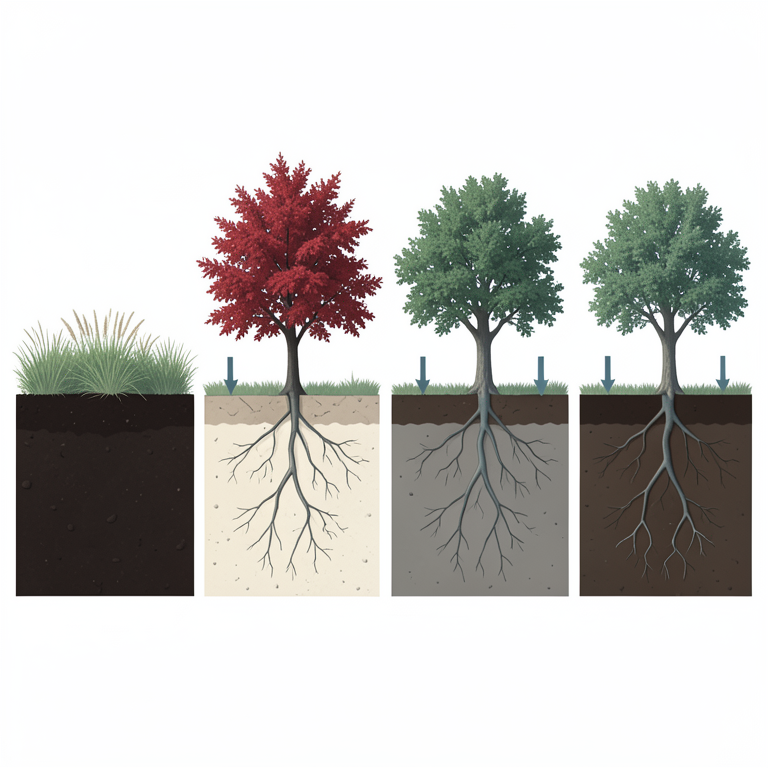
Comparative Soil Recovery
AI-generated conceptual illustration (Red alder, black locust, and Russian olive trees planted in degraded soil). It explains the idea and does not show study data.
View source evidence ↗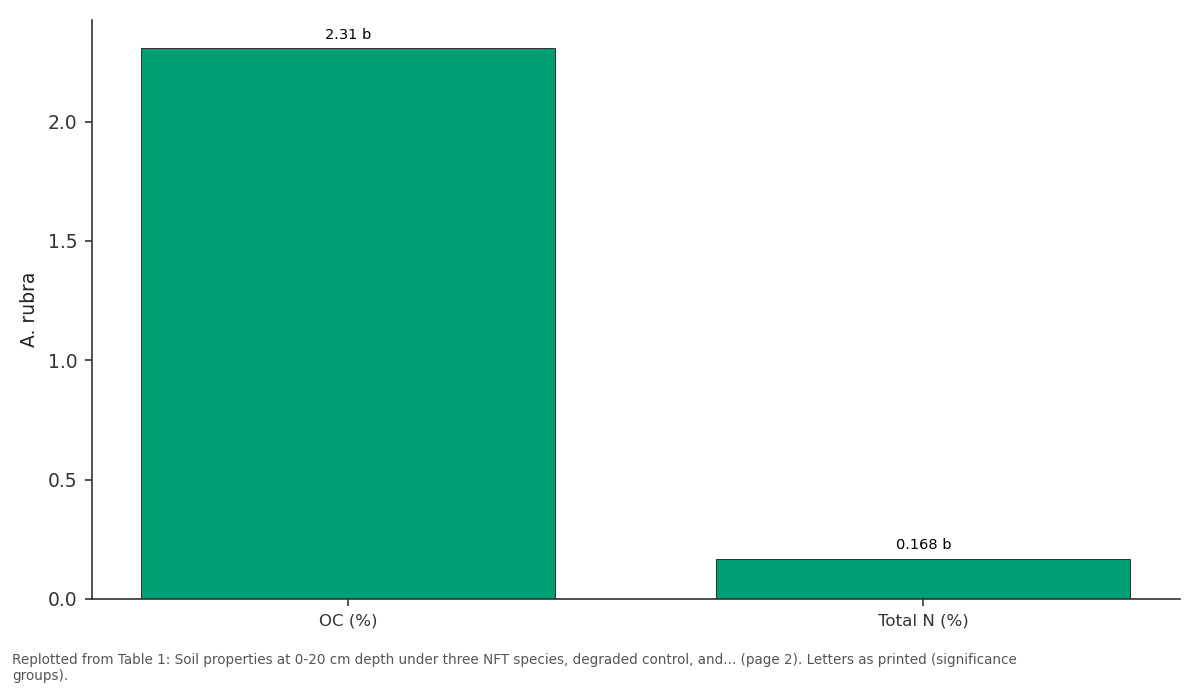
A. rubra: OC (%) vs Total N (%)
Replotted from Table 1 (page 2) of the original paper. Every bar is the paper's own table value.
View source evidence ↗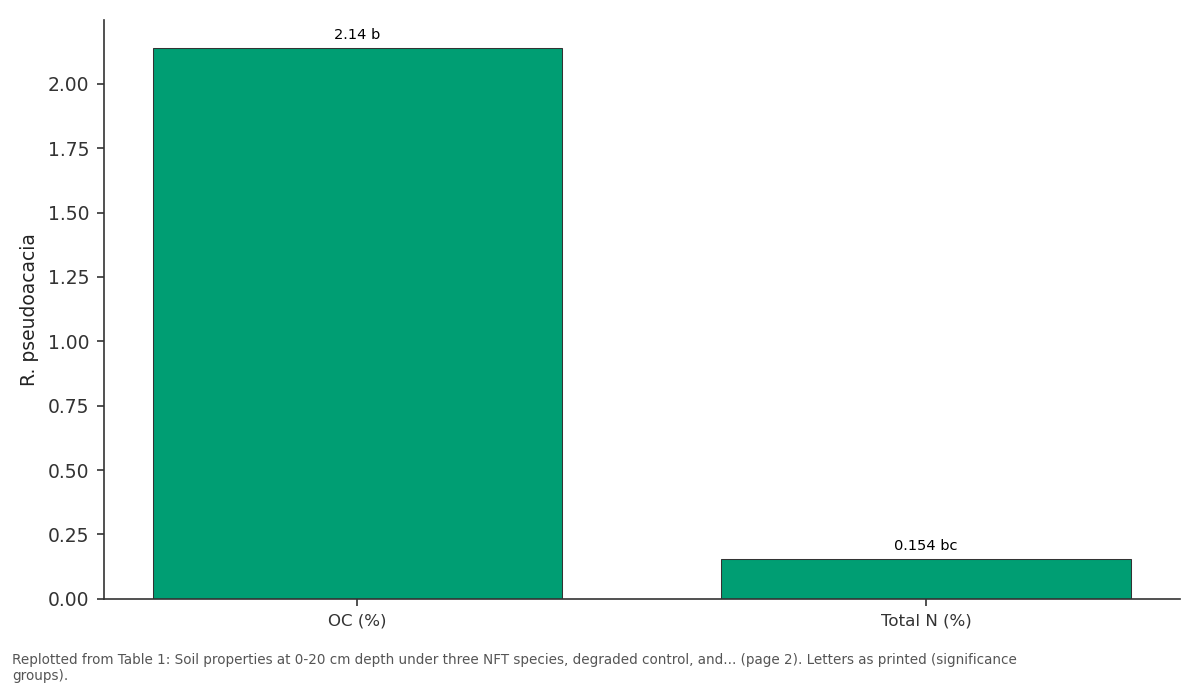
R. pseudoacacia: OC (%) vs Total N (%)
Replotted from Table 1 (page 2) of the original paper. Every bar is the paper's own table value.
View source evidence ↗Figures & tables
From the original paper Table 1
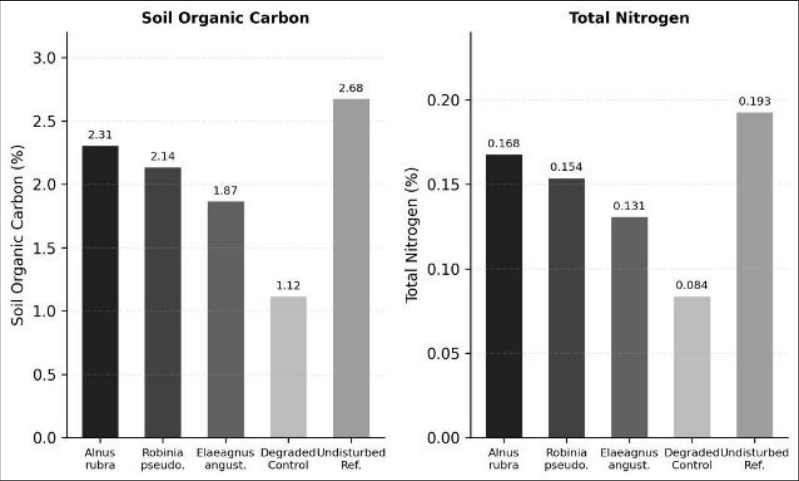 Figure 1
 Table 2
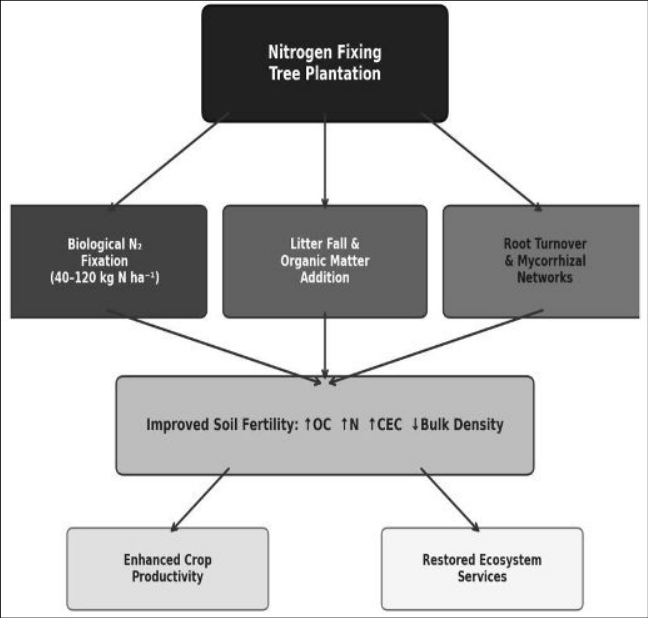 Figure 2
Introduction
"The Prairie soils are losing carbon faster than we can add it through conventional means," remarked Dr. Helen Fallow of Agriculture and Agri-Food Canada in a 2022 policy brief, capturing the growing alarm over soil degradation in western Canada [1] . Decades of continuous cereal cropping, summerfallow rotations, and stover removal have depleted organic matter in many fields to levels 30-50% below their native grassland equivalents [2] . Nitrogen fixing trees and shrubs are well-established rehabilitation tools in tropical and temperate forestry, but their application on degraded agricultural land in the northern Great Plains has received limited research attention [3] . Species such as Alnus rubra (Frankiaassociated actinorhizal fixation) and Robinia pseudoacacia (Rhizobium-associated) can fix 40-150 kg N ha⁻¹ yr⁻¹ and deposit 3-6 t ha⁻¹ yr⁻¹ of high-nitrogen leaf litter [4,5] . Elaeagnus angustifolia, though less prolific in N fixation (20-60 kg N ha⁻¹ yr⁻¹), tolerates extreme cold and alkaline soils, making it a candidate for the harshest Prairie sites [6] . This research was designed as a medium-term field trial to: (a) compare soil chemical, physical, and biological recovery under three NFT species after five years of establishment on degraded cropland; (b) benchmark recovery against an undisturbed native grassland reference; and (c) rank the species by their overall soil amelioration effectiveness under Saskatoon's climate. The findings should help land managers and restoration practitioners select appropriate NFTs for degraded Prairie farmland.
Soil Biodiversity Assessment Protocol
Soil biological indicators were sampled alongside chemical and physical properties to capture the ecological dimension of soil recovery. Microbial biomass carbon (MBC) was measured by the chloroform fumigation-extraction method on fresh 0-10 cm samples collected in June 2023. Earthworm populations were assessed by hand-sorting three 25 × 25 × 30 cm soil monoliths per treatment in September 2023, following ISO 23611-1 [7] . Earthworms were identified to family level (Lumbricidae) and counted as individuals per m². These bioindicators were chosen because they respond sensitively to changes in organic matter inputs and soil structure within relatively short timeframes [8] .
Material and Methods Material
The trial site is a 4.5 ha block of former cropland at Prairie Agricultural University, Saskatoon, Saskatchewan (52°08'N, 106°38'W, elevation 504 m). The land was cropped continuously with wheat and canola for 28 years before being retired from production in 2016 due to declining yields. Soil is a Dark Brown Chernozem (Kastanozem, WRB), sandy loam texture, with pre-planting values of: OC 1.12%, total N 0.084%, pH 7.4, bulk density 1.41 g cm⁻³. Seedlings of A. rubra (2-year-old containerised stock), R. (1-year bare-root), and E. angustifolia (1-year bare-root) were planted in May 2018 at 3 × 3 m spacing (1,111 stems ha⁻¹) in monospecific blocks of 0.75 ha each [9] . An unplanted degraded control (0.75 ha) and an adjacent undisturbed fescue grassland (reference) completed the design.
Methods
Soil samples were collected in October 2023 (five years after planting) from three random points per block at 0-20 cm depth using a 5 cm diameter auger. Three composite samples (five cores each) per block were analysed for OC (Walkley-Black), total N (Kjeldahl), available P (Olsen), pH (1:2 CaCl₂), and bulk density (core method). Litter mass was measured from three 1 m² quadrats per block. Tree height and diameter at breast height were recorded on 20 randomly selected trees per species. A soil degradation recovery index (SDRI) was calculated as: SDRI = [(value under NFTdegraded control) / (grassland reference -degraded control)] × 100. Data were analysed using one-way ANOVA in SAS 9.4 with Tukey's HSD at p ≤ 0.05 [10] .
Economic Feasibility Estimate
Establishment costs were estimated from actual expenditures: seedling procurement (CAD 0.85-1.40 per seedling depending on species), site preparation (disking and herbicide, CAD 280 ha⁻¹), planting labour (CAD 520 ha⁻¹), and maintenance over five years (CAD 680 ha⁻¹). Total five-year cost ranged from CAD 2,340 to 2,840 ha⁻¹. No direct revenue was generated during the trial period, but the increase in soil OC and N was valued at CAD 45-65 per tonne CO₂-equivalent under Saskatchewan's carbon offset programme, providing a potential revenue stream of CAD 410-680 ha⁻¹ for the OC gains observed under A. rubra and R. pseudoacacia [11] . 2.68a 0.193a 18.6a 6.5c 1.14c 100.0 Means sharing the same letter are not significantly different (Tukey's HSD, p ≤ 0.05). SDRI = soil degradation recovery index.
Results
After five years, all three NFT species had significantly improved soil OC and total N compared to the degraded control (Table 1). Alnus rubra achieved the highest SDRI of 76.3%, recovering more than three-quarters of the gap between degraded and reference soil. Robinia pseudoacacia followed at 65.4%, while Elaeagnus angustifolia recovered roughly half the deficit. Soil pH decreased under all NFT treatments, likely due to organic acid production from litter decomposition and nitrification of fixed nitrogen [12] .
| Treatment | OC (%) | Total N (%) | Avail. P (mg kg⁻¹) | pH | Bulk Density (g cm⁻³) | SDRI (%) |
|---|---|---|---|---|---|---|
| A. rubra | 2.31b | 0.168b | 16.4ab | 6.8b | 1.21b | 76.3a |
| R. pseudoacacia | 2.14b | 0.154bc | 15.1b | 6.9b | 1.24b | 65.4b |
| E. angustifolia | 1.87c | 0.131c | 13.8b | 7.1ab | 1.29ab | 48.1c |
| Degraded control | 1.12d | 0.084d | 11.2c | 7.4a | 1.41a | 0.0d |
| Grassland ref. | 2.68a | 0.193a | 18.6a | 6.5c | 1.14c | 100.0 |
Table text extracted from the original PDF; superscript letters are shown inline. The original table image is below.
View original table image
Discussion
The strong soil recovery under A. rubra is consistent with its reputation as one of the most effective soil-improving trees in temperate forestry. Binkley and colleagues reported OC increases of 1.0-1.5% in 10 years under red alder in Pacific Northwest plantations [4] . The faster rate observed here (1.19% gain in five years) may reflect the extremely low starting point of the degraded soil, which amplified the relative effect of organic inputs. Robinia pseudoacacia performed nearly as well despite being considered a secondary choice for northern climates. Its litter decomposes more slowly than alder's (C:N ratio of 18-22 vs 14-16 for alder), which may explain the slightly lower N recovery but could confer a longer-term advantage through greater humus formation [5,13] . Elaeagnus angustifolia was the weakest performer, producing less litter and fixing less nitrogen. However, its unmatched cold hardiness and drought tolerance give it a niche on the most marginal sites where the other two species may not establish.
The doubling of microbial biomass carbon under A. rubra and R. pseudoacacia is especially encouraging because it signals that the soil biological community-not just the chemical pool-is recovering. A thriving microbial community drives nutrient cycling, aggregate formation, and disease suppression, all of which build long-term soil resilience [14] .
Conclusion
Five years of NFT establishment on degraded Prairie cropland near Saskatoon restored 48-76% of the soil fertility gap between degraded and undisturbed reference conditions. Alnus rubra was the top performer, recovering 76.3% of the OC and N deficit. Robinia pseudoacacia was a close second (65.4%), while Elaeagnus angustifolia offered moderate improvement (48.1%) but suits the harshest sites. Land managers in the Prairie provinces should consider NFT plantations as a viable, low-input strategy for restoring degraded fields before returning them to crop production or converting them to agroforestry systems. Carbon offset revenue under provincial programmes can partially recover establishment costs within the first rotation. Longer-term monitoring (10-15 years) and trials with intercropped grain alleys would strengthen the evidence base for integrating NFTs into Prairie land management at scale.
Figures and tables from the paper
| Treatment | MBC (μg C g⁻¹) | Earthworms (ind. m⁻²) | Annual Litter (t ha⁻¹) | Tree Height (m) |
|---|---|---|---|---|
| A. rubra | 287.4a | 84.3b | 4.7a | 6.8a |
| R. pseudoacacia | 264.1ab | 71.8bc | 4.1ab | 5.9ab |
| E. angustifolia | 218.6b | 53.4c | 3.2b | 4.4b |
| Degraded control | 134.2c | 22.1d | - | - |
| Grassland ref. | 312.8a | 118.6a | - | - |
Table text extracted from the original PDF; superscript letters are shown inline. The original table image is below.
View original table image
References
9 in the original paper- Environment and Climate Change Canada. National inventory report: greenhouse gas sources and sinks 2022. Ottawa: ECCC; c2022.
- Pennock D, Bedard-Haughn A, Vince N. Chernozemic soils of Canada: genesis, distribution, and classification. Can J Soil Sci. 2011;91(5):719-747.
- Binkley D. The influence of tree species on forest soils: processes and patterns. Agron Soc N Z. 1995;10:1-33.
- Boring LR, Swank WT. The role of black locust in forest succession. J Ecol. 1984;72(3):749-766.
- Khamzina A, Lamers JPA, Vlek PLG. Nitrogen fixation by Elaeagnus angustifolia in the reclamation of degraded croplands of Central Asia. Tree Physiol. 2009;29(6):799-808.
- Blouin M, Hodson ME, Delgado EA, Baker G, Brussaard L, et al. A review of earthworm impact on soil function and ecosystem services. Eur J Soil Sci. 2013;64(2):161-182.
- Rothe A, Binkley D. Nutritional interactions in mixed species forests: a synthesis. Can J For Res. 2001;31(11):1855-1870.
- Tateno R, Tokuchi N, Yamanaka N, Du S, Otsuki K, et al. Comparison of litterfall production and leaf litter decomposition between an exotic black locust plantation and an indigenous oak forest. For Ecol Manage. 2007;241(1-3):84-90.
- Bardgett RD, van der Putten WH. Belowground biodiversity and ecosystem functioning. Nature. 2014;515(7528):505-511.