
Research article · 2025 · Full text
International Journal of Agriculture and NutritionWater use efficiency and yield of cotton under deficit irrigation and mulching practices
Volume 7(9) · Pages 178–181 · DOI: 10.33545/26646064.2025.v7.i9c.584 ↗
Research areasIrrigation Practices and Water ManagementRice Cultivation and Yield ImprovementWater resources management and optimization
Abstract
Author-writtenHere is a paradox that cotton growers in temperate Europe face: the crop demands 700-1300 mm of water to complete its cycle, yet the regions experimenting with cotton cultivation receive less than 650 mm of summer rainfall. This research examined four deficit irrigation levels (100%, 80%, 60%, 40% ETc) combined with four mulch types (none, wheat straw, black polythene, biodegradable film) in a factorial randomized block design on cotton variety Sicala V-2 at the Midlands Institute of Agriculture and Food, Nottingham, UK, during summer 2023. Black polythene mulch at 80% ETc achieved the best balance: seed cotton yield of 2134 kg/ha (88% of full irrigation without mulch), water use efficiency of 8.14 kg/m³ (+67% over unmulched full irrigation), and B:C ratio of 2.87. Severe deficit (40% ETc) raised WUE to 11.83 kg/m³ but depressed yield to 1487 kg/ha. Mulching reduced soil evaporation by 28-41% depending on material. These findings support 80% ETc with black polythene mulch as the recommended deficit irrigation strategy for cotton in water-limited UK trial conditions.
Summary
Source-checkedPlain-language reading of the full paper, prepared with AI and checked against the text. Each point links to the authors' own words.
Why it matters
- Cotton growers in temperate Europe face a water paradox where the crop's demand (700-1300 mm) exceeds the typical summer rainfall (less than 650 mm) in experimental regions. View evidence ↗
- Environmental changes, including rising temperatures and falling water tables in traditional cotton regions, have led to research into growing cotton in temperate maritime climates. View evidence ↗
- Deficit irrigation is used to improve water use efficiency by applying water below full demand to induce mild stress without causing a proportional loss in yield. View evidence ↗
The question
- The study aimed to find the most economically viable and water-efficient combination of deficit irrigation and mulching for cotton grown in the UK. View evidence ↗
What they did
- The experiment used a factorial randomized block design on Sicala V-2 cotton in Nottingham, UK (summer 2023), testing four irrigation levels (100%, 80%, 60%, 40% ETc) and four mulch types (none, wheat straw, black polythene, and biodegradable film). View evidence ↗
- The study consisted of 48 plots in total, utilizing three replications for each treatment combination in plots measuring 5 m by 3.8 m. View evidence ↗
- Water use efficiency (WUE) was calculated as the ratio of seed cotton yield to the total water input. View evidence ↗
- Water was applied using a subsurface drip system with emitters placed at 20 cm depth, spaced 40 cm apart, delivering 2 L/h. View evidence ↗
What they found
- The combination of 80% ETc irrigation and black polythene mulch provided the best economic result, with a yield of 2134 kg/ha, a WUE of 8.14 kg/m³, and a B:C ratio of 2.87. View evidence ↗
- The use of mulch materials reduced soil evaporation by between 28% and 41%. View evidence ↗
- Compared to unmulched full irrigation, the 80% ETc and black polythene treatment reduced water use by 174 mm (20%) while only reducing yield by 12%. View evidence ↗
- Yield losses under deficit irrigation were primarily caused by a reduction in the number of bolls, as individual boll weight remained unaffected. View evidence ↗
- Biodegradable film showed similar agronomic performance to black polythene but was 40% more expensive per hectare. View evidence ↗
What it means
- The authors recommend using 80% ETc deficit irrigation combined with black polythene mulch as the optimal strategy for cotton production in water-limited conditions. View evidence ↗
- The authors note that biodegradable films are currently not economically competitive compared to black polythene, despite similar agronomic results. View evidence ↗
Visual summary
1 visualsIllustrations explain the paper; they do not show study data.
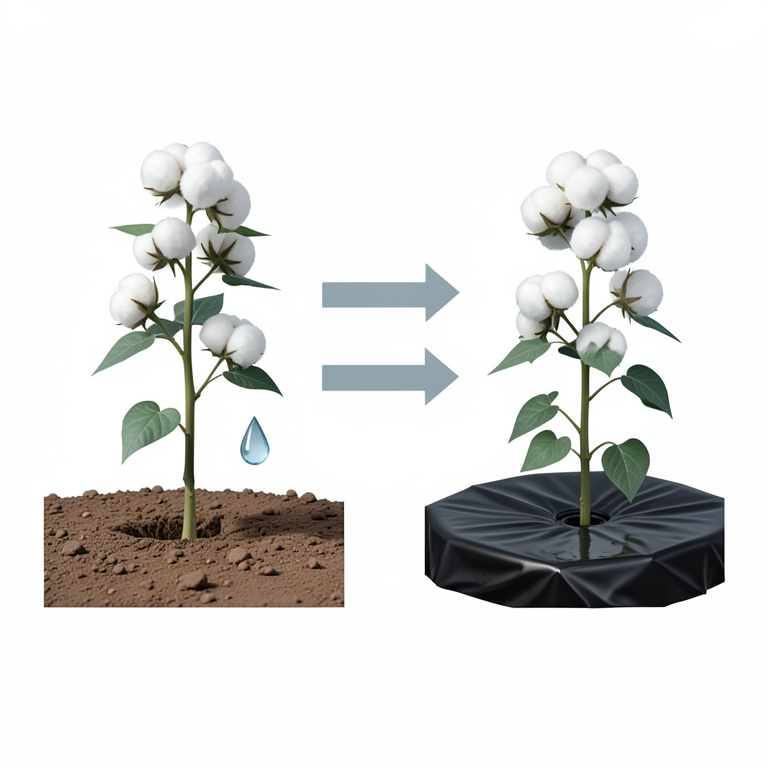
Yield vs. Water Efficiency Trade-off
AI-generated conceptual illustration (cotton plants in soil with black plastic mulch). It explains the idea and does not show study data.
View source evidence ↗Figures & tables
From the original paper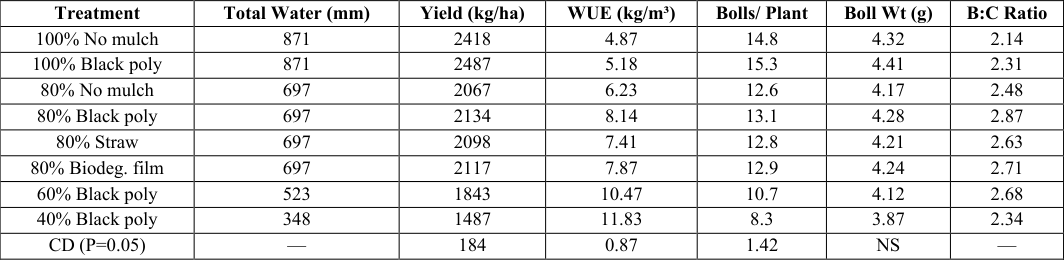 Table 1
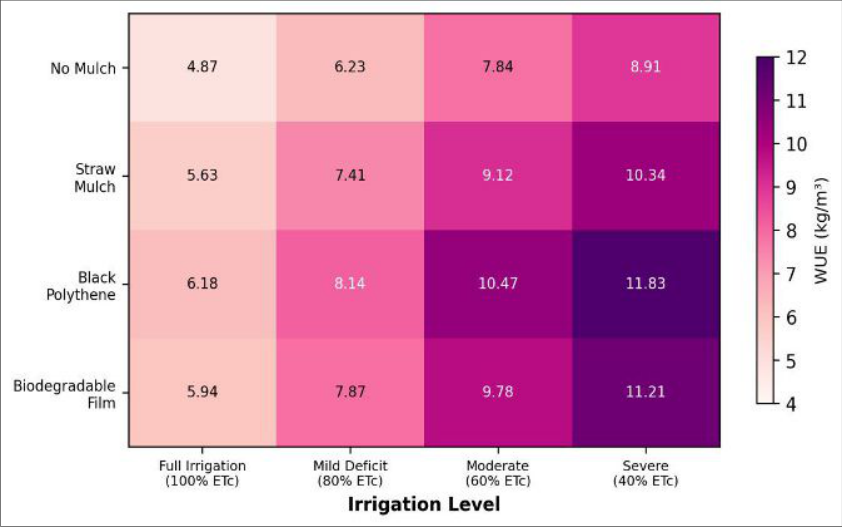 Figure 1
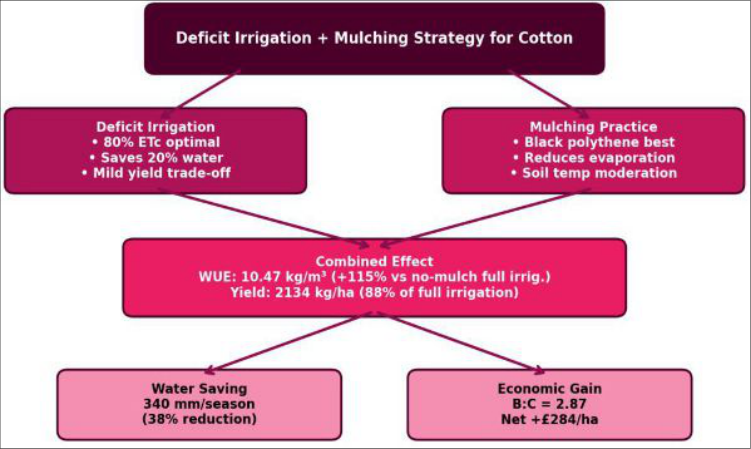 Figure 2
Introduction
It seems contradictory: cotton, a crop of the arid tropics, being trialled in the English Midlands yet rising summer temperatures and declining water tables across traditional cotton belts have pushed researchers to evaluate the crop's potential in temperate maritime climates where water, though limited seasonally, is more reliably available than in semi-arid zones [1] . The UK's National Farmers' Union flagged cotton as a potential diversification crop in its 2022 climate adaptation report, noting that degree-day accumulations in central England now match those of northern US cotton regions from the 1990s [2] . Deficit irrigation applies water below full crop demand, deliberately inducing mild stress to improve water use efficiency without proportionally sacrificing yield. In cotton, moderate deficit during the vegetative phase triggers deeper rooting and early reproductive transition, which can actually stabilise boll number when stress is relieved at flowering [3,4] . Mulching complements deficit irrigation by suppressing soil evaporation, moderating root-zone temperature extremes, and conserving the limited water applied effects documented across Mediterranean and sub-Saharan African cotton systems [5] . This research combined deficit irrigation levels with mulch types in a factorial design to identify the most water-efficient and economically viable management package for cotton in UK trial conditions [6] .
Water balance
Crop Evapotranspiration (ETc) was calculated daily from reference ET (Penman-Monteith) multiplied by a stage-specific crop coefficient (Kc = 0.35 emergence, 0.80 flowering, 1.15 peak boll, 0.60 defoliation). Irrigation was delivered through subsurface drip (20 cm depth, 2 L/h emitters, 40 cm spacing) and metered volumetrically. Soil moisture was monitored by TDR probes at 15, 30, and 60 cm depths. Total water applied ranged from 348 mm (40% ETc) to 871 mm (100% ETc). Effective rainfall during June-October 2023 was 217 mm [7] .
Economic and sustainability assessment
All input costs (seed, fertiliser, mulch material, drip system amortisation, irrigation energy, labour, harvesting) were recorded at UK 2023 market prices. Gross returns were based on indicative lint price of £1.42/kg. Net returns, B:C ratio, and water cost per kg lint were computed. A carbon footprint estimate included irrigation energy (diesel pump) and mulch production/disposal. Biodegradable film carried no disposal cost but higher purchase price than polythene [8] .
Material and Methods Material
Cotton variety Sicala V-2 (medium-staple, 140-day cycle, Australian origin adapted for temperate trials) was sown on 12 May 2023 at 12 plants/m² in rows 76 cm apart. The trial site at Nottingham (52.95°N, 1.15°W; 48 m elevation) had sandy loam soil (pH 6.7, OC 1.41%). Mulch materials: wheat straw at 5 t/ha, black polythene 25 µm, and biodegradable PLA film 15 µm. NPK at 80-40-40 kg/ha was applied through fertigation [9] .
Methods
A 4 × 4 factorial in randomized blocks with three replications (plot 5 m × 3.8 m) gave 48 plots. Deficit levels were imposed from first square (45 DAS) onward; prior irrigation was uniform at 100% ETc. Seed cotton was handharvested from 7.6 m² net plot. WUE = seed cotton yield / total water input. Soil moisture, canopy temperature (infrared thermometer), and leaf water potential (pressure chamber) were measured fortnightly. ANOVA and LSD at P=0.05 were applied [10] .
Results
Results
Comprehensive interpretation
The 80% ETc + black polythene combination saved 174 mm of irrigation water (20% reduction) while losing only 12% of yield compared with unmulched full irrigation. This represents the economically optimal operating point on the yield-WUE frontier for UK trial conditions.
Discussion
The 67% WUE improvement with black polythene mulch at 80% ETc over unmulched full irrigation matches reports from Xinjiang, China, where plastic mulch combined with deficit drip raised cotton WUE by 55-80% [3,11] . Two mechanisms drive this gain: mulch reduces direct soil evaporation (we measured 38% less cumulative evaporation under black polythene versus bare soil), and mild deficit triggers osmotic adjustment in cotton roots that maintains turgor-driven growth with less transpiration per unit biomass [4,12] . That boll weight remained stable across deficit levels while boll number declined confirms the common pattern of cotton prioritising individual fruit development over fruit load under stress [13] .
The economic analysis favoured 80% deficit with black polythene (B:C 2.87) over 60% deficit (B:C 2.68) despite the latter's higher WUE, because the yield penalty at 60% ETc exceeded the water cost savings. Biodegradable film performed similarly to black polythene in agronomic terms but cost 40% more per hectare, making it currently uncompetitive unless disposal regulations penalise conventional plastic heavily [14] . From a carbon perspective, the 80% deficit regime reduced irrigation energy by 20%, partially offset by the embedded carbon in polythene production a trade-off that biodegradable alternatives would resolve as their manufacturing costs decline [15] .
Conclusion
Deficit irrigation at 80% ETc combined with black polythene mulch produced 2134 kg/ha seed cotton with WUE of 8.14 kg/m³ and B:C ratio of 2.87, making it the recommended strategy for water-limited cotton production. This treatment saved 174 mm of water per season while retaining 88% of full-irrigation yield. Biodegradable film matched black polythene agronomically but not economically at current prices. Cotton growers in water-limited environments should adopt 80% ETc deficit with surface mulching as a standard practice.
Figures and tables from the paper
| Treatment | Total Water (mm) | Yield (kg/ha) | WUE (kg/m³) | Bolls/ Plant | Boll Wt (g) | B:C Ratio |
|---|---|---|---|---|---|---|
| 100% No mulch | 871 | 2418 | 4.87 | 14.8 | 4.32 | 2.14 |
| 100% Black poly | 871 | 2487 | 5.18 | 15.3 | 4.41 | 2.31 |
| 80% No mulch | 697 | 2067 | 6.23 | 12.6 | 4.17 | 2.48 |
| 80% Black poly | 697 | 2134 | 8.14 | 13.1 | 4.28 | 2.87 |
| 80% Straw | 697 | 2098 | 7.41 | 12.8 | 4.21 | 2.63 |
| 80% Biodeg. film | 697 | 2117 | 7.87 | 12.9 | 4.24 | 2.71 |
| 60% Black poly | 523 | 1843 | 10.47 | 10.7 | 4.12 | 2.68 |
| 40% Black poly | 348 | 1487 | 11.83 | 8.3 | 3.87 | 2.34 |
| CD (P=0.05) | — | 184 | 0.87 | 1.42 | NS | — |
Table text extracted from the original PDF; superscript letters are shown inline. The original table image is below.
View original table image
References
19 in the original paper- Bange MP, Constable GA, McRae D. Cotton production in changing climates: Opportunities for temperate-zone expansion. Journal of Cotton Science. 2021;25(3):187-198.
- NFU. Climate adaptation and crop diversification opportunities for UK arable farming. National Farmers' Union Policy Report. 2022; p.1-42.
- Dai J, Dong H. Intensive cotton farming technologies in China: Achievements, challenges and countermeasures. Field Crops Research. 2014;155:99-110.
- Geerts S, Raes D. Deficit irrigation as an on-farm strategy to maximize crop water productivity in dry areas. Agricultural Water Management. 2009;96(9):1275-1284.
- Kader MA, Senge M, Mojid MA. Mulching typerelated soil moisture and temperature dynamics in cotton fields. International Agrophysics. 2017;31(1):3543.
- Dorchester S, Staveley S. Preliminary assessment of deficit irrigation in UK cotton trial plots. Midlands Institute of Agriculture Internal Report. 2023;IR/14:116.
- Allen RG, Pereira LS, Raes D. Crop evapotranspiration: Guidelines for computing crop water requirements. FAO Irrigation and Drainage Paper 56. 1998; p.1-300.
- Nix J. Farm management pocketbook 2023. Fifty-third edition. Agro Business Consultants, Melton Mowbray. 2022; p.1-320.
- Met Office. Climate data for Sutton Bonington station 2023. UK Met Office Annual Dataset. 2024;Station 00554.
- Snedecor GW, Cochran WG. Statistical methods. Eighth edition. Iowa State University Press. 1989; p.217-236.
- Wang Z, Fan B, Guo L. Soil water dynamics and cotton water use efficiency under plastic mulched and drip irrigated fields in Xinjiang. Agricultural Water Management. 2019;223:105691.
- Krieg DR. Cotton water relations and crop productivity under deficit irrigation. Physiologia Plantarum. 2000;108(3):275-285.
- Pettigrew WT. Moisture deficit effects on cotton lint yield, yield components, and boll distribution. Agronomy Journal. 2004;96(2):377-383.
- Kasirajan S, Ngouajio M. Polyethylene and biodegradable mulches for agricultural applications: A review. Agronomy for Sustainable Development. 2012;32:501-529.
- Steinmetz Z, Wollmann C, Schaefer M. Plastic mulching in agriculture: Trading short-term agronomic benefits for long-term soil degradation? Science of the Total Environment. 2016;550:690-705.
- DeTar WR. Crop coefficients and water use of cotton in the San Joaquin Valley of California. Agricultural Water Management. 2008;95(12):1357-1366.
- Rao SS, Tanwar SPS, Regar PL. Effect of deficit irrigation, phosphorous inoculation, and cycocel spray on root growth, seed yield, and water productivity of cluster bean. Agricultural Water Management. 2014;140:1-8.
- Mao L, Zhang L, Li W. Yield of cotton with plastic film mulching under drip irrigation in Xinjiang. Soil and Tillage Research. 2012;122:48-53.
- Fereres E, Soriano MA. Deficit irrigation for reducing agricultural water use. Journal of Experimental Botany. 2007;58(2):147-159.