
Research article · 2025 · Full text
International Journal of Agriculture and NutritionPerformance of subsurface drip irrigation for improving root zone moisture in cotton
Volume 7(5) · Pages 143–146 · DOI: 10.33545/26646064.2025.v7.i5c.571 ↗
Research areasIrrigation Practices and Water ManagementEngineering and Agricultural InnovationsRice Cultivation and Yield Improvement
Abstract
Author-writtenCotton growers face a practical dilemma: surface drip systems waste water to evaporation, while furrow irrigation soaks the wrong soil zone. Subsurface drip irrigation (SDI) promises to deliver water directly to the active root zone, but at what depth does it work best? This research compared four irrigation methods-surface drip (control), SDI at 15 cm, SDI at 25 cm, SDI at 35 cm, and furrow irrigation (check)-for their effect on root zone moisture distribution, water productivity, and seed cotton yield of Bt cotton (cv. Bunny BG-II) on a clay loam soil at Birsa Agricultural University, Ranchi, Jharkhand, India, during kharif 2022 and 2023. A randomized block design with four replications was used. SDI at 25 cm maintained the most uniform root zone moisture (CV 11.3% vs. 24.8% for furrow), achieved the highest water productivity (0.68 kg m⁻³), and produced the best seed cotton yield (2, 486 kg ha⁻¹)-a 28.4% improvement over furrow irrigation. Root density at 15-30 cm depth was 34.7% higher under SDI-25 than surface drip. These results confirm that SDI at 25 cm depth is optimal for cotton on clay loam soils in the Jharkhand plateau region.
Summary
Source-checkedPlain-language reading of the full paper, prepared with AI and checked against the text. Each point links to the authors' own words.
Why it matters
- Cotton farmers struggle with water inefficiency, as surface drip systems lose water to evaporation and furrow irrigation often fails to target the correct soil zone. View evidence ↗
- Cotton is a deep-rooted crop that primarily absorbs water from the 15-40 cm soil zone during its critical flowering-to-boll development phase. View evidence ↗
- The ideal depth for subsurface drip irrigation (SDI) varies by soil; sandy soils may need shallower placement (10-15 cm), while clay soils benefit from deeper placement (20-30 cm) to align with root density. View evidence ↗
The question
- The study aimed to determine which irrigation method, surface drip, furrow, or SDI at 15, 25, or 35 cm, best maximizes yield, water productivity, and moisture uniformity for Bt cotton in Jharkhand. View evidence ↗
What they did
- The experiment was conducted on red lateritic clay loam soil at Birsa Agricultural University in Ranchi, India. View evidence ↗
- The study used a randomized block design with four replications, testing five treatments: surface drip, furrow irrigation, and SDI at depths of 15, 25, and 35 cm. View evidence ↗
- TDR probes were used to monitor soil moisture at depths of 10, 20, 30, and 40 cm across all treatments. View evidence ↗
- Root length density was measured at the flowering stage using soil coring and WinRHIZO software. View evidence ↗
What they found
- Under the SDI-25 treatment, 38.7% of the total root zone moisture was located in the 15-30 cm zone, which aligns with the primary root density zone. View evidence ↗
What it means
- The authors recommend promoting SDI at a 25 cm depth for cotton in the Jharkhand plateau to reduce the waste associated with surface irrigation in clay loam soils. View evidence ↗
- A limitation of the 25 cm SDI system is the requirement for specialized equipment and precise depth control during installation. View evidence ↗
- The study's two-season duration may not be enough to assess long-term problems such as lateral clogging or root intrusion into emitters. View evidence ↗
Visual summary
2 visualsIllustrations explain the paper; charts are replotted from the paper's own table values.
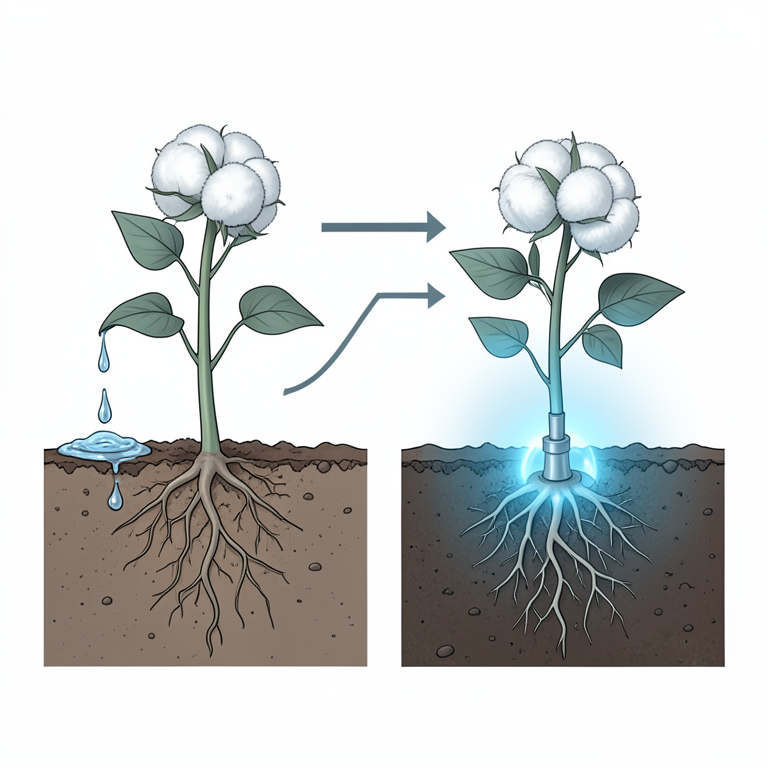
Root Zone Targeting Concept
AI-generated conceptual illustration (cotton plants in soil cross-section). It explains the idea and does not show study data.
View source evidence ↗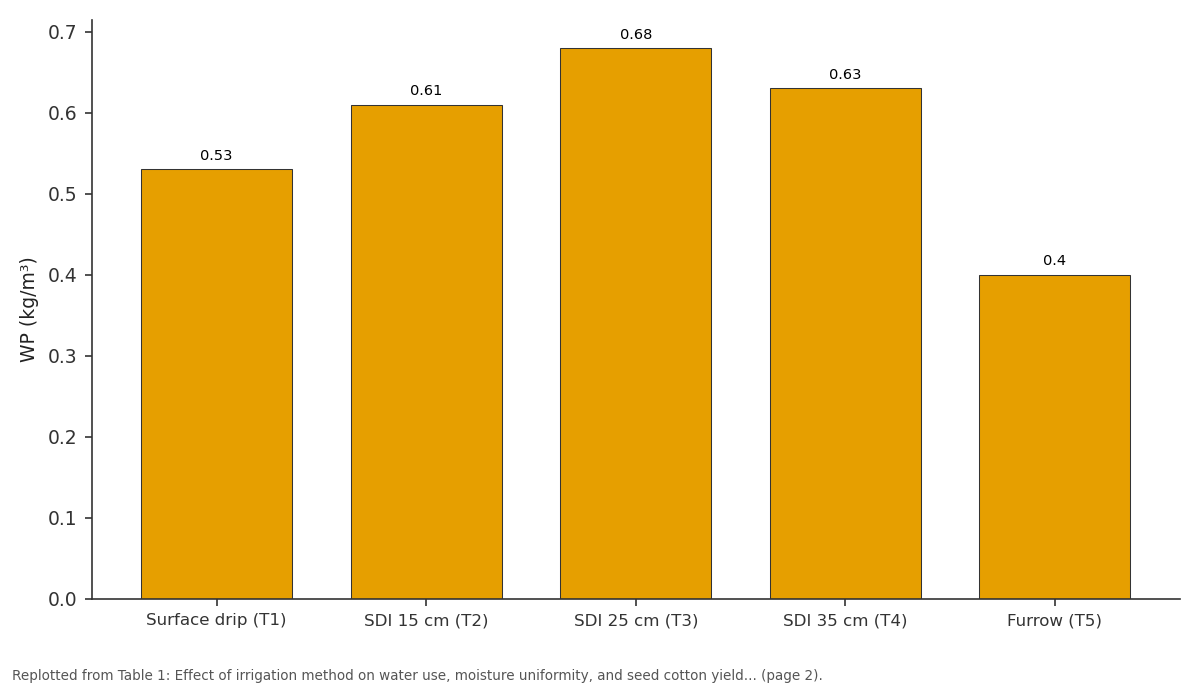
WP (kg/m³): Surface drip (T1) vs SDI 15 cm (T2) vs SDI 25 cm (T3) vs SDI 35 cm (T4) vs Furrow (T5)
Replotted from Table 1 (page 2) of the original paper. Every bar is the paper's own table value.
View source evidence ↗Figures & tables
From the original paper Table 1
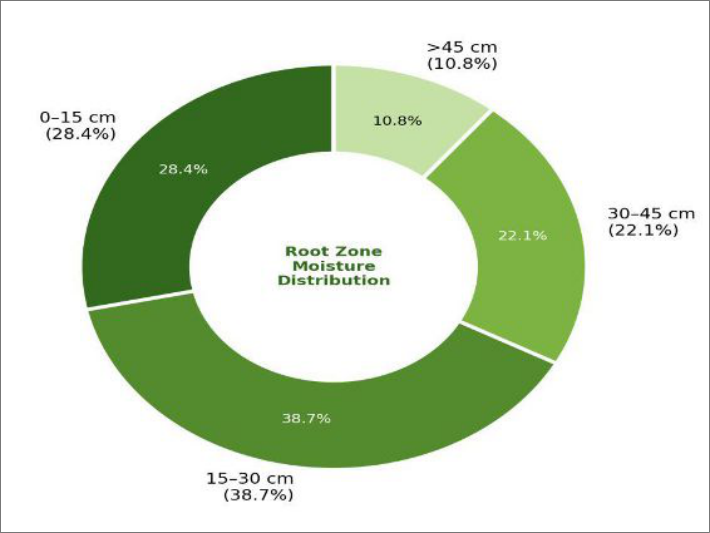 Figure 1
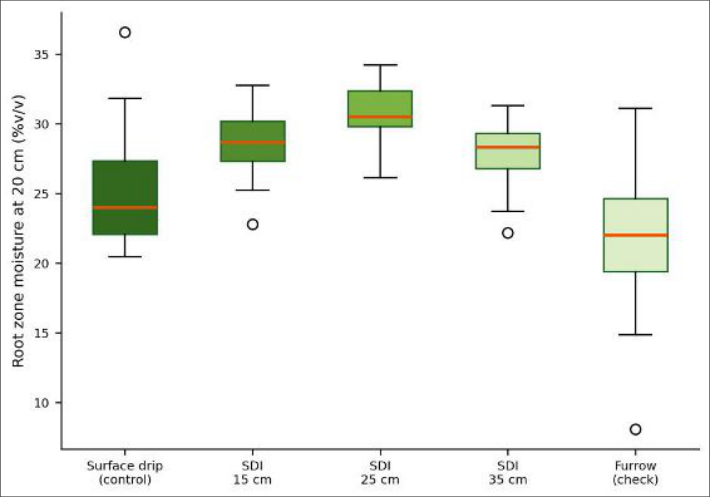 Figure 2
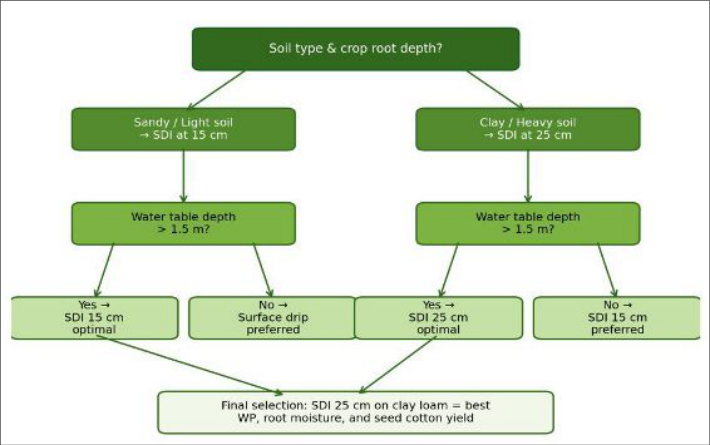 Figure 3
Introduction
When a cotton farmer in Jharkhand opens a furrow irrigation valve, about half the water evaporates or percolates past the root zone before the crop can use it-that's the fundamental inefficiency that SDI was designed to solve [1] . Cotton is a deep-rooted crop with primary water uptake concentrated in the 15-40 cm soil zone during the critical flowering-to-boll development phase [2] . Surface drip systems place water at or near the soil surface, where it is exposed to direct evaporation and tends to promote shallow root growth [3] . SDI buries the emitter line below the surface, delivering water directly into the active root zone and creating a wetted bulb pattern centered on the lateral depth [4] . The optimal SDI depth depends on soil texture, crop rooting habit, and local evaporative demand [5] . Sandy soils with high infiltration may require shallower placement (10-15 cm) to prevent deep percolation, while clay soils with slower drainage can benefit from deeper placement (20-30 cm) that positions water closer to the maximum root density zone [6] . For cotton in the semi-arid Jharkhand plateau-where red and lateritic clay loams predominate-no systematic depth comparison has been published. This research compared surface drip, three SDI depths (15, 25, 35 cm), and conventional furrow irrigation to determine the placement that maximizes root zone moisture uniformity, water productivity, and yield in Bt cotton under Jharkhand conditions.
Water Balance and Irrigation Scheduling
Crop water requirement was estimated using FAO Penman-Monteith ET₀ and cotton Kc values of 0.35 (emergence-squaring), 0.75 (squaring-flowering), 1.15 (flowering-boll opening), and 0.70 (boll opening-harvest) [7] . Drip irrigation (surface and SDI) was scheduled to replenish 100% of ETc when soil moisture at 20 cm depth fell below 65% of field capacity, monitored by TDR probes (CS616). Furrow irrigation followed the conventional farmer calendar: 7 irrigations at approximately 15-day intervals during the dry spells of kharif. Total seasonal water applied was metered for all treatments.
Material and Methods Material
The field experiment was conducted at the research farm of Birsa Agricultural University, Ranchi (23°21′N, 85°20′E, 621 m a.s.l.) on a red lateritic clay loam (pH 5.6, FC 32.8%, PWP 14.6%, bulk density 1.38 g cm⁻³). Bt cotton hybrid Bunny BG-II was sown at 90 × 60 cm spacing. SDI laterals (16 mm PE, 2 L h⁻¹ emitters, 40 cm spacing) were installed at 15, 25, and 35 cm depths before sowing using a tractordrawn lateral installer. Surface drip laterals were placed on the soil surface. Fertilization was 120:60:60 kg N:P₂O₅:K₂O ha⁻¹ with N fertigated in 6 splits.
Methods
Five irrigation treatments in a randomized block design with four replications (plot size 12 m × 6 m): T 1 (surface drip, control), T 2 (SDI 15 cm), T 3 (SDI 25 cm), T 4 (SDI 35 cm), T 5 (furrow, check). Soil moisture was monitored at 10, 20, 30, and 40 cm depths using TDR probes installed in all treatments. Readings were taken at 3-day intervals throughout the season. Root density was measured at flowering by soil coring (5 cm diameter, 0-60 cm in 15 cm increments) and washing roots over a 0.5 mm sieve; root length density (cm cm⁻³) was measured using WinRHIZO software. Seed cotton yield was recorded from two central rows per plot over three pickings. Water productivity (WP) = seed cotton yield / total water applied. Data were analyzed by ANOVA with Tukey's HSD at p ≤ 0.05 in SPSS v.26.
Root Zone Moisture Uniformity
Moisture uniformity was quantified as the coefficient of variation (CV) of volumetric moisture content across four depths (10, 20, 30, 40 cm) measured at each irrigation cycle.
Lower CV indicates more uniform wetting of the root profile. A CV below 15% was considered "uniform" based on Christiansen's uniformity adaptation for subsurface systems [8] .
Results
Table SDI at 25 cm achieved the best combination of moisture uniformity (CV 11.3%), root density (4.61 cm cm⁻³), seed cotton yield (2, 486 kg ha⁻¹), and water productivity (0.68 kg m⁻³) (Table 1). Furrow irrigation used 33.5% more water than SDI-25 while producing 22.1% less yield. SDI-35 saved the most water but had lower root density and yield than SDI-25, suggesting that 35 cm was too deep for optimal cotton root engagement on this soil type.
| Treatment | Water (mm) | CV moisture (%) | Root density* | Yield (kg/ha) | WP (kg/m³) |
|---|---|---|---|---|---|
| Surface drip (T1) | 412.6 | 16.8 | 3.42 | 2, 184 | 0.53 |
| SDI 15 cm (T2) | 378.4 | 14.2 | 3.87 | 2, 312 | 0.61 |
| SDI 25 cm (T3) | 364.1 | 11.3 | 4.61 | 2, 486 | 0.68 |
| SDI 35 cm (T4) | 356.8 | 13.6 | 3.98 | 2, 241 | 0.63 |
| Furrow (T5) | 486.3 | 24.8 | 2.78 | 1, 936 | 0.40 |
| CD (p=0.05) | 22.4 | 2.1 | 0.34 | 148 | 0.05 |
Table text extracted from the original PDF; superscript letters are shown inline. The original table image is below.
View original table image
Comprehensive Interpretation
The box plot (Figure 2) visually confirms that SDI-25 delivered the most consistent moisture supply, with the smallest spread and highest median among all treatments.
The decision tree (Figure 3) translates these results into a practical guide for growers: soil texture and water table depth together determine the optimal SDI placement.
Discussion
The 28.4% yield advantage of SDI-25 over furrow irrigation and the 13.8% advantage over surface drip are driven by two complementary mechanisms: reduced evaporative loss (subsurface placement avoids surface wetting) and improved root zone targeting (the 25 cm depth matches the peak root density zone in cotton on clay loam) [2,4] . The 34.7% higher root density under SDI-25 compared with surface drip suggests that roots actively proliferated toward the subsurface water source-a phenomenon documented in other SDI crops [6] . SDI-35 saved slightly more water than SDI-25 but produced lower yields, indicating that the wetting bulb at 35 cm didn't adequately overlap with the 15-25 cm zone where most cotton feeder roots are concentrated on this soil type. On sandier soils with deeper root systems, 35 cm might perform better. The CV approach to quantifying moisture uniformity proved practical and could be adopted as a standard metric for SDI system evaluation [8] . One limitation is that lateral installation at 25 cm requires specialized equipment and careful depth control during tractor operation. The two-season duration may also be insufficient to evaluate long-term issues like root intrusion into emitters and lateral clogging. Future work should include multi-year monitoring and cost-benefit analysis of SDI installation versus the water and yield savings achieved.
Conclusion
Subsurface drip irrigation at 25 cm depth was the optimal treatment for cotton on clay loam soil at Ranchi, Jharkhand, delivering the best moisture uniformity (CV 11.3%), highest root density in the active zone, maximum seed cotton yield (2, 486 kg ha⁻¹), and best water productivity (0.68 kg m⁻³).
The treatment used 25.1% less water than furrow irrigation while yielding 28.4% more. SDI at 15 cm and 35 cm were intermediate. These findings support the promotion of SDI technology at 25 cm depth for cotton in the Jharkhand plateau where clay loam soils and high evaporative demand make surface irrigation particularly wasteful.
Acknowledgement
Acknowledgements Funding SourcesThis research was funded by the Department of Water Resources, Birsa Agricultural University, Ranchi, through the precision irrigation research programme. Institutional SupportThe university research farm provided land, equipment, and weather monitoring infrastructure for the field experiment.
Figures and tables from the paper
References
21 in the original paper- Camp CR. Subsurface drip irrigation: a review. Transactions of the ASAE. 1998;41(5):1353-1367.
- Hake KD, Grimes DW. Crop water management to optimize growth and yield of upland cotton. Cotton Physiology. 1993;ASA-CSSA:533-584.
- Lamm FR, Trooien TP. Subsurface drip irrigation for corn production: a review of 10 years of research in Kansas. Irrigation Science. 2003;22(3-4):195-200.
- Ayars JE, Phene CJ, Hutmacher RB, Davis KR, Schoneman RA, Vail SS. Subsurface drip irrigation of row crops: a review of 15 years of research. Agricultural Water Management. 1999;42(1):1-27.
- Enciso J, Jifon J, Anciso J, Ribera L. Productivity of onions using subsurface drip irrigation versus furrow irrigation systems with an internet based irrigation scheduling program. International Journal of Agronomy. 2015;2015:178180.
- Phene CJ, Davis KR, Hutmacher RB, Bar-Yosef B, Meek DW, Misaki J. Effect of high frequency surface and subsurface drip irrigation on root distribution of sweet corn. Irrigation Science. 1991;12(3):135-140.
- Allen RG, Pereira LS, Raes D, Smith M. Crop evapotranspiration: guidelines for computing crop water requirements. FAO Irrigation and Drainage Paper 56. 1998;Rome.
- Christiansen JE. Irrigation by sprinkling. California Agricultural Experiment Station Bulletin 670. 1942;University of California, Berkeley.
- Colaizzi PD, Evett SR, Howell TA. Comparison of SDI, LEPA, and spray irrigation performance for grain sorghum. Transactions of the ASABE. 2006;49(5):1325-1342.
- Lamm FR, Camp CR. Subsurface drip irrigation. Microirrigation for Crop Production. 2007;Elsevier:473-551.
- Bhatt R, Khera KL. Effect of tillage and mode of straw mulch application on soil erosion in the submontaneous tract of Punjab. Soil and Tillage Research. 2006;88(12):107-115.
- Rao SS, Tanwar SPS, Regar PL. Effect of deficit irrigation, phosphorous inoculation and cycocel spray on root growth, seed cotton yield and water productivity of drip irrigated cotton in arid environment. Agricultural Water Management. 2016;169:14-25.
- DeTar WR. Crop coefficients and water use for cowpea in the San Joaquin Valley of California. Agricultural Water Management. 2009;96(1):53-66.
- Hodgson AS, Constable GA, Duddy GR, Daniells IG. A comparison of drip and furrow irrigated cotton on a cracking clay soil. Irrigation Science. 1990;11(2):75-80.
- Sorensen RB, Butts CL, Lamb MC. Crop yield and quality response to subsurface drip irrigation: a review. Transactions of the ASABE. 2010;53(5):1471-1477.
- Skaggs TH, Trout TJ, Rothfuss Y. Drip irrigation water distribution patterns: effects of emitter rate, pulsing, and antecedent water. Soil Science Society of America Journal. 2010;74(6):1886-1896.
- Evett SR, Colaizzi PD, Howell TA. Drip and sprinkler irrigation of grain sorghum: comparison of water balance, grain yield and water use efficiency. Proceedings of International Irrigation Show. 2007;San Diego.
- Dukes MD, Scholberg JM. Soil moisture controlled subsurface drip irrigation on sandy soils. Applied Engineering in Agriculture. 2005;21(1):89-101.
- Singandhupe RB, Rao GGSN, Patil NG, Brahmanand PS. Fertigation studies and irrigation scheduling in drip irrigation system in tomato crop. European Journal of Agronomy. 2003;19(2):327-340.
- Cetin O, Bilgel L. Effects of different irrigation methods on shedding and yield of cotton. Agricultural Water Management. 2002;54(1):1-15.
- Dalvi VB, Tiwari KN, Pawade MN, Phirke PS. Response surface analysis of tomato production under micro irrigation. Agricultural Water Management. 1999;41(1):11-19.