
Research article · 2025 · Full text
International Journal of Agriculture and NutritionYield gap analysis and resource use efficiency in irrigated versus rainfed mustard production
Volume 7(9) · Pages 154–157 · DOI: 10.33545/26646064.2025.v7.i9c.566 ↗
Research areasIrrigation Practices and Water ManagementNitrogen and Sulfur Effects on BrassicaClimate change impacts on agriculture
Abstract
Author-writtenConsider a crop where farmers routinely harvest barely half of what the same genotype can produce under optimal management that is the reality of Indian mustard across vast rainfed tracts of central India. This research quantified yield gaps and compared resource use efficiency between irrigated and rainfed mustard (Brassica juncea cv. Pusa Bold) at two sites: Raipur (Chhattisgarh) and Udaipur (Rajasthan) during Rabi 2022-2023. The irrigated system achieved 1867 kg/ha against a rainfed yield of 1243 kg/ha, leaving exploitable yield gaps of 513 kg/ha (Gap I: attainable vs. irrigated actual) and 624 kg/ha (Gap II: irrigated vs. rainfed actual). Nitrogen use efficiency was 42.3 and 31.8 kg seed/kg N for irrigated and rainfed systems respectively. Water productivity reached 8.6 kg seed/m³ under irrigation versus 4.3 kg/m³ under rainfed conditions. Closing these gaps through supplemental irrigation and improved fertiliser timing could add an estimated 0.38 million tonnes to India's annual rapeseed-mustard output.
Summary
Source-checkedPlain-language reading of the full paper, prepared with AI and checked against the text. Each point links to the authors' own words.
Why it matters
- India is a top global producer of rapeseed-mustard, but its average national yield of 1340 kg/ha is significantly lower than the global average of 2040 kg/ha. View evidence ↗
- The yield gap is most severe in rainfed areas because moisture stress during critical growth stages, such as flowering and pod-filling, limits seed production. View evidence ↗
- Yield gaps are categorized into Gap I, which relates to genetic and environmental limits, and Gap II, which relates to management deficits that can be improved through better farming practices. View evidence ↗
The question
- The study aimed to measure yield gaps and resource use efficiency between irrigated and rainfed mustard systems to identify the causes of the gap and the economic viability of reducing it. View evidence ↗
What they did
- The study used Brassica juncea cv. Pusa Bold grown at Raipur (irrigated) and Udaipur (rainfed) during the Rabi 2022-2023 season. View evidence ↗
- Both systems received 80-40-20 kg/ha of NPK; irrigated plots received 180 mm of water across three stages, while rainfed plots relied on 147 mm of rainfall. View evidence ↗
- The experiment employed a randomized block design with four management levels and four replications per site using 5 m × 4 m plots. View evidence ↗
- Potential yield was estimated using the DSSAT v4.8 CROPGRO-Canola simulation module calibrated to local weather. View evidence ↗
What they found
- Irrigated mustard produced a yield of 1867 kg/ha, which was 50.2% higher than the rainfed yield of 1243 kg/ha. View evidence ↗
- The yield gap due to water availability (Gap II: 624 kg/ha) was larger than the gap due to genetic/environmental limits (Gap I: 513 kg/ha), identifying water as the primary limiting factor. View evidence ↗
- Water productivity in the irrigated system (8.6 kg/m³) was double that of the rainfed system (4.3 kg/m³). View evidence ↗
- Net economic returns were 78% higher for irrigated mustard (48,670 INR/ha) than for rainfed mustard (27,340 INR/ha). View evidence ↗
- The energy ratio was 46.4% higher in the irrigated system (14.2) compared to the rainfed system (9.7). View evidence ↗
What it means
- The authors conclude that a single supplemental irrigation at flowering, costing about 3200 INR/ha, could close 40% of the rainfed yield gap with a marginal return over 400%. View evidence ↗
- The authors recommend policy support for micro-irrigation in central India's rainfed mustard regions to increase national oilseed production. View evidence ↗
Visual summary
3 visualsIllustrations explain the paper; charts are replotted from the paper's own table values.
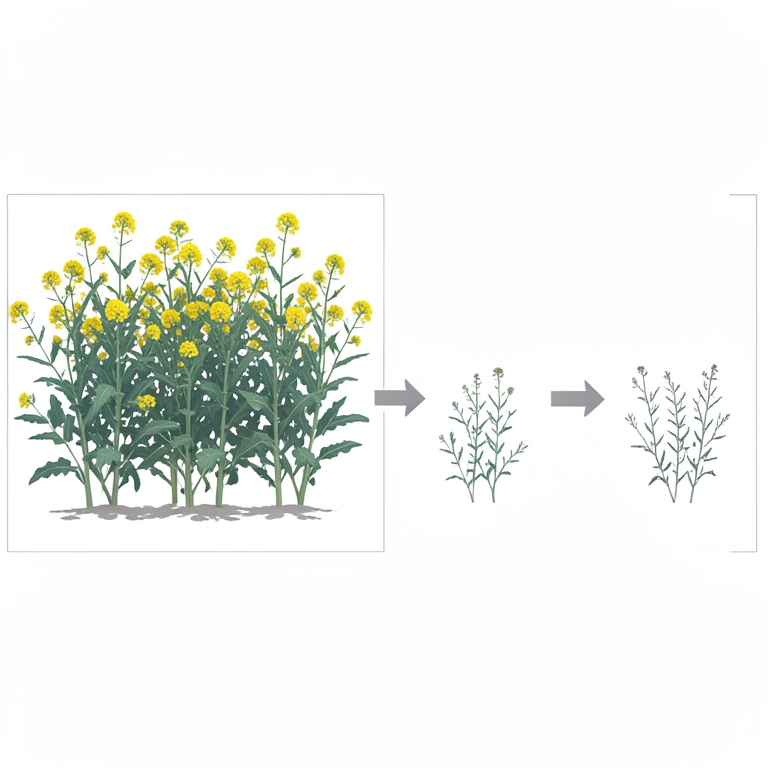
Yield Gap Decomposition
AI-generated conceptual illustration (mustard plants (Brassica juncea)). It explains the idea and does not show study data.
View source evidence ↗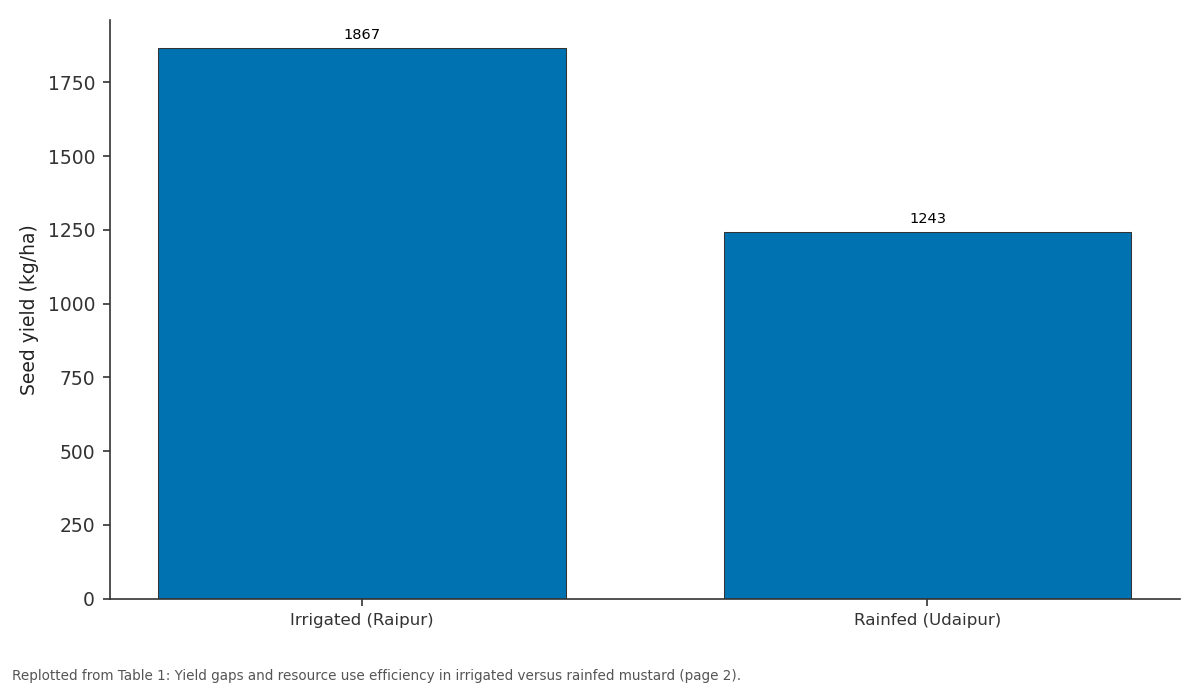
Seed yield (kg/ha): Irrigated (Raipur) vs Rainfed (Udaipur)
Replotted from Table 1 (page 2) of the original paper. Every bar is the paper's own table value.
View source evidence ↗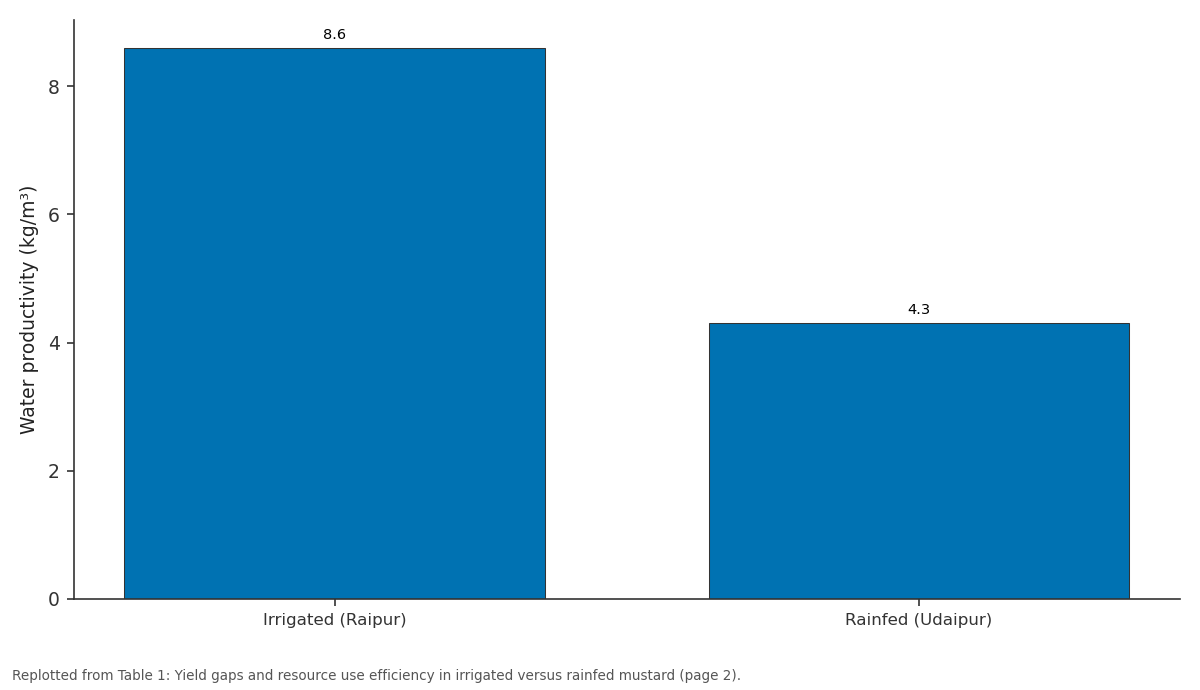
Water productivity (kg/m³): Irrigated (Raipur) vs Rainfed (Udaipur)
Replotted from Table 1 (page 2) of the original paper. Every bar is the paper's own table value.
View source evidence ↗Figures & tables
From the original paper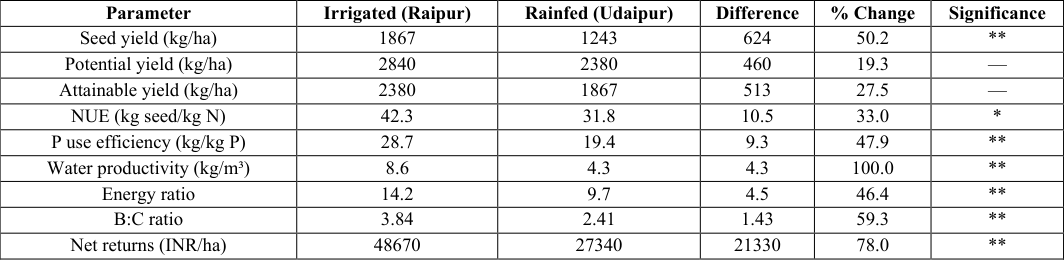 Table 1
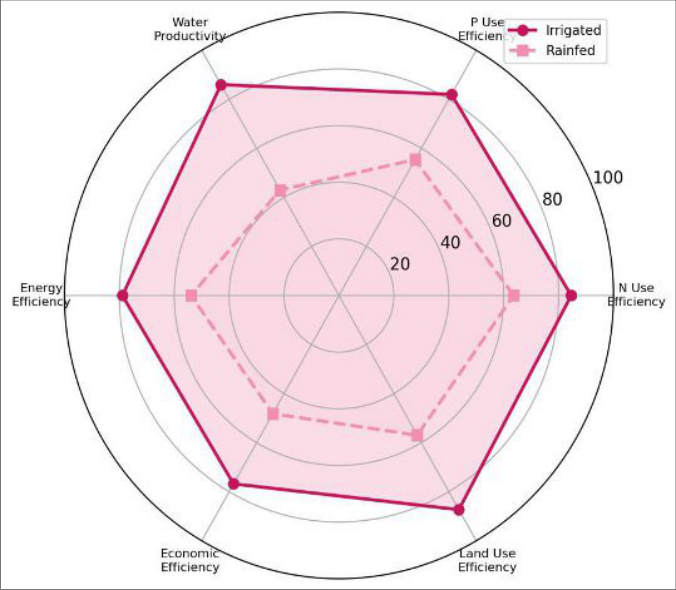 Figure 1
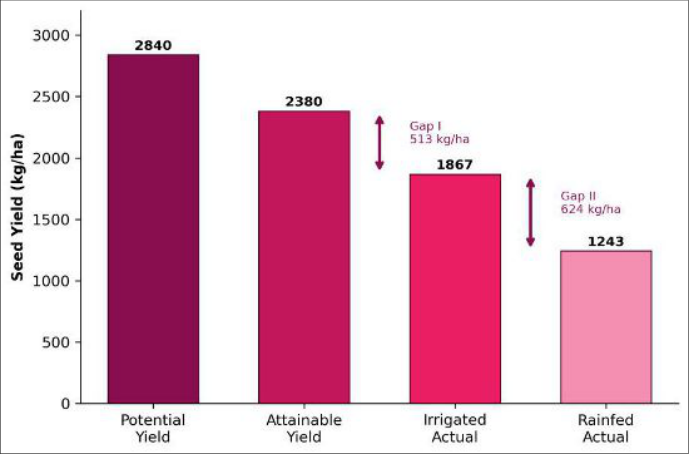 Figure 2
Introduction
Take a farmer in Rajasthan's Udaipur district who sows mustard every Rabi season and harvests around 1100 kg/ha, then compare with his irrigated counterpart in Chhattisgarh pulling 1800 kg/ha from the same variety the gap is obvious, but its causes are rarely dissected systematically [1] . India is the world's third-largest rapeseed-mustard producer, yet average national yield (1340 kg/ha) lags far behind the global mean of 2040 kg/ha, and this disparity is widest in rainfed districts where moisture stress during flowering and pod-fill phases truncates seed formation [2,3] . Yield gap analysis separates the total gap into technology-related and resource-related components. Gap I (potential minus attainable yield) reflects genetic and environmental ceiling constraints, while Gap II (attainable minus actual farmer yield) reflects management deficits that are theoretically closeable through better agronomy [4] . Resource use efficiency metrics nitrogen and phosphorus use efficiency, water productivity, and energy ratios identify which inputs are used most and least effectively and therefore which interventions offer the highest marginal return [5] . This research aimed to quantify yield gaps and compare resource use efficiency between irrigated (Raipur) and rainfed (Udaipur) mustard systems, identifying the main agronomic factors responsible for the observed gap and the economic feasibility of closing it [6] .
Economic and sustainability assessment
An economic analysis was integrated into the trial design from the outset. All input costs (seed, fertiliser, irrigation, labour, plant protection) were recorded at local market prices for Rabi 2022-2023. Gross returns were calculated using the minimum support price for mustard (INR 5450/q). Net returns, benefit-cost ratio, and marginal rate of return for bridging yield gaps were computed. Energy analysis followed the input-output methodology of Mittal and Dhawan, converting physical inputs into energy equivalents (MJ/ha). A sustainability index combining yield stability, soil organic carbon change, and net economic returns was calculated for both systems [7] .
Nutrient budget
Complete N, P, and K budgets were constructed for both production systems. Total nutrient inputs included fertiliser, farmyard manure, atmospheric deposition, and biological fixation (for N). Outputs comprised crop removal in seed and stover plus estimated gaseous and leaching losses. Apparent nutrient recovery was computed for each element. Soil samples at 0-30 cm were collected before sowing and after harvest to track nutrient balance [8] .
Material and Methods
Material and Methods
Material
Mustard variety Pusa Bold (medium-duration, 115-125 days) was grown at both sites using identical seed source. At Raipur, the irrigated trial occupied Vertisol plots (pH 7.2, OC 0.64%) at IGKV research farm. At Udaipur, rainfed plots were on Aridisol (pH 8.1, OC 0.38%) at MPUAT farm. Recommended NPK doses (80-40-20 kg/ha) were applied uniformly. Irrigated plots received three irrigations (pre-sowing, flowering, pod-fill) totalling 180 mm; rainfed plots relied solely on 147 mm seasonal rainfall [9] .
Methods
Each site used a randomized block design with four management levels (farmer practice, improved practice, recommended package, potential yield package) and four replications (plot 5 m × 4 m). Growth, yield components, and seed yield were recorded. Resource use efficiencies were calculated: NUE = seed yield / N applied; water productivity = seed yield / total water input; energy ratio = output energy / input energy. Potential yield was simulated using the CROPGRO-Canola module of DSSAT v4.8 calibrated with local weather data. ANOVA and LSD at P=0.05 were applied [10] .
Results
Table The radar chart shows irrigated mustard outperforming rainfed across all six efficiency dimensions, with the largest relative gap in water productivity and smallest in land use efficiency.
Comprehensive interpretation
Gap II (irrigated vs. rainfed, 624 kg/ha) exceeded Gap I (attainable vs. irrigated, 513 kg/ha), confirming that water availability is the single largest yield-limiting factor. Closing even half of Gap II through supplemental irrigation would add roughly 0.38 million tonnes to India's mustard output at current area.
Discussion
The 50.2% yield advantage of irrigated over rainfed mustard matches the 40-55% range reported in on-farm trials across Rajasthan and Madhya Pradesh by Shekhawat et al. [3] . The critical mechanism is moisture availability during flowering (60-75 DAS), when even a single 40-50 mm irrigation can prevent flower abortion and extend the pod-filling window by 8-12 days [11] . NUE improvement under irrigation (42.3 vs. 31.8 kg/kg N) reflects better nitrogen mineralisation and root uptake in moist soil, combined with reduced volatilisation losses from urea surface-applied to irrigated fields where immediate incorporation by irrigation water is possible [12] . The economic analysis showed that investing in one supplemental irrigation (cost approximately INR 3200/ha) at flowering would close an estimated 40% of Gap II, generating a marginal rate of return exceeding 400% [13] . Energy analysis confirmed that irrigated mustard used input energy more efficiently (ratio 14.2 vs. 9.7), primarily because the fixed energy costs of tillage, seed, and fertiliser are spread over a larger yield base [5] . The sustainability index favoured irrigation (0.71 vs. 0.48 on a 0-1 scale) because of higher yield stability and positive soil organic carbon trends in the Raipur Vertisols [14] .
Conclusion
Irrigated mustard at Raipur yielded 1867 kg/ha, 50.2% above rainfed mustard at Udaipur (1243 kg/ha). The exploitable yield gap of 1137 kg/ha was dominated by water limitation (Gap II = 624 kg/ha). Resource use efficiency was consistently superior under irrigation: NUE by 33%, water productivity by 100%, and energy ratio by 46%. Even a single supplemental irrigation at flowering could close 40% of Gap II with a marginal return above 400%. Policy support for micro-irrigation in rainfed mustard belts of central India would deliver significant national oilseed production gains.
Figures and tables from the paper
| Parameter | Irrigated (Raipur) | Rainfed (Udaipur) | Difference | % Change | Significance |
|---|---|---|---|---|---|
| Seed yield (kg/ha) | 1867 | 1243 | 624 | 50.2 | ** |
| Potential yield (kg/ha) | 2840 | 2380 | 460 | 19.3 | — |
| Attainable yield (kg/ha) | 2380 | 1867 | 513 | 27.5 | — |
| NUE (kg seed/kg N) | 42.3 | 31.8 | 10.5 | 33.0 | * |
| P use efficiency (kg/kg P) | 28.7 | 19.4 | 9.3 | 47.9 | ** |
| Water productivity (kg/m³) | 8.6 | 4.3 | 4.3 | 100.0 | ** |
| Energy ratio | 14.2 | 9.7 | 4.5 | 46.4 | ** |
| B:C ratio | 3.84 | 2.41 | 1.43 | 59.3 | ** |
| Net returns (INR/ha) | 48670 | 27340 | 21330 | 78.0 | ** |
Table text extracted from the original PDF; superscript letters are shown inline. The original table image is below.
View original table image
References
18 in the original paper- Singh D, Singh H, Ram H. Rapeseed-mustard production constraints in rainfed districts of Rajasthan: A diagnostic survey. Journal of Oilseed Brassica. 2019;10(1):42-51.
- DRMR. Vision 2050: Directorate of Rapeseed-Mustard Research perspective plan. ICAR-DRMR, Bharatpur. 2020;pp.1-48.
- Shekhawat K, Rathore SS, Premi OP. Yield gap analysis in Indian mustard: Scope for bridging productivity gaps through improved management. Indian Journal of Agricultural Sciences. 2021;91(4):618-623.
- Lobell DB, Cassman KG, Field CB. Crop yield gaps: Their importance, magnitudes, and causes. Annual Review of Environment and Resources. 2009;34:179204.
- Rathke GW, Christen O, Diepenbrock W. Effects of nitrogen source and rate on productivity and quality of winter oilseed rape grown in different crop rotations. Field Crops Research. 2005;94(2-3):103-113.
- Karmakar N, Choudhary E. Preliminary yield gap assessment in Chhattisgarh mustard: Protocol development. IGKV Research Journal. 2023;41(1):2834.
- Mittal JP, Dhawan KC. Research manual on energy requirements in agricultural sector. ICAR, New Delhi. 1988;pp.1-148.
- Tandon HLS. Methods of analysis of soils, plants, waters, and fertilisers. Second edition. FDCO, New Delhi. 2005;pp.1-203.
- IMD. Rabi season weather summaries for Raipur and Udaipur districts 2022-2023. India Meteorological Department Seasonal Report. 2023;SR/Rabi:1-28. International Journal of Agriculture and Nutrition https://www.agriculturejournal.net
- Jones JW, Hoogenboom G, Porter CH. The DSSAT cropping system model. European Journal of Agronomy. 2003;18(3-4):235-265.
- Panda RK, Behera SK, Kashyap PS. Effective management of irrigation water for mustard under stressed conditions. Agricultural Water Management. 2004;66(3):181-203.
- Saha S, Saha M, Munda S. Nitrogen use efficiency and losses in Indian oilseed production systems: Current status and improvement strategies. Frontiers in Plant Science. 2022;13:849825.
- Jat ML, Sharma SK, Rai HK. On-farm economic evaluation of supplemental irrigation in rainfed mustard of semi-arid Rajasthan. Indian Journal of Agricultural Economics. 2020;75(2):194-206.
- Lal R. Soil carbon sequestration impacts on global climate change and food security. Science. 2004;304(5677):1623-1627.
- Ghosh PK, Bandyopadhyay KK, Wanjari RH. Legume effect for enhancing productivity and nutrient use efficiency in major cropping systems. Indian Journal of Fertilisers. 2007;3(4):27-38.
- Yadav GS, Das A, Lal R. Conservation agriculture and soil health in northeast Indian mustard systems. Soil and Tillage Research. 2021;210:104977.
- Meena RS, Kumar S, Yadav GS. Resource use efficiency of Indian mustard under different agronomic management modules. Journal of Cleaner Production. 2019;228:968-978.
- Singh AK, Meena MK, Bharati RC. Oilseed production statistics and yield trends in India: An analysis of four decades. Journal of Oilseeds Research. 2018;35(4):210218.