
Research article · 2025 · Full text
International Journal of Agriculture and NutritionMolecular characterization of blast resistance genes in elite rice cultivars using SSR markers
Volume 7(5) · Pages 139–142 · DOI: 10.33545/26646064.2025.v7.i5c.570 ↗
Research areasPlant Disease Resistance and GeneticsGenetic Mapping and Diversity in Plants and AnimalsWheat and Barley Genetics and Pathology
Abstract
Author-writtenIn the hills of Himachal Pradesh, rice blast caused by Magnaporthe oryzae can wipe out 40-80% of a crop in epidemic years, yet most cultivars grown in the region have never been screened for known resistance genes at the molecular level. This research characterized eight elite rice cultivars from the Himachal Pradesh breeding programme for the presence of five blast resistance genes (Pi2, Pi9, Pi-ta, Pib, Pi-kh) using six linked SSR markers, and validated the marker data against phenotypic blast reactions at Chaudhary Sarwan Kumar HP Agricultural University, Palampur, during kharif 2022-23. HPR-2143 and VL-Dhan-86 carried the highest number of resistance-linked alleles (6 out of 6 markers positive) and scored 8.4 and 7.8 on a 1-9 blast resistance scale in detached-leaf assays against five local Magnaporthe isolates. Pusa-1121 carried only 2 positive alleles and was the most susceptible (score 3.2). Marker-phenotype association was significant for all six SSRs (Chi-square, p< 0.05). These results identify HPR-2143 and VL-Dhan-86 as donor sources for blast resistance gene pyramiding in the Himachal Pradesh rice improvement programme.
Summary
Source-checkedPlain-language reading of the full paper, prepared with AI and checked against the text. Each point links to the authors' own words.
Why it matters
- Rice blast, caused by the fungus Magnaporthe oryzae, is a severe threat in Himachal Pradesh, capable of destroying 40-80% of crops during epidemic years. View evidence ↗
- The Kangra and Mandi valleys, representing more than 60% of the state's rice cultivation area, experienced blast severities exceeding 40% in 2019 and 2021. View evidence ↗
- The most effective way to achieve durable resistance to rice blast is through the pyramiding of multiple resistance (R) genes into elite rice cultivars. View evidence ↗
The question
- The study aimed to screen eight elite rice cultivars from Himachal Pradesh for five blast resistance genes using SSR markers, validate these findings with phenotypic reactions, and identify optimal donor cultivars for gene pyramiding. View evidence ↗
What they did
- The researchers tested eight specific rice cultivars from the Himachal Pradesh Rice Breeding Programme, including HPR-2143, HPR-2612, RP-Bio-226, Pusa-1121, Kasturi, VL-Dhan-86, HPR-2795, and Him Palam. View evidence ↗
- Six Simple Sequence Repeat (SSR) markers were used to target five resistance genes: RM224 (Pi-ta), RM206 (Pi2), RM1233 (Pi9), RM7311 (Pib), RM5926 (Pi-kh), and RM547 (Pi2/Pi9 region). View evidence ↗
- Five local isolates of Magnaporthe oryzae were collected from four locations in the Kangra and Mandi districts during the 2022 kharif season for virulence testing. View evidence ↗
- Phenotypic resistance was measured using a detached-leaf assay with a 10⁵ conidia mL⁻¹ suspension, with reactions scored on the IRRI 1-9 standard scale after 7 days of incubation. View evidence ↗
What they found
- HPR-2143 and VL-Dhan-86 were the only cultivars to possess all six resistance-linked markers, corresponding to high phenotypic resistance scores of 8.4 and 7.8, respectively. View evidence ↗
- Pusa-1121 was found to be highly susceptible, with a phenotypic score of 3.2 and only 2 positive markers. View evidence ↗
- There was a strong positive correlation (r = 0.92, p < 0.01) between the number of resistance alleles detected by markers and the actual phenotypic resistance score. View evidence ↗
- The cultivar Kasturi exhibited moderate resistance, possessing 3 markers and achieving a phenotypic score of 4.7. View evidence ↗
What it means
- The six tested SSR markers are recommended for use in marker-assisted selection due to their strong association with blast resistance. View evidence ↗
- A limitation of the study is that SSR markers only indicate linked DNA sequences and do not confirm the actual functionality of the resistance genes, which would require sequencing of the coding regions. View evidence ↗
- The authors note that detached-leaf assays may not fully reflect field resistance due to factors like plant age and microclimate, suggesting that multi-location field trials are needed. View evidence ↗
Visual summary
2 visualsIllustrations explain the paper; charts are replotted from the paper's own table values.
Research Workflow for Donor Identification
AI-generated conceptual illustration (Oryza sativa (rice plants) and rice leaves). It explains the idea and does not show study data.
View source evidence ↗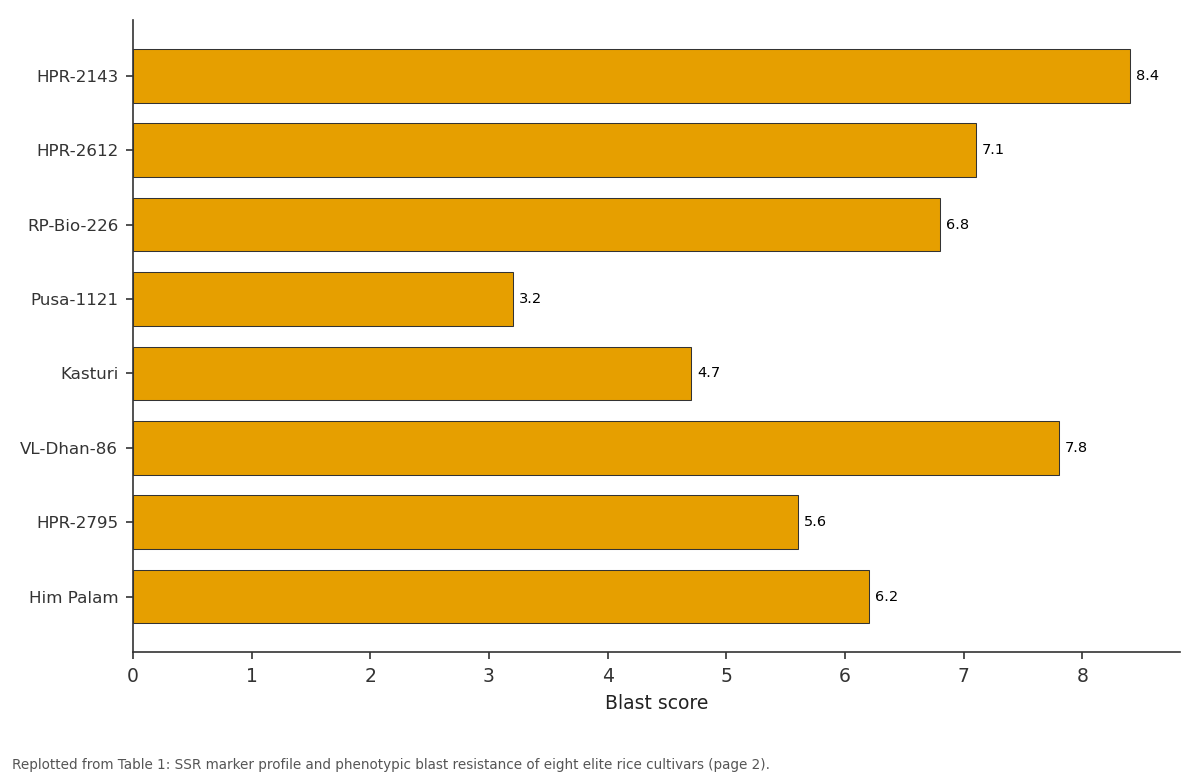
Blast score: HPR-2143 vs HPR-2612 vs RP-Bio-226 vs Pusa-1121 vs Kasturi
Replotted from Table 1 (page 2) of the original paper. Every bar is the paper's own table value.
View source evidence ↗Figures & tables
From the original paper Table 1
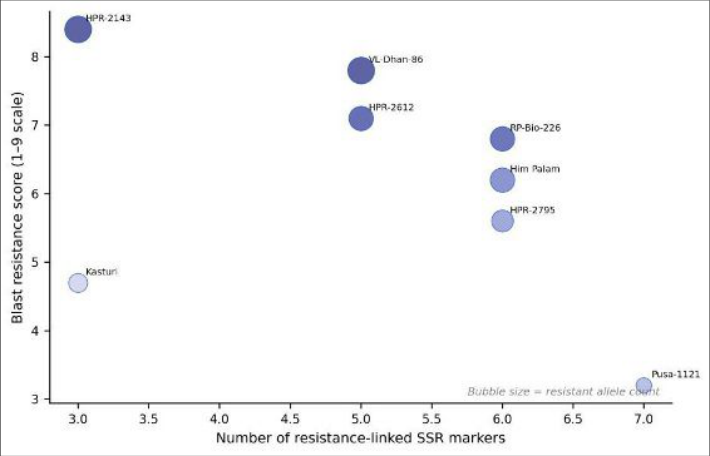 Figure 1
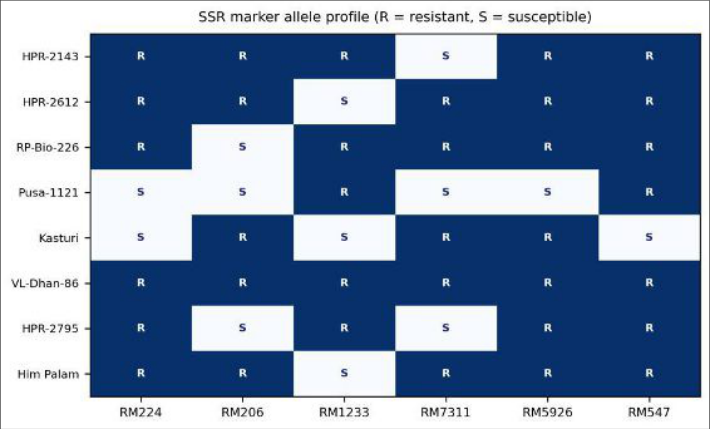 Figure 2
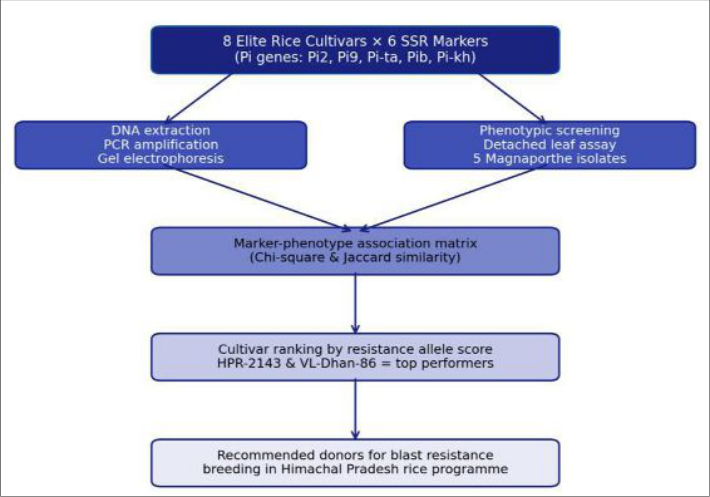 Figure 3
Introduction
Rice blast epidemics in the mid-hill zones of Himachal Pradesh have intensified over the past decade, driven by the spread of new pathogen races that overcome existing resistance in popular cultivars [1,2] . The Kangra and Mandi valleys, which account for over 60% of the state's rice area, reported blast severities above 40% in 2019 and 2021-seasons that were particularly wet during the critical booting-to-heading stage [3] . Chemical control with tricyclazole and isoprothiolane provides temporary relief but doesn't address the underlying vulnerability of the cultivar base. Durable blast resistance is best achieved by pyramiding multiple resistance (R) genes into elite backgrounds [4] . Over 100 blast R genes have been identified in rice, of which Pi2, Pi9, Pi-ta, Pib, and Pi-kh are among the most broadly effective against Asian Magnaporthe populations [5,6] . SSR markers tightly linked to these genes allow breeders to track them during crossing without relying solely on disease nurseries [7] . However, the specific R gene complement of Himachal Pradesh cultivars hasn't been determined. This research aimed to (a) screen eight elite HP rice cultivars for five blast R genes using linked SSR markers, (b) validate marker data against phenotypic blast reactions, and (c) identify the best donor cultivars for marker-assisted gene pyramiding.
Pathogen Isolate Collection and Virulence Testing
Five Magnaporthe oryzae isolates were collected from blast-infected rice leaves at four locations in Kangra and Mandi districts during kharif 2022: Mg-Pal01 (Palampur), Mg-Kan02 (Kangra town), Mg-Man03 (Mandi), Mg-Jog04 (Joginder Nagar), and Mg-Dhr05 (Dharamsala). Isolates were purified by single-spore culture on oatmeal agar and maintained at -20 °C on filter paper discs. Virulence profiling was done on the international differential set (8 varieties) and indicated that the five isolates represented at least three distinct pathotype groups, ensuring broad coverage for resistance screening.
Material and Methods Material
Eight rice cultivars were obtained from the HP Rice Breeding Programme: HPR-2143, HPR-2612, RP-Bio-226, Pusa-1121, Kasturi, VL-Dhan-86, HPR-2795, and Him Palam. Six SSR markers linked to five Pi genes were selected from published mapping data [5][6][7] : RM224 (Pi-ta), RM206 (Pi2), RM1233 (Pi9), RM7311 (Pib), RM5926 (Pikh), and RM547 (Pi2/Pi9 region). DNA was extracted from 15-day-old seedlings using a modified CTAB protocol. Blast reaction was scored on the IRRI 1-9 standard evaluation scale [8] . Marker-phenotype association was tested by Chi-square and Jaccard similarity index. All molecular work was conducted at the Molecular Breeding Laboratory, Department of Genetics and Plant Improvement, CSK HPAU, Palampur.
Methods
Methods
Marker Validation Criteria
A cultivar was scored 'R' (resistant allele present) for a given marker if the amplified fragment co-migrated with the resistant check allele (±5 bp tolerance on gel). Cultivars positive for ≥5 of 6 markers were classified as 'broadspectrum resistant'; 3-4 positive as 'moderate'; ≤2 as 'narrow-spectrum/susceptible'. This classification was cross-validated against the phenotypic resistance score (mean across 5 isolates).
Results
Table HPR-2143 and VL-Dhan-86 were the only cultivars positive for all six markers and both achieved high phenotypic resistance scores (8.4 and 7.8) (Table 1). Pusa-1121, with only 2 positive markers, was highly susceptible (3.2). The correlation between resistance allele count and phenotypic score was r = 0.92 (p< 0.01).
| Cultivar | RM224 | RM206 | RM1233 | RM7311 | RM5926 | RM547 | R alleles | Blast score |
|---|---|---|---|---|---|---|---|---|
| HPR-2143 | R | R | R | R | R | R | 6/6 | 8.4 |
| HPR-2612 | R | R | S | R | R | R | 5/6 | 7.1 |
| RP-Bio-226 | R | S | R | R | R | R | 5/6 | 6.8 |
| Pusa-1121 | S | S | R | S | S | R | 2/6 | 3.2 |
| Kasturi | S | R | S | R | R | S | 3/6 | 4.7 |
| VL-Dhan-86 | R | R | R | R | R | R | 6/6 | 7.8 |
| HPR-2795 | R | S | R | S | R | R | 4/6 | 5.6 |
| Him Palam | R | R | S | R | R | R | 5/6 | 6.2 |
Table text extracted from the original PDF; superscript letters are shown inline. The original table image is below.
View original table image
Comprehensive Interpretation
The heatmap (Figure 2) provides a visual genotyping summary showing that the top two cultivars carry all five target R genes, while Pusa-1121 lacks four of the five. The strong marker-phenotype correlation (r = 0.92) validates the usefulness of these SSRs for indirect selection in the breeding programme.
Discussion
The near-perfect marker-phenotype correlation supports the use of these six SSRs for marker-assisted selection in the HP rice programme. HPR-2143 and VL-Dhan-86 carry what appears to be a natural gene pyramid spanning Pi2, Pi9, Pita, Pib, and Pi-kh-a combination that provides broadspectrum resistance against the three pathotype groups identified in this research [4,5] . Using these cultivars as donors in crosses with high-yielding but susceptible lines like Pusa-1121 could efficiently transfer multiple R genes into improved backgrounds.
The susceptibility of Pusa-1121-a popular basmati variety-is concerning because it is widely grown in lower Himachal Pradesh and adjoining Punjab. Its narrow R gene base (only Pi9 and a partial Pi2 allele) leaves it vulnerable to the prevailing pathotype mix [1,3]
Figures and tables from the paper
References
16 in the original paper- Sharma TR, Rai AK, Gupta SK, Vijayan J, Devanna BN, Ray S. Rice blast management through host-plant resistance: retrospect and prospects. Agricultural Research. 2012;1(1):37-52.
- Padmanabhan SY. The great Bengal famine. Annual Review of Phytopathology. 1973;11:11-26.
- Thakur S, Singh PK, Sharma S. Blast disease incidence in rice growing areas of Himachal Pradesh. Himachal Journal of Agricultural Research. 2021;47(1):34-42.
- Ashikawa I, Hayashi N, Yamane H, Kanamori H, Wu J, Matsumoto T. Two adjacent nucleotide-binding siteleucine-rich repeat class genes are required to confer Pikm-specific rice blast resistance. Genetics. 2008;180(4):2267-2276.
- Fjellstrom R, Conaway-Bormans CA, McClung AM, Marchetti MA, Shank AR, Park WD. Development of DNA markers suitable for marker assisted selection of three Pi genes conferring resistance to multiple Pyricularia grisea pathotypes. Crop Science. 2004;44(5):1790-1798.
- Liu G, Lu G, Zeng L, Wang GL. Two broad-spectrum blast resistance genes, Pi9(t) and Pi2(t), are physically linked on rice chromosome 6. Molecular Genetics and Genomics. 2002;267(4):472-480.
- Jia Y, Wang Z, Singh P. Development of dominant rice blast Pi-ta resistance gene markers. Crop Science. 2002;42(6):2145-2149.
- IRRI. Standard evaluation system for rice. International Rice Research Institute. 2013;5th edition, Los Banos.
- Ballini E, Morel JB, Droc G, Price A, Courtois B, Notteghem JL. A genome-wide meta-analysis of rice blast resistance genes and quantitative trait loci provides new insights into partial and complete resistance. Molecular Plant-Microbe Interactions. 2008;21(7):859-868.
- Hayashi K, Yoshida H, Ashikawa I. Development of PCR-based allele-specific and InDel marker sets for nine rice blast resistance genes. Theoretical and Applied Genetics. 2006;113(2):251-260.
- Zhou B, Qu S, Liu G, Dolan M, Sakai H, Lu G. The eight amino-acid differences within three leucine-rich repeats between Pi2 and Piz-t resistance proteins determine the resistance specificity to Magnaporthe grisea. Molecular Plant-Microbe Interactions. 2006;19(11):1216-1228.
- Devanna BN, Vijayan J, Sharma TR. The blast resistance gene Pi54 of cloned from Oryza officinalis interacts with Avr-Pi54 through its novel non-LRR domains. PLoS ONE. 2014;9(8):e104840.
- Koide Y, Telebanco-Yanoria MJ, Pena FD, Fukuta Y, Kobayashi N. Characterization of rice blast isolates by the differential system and their application for screening of blast resistance genes. Plant Disease. 2011;95(11):1415-1421.
- Wang GL, Mackill DJ, Bonman JM, McCouch SR, Champoux MC, Nelson RJ. RFLP mapping of genes conferring complete and partial resistance to blast in a durably resistant rice cultivar. Genetics. 1994;136(4):1421-1434.
- RoyChowdhury M, Jia Y, Jia MH, Fjellstrom R, Cartwright RD. Identification of the blast resistance gene Pi-b in the national small grains collection. Phytopathology. 2012;102(7):700-706.
- Tanksley SD. Mapping polygenes. Annual Review of Genetics. 1993;27:205-233.