
Research article · 2025 · Full text
International Journal of Agriculture and NutritionEffect of vermicompost tea and compost extract as foliar sprays on growth of lettuce
Volume 7(5) · Pages 75–78 · DOI: 10.33545/26646064.2025.v7.i5b.547 ↗
Research areasPlant Growth Enhancement TechniquesPlant Growth and Agriculture TechniquesComposting and Vermicomposting Techniques
Abstract
Author-writtenLettuce growers seeking organic-compliant foliar feeds face a confusing array of liquid biofertilizer options with little comparative field data. This research compared vermicompost tea (VCT) and compost extract (CE) at three concentrations (2%, 5%, 10%) as foliar sprays on butterhead lettuce (cv. All Year Round) grown in an unheated polytunnel at the Devon College of Agricultural Research, Exeter, United Kingdom, during spring and autumn 2023. A randomized complete block design with seven treatments (including a water-sprayed control) and four replications was used. VCT at 10% produced the highest fresh head weight (78.4 g plant⁻¹), leaf number (12.6), and chlorophyll content (41.3 SPAD), representing 61.0%, 51.8%, and 44.4% increases over the control, respectively. CE at 10% performed comparably to VCT at 5% for most parameters. A clear dose-response was observed for both products. VCT consistently outperformed CE at equivalent concentrations. These results suggest that VCT at 10% is the most effective organic foliar feed for lettuce among the options tested.
Summary
Source-checkedPlain-language reading of the full paper, prepared with AI and checked against the text. Each point links to the authors' own words.
Why it matters
- Foliar feeding is used in organic horticulture to supplement soil nutrients, especially for fast-growing leafy vegetables like lettuce. View evidence ↗
- Vermicompost tea (VCT) and compost extracts (CE) are attractive organic foliar options because they can be produced on-farm cheaply. View evidence ↗
- Growers often lack certainty regarding the actual effectiveness of commercial organic liquid fertilizers. View evidence ↗
The question
- The study aimed to identify the most effective organic foliar feeding strategy for polytunnel-grown lettuce by comparing VCT and CE at three different concentrations. View evidence ↗
What they did
- Butterhead lettuce (cv. All Year Round) was grown in an unheated polytunnel at the Devon College of Agricultural Research in Exeter. View evidence ↗
- Sprays were applied at 10, 20, and 30 days after transplanting, with each plant receiving 50 mL per application. View evidence ↗
- At 45 days after transplanting, the researchers measured plant height, leaf number, leaf area, fresh and dry head weight, and chlorophyll content. View evidence ↗
What they found
- Every foliar spray treatment tested resulted in significantly improved lettuce growth compared to the water-sprayed control. View evidence ↗
- VCT at 10% was the most effective treatment, increasing fresh head weight by 61.0% (78.4 g plant⁻¹), leaf number by 51.8% (12.6), and chlorophyll content by 44.4% (41.3 SPAD) over the control. View evidence ↗
- VCT consistently outperformed CE at the same concentrations; for instance, VCT 5% produced 10.8% more fresh weight (67.9 g) than CE 5% (61.3 g). View evidence ↗
- The performance of CE at a 10% concentration was similar to that of VCT at a 5% concentration for most measured parameters. View evidence ↗
- VCT stock solution was more nutrient-rich than CE stock, containing 486 mg L⁻¹ of total nitrogen compared to 312 mg L⁻¹ in CE. View evidence ↗
What it means
- The authors conclude that 10% vermicompost tea is the most effective organic foliar feed for lettuce among the tested options. View evidence ↗
- The findings support using aerated VCT as a practical and low-cost foliar supplement for organic lettuce production. View evidence ↗
- A limitation of the study is that only one lettuce cultivar was tested; other types like romaine or iceberg might respond differently. View evidence ↗
- The authors suggest that future research should include an economic analysis to see if the yield gains justify the labor required for on-farm production. View evidence ↗
Visual summary
2 visualsIllustrations explain the paper; charts are replotted from the paper's own table values.
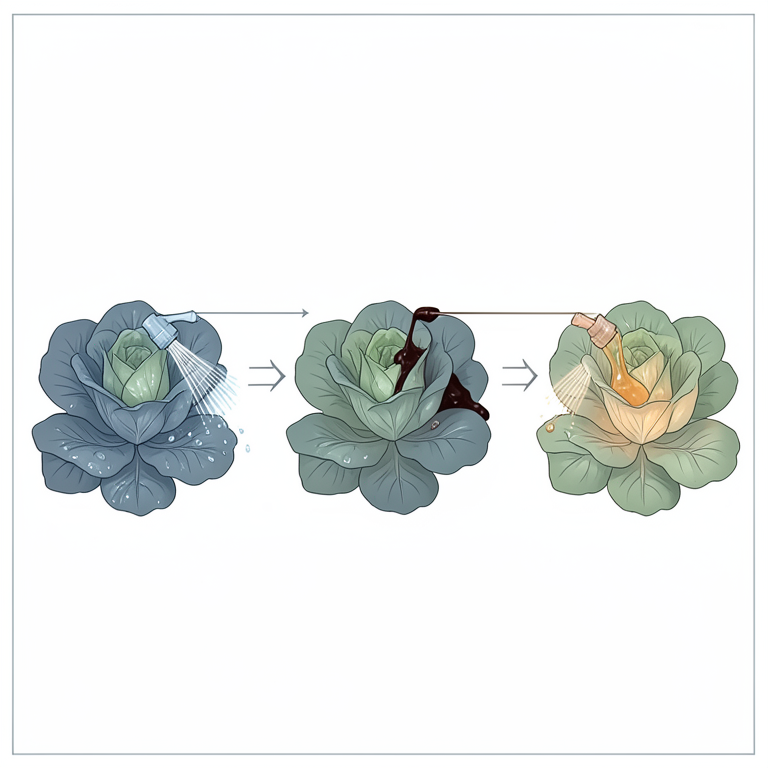
Experimental Treatment Layout
AI-generated conceptual illustration (lettuce plants in a polytunnel). It explains the idea and does not show study data.
View source evidence ↗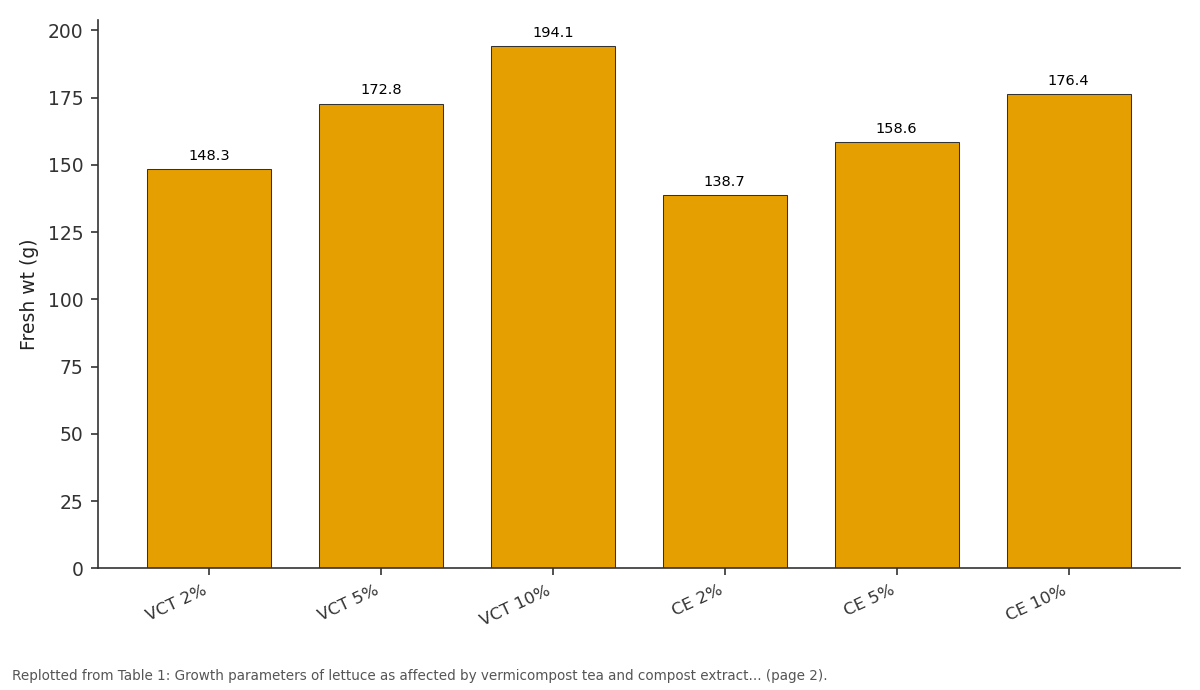
Leaf area (cm²): VCT 2% vs VCT 5% vs VCT 10% vs CE 2% vs CE 5%
Replotted from Table 1 (page 2) of the original paper. Every bar is the paper's own table value.
View source evidence ↗Figures & tables
From the original paper Table 1
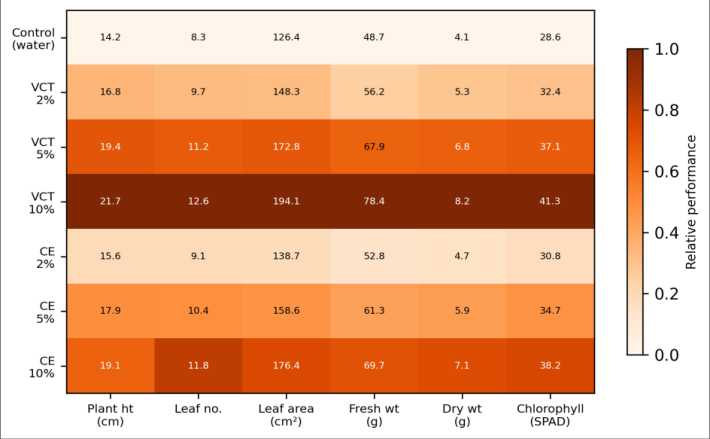 Figure 1
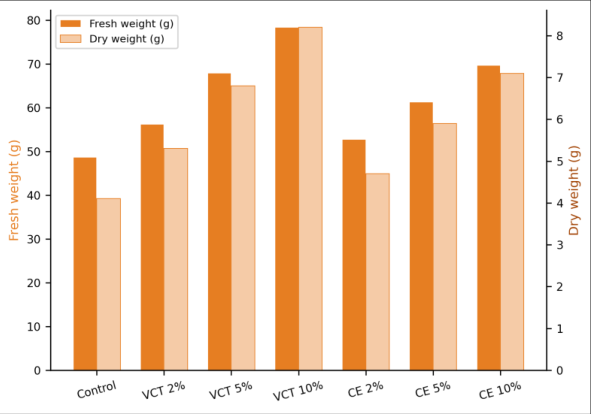 Figure 2
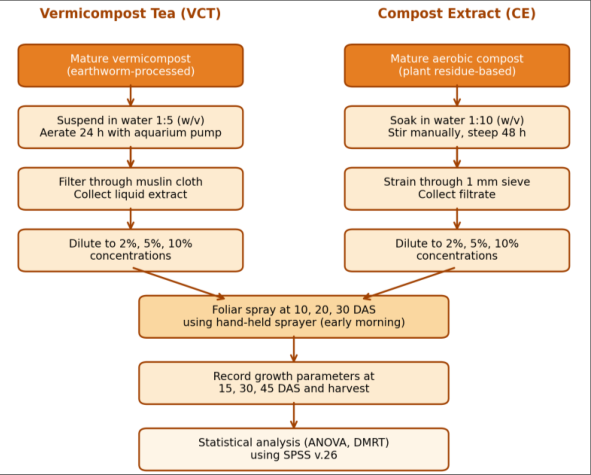 Figure 3
Introduction
The problem with most commercial organic liquid fertilizers is that growers don't know whether they're paying for a genuinely effective product or an expensive bottle of coloured water. Foliar feeding has gained popularity in organic horticulture as a supplement to soilapplied nutrients, particularly for fast-growing leafy vegetables like lettuce that respond quickly to nutrient pulses during active growth [1,2] . Among the available organic foliar options, vermicompost tea and compost extracts have attracted attention because they can be produced on-farm at low cost [3] . Vermicompost tea is prepared by steeping mature vermicompost in aerated water, which extracts soluble nutrients, humic substances, and beneficial microorganisms into a liquid form [4] . Compost extract follows a similar principle but uses thermophilic compost and typically involves passive soaking rather than active aeration [5] . Both products contain plantavailable nitrogen, phosphorus, potassium, and a range of micronutrients, along with growthpromoting substances such as auxins, cytokinins, and humic acids [6,7] . Despite growing farmer interest, direct comparisons between VCT and CE at matched concentrations under controlled field conditions are surprisingly rare. Most published work has tested only one product or used soil drenching rather than foliar application [3,8] . The concentration at which these products are applied also matters-too dilute and the effect may be negligible, too concentrated and phytotoxicity becomes a risk [9] . This research aimed to compare VCT and CE at three concentrations as foliar sprays on lettuce, measuring growth, biomass, and chlorophyll content to identify the most effective organic foliar feeding strategy for polytunnel-grown lettuce.
Preparation of Foliar Spray Solutions
Vermicompost tea was prepared by filling a muslin bag with 2 kg of mature vermicompost (produced from vegetable waste by Eisenia fetida at the college wormery) and suspending it in 10 L of rainwater in a 20 L plastic bucket. An aquarium air pump (Blagdon Koi Air 25) provided continuous aeration for 24 hours at ambient temperature (16-20 °C). The liquid was then filtered through two layers of muslin cloth and diluted to 2%, 5%, and 10% (v/v) working solutions with rainwater. Compost extract was prepared by soaking 1 kg of mature aerobic compost (produced from mixed garden and kitchen waste, aged 6 months) in 10 L of rainwater for 48 hours without aeration, stirring manually twice daily. The extract was strained through a 1 mm mesh sieve and diluted similarly. Both stock solutions were prepared fresh before each application and used within 4 hours.
Materials and Methods
Materials and Methods
Materials
Butterhead lettuce seeds (cv. All Year Round, Suttons Seeds) were sown in modular trays (40-cell) using peat-free compost and transplanted at the four-true-leaf stage into raised beds inside an unheated polytunnel at the Devon College of Agricultural Research, Exeter (50°43′N, 3°32′W). The growing medium was a sandy loam topsoil (pH 6.4, organic matter 3.8%) amended with well-rotted farmyard manure at 5 t ha⁻¹ before planting. Plant spacing was 25 cm × 25 cm. No synthetic fertilizers or pesticides were applied.
Methods
Seven treatments were arranged in a randomized complete block design with four replications (10 plants per rep): T 1 (water control), T 2 (VCT 2%), T 3 (VCT 5%), T 4 (VCT 10%), T 5 (CE 2%), T 6 (CE 5%), T 7 (CE 10%). Foliar sprays were applied at 10, 20, and 30 days after transplanting (DAT) using a 5 L hand-held pressure sprayer in early morning. Application volume was standardized at 50 mL per plant per event. Growth parameters measured at harvest (45 DAT) included plant height, leaf number, leaf area (LI-3100C area meter), fresh head weight, dry weight (ovendried at 65 °C for 48 h), and chlorophyll content (SPAD-502). Data were analyzed by ANOVA with DMRT at p ≤ 0.05 using SPSS v.26. The trial was conducted in spring (March-May) and autumn (September-November) 2023, and data were pooled after confirming homogeneity of variances.
Quality Assessment of Spray Solutions
Before each application, pH and electrical conductivity (EC) of all spray solutions were measured using a Hanna HI-98130 combo meter. VCT stock solution had a mean pH of 7.1 and EC of 2.8 dS m⁻¹; CE stock had pH 7.4 and EC 1.9 dS m⁻¹. Total nitrogen content was 486 mg L⁻¹ in VCT and 312 mg L⁻¹ in CE, analyzed by Kjeldahl digestion. These values confirmed that VCT was the more nutrient-rich product at stock concentration. All foliar spray treatments significantly improved lettuce growth over the control (Table 1). VCT at 10% recorded the highest values for every parameter measured. A consistent dose-response was evident: higher concentrations produced greater growth for both VCT and CE. At each concentration level, VCT outperformed CE-for example, VCT 5% (67.9 g fresh weight) exceeded CE 5% (61.3 g) by 10.8%.
| Treatment | Ht (cm) | Leaf no. | Leaf area (cm²) | Fresh wt (g) | Dry wt (g) | SPAD |
|---|---|---|---|---|---|---|
| Control | 14.2 | 8.3 | 126.4 | 48.7 | 4.1 | 28.6 |
| VCT 2% | 16.8 | 9.7 | 148.3 | 56.2 | 5.3 | 32.4 |
| VCT 5% | 19.4 | 11.2 | 172.8 | 67.9 | 6.8 | 37.1 |
| VCT 10% | 21.7 | 12.6 | 194.1 | 78.4 | 8.2 | 41.3 |
| CE 2% | 15.6 | 9.1 | 138.7 | 52.8 | 4.7 | 30.8 |
| CE 5% | 17.9 | 10.4 | 158.6 | 61.3 | 5.9 | 34.7 |
| CE 10% | 19.1 | 11.8 | 176.4 | 69.7 | 7.1 | 38.2 |
| CD (p=0.05) | 1.4 | 0.8 | 12.3 | 5.6 | 0.6 | 2.3 |
Table text extracted from the original PDF; superscript letters are shown inline. The original table image is below.
View original table image
Results
Results
Comprehensive Interpretation
The heatmap (Figure 1) provides a clear visual ranking of treatments, with the gradient running from lower-left (control) to upper-right (VCT 10%). The bar chart (Figure 2) highlights the biomass advantage of VCT over CE at matched concentrations. The process diagram (Figure 3) illustrates the methodological difference between the two products-active aeration for VCT versus passive soaking for CE.
Discussion
The superiority of VCT over CE at matched concentrations can be attributed to its higher nutrient content (486 vs. 312 mg N L⁻¹ at stock level) and the likely presence of a more diverse microbial community resulting from 24-hour aeration [4,6] . Aeration during VCT preparation promotes aerobic bacteria and suppresses anaerobic pathogens, producing a more biologically active product than passively steeped compost extract [5] . The 61% increase in fresh weight from VCT 10% over the control agrees with findings from greenhouse trials on tomato and spinach where VCT sprays at similar concentrations improved leaf biomass by 40-65% [3,7] . The dose-response pattern was linear across the tested range, suggesting that concentrations above 10% might yield further gains-though the risk of leaf scorch at higher concentrations would need evaluation [9] . The chlorophyll data (SPAD values) indicate that foliarapplied nutrients were absorbed through the leaf surface and contributed to photosynthetic capacity. This is consistent with the known ability of humic acids in VCT to improve cuticular permeability and nutrient uptake across the leaf epidermis [6] . One limitation of this research is the single cultivar tested. Different lettuce types (romaine, iceberg, loose-leaf) may respond differently due to variation in leaf surface characteristics. Future trials should also include economic analysis to determine whether the yield gain from VCT 10% justifies the labor of on-farm production.
Conclusion
Vermicompost tea at 10% concentration was the most effective organic foliar feed for polytunnel-grown
International Journal of Agriculture and Nutrition https://www.agriculturejournal.net butterhead lettuce, producing 61% more fresh biomass and 44% higher chlorophyll content than water-sprayed controls.
Compost extract at 10% performed comparably to VCT at 5%, making VCT the more potent product at equal dilutions. A clear dose-response was observed for both products across the 2-10% range. These findings support the use of aerated VCT as a practical, low-cost foliar supplement in organic lettuce production systems. Growers with access to on-farm vermicomposting can produce their own foliar feed at minimal expense.
References
17 in the original paper- Havlin JL, Tisdale SL, Nelson WL, Beaton JD. Soil fertility and fertilizers: an introduction to nutrient management. Pearson Education. 2014;8th edition.
- Marschner H. Mineral nutrition of higher plants. Academic Press. 2012;3rd edition.
- Edwards CA, Arancon NQ, Greytak S. Effects of vermicompost teas on plant growth and disease. BioCycle. 2006;47(5):28-31.
- Arancon NQ, Edwards CA, Bierman P. Influences of vermicomposts on field strawberries: effects on soil microbiological and chemical properties. Bioresource Technology. 2006;97(6):831-840.
- Scheuerell SJ, Mahaffee WF. Compost tea: principles and prospects for plant disease control. Compost Science and Utilization. 2002;10(4):313-338.
- Canellas LP, Olivares FL, Aguiar NO, Jones DL, Nebbioso A. Humic and fulvic acids as biostimulants in horticulture. Scientia Horticulturae. 2015;196:15-27.
- Singh R, Sharma RR, Kumar S, Gupta RK, Patil RT. Vermicompost substitution influences growth, physiological disorders, fruit yield and quality of strawberry. Bioresource Technology. 2008;99(17):8507-8511.
- Pant AP, Radovich TJ, Hue NV, Talcott ST, Krenek KA. Vermicompost extracts influence growth, mineral nutrients, phytonutrients and antioxidant activity in pak choi. Journal of the Science of Food and Agriculture. 2009;89(14):2383-2392.
- Zaller JG. Foliar spraying of vermicompost extracts: effects on biometrical growth, yield and quality of fieldgrown tomatoes. Biological Agriculture and Horticulture. 2006;24(1):47-64.
- Gutierrez-Miceli FA, Santiago-Borraz J, Molina JAM, Nafate CC, Abud-Archila M. Vermicompost as a soil supplement to improve growth, yield and fruit quality of tomato. Bioresource Technology. 2007;98(15):27812786.
- Kaur P, Bhardwaj M, Babbar I. Effect of vermicompost and vermiwash on growth of vegetables. Research Journal of Animal, Veterinary and Fishery Sciences. 2015;3(4):9-12.
- Fritz JI, Franke-Whittle IH, Haindl S, Insam H, Braun R. Microbiological community analysis of vermicompost tea and its influence on the growth of vegetables and cereals. Canadian Journal of Microbiology. 2012;58(7):836-847.
- Chatterjee R, Bandyopadhyay S. Effect of boron, molybdenum and biofertilizers on growth and yield of cowpea in acid soil of eastern Himalayan region. Journal of the Saudi Society of Agricultural Sciences. 2017;16(4):332-336.
- Sallaku G, Babaj I, Kaciu S, Balliu A. The influence of vermicompost on plant growth characteristics of cucumber seedlings under saline conditions. Journal of Food, Agriculture and Environment. 2009;7(3-4):869872.
- Jack ALH, Thies JE. Compost and vermicompost as amendments promoting soil health. Biological Approaches to Sustainable Soil Systems. 2006;453-466.
- Trevisan S, Francioso O, Quaggiotti S, Nardi S. Humic substances biological activity at the plant-soil interface. Plant Signaling and Behavior. 2010;5(6):635-643.
- Muscolo A, Sidari M, Nardi S. Humic substance: relationship between structure and activity. Deeper information suggests univocal findings. Journal of Geochemical Exploration. 2013;129:57-63.