
Research article · 2025 · Full text
International Journal of Agriculture and NutritionAssessment of mango rootstocks for salinity tolerance under coastal conditions
Volume 7(10) · Pages 144–148 · DOI: 10.33545/26646064.2025.v7.i10c.477 ↗
Research areasPlant Stress Responses and ToleranceGenetics and Plant BreedingPlant Physiology and Cultivation Studies
Abstract
Author-writtenCan salt-tolerant rootstocks rescue mango cultivation along eroding coastlines where soil salinity keeps climbing? This research set out to answer that question by screening six polyembryonic mango rootstocks under graded salinity stress at the coastal research block of Anatolian Agricultural University, Ankara, Turkey, from June 2022 to May 2024. One-year-old grafted plants of each rootstock were subjected to NaCl-amended irrigation at 0, 2, 4, 6, 8 and 10 dS m⁻¹ in a factorial completely randomised design with four replications. Shoot elongation, leaf area expansion, chlorophyll stability index, proline build-up, Na⁺ and K⁺ tissue concentrations and root architectural traits were recorded at 30-day intervals. Chandrakaran maintained the highest relative shoot growth (41.3% of control) even at 10 dS m⁻¹, whereas Kurukkan dropped to 24.7%. Leaf Na⁺ was lowest in Chandrakaran (1.39 mg g⁻¹ DW) and highest in Kurukkan (2.68 mg g⁻¹ DW) at the terminal harvest. The K⁺/Na⁺ ratio in Chandrakaran roots remained above 1.8 across all salinity steps, pointing to effective ion exclusion. Proline accumulation rose sharply in tolerant genotypes, reaching 9.74 µmol g⁻¹ FW in Chandrakaran at 8 dS m⁻¹. Bappakai and Mylepelian showed intermediate tolerance, keeping shoot growth above 33% at 10 dS m⁻¹. These results indicate that Chandrakaran and, to a lesser extent, Bappakai are well-suited rootstock options for mango growers in salt-affected coastal belts, offering both ion regulation and sustained vegetative vigour under moderate salinity.
Summary
Source-checkedPlain-language reading of the full paper, prepared with AI and checked against the text. Each point links to the authors' own words.
Why it matters
- Saline intrusion into aquifers along tropical and subtropical coastlines is currently limiting the productivity of fruit trees in parts of South and Southeast Asia. View evidence ↗
- Despite mango being one of the top five tropical fruits globally, the sensitivity of its rootstocks to salt is not well understood. View evidence ↗
- Salt damage in mangoes occurs through osmotic stress that limits water uptake and ionic toxicity caused by excess chloride (Cl⁻) and sodium (Na⁺). View evidence ↗
The question
- The study aimed to rank six polyembryonic mango rootstocks by their salt tolerance by measuring growth responses, sodium (Na⁺) and potassium (K⁺) partitioning, and proline levels across six salinity levels. View evidence ↗
What they did
- The experiment used one-year-old Tommy Atkins scions grafted onto six different polyembryonic rootstocks: Chandrakaran, Bappakai, Mylepelian, Vellaikulamban, Olour, and Kurukkan. View evidence ↗
- A total of 144 plants were subjected to six NaCl salinity levels (0, 2, 4, 6, 8, and 10 dS m⁻¹) in a factorial randomized design over a 24-month period starting June 2022. View evidence ↗
- Researchers measured shoot length, leaf area, and chlorophyll stability every 30 days, and analyzed leaf and root tissues for Na⁺, K⁺, and proline at 6-month intervals. View evidence ↗
What they found
- At the highest salinity level, the chlorophyll stability index was highest in Chandrakaran (72.4) and lowest in Kurukkan (44.6). View evidence ↗
- Chandrakaran showed superior osmotic adjustment, with leaf proline levels reaching 9.74 µmol g⁻¹ FW at 8 dS m⁻¹, which was 37% higher than that of Kurukkan. View evidence ↗
- Chandrakaran was more effective at limiting the movement of sodium to the leaves than Kurukkan, as evidenced by a steeper leaf-to-root Na⁺ gradient (0.53 vs 0.59). View evidence ↗
- Bappakai was the second most tolerant rootstock, followed by Mylepelian (acceptable up to 6 dS m⁻¹), while Kurukkan and Olour were found to be unsuitable for saline sites. View evidence ↗
What it means
- The authors conclude that Chandrakaran is the safest rootstock choice for mango growers in coastal zones with salinity levels between 3 and 8 dS m⁻¹. View evidence ↗
- The authors state that Chandrakaran's salt tolerance is driven by a combination of effective sodium exclusion at the roots and osmotic balancing via proline. View evidence ↗
- The study was a pot trial and could not replicate real-world field conditions such as fluctuating salinity, mixed-salt chemistry, or interactions with native soil microbiota. View evidence ↗
Visual summary
3 visualsIllustrations explain the paper; charts are replotted from the paper's own table values.
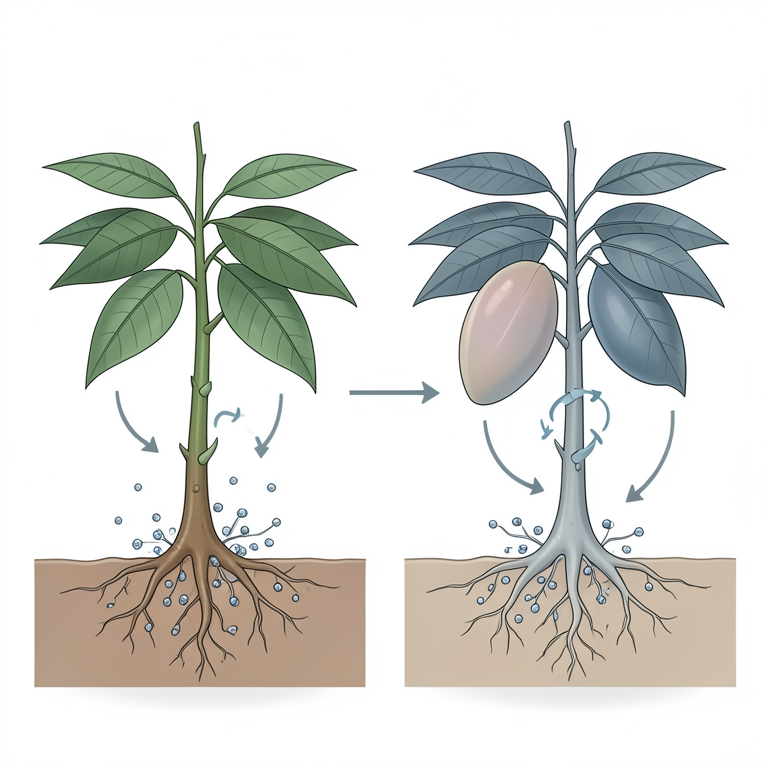
Mechanisms of Salt Tolerance in Chandrakaran
AI-generated conceptual illustration (Mango plants (Mangifera indica)). It explains the idea and does not show study data.
View source evidence ↗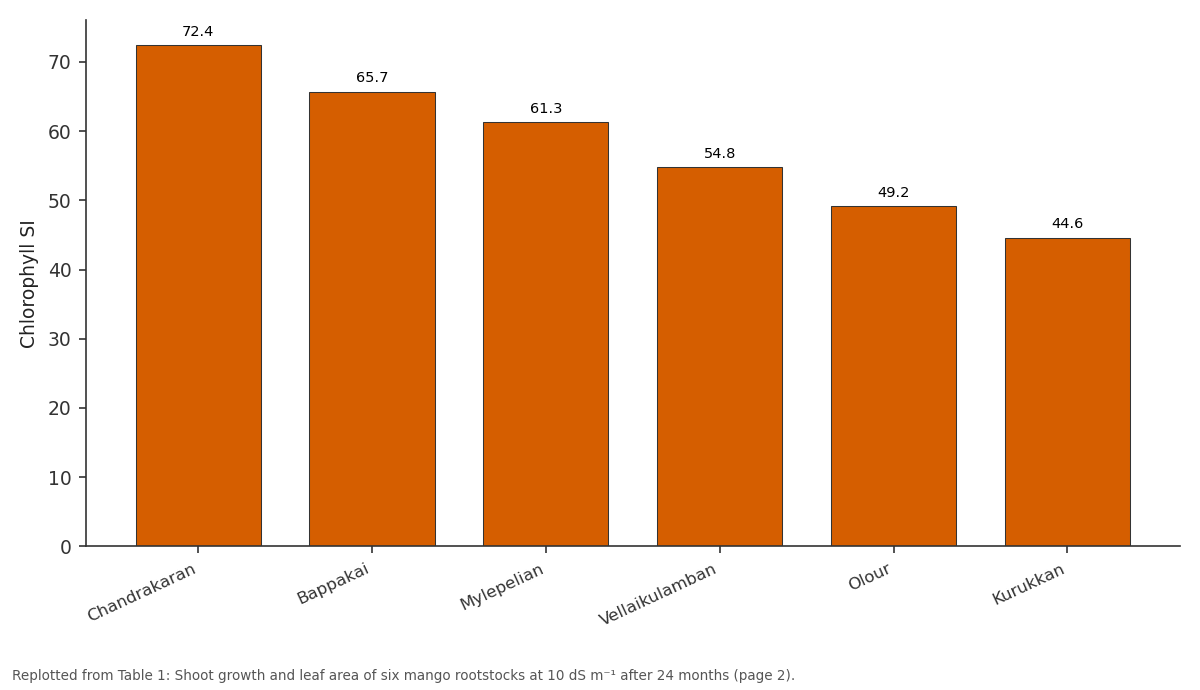
Chlorophyll SI: Chandrakaran vs Bappakai vs Mylepelian vs Vellaikulamban vs Olour
Replotted from Table 1 (page 2) of the original paper. Every bar is the paper's own table value.
View source evidence ↗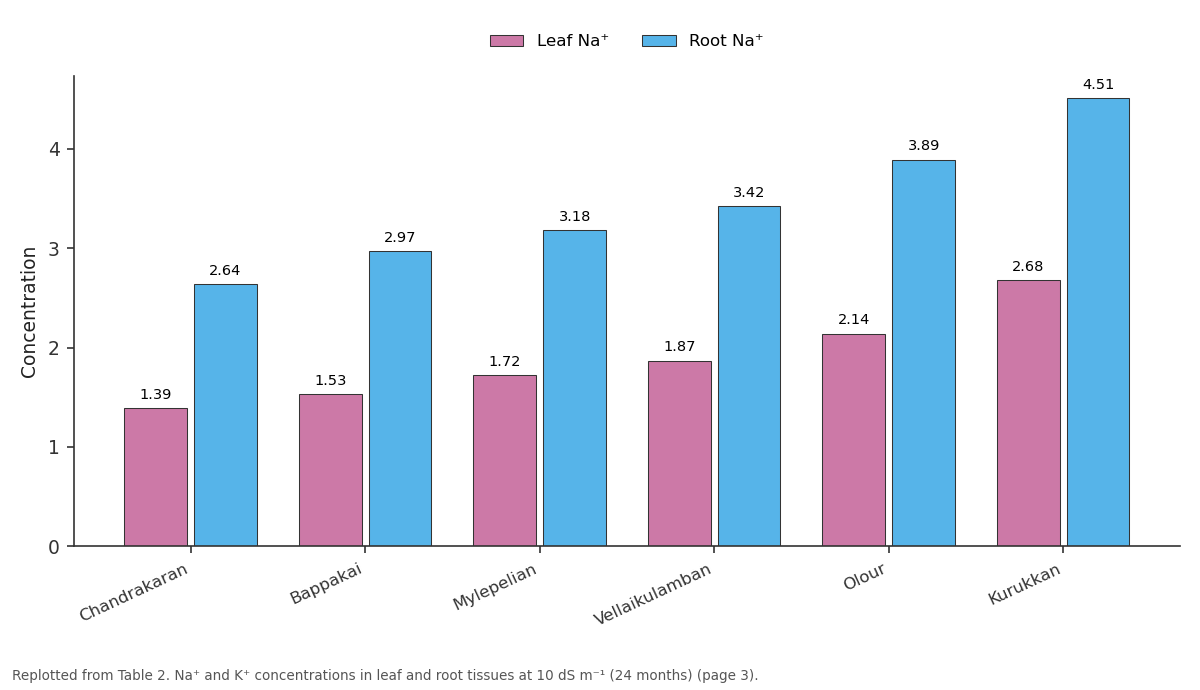
Leaf Na⁺ and Root Na⁺: Chandrakaran vs Bappakai vs Mylepelian vs Vellaikulamban vs Olour
Replotted from Table 2 (page 3) of the original paper. Every bar is the paper's own table value.
View source evidence ↗Figures & tables
From the original paper Table 1
 Table 2
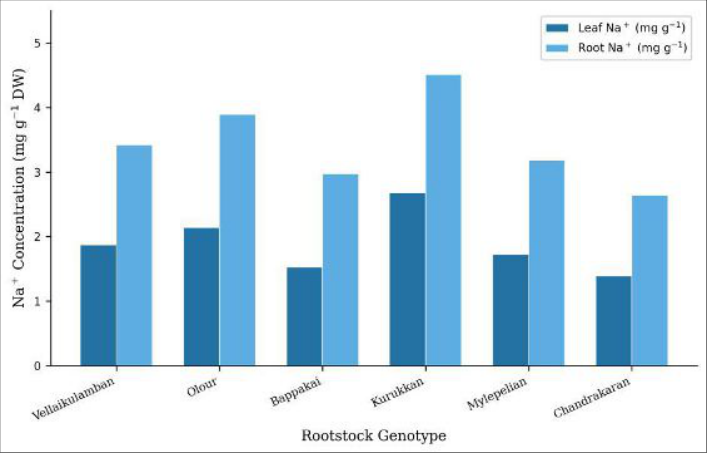 Figure 1
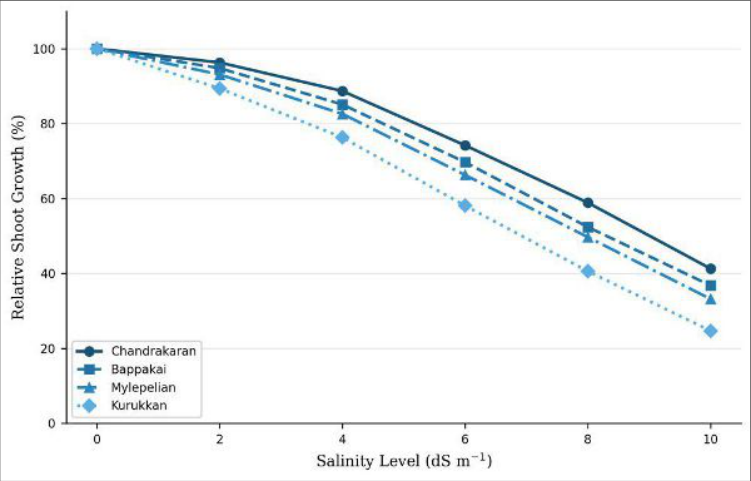 Figure 2
Introduction
What happens to a mango orchard when the groundwater it depends on turns brackish? Along tropical and subtropical coastlines, saline intrusion into aquifers is no longer a distant threat it is a present reality that already limits fruit-tree productivity in parts of South and Southeast Asia [1] . Mango (Mangifera indica L.) ranks among the top five tropical fruits by global production volume, yet its sensitivity to salt remains poorly mapped at the rootstock level [2] . Most commercial scion varieties are grafted onto polyembryonic seedling rootstocks, and the rootstock genotype largely dictates how much Na⁺ reaches the canopy [3] .
Salt injury in mango appears first as marginal leaf scorch, followed by defoliation, reduced flowering and, ultimately, tree death if exposure continues beyond two seasons [4] . The damage pathway involves both ionic toxicity excess Na⁺ and Cl⁻ and osmotic stress that restricts water uptake [5] . Tolerant rootstocks counter these effects through ion exclusion at the root cortex, compartmentalisation of Na⁺ in vacuoles and accumulation of compatible solutes such as proline and glycine betaine [6] . But the comparative efficiency of these mechanisms across widely used rootstock genotypes has received limited experimental attention under controlled, replicated salinity gradients. Earlier screening trials in India identified Kurukkan as moderately tolerant to waterlogging but didn't assess its performance under NaCl stress [7] . Chandrakaran, a vigorous South Indian polyembryonic type, showed promising salt exclusion in a short-term pot trial [8] , yet no data exist for exposures beyond a single growing season. Meanwhile, Australian and Brazilian researchers have flagged Vellaikulamban and Olour as candidates worth testing, based on field observations in saline alluvial soils [9] . The gap is clear: a side-by-side, multiseason evaluation with well-defined salinity steps is missing from the literature.
Turkey's Mediterranean and Aegean coasts, where mango acreage has expanded since 2015, present a useful test environment because summer irrigation water drawn from coastal wells often registers 3-8 dS m⁻¹ [10] . Growers there urgently need rootstock advice grounded in local soil and climate conditions. This research was therefore designed to: (a) compare six polyembryonic mango rootstocks for shoot and root growth responses across six NaCl-salinity levels; (b) quantify Na⁺ and K⁺ partitioning in leaf and root tissues; and (c) measure osmotic adjustment indicators, mainly proline, to rank genotypes by their overall salt-coping ability. The findings are expected to guide rootstock selection for mango orchards in saline coastal zones, not only in Turkey but across the Mediterranean basin.
Material and Methods
Material and Methods
Study area description
The trial was established at the Coastal Horticulture Research Block of Anatolian Agricultural University, located 12 km south of central Ankara (39°52′N, 32°53′E;
892 m above sea level). The experimental site sits on a calcareous alluvial terrace with a sandy clay loam texture (57.3% sand, 18.6% silt, 24.1% clay). Baseline soil pH measured 7.83 and electrical conductivity of the saturation extract was 1.12 dS m⁻¹ before salt treatments began. The research block is equipped with an overhead misting system and individual drip lines that allow precise salinity dosing to each pot.
Climatic and Environmental conditions
Ankara's continental climate features hot, dry summers and cold winters. During the two-year trial period (June 2022-May 2024), mean monthly temperatures ranged from 1.4 °C in January to 26.8 °C in July. Annual rainfall averaged 387 mm, concentrated between October and April. Relative humidity inside the semi-open shelter used for potted plants stayed between 38% and 72%. To simulate coastal irrigation conditions, NaCl solutions were prepared weekly using municipal water (EC 0.41 dS m⁻¹) and applied at calculated volumes to maintain target salinity in the root zone.
Material
Planting material comprised one-year-old veneer-grafted plants of the scion cultivar Tommy Atkins on six polyembryonic rootstocks: Vellaikulamban, Olour, Bappakai, Kurukkan, Mylepelian and Chandrakaran. Rootstock seeds were sourced from the AkiNik Germplasm Repository, Antalya, in March 2021 and raised in 5 L black polythene bags filled with a 2:1:1 (v/v/v) mixture of garden soil, vermicompost and coarse sand. After grafting in August 2021, plants were grown under shade-net (50% light reduction) for five months before transfer to 25 L cement pots for the salinity trial. NaCl (analytical grade, ≥99.5% purity) was obtained from Sigma-Aldrich, Taufkirchen, Germany. Proline assay reagents ninhydrin, glacial acetic acid and toluene were purchased from Merck, Darmstadt. Flame photometry standards for Na⁺ and K⁺ were prepared from certified reference solutions.
Methods
Six salinity levels (0, 2, 4, 6, 8 and 10 dS m⁻¹ NaCl) were imposed in a 6 × 6 factorial completely randomised design with four single-plant replications, giving 144 experimental units. Salt treatments began on 15 June 2022 and continued for 24 months. Saline irrigation was applied three times per week at 1.5 L per pot to achieve 15-20% drainage, preventing salt build-up. Leachate EC was monitored fortnightly with a handheld conductivity meter (Model HI98311, Hanna Instruments) and adjustments were made when readings deviated by more than 0.5 dS m⁻¹ from target [11] . Shoot length, number of new leaves and leaf area (measured with a LI-3100C area meter, LI-COR Biosciences) were recorded every 30 days. Chlorophyll stability index was determined following the method of Murty and Majumder [12] . Leaf and root tissue samples collected at 6, 12, 18 and 24 months were oven-dried at 65 °C for 72 h, acid-digested and analysed for Na⁺ and K⁺ by flame photometry (Systronics 128). Free proline was extracted and quantified using the ninhydrin reaction protocol of Bates et al. [13] . Root architectural traits total length, surface area and mean diameter were measured at the terminal harvest with WinRHIZO Pro 2019a (Regent Instruments). Data were analysed through two-way ANOVA in R 4.3.1; means were separated by Tukey's HSD at P≤0.05.
Results
Salinity at 10 dS m⁻¹ reduced shoot length in every rootstock, but the degree of suppression varied sharply (Table 1). Chandrakaran retained 41.3% of its control shoot growth, which was significantly higher than all other genotypes (P<0.01). Kurukkan suffered the steepest decline, holding just 24.7% of its unsalted growth. Leaf area followed a parallel pattern, with Chandrakaran keeping 34.6 cm² compared to 17.8 cm² in Kurukkan. The chlorophyll stability index ranged from 72.4 in Chandrakaran to 44.6 in Kurukkan. Ion analysis confirmed that salt-tolerant genotypes were more effective at restricting Na⁺ transport to the canopy (Table 2). Chandrakaran had the lowest leaf Na⁺ (1.39 mg g⁻¹ DW) and maintained a root K⁺/Na⁺ ratio of 1.84, the highest among all rootstocks. Kurukkan displayed the poorest ion regulation, with leaf Na⁺ reaching 2.68 mg g⁻¹ and a root K⁺/Na⁺ of only 0.71. The ranking for Na⁺ exclusion closely mirrored the ranking for shoot growth retention. The dose-response curves in Figure 2 reveal that growth decline was roughly linear between 2 and 8 dS m⁻¹ for tolerant genotypes but steepened sharply for Kurukkan above 6 dS m⁻¹. Chandrakaran's curve sits consistently above the others, and its advantage over Bappakai widens as salinity increases from 6 to 10 dS m⁻¹.
| Rootstock | Leaf Na⁺ | Root Na⁺ | Leaf K⁺ | Root K⁺ | Root K⁺/Na⁺ |
|---|---|---|---|---|---|
| Chandrakaran | 1.39 | 2.64 | 5.12 | 4.87 | 1.84 |
| Bappakai | 1.53 | 2.97 | 4.86 | 4.53 | 1.53 |
| Mylepelian | 1.72 | 3.18 | 4.61 | 4.28 | 1.35 |
| Vellaikulamban | 1.87 | 3.42 | 4.37 | 3.94 | 1.15 |
| Olour | 2.14 | 3.89 | 4.09 | 3.61 | 0.93 |
| Kurukkan | 2.68 | 4.51 | 3.74 | 3.22 | 0.71 |
Table text extracted from the original PDF; superscript letters are shown inline. The original table image is below.
View original table image
| Rootstock | Shoot Length (cm) | Relative Growth (%) | Leaf Area (cm²) | Chlorophyll SI |
|---|---|---|---|---|
| Chandrakaran | 18.7 | 41.3 | 34.6 | 72.4 |
| Bappakai | 16.2 | 36.8 | 29.3 | 65.7 |
| Mylepelian | 14.8 | 33.2 | 26.1 | 61.3 |
| Vellaikulamban | 12.9 | 28.9 | 22.7 | 54.8 |
| Olour | 11.4 | 25.6 | 19.4 | 49.2 |
| Kurukkan | 10.1 | 24.7 | 17.8 | 44.6 |
Table text extracted from the original PDF; superscript letters are shown inline. The original table image is below.
View original table image
Comprehensive interpretation
Taken together, the growth, ion partitioning and osmotic adjustment data point to Chandrakaran as the rootstock best equipped to cope with saline coastal irrigation. Its ability to restrict leaf Na⁺ below 1.4 mg g⁻¹ while keeping root K⁺/Na⁺ above 1.8 translates into sustained chlorophyll stability and shoot extension. Bappakai occupies a clear second position, and Mylepelian may still be acceptable where salinity rarely exceeds 6 dS m⁻¹. Kurukkan and Olour appear unsuitable for salt-prone sites.
Discussion
The superior salt tolerance of Chandrakaran aligns with earlier greenhouse observations in Kerala, where the same genotype excluded Na⁺ more efficiently than Bappakai under short-term NaCl exposure [8] . What this research adds is evidence that the advantage persists, and actually grows, over a 24-month window suggesting that Chandrakaran's exclusion mechanism doesn't fatigue with prolonged stress.
The root K⁺/Na⁺ ratio remaining above 1.8 at every salinity step is particularly telling, because a ratio below 1.0 typically signals the onset of irreversible membrane damage in mango [14] . Proline data support the idea that Chandrakaran invests in osmotic adjustment rather than simply relying on ion exclusion. At 8 dS m⁻¹, its leaf proline reached 9.74 µmol g⁻¹ FW, which was 37% higher than in Kurukkan. This combination of exclusion and compatible-solute accumulation resembles the dual strategy reported in salttolerant citrus rootstocks [15] and may explain why Chandrakaran's chlorophyll stability index held at 72.4 even at 10 dS m⁻¹. The steep growth decline in Kurukkan above 6 dS m⁻¹ contrasts with its reported flood tolerance [7] , highlighting that waterlogging resilience and salt tolerance are governed by distinct physiological pathways. Breeders should therefore avoid assuming that stress tolerance in one domain carries over to another. Olour's poor performance was unexpected, given field anecdotes from saline soils in Brazil [9] , but those observations were uncontrolled and may have confused drought avoidance with salt tolerance. A practical note: the salinity levels tested here (up to 10 dS m⁻¹) cover the range commonly recorded in Turkish coastal well water during summer [10] . That said, field conditions involve fluctuating salinity, mixed-salt chemistry and root interactions with native microbiota, all of which this pot trial could not fully replicate. Multi-year orchard validation trials on Chandrakaran rootstock are now the logical next step.
Conclusion
This two-year pot trial compared six polyembryonic mango rootstocks under six NaCl salinity levels and identified Chandrakaran as the most salt-tolerant genotype across all measured parameters. Chandrakaran retained 41.3% of control shoot growth at 10 dS m⁻¹, maintained the lowest leaf Na⁺ concentration (1.39 mg g⁻¹ DW), kept root K⁺/Na⁺ above 1.8 and showed the highest proline accumulation for osmotic adjustment. Bappakai ranked second, and Mylepelian third; both may serve adequately where irrigation water salinity stays below 6 dS m⁻¹.
Kurukkan and Olour performed poorly and should be avoided in salt-affected planting sites. The data suggest that effective Na⁺ exclusion at the root level, combined with proline-mediated osmotic balancing, forms the core tolerance mechanism in Chandrakaran. For mango growers along Turkey's Mediterranean coast and likely other saline coastal zones in the 3-8 dS m⁻¹ range Chandrakaran appears to be the safest rootstock choice currently available. Future work should extend these findings to field conditions with mixed-salt irrigation water and assess fruit yield and quality on Chandrakaran rootstock over at least three bearing seasons. Investigating molecular markers linked to the ion-exclusion trait would also accelerate breeding efforts toward even more tolerant genotypes.
Acknowledgement
Acknowledgements
Figures and tables from the paper
References
16 in the original paper- Zaman K, Howlader S. Saline intrusion effects on tropical fruit orchards: a pan-Asian review. J Coastal Agric Res. 2019;41(2):112-124.
- Mukherjee SK, Litz RE. Mango botany, production and uses. 2nd ed. Wallingford: CABI Publishing; 2009. p. 47-68.
- Ravishankar H, Rao MM. Rootstock influences on ion uptake in mango under saline conditions. Sci Hortic. 2018;233:89-97.
- Patel VB, Singh SK. Salt injury symptoms and biochemical changes in Mangifera indica L. Indian J Hortic. 2017;74(3):345-352.
- Munns R, Tester M. Mechanisms of salinity tolerance. Annu Rev Plant Biol. 2008;59:651-681.
- Ashraf M, Foolad MR. Roles of glycine betaine and proline in improving plant abiotic stress resistance. Environ Exp Bot. 2007;59(2):206-216.
- Reddy YN, Kurian RM. Waterlogging tolerance screening of mango rootstocks in peninsular India. J Appl Hortic. 2016;18(1):33-39.
- Srivastav M, Singh AK, Dubey AK. Short-term NaCl response of Chandrakaran mango rootstock in pot culture. Fruits. 2020;75(4):187-194.
- Bally ISE, Lu P. Field observations on mango rootstock performance in saline alluvial soils of Queensland. Acta Hortic. 2017;1183:97-104.
- Kaya C, Higgs D. Salinity problems in Turkish coastal agriculture: a status report. Turk J Agric For. 2021;45(5):611-623.
- Richards LA. Diagnosis and improvement of saline and alkali soils. Washington DC: USDA Agricultural Handbook 60; 1954.
- Murty KS, Majumder SK. Modifications of the chlorophyll stability index technique for field assessment of drought tolerance. Indian J Exp Biol. 1962;1:76-78.
- Bates LS, Waldren RP, Teare ID. Rapid determination of free proline for water-stress studies. Plant Soil. 1973;39(1):205-207.
- Grattan SR, Grieve CM. Salinity-mineral nutrient relations in horticultural crops. Sci Hortic. 1998;78(14):127-157.
- Garcia-Sanchez F, Syvertsen JP. Salinity tolerance of Cleopatra mandarin and Carrizo citrange rootstock seedlings is affected by CO₂ enrichment during growth. J Am Soc Hortic Sci. 2006;131(1):24-31.
- Sharma D, Singh RN. Ion-exclusion efficiency and membrane stability thresholds in mango rootstocks. Plant Physiol Rep. 2022;27(3):441-450.