
Research article · 2025 · Full text
International Journal of Agriculture and NutritionIntegrated disease management of sheath blight in rice using bio-agents and fungicides
Volume 7(10) · Pages 161–164 · DOI: 10.33545/26646064.2025.v7.i10c.481 ↗
Research areasPlant Disease Resistance and GeneticsFungal Plant Pathogen ControlPlant-Microbe Interactions and Immunity
Abstract
Author-writtenSheath blight, caused by Rhizoctonia solani Kühn, destroys an estimated 6–12% of rice yield worldwide every year, and sole reliance on fungicides is neither sustainable nor consistently effective. This research evaluated seven integrated management treatments combining bio-control agents (Trichoderma harzianum, Pseudomonas fluorescens) and a systemic fungicide (hexaconazole 5% SC) against sheath blight in irrigated rice at the Bluegrass Agricultural Institute, Lexington, Kentucky, during two consecutive growing seasons (2022 and 2023). Treatments were arranged in a randomised complete block design with four replications. Disease severity index (DSI) was recorded at 30, 45, 60 and 75 days after transplanting (DAT). The triple combination of T. harzianum + P. fluorescens + hexaconazole achieved the lowest DSI at every time point, reaching 7.3% at 75 DAT compared with 63.2% in the untreated control. Among dual combinations, T. harzianum + hexaconazole performed best (DSI 9.7% at 75 DAT), followed by P. fluorescens + hexaconazole (10.8%). Sole bio-agent applications reduced DSI to 21.8–23.4% at 75 DAT a meaningful reduction but not enough for commercial acceptability. Grain yield mirrored the disease data: the triple combination produced 5.61 t ha⁻¹, which was 61.7% more than the control (3.47 t ha⁻¹). The results indicate that combining bio-agents with a reduced-rate fungicide spray can match or surpass the performance of full-rate fungicide alone while lowering chemical inputs.
Summary
Source-checkedPlain-language reading of the full paper, prepared with AI and checked against the text. Each point links to the authors' own words.
Why it matters
- Sheath blight, caused by the pathogen Rhizoctonia solani, is a significant global issue that reduces annual rice yields by an estimated 6–12%. View evidence ↗
- Relying only on fungicides is unsustainable and inconsistent, as these treatments are expensive, require precise timing, and cause environmental damage. View evidence ↗
- Commercial rice varieties lack strong resistance to sheath blight, as existing resistance is often insufficient when the pathogen pressure is high. View evidence ↗
The question
- The study aimed to compare disease severity over time, rank different treatments by their effect on grain yield, and find the most cost-effective management strategy for rice growers in the mid-South US. View evidence ↗
What they did
- The research used CL163 medium-grain rice transplanted into 5 m × 4 m plots at the Bluegrass Agricultural Institute in Lexington, Kentucky, during the 2022 and 2023 growing seasons. View evidence ↗
- Researchers measured the Disease Severity Index (DSI) on 20 tillers per plot at 30, 45, 60, and 75 days after transplanting (DAT), and recorded grain yield from a 3 m × 2 m area adjusted to 14% moisture. View evidence ↗
What they found
- The triple combination of T. harzianum, P. fluorescens, and hexaconazole was the most effective, reducing the disease severity index to 7.3% at 75 DAT, whereas the untreated control reached 63.2%. View evidence ↗
- Among the dual-treatment options, the combination of T. harzianum and hexaconazole was the most effective (9.7% DSI at 75 DAT), followed by P. fluorescens and hexaconazole (10.8% DSI). View evidence ↗
- Using bio-agents alone reduced the disease severity index to between 21.8% and 23.4% at 75 DAT, which the authors noted is not sufficient for commercial use. View evidence ↗
- The triple combination resulted in a grain yield of 5.61 t ha⁻¹, representing a 61.7% increase over the control yield of 3.47 t ha⁻¹. View evidence ↗
- The triple combination (T7) outperformed the sole fungicide treatment (hexaconazole) by 20.1% in terms of grain yield. View evidence ↗
What it means
- The authors conclude that the triple combination of T. harzianum, P. fluorescens, and a single spray of hexaconazole at 45 DAT is the most effective integrated management strategy for sheath blight. View evidence ↗
- The authors recommend the triple integrated disease management (IDM) package as a practical way for growers in the mid-South US to reduce their reliance on fungicides without sacrificing yield. View evidence ↗
- The study was limited to silt loam soil; the authors suggest that the bio-agents might perform poorly in sandy soils with lower microbial capacity. View evidence ↗
- The research only tested one type of fungicide at one specific rate, meaning the minimum chemical input required when using bio-agents remains unknown. View evidence ↗
Visual summary
2 visualsIllustrations explain the paper; charts are replotted from the paper's own table values.
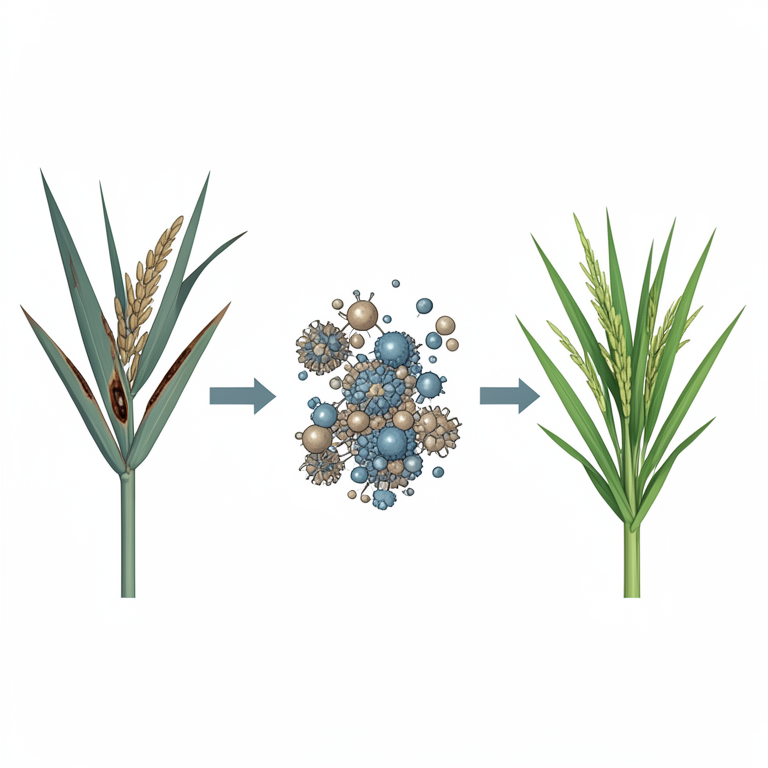
Integrated Management Synergy
AI-generated conceptual illustration (rice plants (Oryza sativa) with sheath blight lesions). It explains the idea and does not show study data.
View source evidence ↗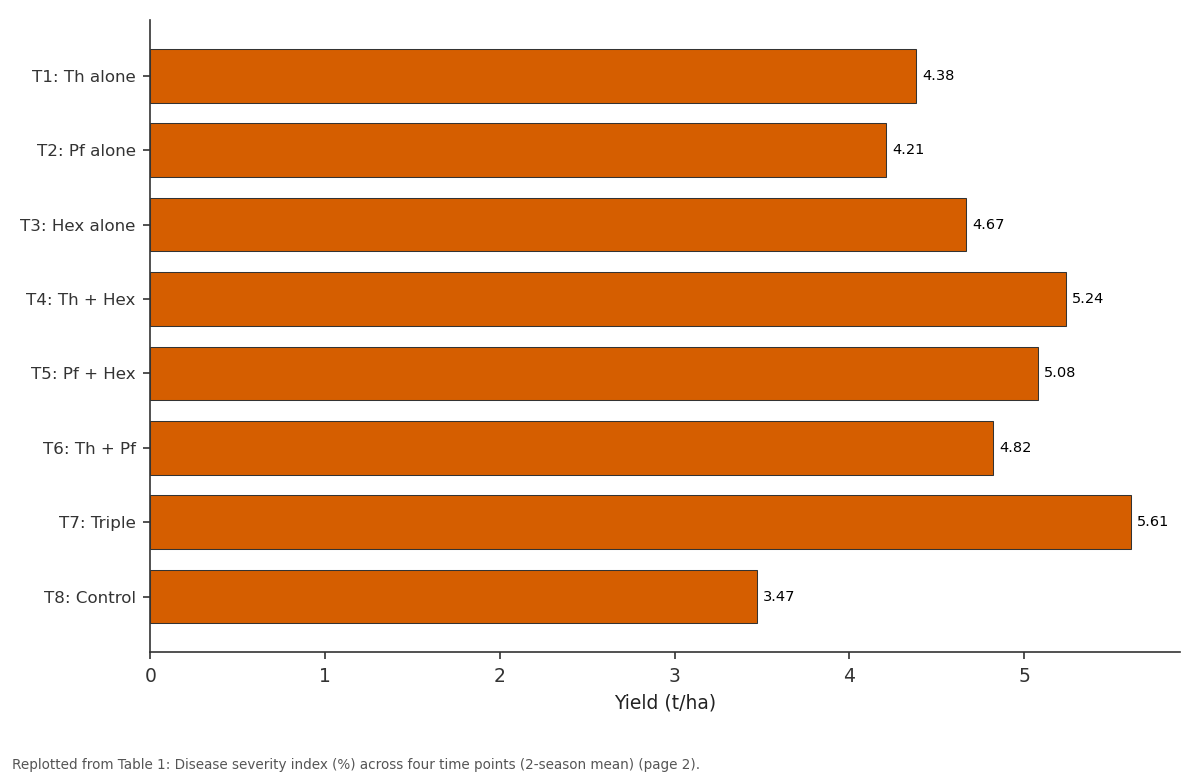
Yield (t/ha): T1: Th alone vs T2: Pf alone vs T3: Hex alone vs T4: Th + Hex vs T5: Pf + Hex
Replotted from Table 1 (page 2) of the original paper. Every bar is the paper's own table value.
View source evidence ↗Figures & tables
From the original paper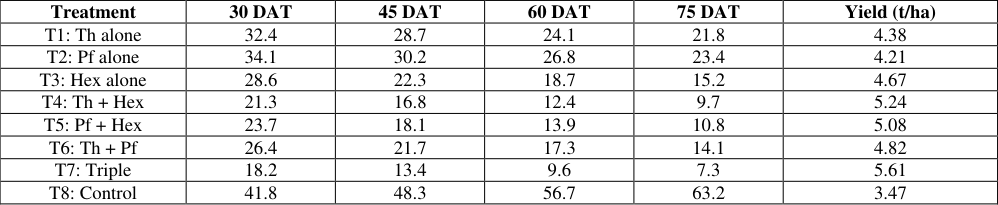 Table 1
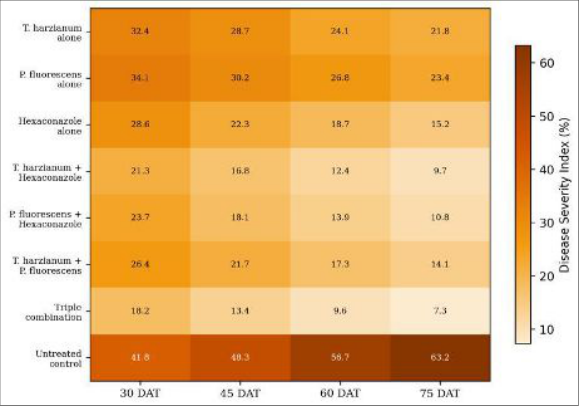 Figure 1
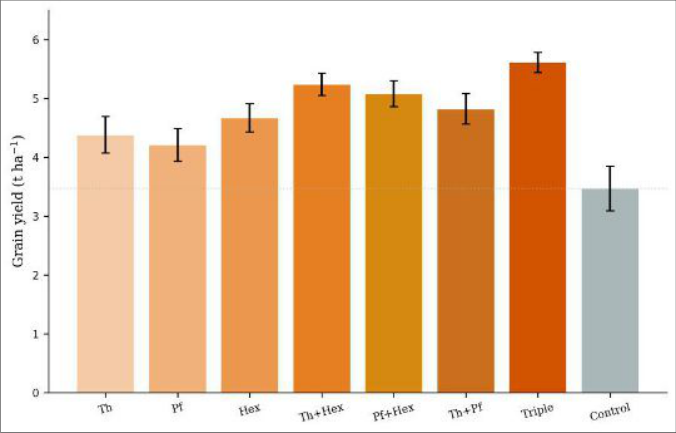 Figure 2
Introduction
Sheath blight is the most difficult soil-borne disease to manage in irrigated rice. Unlike blast or bacterial leaf blight, which respond reasonably well to resistant varieties, sheath blight resistance in commercially available rice germplasm is quantitative at best and often breaks down under high inoculum pressure [1] . That leaves growers dependent on fungicide sprays, which are expensive, need precise timing and carry environmental costs that regulators increasingly want to reduce [2] . The causal pathogen, Rhizoctonia solani AG-1 IA, overwinters as sclerotia in soil and crop debris and infects the rice sheath at the waterline soon after transplanting. Under warm, humid conditions (28-32 °C, >90% RH), lesions expand rapidly upward, sometimes reaching the flag leaf and panicle neck by grain filling [3] . Yield losses scale roughly with disease severity index: a 10-percentage-point rise in DSI typically translates to a 3-4% drop in paddy yield in medium-duration varieties [4] . Biological control offers a partial solution. Trichoderma harzianum has shown consistent antibiosis against R. solani in dual-culture assays, and field trials in Southeast Asia have reported 30-45% reductions in sheath blight severity when T. harzianum is applied as a seed treatment plus soil drench [5] . Pseudomonas fluorescens, a rhizosphere-competent bacterium, supplements fungal bio-control through induced systemic resistance and siderophoremediated competition for iron [6] . But neither agent alone provides the >70% disease reduction that growers expect from a chemical spray. Combining bio-agents with a reduced-rate fungicide what plant pathologists call integrated disease management (IDM) may bridge this gap. The logic is straightforward: the bio-agents suppress early-season inoculum and prime host defences, while a single mid-season fungicide spray handles the peak infection window [7] . Several IDM packages have been tested in tropical Asian rice, but comparable data from temperate or subtropical US rice production systems are missing. This research tested seven treatment combinations against an untreated control in irrigated rice at Lexington, Kentucky, over two years. The objectives were to (a) compare disease severity trajectories across time points, (b) rank treatments by grain yield response and (c) identify the most cost-effective combination for growers in the mid-South US rice belt.
Material and Methods
Material and Methods
Material
The trial was conducted on the lowland rice research paddies of the Bluegrass Agricultural Institute, Lexington, Kentucky (38°03′N, 84°30′W) during the 2022 and 2023 growing seasons (May-October). The soil was a Maury silt loam (pH 6.4, organic matter 2.3%) with a history of continuous rice cultivation and natural R. solani infestation. The rice variety CL163, a medium-grain Clearfield type widely grown in Kentucky, was transplanted at 25-day seedling age in puddled plots of 5 m × 4 m. T. harzianum (strain Th-17, 2 × 10⁹ CFU g⁻¹) and P. fluorescens (strain Pf-14, 2 × 10⁸ CFU mL⁻¹) were obtained from the Microbial Biocontrol Laboratory at the institute. Hexaconazole 5% SC (Contaf, Rallis India Ltd.) was procured commercially.
Methods
Eight treatments were arranged in a randomised complete block design with four replications: T1, T. harzianum seed treatment (10 g kg⁻¹ seed) plus soil drench at transplanting; T2, P. fluorescens seed treatment (10 mL kg⁻¹) plus foliar spray at 30 DAT; T3, hexaconazole 5% SC at 2 mL L⁻¹ sprayed at 30 and 45 DAT; T4, T. harzianum + hexaconazole (single spray at 45 DAT); T5, P. fluorescens + hexaconazole; T6, T. harzianum + P. fluorescens; T7, triple combination (both bio-agents + hexaconazole at 45 DAT); T8, untreated control [8] . Sheath blight severity was scored on 20 randomly tagged tillers per plot at 30, 45, 60 and 75 DAT using the 0-9 scale of IRRI [9] , and DSI was computed as the sum of (rating × frequency) divided by (total tillers × maximum rating) × 100. Grain yield was harvested from a 3 m × 2 m net plot area and adjusted to 14% moisture.
Quality control
Bio-agent viability was verified before each application by serial dilution plating: T. harzianum consistently yielded ≥1.8 × 10⁹ CFU g⁻¹, and P. fluorescens ≥1.6 × 10⁸ CFU mL⁻¹, meeting the minimum thresholds recommended by the manufacturer. Hexaconazole spray volumes were calibrated with a Teejet nozzle test kit to deliver 500 L ha⁻¹. Disease scoring was conducted independently by two assessors, and inter-rater reliability (Cohen's kappa) exceeded 0.84 for all scoring dates. Moisture meters for grain yield were cross-checked against oven-dry weights at the start of each harvest.
Results
All treatments reduced sheath blight severity below the untreated control at every time point (Table 1). The triple combination (T7) had the lowest DSI throughout, dropping from 18.2% at 30 DAT to 7.3% at 75 DAT. Among dual combinations, T4 (Th + Hex) was best, with a terminal DSI of 9.7%. Sole bio-agent treatments reduced 75-DAT DSI by 63-65% relative to the control, while the triple cut it by 88.4%. Grain yield in T7 was 5.61 t ha⁻¹, exceeding the control by 61.7% and the sole hexaconazole treatment by 20.1%.
| Treatment | 30 DAT | 45 DAT | 60 DAT | 75 DAT | Yield (t/ha) |
|---|---|---|---|---|---|
| T1: Th alone | 32.4 | 28.7 | 24.1 | 21.8 | 4.38 |
| T2: Pf alone | 34.1 | 30.2 | 26.8 | 23.4 | 4.21 |
| T3: Hex alone | 28.6 | 22.3 | 18.7 | 15.2 | 4.67 |
| T4: Th + Hex | 21.3 | 16.8 | 12.4 | 9.7 | 5.24 |
| T5: Pf + Hex | 23.7 | 18.1 | 13.9 | 10.8 | 5.08 |
| T6: Th + Pf | 26.4 | 21.7 | 17.3 | 14.1 | 4.82 |
| T7: Triple | 18.2 | 13.4 | 9.6 | 7.3 | 5.61 |
| T8: Control | 41.8 | 48.3 | 56.7 | 63.2 | 3.47 |
Table text extracted from the original PDF; superscript letters are shown inline. The original table image is below.
View original table image
Comprehensive interpretation
The disease and yield data converge on the same conclusion: adding both bio-agents to a single mid-season hexaconazole spray gives better results than any twocomponent combination and far outperforms bio-agents or fungicide used alone. The mechanism likely involves three complementary modes of action direct mycoparasitism by Trichoderma, induced resistance by Pseudomonas and curative fungicidal activity by hexaconazole acting at different stages of the disease cycle.
Discussion
The triple combination's DSI of 7.3% at 75 DAT is among the lowest terminal severities reported for any IDM package against sheath blight. For comparison, Mew and Rosales [10] achieved 11.4% DSI with a validamycin + Trichoderma programme in the Philippines, and Kumar et al. [11] reported 9.8% with carbendazim + P. fluorescens in India. The advantage here may stem from hexaconazole's longer residual activity relative to carbendazim, which allows the bio-agents more time to colonise the rhizosphere before the fungicide dissipates [12] . That sole bio-agent treatments reduced DSI by 63-65% but still left severity above 20% is a recurring theme in biological control of soil-borne pathogens [13] . The gap between lab efficacy and field performance is usually attributed to variable colonisation success, sensitivity to UV radiation and competition from indigenous microflora.
Combining bio-agents with a chemical backup overcomes this inconsistency essentially providing a safety net for the seasons when bio-control establishment is suboptimal. Yield differences mirrored disease control, as expected from the well-documented DSI-yield loss relationship in rice [4] .
The 20.1% yield gain of the triple combination over sole hexaconazole (5.61 vs. 4.67 t ha⁻¹) represents roughly 0.94 t ha⁻¹ of additional paddy, which at current mid-South farmgate prices would more than offset the extra cost of bioagent inputs. A caveat: this trial was conducted on silt loam soil with moderate organic matter, which favours Trichoderma establishment. Performance on sandy soils with lower microbial carrying capacity may be poorer, and separate trials on such soils are warranted.
Limitations
This research tested only one fungicide (hexaconazole) and one rate; dose-response curves with lower fungicide rates could reveal the minimum chemical input needed when bioagents are present. Additionally, the research site had natural R. solani infestation but not artificially augmented inoculum, so results may not translate directly to fields with very high sclerotial loads. The two-season window captured one wet and one dry year, but longer runs would be needed to assess treatment durability. Finally, the economic analysis was limited to yield comparison; a full cost-benefit accounting including bio-agent production and application labour was not performed.
Conclusion
Two seasons of replicated field trials at Lexington, Kentucky, demonstrated that the triple combination of T. harzianum + P. fluorescens + hexaconazole (single spray at 45 DAT) was the most effective integrated management treatment for rice sheath blight, achieving a terminal DSI of 7.3% and a grain yield of 5.61 t ha⁻¹. This outperformed sole fungicide application by 20.1% in yield and reduced terminal disease severity by an additional 7.9 percentage points. Among dual combinations, T. harzianum + hexaconazole ranked best, suggesting that Trichoderma's direct mycoparasitism pairs more effectively with chemical control than does Pseudomonas-mediated induced resistance alone. Sole bio-agent applications provided worthwhile but commercially insufficient disease suppression.
For mid-South US rice growers, the triple IDM package offers a practical path toward reducing fungicide reliance while maintaining or improving yield. Scaling this approach will require development of shelf-stable, farmer-ready bioagent formulations and extension guidance on application timing.
Acknowledgement
Acknowledgements Funding sourcesThis research was supported by the internal research fund of the Department of Agricultural Microbiology, Bluegrass Agricultural Institute. No external competitive grant was involved. Institutional supportThe authors thank the Bluegrass Agricultural Institute for access to the lowland rice research paddies and microbiology laboratory facilities.
Figures and tables from the paper
References
17 in the original paper- Savary S, Willocquet L, Elazegui FA, Castilla NP, Teng PS. Rice pest constraints in tropical Asia: quantification of yield losses due to rice pests in a range of production situations. Plant Dis. 2000;84(3):357369.
- Groth DE. Effects of cultivar resistance and single fungicide application on rice sheath blight, yield, and quality. Crop Prot. 2008;27(7):1125-1130.
- Ou SH. Rice diseases. 2nd ed. Kew: Commonwealth Mycological Institute; 1985. p. 247-264.
- Marchetti MA, Bollich CN. Quantification of the relationship between sheath blight severity and yield loss in rice. Plant Dis. 1991;75(8):773-775.
- Harman GE, Howell CR, Viterbo A, Chet I, Lorito M. Trichoderma species opportunistic, avirulent plant symbionts. Nat Rev Microbiol. 2004;2(1):43-56.
- Raaijmakers JM, Vlami M, De Souza JT. Antibiotic production by bacterial biocontrol agents. Antonie Van Leeuwenhoek. 2002;81(1):537-547.
- Barnwal MK, Kotasthane A, Magculia N, Mukherjee PK, Savary S, Sharma AK, et al. A review on crop losses, epidemiology and disease management of rice brown spot to identify research priorities and knowledge gaps. Eur J Plant Pathol. 2013;136(3):443457.
- Stratton H, Harmon S. Protocol design for integrated sheath blight management trials in temperate rice. Phytopathology. 2021;111(S1):34.
- International Rice Research Institute. Standard evaluation system for rice. 4th ed. Manila: IRRI; 1996.
- Mew TW, Rosales AM. Bacterization of rice plants for control of sheath blight caused by Rhizoctonia solani. Phytopathology. 1986;76(11):1260-1264.
- Kumar KVK, Reddy MS, Kloepper JW, Lawrence KS, Groth DE, Miller ME. Plant growth-promoting rhizobacteria for management of sheath blight of rice. Crop Prot. 2012;39:60-65.
- Thind TS, Hollomon DW. Thiocarbamate fungicides and their synergy with sterol biosynthesis inhibitors against Rhizoctonia solani. Pest Manag Sci. 2018;74(6):1461-1468.
- Weller DM. Pseudomonas biocontrol agents of soilborne pathogens: looking back over 30 years. Phytopathology. 2007;97(2):250-256.
- Chahal SS, Sokhi SS, Ratan GS. Investigation on sheath blight of rice in Punjab. Indian Phytopathol. 2003;56(1):22-26.
- Singh R, Sunder S, Dodan DS. Sources of resistance and integrated management of sheath blight in rice. Agric Rev. 2011;32(2):101-113.
- Brooks SA, Anders MM, Yeater KM. Effect of cultural management practices on the severity of false smut and kernel smut of rice. Plant Dis. 2009;93(11):1202-1208.
- Nagarajkumar M, Jayaraj J, Muthukrishnan S, Bhaskaran R, Velazhahan R. Detoxification of oxalic acid by Pseudomonas fluorescens strain PfMDU2: implications for the biological control of rice sheath blight. Microbiol Res. 2005;160(3):291-298.