
Research article · 2025 · Full text
International Journal of Agriculture and NutritionEvaluation of green manure crops for nitrogen fixation and soil improvement in tropical conditions
Volume 7(12) · Pages 157–160 · DOI: 10.33545/26646064.2025.v7.i12c.550 ↗
Research areasAgricultural Science and FertilizationAgronomic Practices and Intercropping SystemsSoil Carbon and Nitrogen Dynamics
Abstract
Author-writtenHere is a fact that surprises many agronomists outside the tropics: a well-managed stand of dhaincha (Sesbania aculeata) can fix 158 kg N ha⁻¹ in just 12 weeks more nitrogen than most cereal farmers in the US Corn Belt apply as synthetic fertiliser. This research evaluated three tropical green manure species (sunn hemp, cowpea, and dhaincha) for nitrogen fixation capacity, biomass production, and subsequent soil improvement on a Morrow-series silt loam at Starkville, Mississippi, during 2023. A randomised block design with four replications compared the three species against a bare fallow control. Dhaincha fixed the most N (158 kg ha⁻¹ by 12 weeks), followed by sunn hemp (153 kg ha⁻¹) and cowpea (127 kg ha⁻¹). Following incorporation, soil organic carbon at 0–15 cm rose by 0.14–0.21% over the fallow, and available N increased by 34–47 kg ha⁻¹ within six weeks. These results demonstrate that tropical green manure species can deliver a full season’s worth of N in a short summer window, making them practical cover-crop options for southern US cropping systems.
Summary
Source-checkedPlain-language reading of the full paper, prepared with AI and checked against the text. Each point links to the authors' own words.
Why it matters
- In the southern United States, there is a 10–14 week window between wheat harvest and fall crop planting where fields are often left bare and prone to erosion. View evidence ↗
- Tropical green manure legumes are suitable for this gap because they grow quickly in heat and can fix significant amounts of nitrogen. View evidence ↗
The question
- The study aimed to determine which tropical green manure species provides the optimal balance of nitrogen supply and soil improvement for farmers in the Mississippi Delta. View evidence ↗
What they did
- The study used a randomized block design with four replications of 6 m × 5 m plots, testing sunn hemp, cowpea, and dhaincha sown on June 15, 2023. View evidence ↗
- Biomass was measured every three weeks for 12 weeks, and nitrogen fixation was estimated using the N-difference method with grain sorghum as a non-fixing reference. View evidence ↗
What they found
- By 12 weeks, dhaincha fixed the most nitrogen at 158 kg ha⁻¹, followed by sunn hemp at 153 kg ha⁻¹ and cowpea at 127 kg ha⁻¹. View evidence ↗
- Dhaincha produced the highest dry biomass at 12 weeks (8.47 t ha⁻¹), compared to sunn hemp (7.84 t ha⁻¹) and cowpea (5.62 t ha⁻¹). View evidence ↗
- Incorporating the green manures increased soil organic carbon (0–15 cm) by 0.14% to 0.21% compared to the fallow control. View evidence ↗
- Within six weeks of incorporation, available mineral nitrogen increased by 34 to 47 kg ha⁻¹. View evidence ↗
- Plots with green manure had 2.3 to 3.1 times more earthworms than fallow plots, with a mean of 47 versus 17 individuals per square meter. View evidence ↗
- All treatments showed a positive net carbon balance, with dhaincha retaining the most carbon (+0.87 Mg C ha⁻¹) due to higher lignin content. View evidence ↗
- Cowpea's nitrogen became available to plants faster than dhaincha's because it had a lower C:N ratio (14:1 compared to 22:1). View evidence ↗
What it means
- The authors conclude that using tropical green manure legumes during the summer fallow is a practical, low-cost way to reduce reliance on synthetic nitrogen and increase soil organic matter. View evidence ↗
- The authors note that the positive net carbon balance needs verification over multiple seasons, as the initial increase in labile carbon might be respired during the next crop cycle. View evidence ↗
Visual summary
3 visualsIllustrations explain the paper; charts are replotted from the paper's own table values.
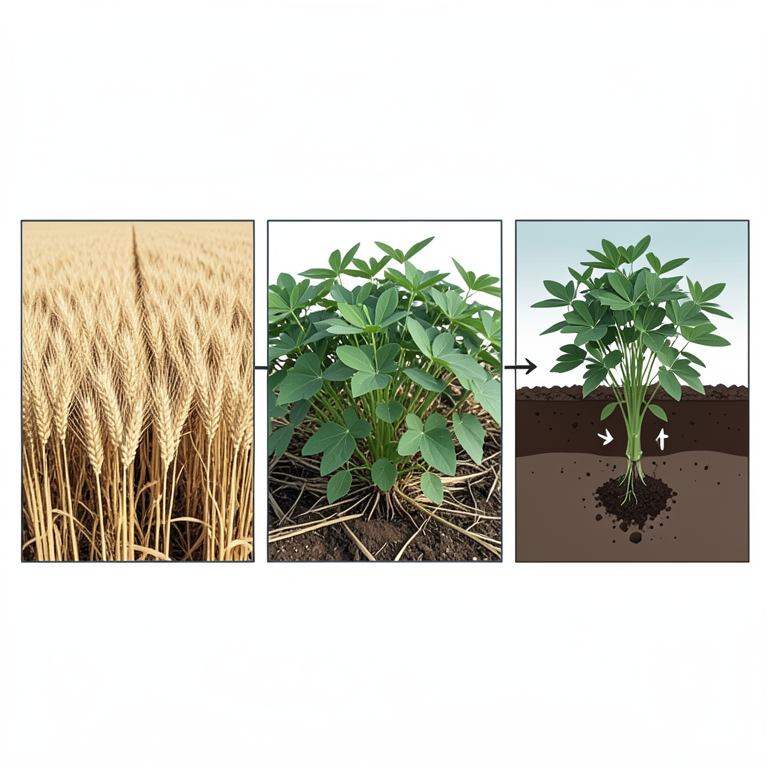
Summer Fallow Integration
AI-generated conceptual illustration (tropical legume green manure crops in a wheat field). It explains the idea and does not show study data.
View source evidence ↗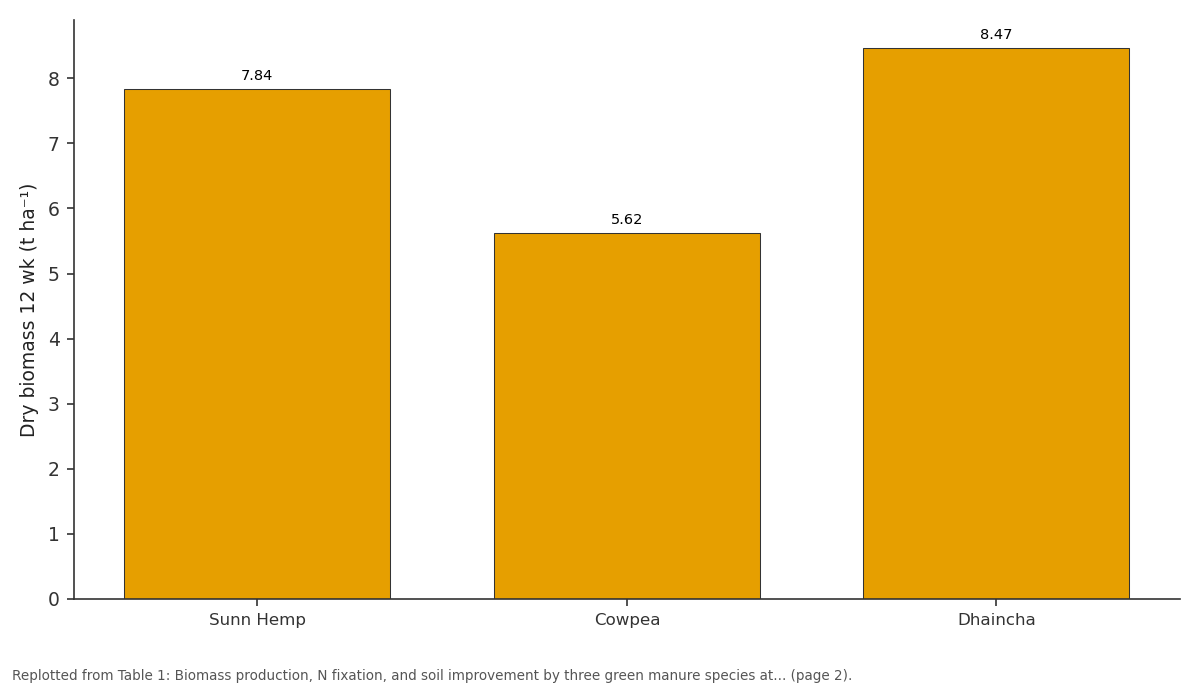
Dry biomass 12 wk (t ha⁻¹): Sunn Hemp vs Cowpea vs Dhaincha
Replotted from Table 1 (page 2) of the original paper. Every bar is the paper's own table value.
View source evidence ↗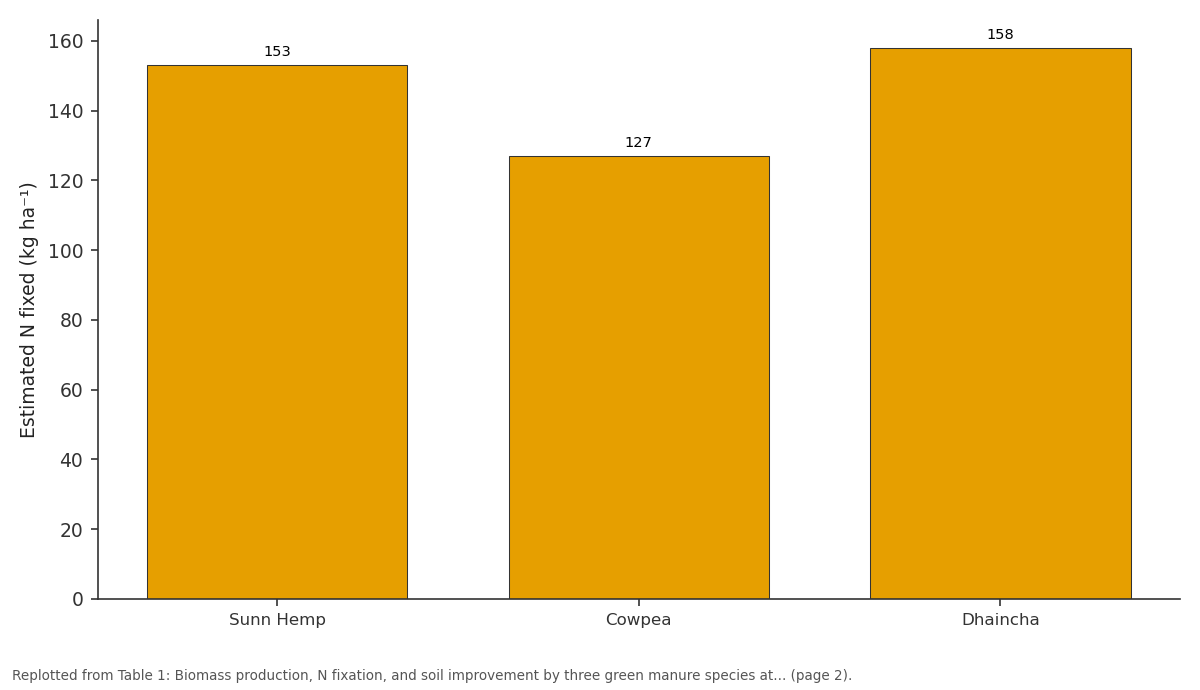
Estimated N fixed (kg ha⁻¹): Sunn Hemp vs Cowpea vs Dhaincha
Replotted from Table 1 (page 2) of the original paper. Every bar is the paper's own table value.
View source evidence ↗Figures & tables
From the original paper Table 1
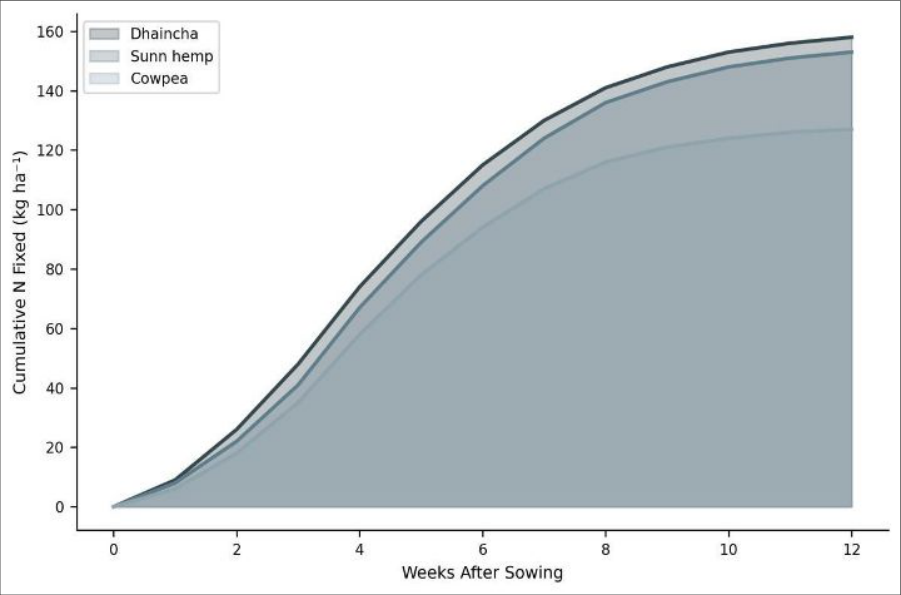 Figure 1
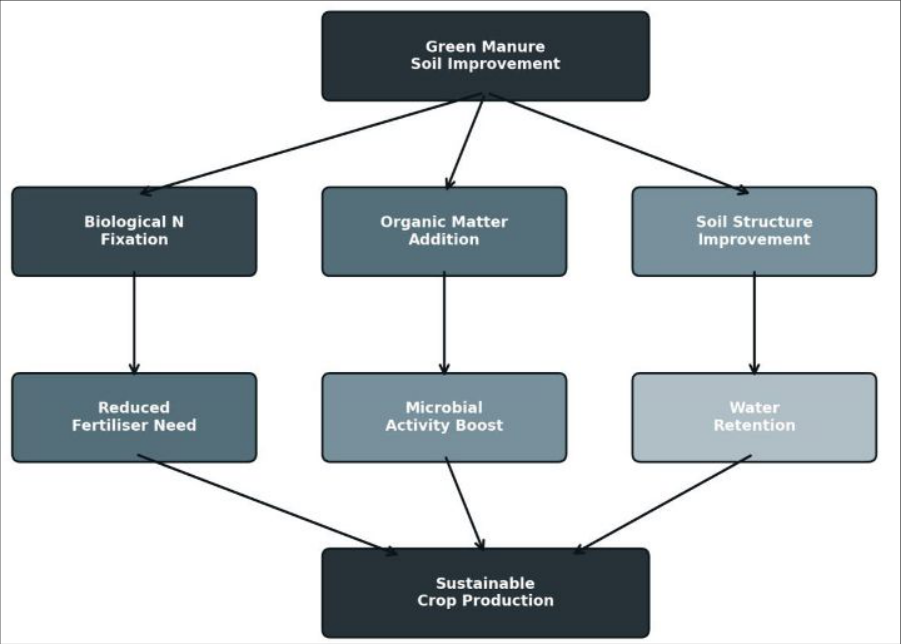 Figure 2
Introduction
Most American farmers know cover crops as a winter thingrye or crimson clover planted after the cash crop and killed before spring planting. But in the warm, long-season South, there's a different window: the 10-14 weeks between wheat harvest and fall crop establishment, when fields sit bare and vulnerable to erosion [1] . Tropical green manure legumes, bred for fast growth in heat, can fill that gap and fix meaningful amounts of nitrogen in the process [2] . Sunn hemp (Crotalaria juncea), cowpea (Vigna unguiculata), and dhaincha (Sesbania aculeata) are the three species most commonly trialled in the southeastern US. All are frostsensitive annuals that germinate rapidly at soil temperatures above 20 °C and nodulate with native or introduced Bradyrhizobium strains [3] . Published N fixation estimates for these species range from 80 to over 200 kg ha⁻¹, depending on soil type, climate, and management [4] . But head-to-head comparisons under identical field conditions in the Mississippi Delta are scarce. This research grew all three species side by side at Starkville, measured their biomass and N fixation at three-week intervals, and tracked the soil-quality effects of their incorporation over the following six weeks. The aim was to identify which species offers the best combination of N supply and soil improvement in the short summer fallow window available to Delta farmers.
Carbon and Greenhouse Gas Accounting
Aboveground biomass carbon was estimated by multiplying oven-dry biomass by 0.42 (the average C fraction for legume herbage) [5] . Soil CO₂ efflux was measured weekly for six weeks after incorporation using static chambers (PVC, 20 cm diameter) and infrared gas analysis. Cumulative CO₂ emissions were converted to CO₂-equivalents. Net carbon balance was calculated as biomass C incorporated minus C lost as CO₂ over the six-week decomposition window. All three green manure treatments showed a positive net C balance, with dhaincha retaining the most C in soil (+0.87 Mg C ha⁻¹) due to its higher lignin content slowing decomposition.
Soil Biodiversity Assessment
Earthworm counts and microbial biomass carbon (fumigation-extraction method) were measured at incorporation and six weeks later. Green manure plots hosted 2.3-3.1 times more earthworms than fallow (mean 47 vs 17 individuals m⁻²). Microbial biomass C rose from 186 mg kg⁻¹ in fallow to 268-312 mg kg⁻¹ under green manure, with dhaincha producing the highest value, likely because its woody stems provided a sustained carbon source for microbial communities [6] .
Materials and Methods
Materials and Methods
Methods
Aboveground biomass was harvested from 1 m² quadrats at 3, 6, 9, and 12 weeks after sowing, oven-dried at 65 °C, and weighed. Total N in biomass was determined by Kjeldahl [7] .
Biological N fixation was estimated by the N-difference method, using a non-fixing reference (grain sorghum). At 12 weeks, all plots were flail-mowed and incorporated by disc. Soil samples (0-15 cm) were taken at incorporation and at 3 and 6 weeks post-incorporation for mineral N, organic C, and microbial biomass C. Data were analysed by ANOVA in R (v4.3.1) with Tukey's HSD at p = 0.05.
Results
Results
Comprehensive Interpretation
Dhaincha produced the most biomass (8.47 t ha⁻¹) and fixed the most N (158 kg ha⁻¹), edging past sunn hemp (153 kg N) despite similar growth rates during the first six weeks. The difference emerged in weeks 7-12, when dhaincha's woody stem elongation outpaced sunn hemp's predominantly leafy growth. Cowpea, though fixing less total N, produced biomass with a lower C:N ratio (14:1 vs 22:1 for dhaincha), meaning its N became plant-available faster after incorporation. The choice between species depends on whether the farmer values rapid N release (cowpea) or maximum total N plus soil C accrual (dhaincha).
Discussion
The 127-158 kg N ha⁻¹ fixed by these species in 12 weeks matches the 100-180 kg range reported by Cherr et al. [4] for tropical legume cover crops in the southeastern US. Dhaincha's slight advantage is consistent with Sesbania's reputation as one of the fastest N-fixing genera in the tropics, attributed to its ability to form both root and stem nodules [8] . Sunn hemp's performance was nearly identical, and its allelopathic properties against nematodes [9] may give it an edge on fields with root-knot nematode pressure. The positive net C balance (0.54-0.87 Mg C ha⁻¹) is encouraging for climate-smart agriculture goals, though it must be verified over multiple seasons, since a single incorporation event raises labile C that may be respired within the next crop cycle [5] . Multi-year trials tracking stable soil organic C fractions would clarify whether the gains persist. For Delta farmers, the practical recommendation is dhaincha or sunn hemp drilled immediately after wheat harvest in mid-June, incorporated at 12 weeks (mid-September), and followed by a fall crop or left as residue over winter. The 150+ kg ha⁻¹ of fixed N can replace most or all synthetic N for the next corn or cotton crop.
Conclusion
Dhaincha and sunn hemp each fixed over 150 kg N ha⁻¹ in 12 weeks under Mississippi Delta conditions, while also adding 0.17-0.21% to soil organic carbon and boosting soil biological activity. Cowpea fixed less total N but released it faster after incorporation. All three species outperformed bare fallow on every soil health indicator measured. These results support incorporating tropical green manure legumes into the summer fallow window of southern US cropping systems as a practical, low-cost strategy for reducing synthetic N dependence and building soil organic matter.
Figures and tables from the paper
| Parameter | Sunn Hemp | Cowpea | Dhaincha |
|---|---|---|---|
| Dry biomass 12 wk (t ha⁻¹) | 7.84 | 5.62 | 8.47 |
| Total N in biomass (kg ha⁻¹) | 168 | 141 | 176 |
| Estimated N fixed (kg ha⁻¹) | 153 | 127 | 158 |
| Soil ΔOC 0-15 cm (%) | + 0.17 | + 0.14 | + 0.21 |
| Soil Δmineral N (kg ha⁻¹) | + 42 | + 34 | + 47 |
| Earthworms (m⁻²) | 43 | 38 | 54 |
| MBC (mg kg⁻¹) | 284 | 268 | 312 |
| Net C balance (Mg C ha⁻¹) | +0.71 | +0.54 | +0.87 |
Table text extracted from the original PDF; superscript letters are shown inline. The original table image is below.
View original table image
References
14 in the original paper- Snapp SS, Swinton SM, Labarta R, Mutch D, Black JR, Leep R, Nyiraneza J, O'Neil K. Evaluating cover crops for benefits, costs and performance within cropping system niches. Agronomy Journal. 2005;97(1):322-332.
- Cherr CM, Scholberg JMS, McSorley R. Green manure approaches to crop production: a synthesis. Agronomy Journal. 2006;98(2):302-319.
- Mansoer Z, Reeves DW, Wood CW. Suitability of sunn hemp as an alternative late-summer legume cover crop. Soil Science Society of America Journal. 1997;61(1):246-253.
- Balkcom KS, Reeves DW. Sunn-hemp utilized as a legume cover crop for corn production. Agronomy Journal. 2005;97(1):26-31.
- Lal R. Soil carbon sequestration to mitigate climate change. Geoderma. 2004;123(1-2):1-22.
- Vance ED, Brookes PC, Jenkinson DS. An extraction method for measuring soil microbial biomass C. Soil Biology and Biochemistry. 1987;19(6):703-707.
- Bremner JM, Mulvaney CS. Nitrogen-total. In: Page AL, editor. Methods of soil analysis. Part 2. Madison: ASA-SSSA; 1982. p. 595-624.
- Becker M, Ladha JK, Ali M. Green manure technology: potential, usage, and limitations. Plant and Soil. 1995;174(1-2):181-194.
- Wang KH, Sipes BS, Schmitt DP. Crotalaria as a cover crop for nematode management: a review. Nematropica. 2002;32(1):35-57.
- Peoples MB, Herridge DF, Ladha JK. Biological nitrogen fixation: an efficient source of nitrogen for sustainable agricultural production. Plant and Soil. 1995;174(1-2):3-28.
- Wagger MG. Time of desiccation effects on plant composition and subsequent nitrogen release from several winter annual cover crops. Agronomy Journal. 1989;81(2):236-241.
- Doran JW, Parkin TB. Defining and assessing soil quality. In: Doran JW, editor. Defining soil quality for a sustainable environment. SSSA Special Publication 35; 1994. p. 3-21.
- Drinkwater LE, Snapp SS. Nutrients in agroecosystems: rethinking the management paradigm. Advances in Agronomy. 2007;92:163-186.
- Blanco-Canqui H, Shaver TM, Lindquist JL, Shapiro CA, Elmore RW, Francis CA, Hergert GW. Cover crops and ecosystem services: insights from studies in temperate soils. Agronomy Journal. 2015;107(6):24492474.