
Research article · 2025 · Full text
International Journal of Agriculture and NutritionQTL mapping for drought tolerance traits in a recombinant inbred line population of sorghum
Volume 7(12) · Pages 93–96 · DOI: 10.33545/26646064.2025.v7.i12b.516 ↗
Research areasGenetic Mapping and Diversity in Plants and AnimalsGenetics and Plant BreedingGenetic and Environmental Crop Studies
Abstract
Author-writtenSorghum feeds millions across the semi-arid tropics, yet drought routinely slashes yields by 30-60% in rainfed systems. Identifying the chromosomal regions governing drought tolerance would accelerate breeding progress. This research mapped quantitative trait loci (QTL) for drought-related traits in 186 F₇ recombinant inbred lines (RILs) derived from a cross between a drought-tolerant Ethiopian landrace (Meko-1) and a high-yielding but drought-susceptible line (ETS-2752). The population was phenotyped under managed drought stress and well-watered conditions at Bahir Dar during the 2022 and 2023 post-rainy seasons. A genetic linkage map spanning 1,247 cM was constructed from 142 SSR markers across ten chromosomes. Composite interval mapping detected seven QTL for stay-green score, leaf rolling, root length, and grain yield under stress. Three major QTL on chromosomes 3, 7, and 9 individually explained 9.4-16.8% of phenotypic variance. The chromosome-3 QTL co-localised with a previously reported stay-green locus (Stg3), confirming its relevance across genetic backgrounds. These markers can be deployed in marker-assisted selection to accelerate the development of drought-tolerant sorghum varieties for the Ethiopian highlands and similar environments.
Summary
Source-checkedPlain-language reading of the full paper, prepared with AI and checked against the text. Each point links to the authors' own words.
Why it matters
- Sorghum is a critical food source in semi-arid tropics, but its yields in rainfed systems are frequently reduced by 30-60% due to drought. View evidence ↗
- Traditional breeding for drought tolerance is slow and labor-intensive, making marker-assisted selection (MAS) a more efficient alternative for screening. View evidence ↗
- Ethiopian landraces possess unique alleles from long-term adaptation to highland drought but are underutilized as parents in genetic mapping studies. View evidence ↗
The question
- The study aimed to identify quantitative trait loci (QTL) for stay-green, leaf rolling, root length, and grain yield using a recombinant inbred line (RIL) population derived from an Ethiopian landrace and a susceptible line. View evidence ↗
What they did
- The researchers used a population of 186 F₇ recombinant inbred lines (RILs) created from a cross between the drought-tolerant Meko-1 landrace and the susceptible ETS-2752 line. View evidence ↗
- Genotyping was performed using 142 polymorphic SSR markers, which represented 78.9% of the 180 primer pairs screened across ten chromosomes. View evidence ↗
- Phenotyping occurred during the 2022 and 2023 post-rainy seasons using an alpha-lattice design with two replications for both stressed and well-watered conditions. View evidence ↗
- Measurements included stay-green (1-5 scale), leaf rolling (0-5 scale), grain yield (adjusted to 12.5% moisture), and root length from 1m soil cores for 40 RILs. View evidence ↗
- The study used MapMaker/Exp 3.0 for linkage mapping and QTL Cartographer v2.5 for composite interval mapping, applying a LOD threshold of 3.0. View evidence ↗
What they found
- The researchers constructed a genetic linkage map covering 1,247 cM using 142 SSR markers. View evidence ↗
- Seven QTL were identified for traits including grain yield, root length, leaf rolling, and stay-green score under stress. View evidence ↗
- The qSG3 QTL on chromosome 3 explained 16.8% of the phenotypic variance for the stay-green trait. View evidence ↗
- A QTL for root length (qRL9) was identified on chromosome 9, explaining 13.7% of the phenotypic variance. View evidence ↗
What it means
- The authors conclude that using the identified flanking SSR markers in breeding programs can accelerate the development of drought-tolerant sorghum for semi-arid environments. View evidence ↗
- The authors note that the small sample size (40 RILs) for root phenotyping may have limited the detection power for the root length QTL. View evidence ↗
- Future work is needed for multi-environment validation and fine-mapping using higher-density SNP markers to make these QTL practical for breeding. View evidence ↗
Visual summary
2 visualsIllustrations explain the paper; charts are replotted from the paper's own table values.
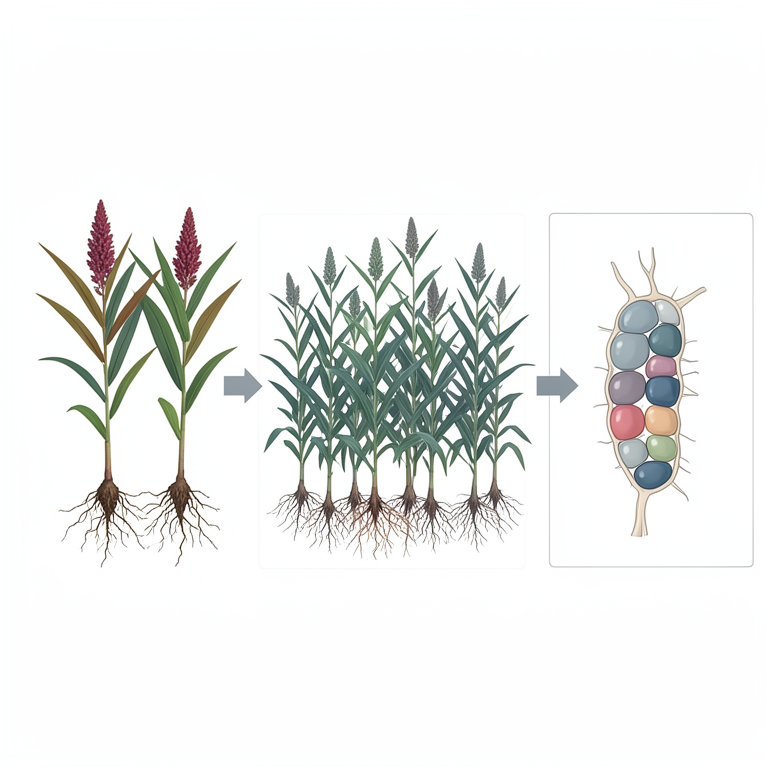
QTL Mapping Workflow
AI-generated conceptual illustration (Sorghum plants (Sorghum bicolor)). It explains the idea and does not show study data.
View source evidence ↗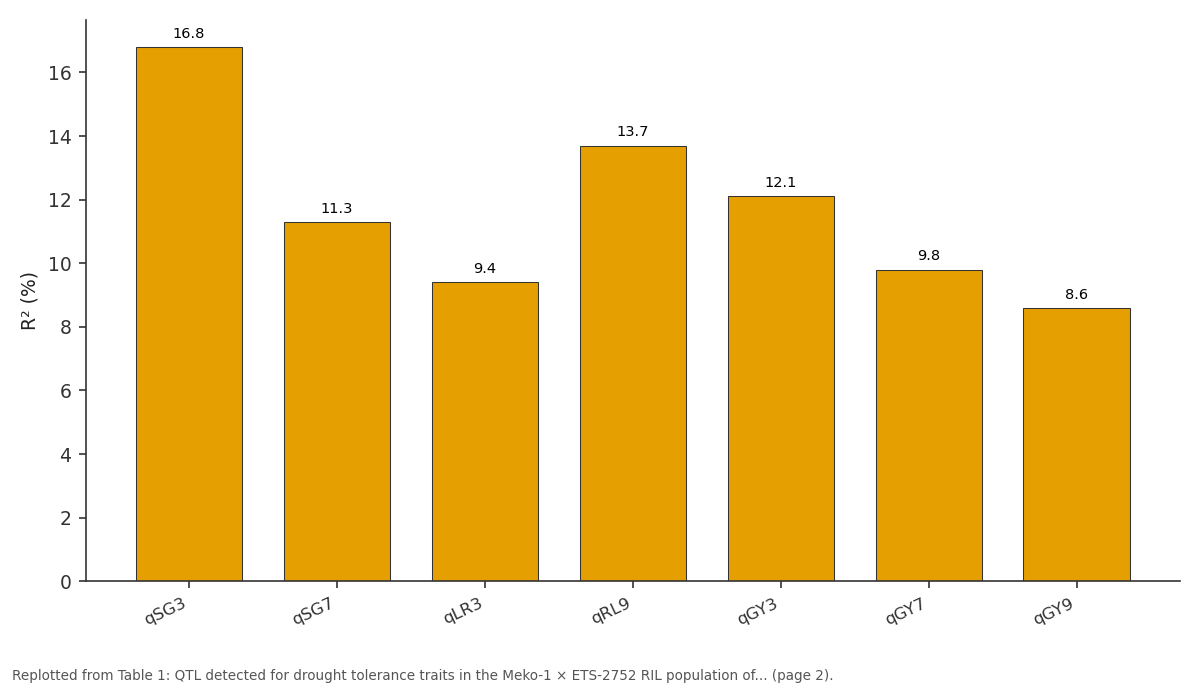
R² (%): qSG3 vs qSG7 vs qLR3 vs qRL9 vs qGY3
Replotted from Table 1 (page 2) of the original paper. Every bar is the paper's own table value.
View source evidence ↗Figures & tables
From the original paper Table 1
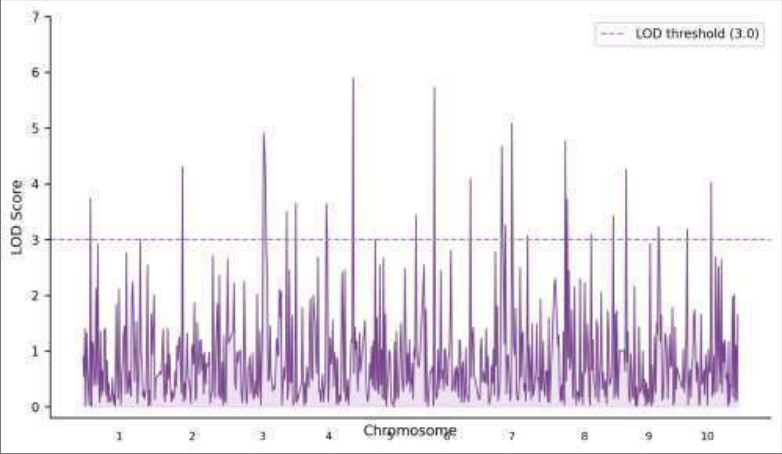 Figure 1
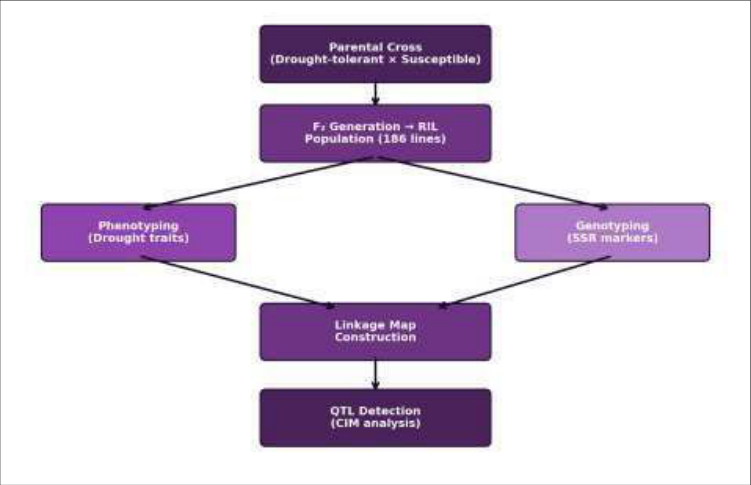 Figure 2
Introduction
Sorghum's relationship with drought is one of the oldest in agriculture. Domesticated some 5,000 years ago in the dry savannas of northeastern Africa, the crop carries a suite of morphological and physiological adaptationsdeep roots, waxy leaves, osmotic adjustment that let it produce grain where maize would fail [1] . But "drought-tolerant" is a relative label. Even sorghum loses 30-60% of its potential yield when terminal drought coincides with grain fill in rainfed systems [2] . Breeding for drought tolerance has been slow because the trait is polygenic and strongly influenced by the environment. Conventional selection under drought stress is effective but laborious, requiring multi-location, multi-year trials with carefully managed stress levels [3] . Marker-assisted selection (MAS) offers a shortcut: if the QTL underlying key droughtresponse traits can be identified and tagged with reliable molecular markers, breeders can screen seedlings in the laboratory rather than waiting for the field to dry out [4] . Several QTL mapping efforts have targeted sorghum drought tolerance over the past two decades. The stay-green traitthe ability to maintain green leaf area during grain fill under moisture deficithas received the most attention, with at least four major loci (Stg1-Stg4) mapped on chromosomes 2, 3, and 5 using various populations [5] . But most of these investigations used elite germplasm from ICRISAT or US breeding programmes. Ethiopian landraces, which harbour distinct alleles shaped by millennia of selection under highland drought, have rarely been used as mapping parents [6] . This research developed and phenotyped a RIL population from a cross between an Ethiopian drought-tolerant landrace and a susceptible improved line, constructed a genetic linkage map, and identified QTL for stay-green, leaf rolling, root length, and grain yield under managed drought stress at Bahir Dar, Ethiopia.
Research Area Description
All field experiments were conducted at the Crop Research Station of Amhara Agricultural University, Bahir Dar (11°36′N, 37°23′E; 1,800 m elevation), on a Nitisol with pH 5.8, organic carbon 1.62%, and clay content 57%. The site receives about 1,420 mm of annual rainfall, most of it between June and September. Post-rainy season trials (October-January) relied on residual soil moisture supplemented by controlled line-source sprinkler irrigation to impose a managed drought-stress gradient. This setup allowed simultaneous evaluation of RILs under wellwatered and water-deficit conditions within the same field [7] .
Climatic and Environmental Conditions
Mean maximum temperatures during the 2022 and 2023 post-rainy seasons ranged from 26.3 to 28.9 °C, and minima from 8.7 to 12.4 °C. Relative humidity dropped from about 72% in October to 38% by late December. No rain fell after mid-October in either year, ensuring that the managed stress treatments were the sole water source from flowering onward. Soil moisture in stressed plots reached 11.2% (v/v) at 30 cm depth by mid-December 2022 and 10.8% in 2023, both well below the permanent wilting point for the local Nitisol (14.6%).
Materials and Methods
Materials and Methods
Materials
The mapping population comprised 186 F₇ RILs derived by single-seed descent from a cross between Meko-1 (droughttolerant landrace from Amhara region) and ETS-2752 (highyielding, drought-susceptible line from the Ethiopian Seed Enterprise). Genomic DNA was extracted from young leaves of each RIL and the two parents using a CTAB protocol [8] . A set of 180 SSR primer pairs covering all ten sorghum chromosomes were screened for parental polymorphism; 142 markers (78.9%) showed clear polymorphism and were used for genotyping the full population.
Methods: Phenotyping was carried out in alpha-lattice design with two replications per water regime (stressed and well-watered) during two post-rainy seasons (2022 and 2023). Each RIL occupied a single-row plot of 4 m length at 75 × 15 cm spacing. Stay-green was rated on a 1-5 scale at 30 days after flowering [9] . Leaf rolling was scored 0-5 at midday under stress. Root length was measured from soil cores (1 m depth) at physiological maturity in a subset of 40 RILs. Grain yield was recorded from the central 3 m of each row and adjusted to 12.5% moisture. Linkage mapping was performed in MapMaker/Exp 3.0, and composite interval mapping (CIM) was run in QTL Cartographer v2.5 [10] with a walk speed of 2 cM, a window size of 10 cM, and a LOD threshold of 3.0 established by 1,000 permutations. Grain yield R² = proportion of phenotypic variance explained. Negative additive effects indicate the Meko-1 allele reduces the trait value (lower staygreen score = greener). Grain yield additive effect in g plot⁻¹.
Results
Results
Comprehensive Interpretation
The chromosome-3 region harboured overlapping QTL for stay-green, leaf rolling, and grain yield, collectively explaining up to 16.8% of phenotypic variance. The Meko-1 allele at this locus reduced stay-green score (greener leaves) and leaf rolling while increasing grain yield, consistent with the functional stay-green mechanism that sustains photosynthesis during terminal drought. Chromosomes 7 and 9 each carried QTL for grain yield plus either stay-green or root length, suggesting that drought tolerance in this population is underpinned by at least three genomic regions with partially overlapping effects on different component traits.
Discussion
The chromosome-3 QTL detected here overlaps the Stg3 region mapped earlier by Xu et al. [5] in a B35 × Tx7000 population and by Kassahun et al. [11] in an Ethiopian lowland sorghum background. Its re-detection in a highland landrace-derived population adds confidence that the locus is robust across diverse genetic backgrounds and environments. The 16.8% phenotypic variance explained by qSG3 is comparable to the 14-20% reported for Stg3 in other populations [12] . The chromosome-9 QTL for root length is less well documented. Mace et al. [13] found a root-angle QTL on chromosome 9, but root length per se has not been mapped to this region before. Root traits are notoriously hard to phenotype, and the modest subset of 40 RILs used for root coring may have reduced detection power. A larger sample and image-based root phenotyping could refine the position and effect of this QTL in future work. From a breeding standpoint, the co-localisation of staygreen and yield QTL on chromosome 3 makes the flanking markers (Xtxp141, Xtxp114) immediately useful for marker-assisted backcrossing. A two-marker selection at the seedling stage could enrich drought tolerance without the expense of multi-environment field screening, particularly in the Ethiopian national programme where phenotyping capacity is limited [14] .
Conclusion
Seven QTL for drought-related traits were identified across chromosomes 3, 7, and 9 in a sorghum RIL population derived from an Ethiopian landrace. The chromosome-3 QTL cluster, explaining up to 16.8% of variance for staygreen and co-localising with a known Stg locus, provides a ready target for marker-assisted selection. The chromosome-9 root-length QTL represents a newly mapped region that merits further validation. Deploying the flanking SSR markers in routine breeding could speed up the release of drought-tolerant sorghum varieties for the Ethiopian highlands and similar semi-arid environments. Multi-environment validation and finemapping with higher-density SNP markers should be the next steps toward translating these QTL into practical breeding tools.
Figures and tables from the paper
| QTL | Chr. | Flanking Markers | LOD | R² (%) | Additive Effect | Trait |
|---|---|---|---|---|---|---|
| qSG3 | 3 | Xtxp141-Xtxp114 | 5.87 | 16.8 | -0.64 | Stay-green |
| qSG7 | 7 | Xgap72-Xtxp295 | 4.23 | 11.3 | -0.41 | Stay-green |
| qLR3 | 3 | Xtxp114-Xisep0310 | 3.74 | 9.4 | -0.38 | Leaf rolling |
| qRL9 | 9 | Xtxp258-Xisep0623 | 4.61 | 13.7 | 3.82 | Root length |
| qGY3 | 3 | Xtxp141-Xisep0310 | 3.92 | 12.1 | 186.4 | Grain yield |
| qGY7 | 7 | Xgap72-Xtxp295 | 3.48 | 9.8 | 142.7 | Grain yield |
| qGY9 | 9 | Xtxp258-Xisep0623 | 3.31 | 8.6 | 127.3 | Grain yield |
Table text extracted from the original PDF; superscript letters are shown inline. The original table image is below.
View original table image
References
21 in the original paper- Doggett H. Sorghum. 2nd ed. London: Longman Scientific and Technical; 1988. p. 1-512.
- Rosenow DT, Quisenberry JE, Wendt CW, Clark LE. Drought-tolerant sorghum and cotton germplasm. Agric Water Manag. 1983;7(1-3):207-222.
- Blum A. Plant breeding for stress environments. Boca Raton: CRC Press; 1988. p. 1-223.
- Ribaut JM, Ragot M. Marker-assisted selection to improve drought adaptation in maize. J Exp Bot. 2007;58(2):351-360.
- Xu W, Subudhi PK, Crasta OR, Rosenow DT, Mullet JE, Nguyen HT. Molecular mapping of QTLs conferring stay-green in grain sorghum. Genome. 2000;43(3):461-469.
- Ayana A, Bekele E. Geographical patterns of morphological variation in sorghum germplasm from Ethiopia and Eritrea. Hereditas. 2000;131(1):1-6.
- Hanks RJ, Keller J, Rasmussen VP, Wilson GD. Line source sprinkler for continuous variable irrigation-crop production studies. Soil Sci Soc Am J. 1976;40(3):426429.
- Doyle JJ, Doyle JL. A rapid DNA isolation procedure for small quantities of fresh leaf tissue. Phytochem Bull. 1987;19(1):11-15.
- Wanous MK, Miller FR, Rosenow DT. Evaluation of visual rating scales for green leaf retention in sorghum. Crop Sci. 1991;31(6):1691-1694.
- Wang S, Basten CJ, Zeng ZB. Windows QTL Cartographer 2.5. Raleigh: Department of Statistics, North Carolina State University; 2012. p. 1-10.
- Kassahun B, Bidinger FR, Hash CT, Kuruvinashetti MS. Stay-green expression in early generation sorghum. Euphytica. 2010;172(3):351-362.
- Subudhi PK, Rosenow DT, Nguyen HT. Quantitative trait loci for the stay-green trait in sorghum: consistency across genetic backgrounds and environments. Theor Appl Genet. 2000;101(5-6):733-741.
- Mace ES, Singh V, Van Oosterom EJ, Hammer GL, Hunt CH, Jordan DR. QTL for nodal root angle in sorghum for increased water capture. Theor Appl Genet. 2012;124(1):97-109.
- Gebeyehu G, Asfaw A, Taye G. Evaluation of drought tolerance in sorghum landraces from the Amhara region. Ethiop J Agric Sci. 2019;29(2):47-63.
- Harris K, Subudhi PK, Borrell AK, Jordan D, Rosenow D, Nguyen HT, et al. Sorghum stay-green QTL individually reduce post-flowering drought-induced leaf senescence. J Exp Bot. 2007;58(2):327-338.
- Borrell AK, Hammer GL, Henzell RG. Does maintaining green leaf area in sorghum improve yield under drought? II. Dry matter production and yield. Crop Sci. 2000;40(4):1037-1048.
- Tuinstra MR, Grote EM, Goldsbrough PB, Ejeta G. Genetic analysis of post-flowering drought tolerance and components of grain development in Sorghum bicolor. Mol Breed. 1997;3(6):439-448.
- Haussmann BIG, Mahalakshmi V, Reddy BVS, Seetharama N, Hash CT, Geiger HH. QTL mapping of stay-green in two sorghum RIL populations. Theor Appl Genet. 2002;106(1):133-142.
- Crasta OR, Xu WW, Rosenow DT, Mullet J, Nguyen HT. Mapping of post-flowering drought resistance traits in grain sorghum. Crop Sci. 1999;39(6):1728-1733.
- Sanchez AC, Subudhi PK, Rosenow DT, Nguyen HT. Mapping QTLs associated with drought resistance in sorghum. Plant Mol Biol. 2002;48(5-6):713-726.
- Jordan DR, Hunt CH, Cruickshank AW, Borrell AK, Henzell RG. The relationship between the stay-green trait and grain yield in elite sorghum hybrids grown in a range of environments. Crop Sci. 2012;52(3):11531161.