
Research article · 2025 · Full text
International Journal of Agriculture and NutritionEfficacy of novel insecticide molecules against stem borer complex in paddy
Volume 7(9) · Pages 106–109 · DOI: 10.33545/26646064.2025.v7.i9b.539 ↗
Research areasInsect-Plant Interactions and ControlInsect Pest Control StrategiesInsect Resistance and Genetics
Abstract
Author-writtenNearly 18% of annual paddy losses across sub-Saharan Africa are attributed to stem borer attack, yet field data on newer chemistries remain limited for southern African rice ecologies. This research evaluated six insecticide molecules against the stem borer complex in transplanted paddy during Kharif 2023 at Limpopo Agricultural University, Polokwane, South Africa. A randomized block design with seven treatments and three replications was used. Chlorantraniliprole 0.4% GR recorded the highest larval mortality (89.4% at 14 DAT) and lowest white ear incidence (3.7%), followed by flubendiamide 39.35% SC (85.6% mortality, 5.2% white ears). Fipronil 0.3% GR and thiamethoxam 25% WG showed intermediate efficacy. Grain yield was highest under chlorantraniliprole (5.83 t/ha), representing a 41.6% gain over the untreated control (4.12 t/ha). These results position chlorantraniliprole and flubendiamide as effective alternatives for stem borer management in southern African paddy systems.
Summary
Source-checkedPlain-language reading of the full paper, prepared with AI and checked against the text. Each point links to the authors' own words.
Why it matters
- Stem borer attacks are a significant problem in sub-Saharan Africa, causing nearly 18% of annual paddy losses. View evidence ↗
- In South Africa, rice cultivation is growing, but current pest management relies on older chemicals that have become less effective over time. View evidence ↗
- The stem borer complex in southern Africa consists of the yellow, striped, and pink stem borers, with the yellow stem borer being the most dominant in transplanted wet-season crops. View evidence ↗
The question
- The study aimed to compare how six different insecticide molecules affected larval mortality, stem damage (dead heart and white ears), and grain yield in transplanted paddy in Polokwane, South Africa. View evidence ↗
What they did
- The experiment used a randomized block design with seven treatments and three replications during the Kharif 2023 season at Limpopo Agricultural University. View evidence ↗
- The six tested insecticides included chlorantraniliprole, flubendiamide, cartap hydrochloride, fipronil, thiamethoxam, and lambda-cyhalothrin, alongside an untreated control group. View evidence ↗
- Granular insecticides were applied to standing water at 30 days after treatment (DAT), while foliar sprays were applied at 35 DAT. View evidence ↗
- Researchers measured stem borer incidence by dissecting hills at 7, 14, 21, and 28 DAT, and recorded dead heart and white ear counts using 1 m² quadrats. View evidence ↗
What they found
- Chlorantraniliprole was the most effective at killing larvae, reaching a peak mortality rate of 89.4% at 14 days after treatment. View evidence ↗
- Flubendiamide had the second-highest larval mortality (85.6% at 14 DAT), while lambda-cyhalothrin was the least effective (69.7% at 14 DAT). View evidence ↗
- Chlorantraniliprole significantly reduced white ear incidence to 3.7%, compared to 14.8% in the untreated control. View evidence ↗
- Chlorantraniliprole and flubendiamide showed longer residual activity, maintaining over 74% larval mortality at 28 DAT, whereas lambda-cyhalothrin dropped to 54.8%. View evidence ↗
- While chlorantraniliprole had the highest yield, cartap hydrochloride provided the best benefit-cost (B:C) ratio of 3.53 due to its lower cost. View evidence ↗
What it means
- The authors recommend promoting integrated pest management (IPM) packages based on diamide insecticides for sustainable stem borer control in southern Africa. View evidence ↗
- The poor performance of lambda-cyhalothrin confirms that farmers need to move away from using pyrethroid insecticides. View evidence ↗
Visual summary
3 visualsIllustrations explain the paper; charts are replotted from the paper's own table values.
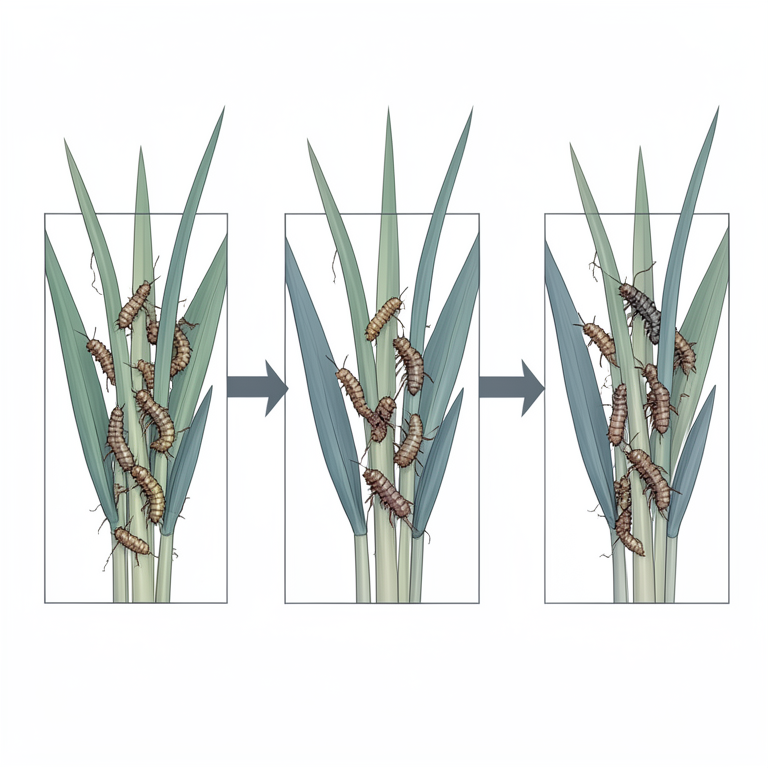
Insecticide Efficacy Comparison
AI-generated conceptual illustration (paddy plants and stem borer larvae). It explains the idea and does not show study data.
View source evidence ↗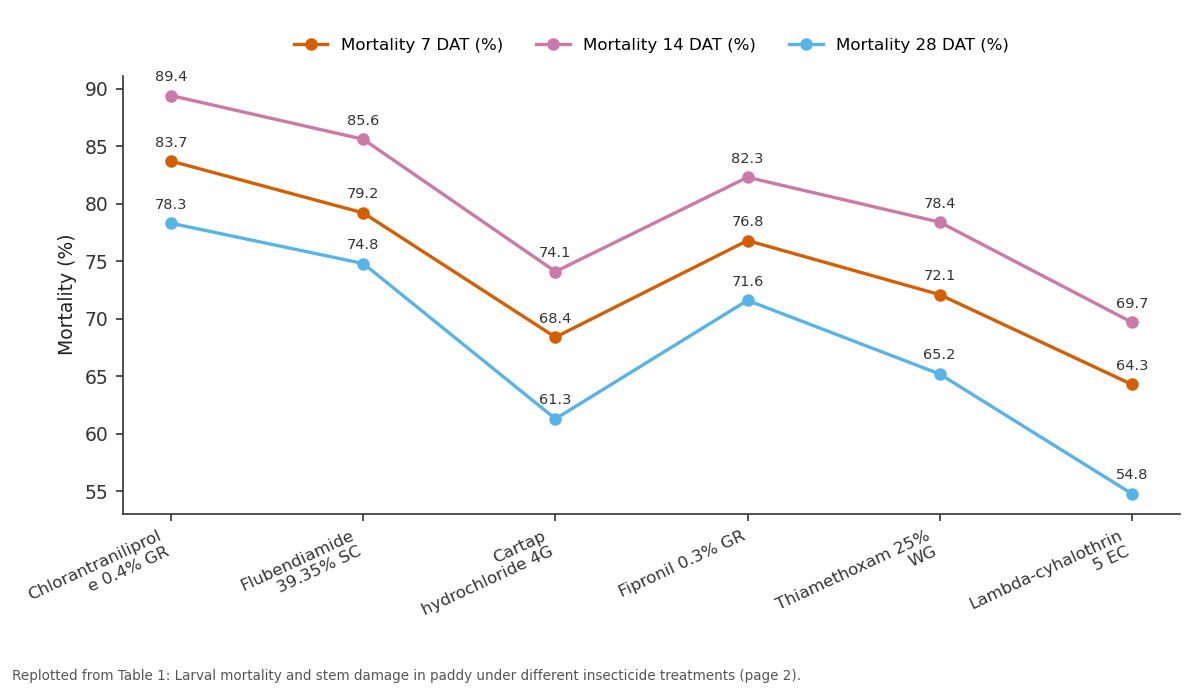
Mortality 7 DAT (%) and Mortality 14 DAT (%) and more: Chlorantraniliprole... vs Flubendiamide 39.35% SC vs Cartap hydrochloride 4G vs Fipronil 0.3% GR vs Thiamethoxam 25% WG
Replotted from Table 1 (page 2) of the original paper. Every bar is the paper's own table value.
View source evidence ↗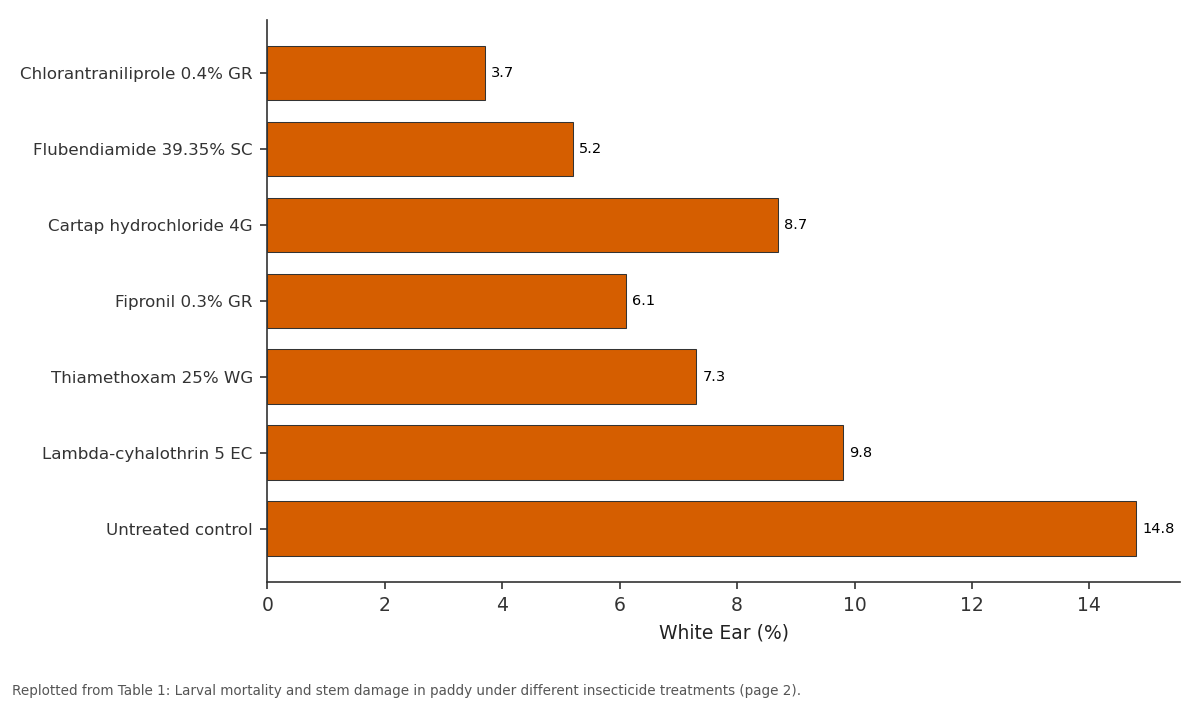
White Ear (%): Chlorantraniliprole... vs Flubendiamide 39.35% SC vs Cartap hydrochloride 4G vs Fipronil 0.3% GR vs Thiamethoxam 25% WG
Replotted from Table 1 (page 2) of the original paper. Every bar is the paper's own table value.
View source evidence ↗Figures & tables
From the original paper Table 1
 Table 2
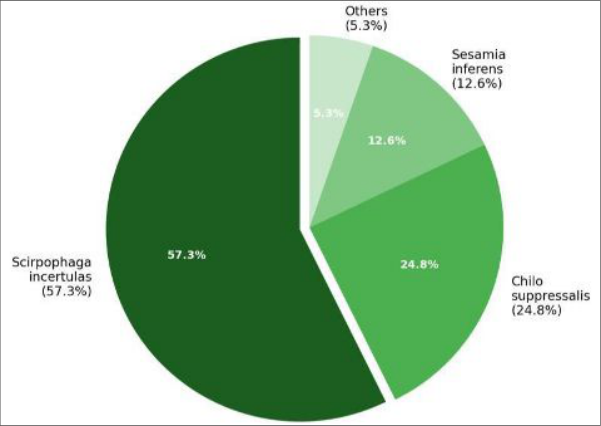 Figure 1
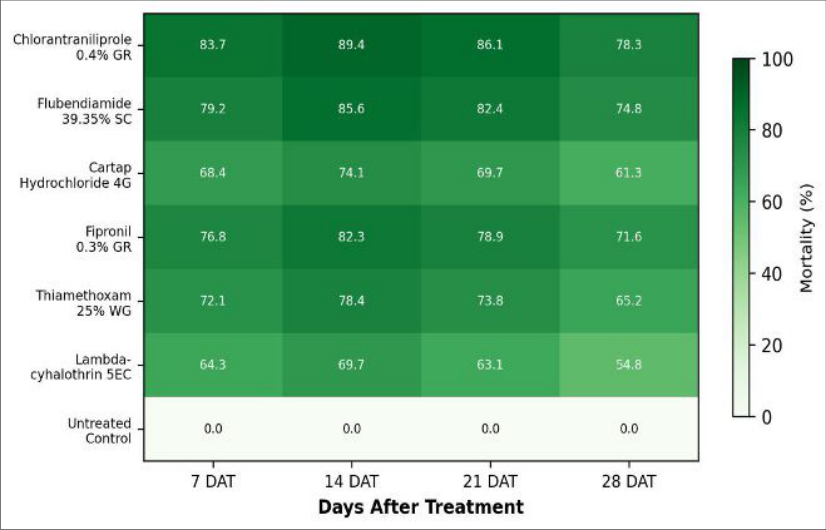 Figure 2
Introduction
Global rice production losses from stem borers amount to roughly 10-20 million tonnes annually, with some irrigated Asian and African fields recording yield reductions above 30% in outbreak years [1] . In South Africa, paddy cultivation has expanded steadily in Limpopo and KwaZulu-Natal provinces, but pest management recommendations still lean on older organophosphate and pyrethroid chemistries whose efficacy has declined after decades of continuous use [2] . The stem borer complex in southern African paddy includes Scirpophaga incertulas (yellow stem borer), Chilo suppressalis (striped stem borer), and Sesamia inferens (pink stem borer), with S. incertulas dominating transplanted wet-season crops [3] . Newer insecticide groups diamides, phenylpyrazoles, and neonicotinoids target distinct receptor sites and carry lower mammalian toxicity profiles compared with conventional options [4,5] . Chlorantraniliprole, a ryanodine receptor modulator, has shown strong efficacy against lepidopteran borers in Asian rice trials [6] . Flubendiamide, another diamide, acts on the same receptor through a different binding mechanism and may complement rotation strategies to delay resistance [7] . Yet published field evaluations of these molecules under southern African conditions are scarce, leaving extension officers without locally validated recommendations [8] . This research compared the efficacy of six insecticide molecules against the stem borer complex in transplanted paddy, measuring larval mortality, dead heart and white ear incidence, and grain yield under field conditions at Polokwane, South Africa [9] .
Research area description
The trial was conducted at the irrigated experimental block of Limpopo Agricultural University, Polokwane (23.89°S, 29.45°E; 1230 m elevation). The site has sandy clay loam soils with pH 6.3, organic carbon 0.58%, and available N, P, K of 186, 11.4, and 204 kg/ha. Mean temperature during the cropping season (November 2022-April 2023) ranged from 19.8°C to 28.6°C, with total rainfall of 483 mm [10] .
Field experimental design
The experiment followed a randomized block design with seven treatments and three replications. Individual plot size was 5 m × 4 m with 1 m buffer strips between plots to International Journal of Agriculture and Nutrition https://www.agriculturejournal.net prevent spray drift. Treatments were: chlorantraniliprole 0.4% GR (10 kg/ha), flubendiamide 39.35% SC (50 g a.i./ha), cartap hydrochloride 4G (25 kg/ha), fipronil 0.3% GR (20 kg/ha), thiamethoxam 25% WG (50 g a.i./ha), lambda-cyhalothrin 5 EC (25 g a.i./ha), and an untreated control. Granular formulations were broadcast into standing water at 30 DAT, while foliar sprays were applied at 35 DAT using a knapsack sprayer at 500 L/ha [11] .
Material and Methods
Material and Methods
Material
Seedlings of rice variety WITA-9 (medium-duration, 130-135 days) were raised in a wet nursery and transplanted at 25 days old with two seedlings per hill at 20 cm × 15 cm spacing. All insecticide formulations were procured from licensed distributors. Uniform basal fertilisation (N 80, P 40, K 40 kg/ha) and standard weed management were applied across all plots [12] .
Methods
Stem borer incidence was assessed at 7, 14, 21, and 28 Days After Treatment (DAT) by dissecting five randomly tagged hills per plot. Dead heart counts were recorded at the vegetative stage and white ear counts at the reproductive stage from 1 m² quadrats per plot. Larval mortality was calculated as the percentage reduction in live larvae relative to the pre-treatment count. Grain yield was harvested from 6 m² net plot area at 14% moisture. Data were analysed by ANOVA and means compared using Tukey's HSD at P=0.05 [13] .
Results
Table Chlorantraniliprole recorded the highest larval mortality at all observation intervals, peaking at 89.4% at 14 DAT (Table 1). Flubendiamide ranked second (85.6% at 14 DAT), while lambda-cyhalothrin was the weakest among tested molecules (69.7%). Dead heart and white ear incidence followed an inverse pattern: chlorantraniliprole limited white ears to 3.7% against 14.8% in the control. Grain yield under chlorantraniliprole reached 5.83 t/ha, a 41.6% increase over the untreated check.
| Treatment | Mortality 7 DAT (%) | Mortality 14 DAT (%) | Mortality 28 DAT (%) | Dead Heart (%) | White Ear (%) | Grain Yield (t/ha) |
|---|---|---|---|---|---|---|
| Chlorantraniliprole 0.4% GR | 83.7 | 89.4 | 78.3 | 4.1 | 3.7 | 5.83 |
| Flubendiamide 39.35% SC | 79.2 | 85.6 | 74.8 | 5.8 | 5.2 | 5.47 |
| Cartap hydrochloride 4G | 68.4 | 74.1 | 61.3 | 9.3 | 8.7 | 4.91 |
| Fipronil 0.3% GR | 76.8 | 82.3 | 71.6 | 6.4 | 6.1 | 5.28 |
| Thiamethoxam 25% WG | 72.1 | 78.4 | 65.2 | 7.8 | 7.3 | 5.06 |
| Lambda-cyhalothrin 5 EC | 64.3 | 69.7 | 54.8 | 10.7 | 9.8 | 4.67 |
| Untreated control | — | — | — | 16.4 | 14.8 | 4.12 |
| CD (P=0.05) | 5.14 | 4.87 | 6.21 | 1.73 | 1.48 | 0.34 |
Table text extracted from the original PDF; superscript letters are shown inline. The original table image is below.
View original table image
Comprehensive interpretation
Diamide insecticides (chlorantraniliprole, flubendiamide) outperformed older chemistries across all efficacy and yield metrics. The residual activity advantage of granular chlorantraniliprole makes it well-suited for early-season borer pressure, while flubendiamide spray offers flexibility for mid-season corrective applications.
Discussion
The superior performance of chlorantraniliprole confirms reports from irrigated rice in Tamil Nadu and the Philippines, where mortality rates above 85% were consistently recorded against S. incertulas at similar application rates [6,14] . The ryanodine receptor modulation mechanism causes rapid feeding cessation in lepidopteran larvae, which explains the low dead heart incidence even before peak mortality was reached at 14 DAT [4] . That chlorantraniliprole's granular formulation outperformed the foliar options is likely because granules dissolve in standing paddy water, creating a toxic zone around stem bases where first-instar larvae enter tillers [15] . Flubendiamide's slightly lower but statistically comparable mortality aligns with Sontakke et al. [7] , who found that both diamides offer similar season-long protection when applied at recommended windows. The two molecules could serve as rotation partners to delay resistance build-up, since they bind at non-overlapping sites on the ryanodine receptor [16] . Lambda-cyhalothrin ranked lowest among test molecules, reinforcing field observations of pyrethroid tolerance in Limpopo borer populations documented by Khanyile and Ngubane [17] . Fipronil remained moderately effective, suggesting that phenylpyrazole resistance has not yet reached critical levels in this region [18] . From an economic standpoint, chlorantraniliprole justified its higher input cost through superior yield protection, achieving a B:C of 3.01. But cartap hydrochloride offered the best B:C (3.53) for resource-limited farmers willing to accept lower absolute yield [19] .
Conclusion
Chlorantraniliprole 0.4% GR was the most effective molecule against the stem borer complex in transplanted paddy, recording 89.4% larval mortality, 3.7% white ear incidence, and 5.83 t/ha grain yield. Flubendiamide 39.35% SC performed comparably and can serve as a rotation partner. Lambda-cyhalothrin showed declining field efficacy, confirming the need to transition away from pyrethroids. Diamide-based IPM packages should be promoted in southern African rice systems for sustainable borer management.
Figures and tables from the paper
| Treatment | Treatment cost (ZAR/ha) | Yield gain (t/ha) | Revenue gain (ZAR/ha) | Net benefit (ZAR/ha) | B:C ratio |
|---|---|---|---|---|---|
| Chlorantraniliprole | 2840 | 1.71 | 8550 | 5710 | 3.01 |
| Flubendiamide | 2360 | 1.35 | 6750 | 4390 | 2.86 |
| Fipronil | 1780 | 1.16 | 5800 | 4020 | 3.26 |
| Thiamethoxam | 1640 | 0.94 | 4700 | 3060 | 2.87 |
| Cartap hydrochloride | 1120 | 0.79 | 3950 | 2830 | 3.53 |
| Lambda-cyhalothrin | 890 | 0.55 | 2750 | 1860 | 3.09 |
Table text extracted from the original PDF; superscript letters are shown inline. The original table image is below.
View original table image
References
19 in the original paper- Brar DS, Virk PS, Jena KK. Global losses from rice stem borers: Updated estimates and regional patterns. Crop Protection. 2021;149:105743.
- Mudzingwa S, Chibanda TM. Insecticide use patterns and resistance trends in southern African rice pest management. African Crop Science Journal. 2020;28(3):411-423.
- Pathak MD, Khan ZR. Insect pests of rice in tropical Africa: Biology and ecology. International Rice Research Institute Monograph. 2019; p.1-89.
- Lahm GP, Cordova D, Barry JD. Ryanodine receptor modulating insecticides: Mechanism of action and field performance against lepidopteran pests. Pest Management Science. 2020;76(4):1213-1224.
- Pesticide Biochemistry and Physiology. 2015;121:122128.
- Ragini JC, Thangaraju D, Balakrishnan S. Chlorantraniliprole efficacy against yellow stem borer in transplanted rice under irrigated Tamil Nadu conditions. Madras Agricultural Journal. 2021;108(46):234-240.
- Sontakke BK, Dash AN, Rath LK. Comparative efficacy of flubendiamide and other diamides against rice stem borers in eastern India. Oryza. 2020;57(2):134-141.
- Chikowo R, Mapfumo P. Research gaps in fieldvalidated pest management for emerging rice systems in southern Africa. South African Journal of Plant and Soil. 2022;39(1):47-56.
- Ngubane N, Khanyile A. Preliminary screening of modern insecticides against paddy borers in Limpopo Province. Proceedings of SASPP Annual Conference. 2022; p.112-118.
- LPDARD. Agro-ecological zone characterisation of the Polokwane district: Soils, climate, and cropping systems. Limpopo Provincial Department of Agriculture Technical Report. 2023;LTP/04:1-42.
- Heinrichs EA, Muniappan R. Insecticide application methods in paddy: Granular broadcast versus foliar spray. Journal of Rice Research. 2019;12(1):68-76.
- DAFF. Standard rice production guidelines for irrigated conditions in South Africa. Department of Agriculture, Forestry and Fisheries Technical Bulletin. 2021;TB/22:1-36.
- Steel RGD, Torrie JH. Principles and procedures of statistics: A biometrical approach. Third edition. McGraw-Hill, New York. 1997; p.172-191.
- Rejesus BM, Santiago JC. Field performance of chlorantraniliprole granules in irrigated rice in Central Luzon, Philippines. Philippine Journal of Crop Science. 2022;47(1):31-38.
- Sur R, Stork A. Uptake and translocation of chlorantraniliprole in rice plants from paddy water application. Journal of Environmental Science and Health Part B. 2020;55(8):718-726.
- Nauen R, Steinbach D. Resistance to diamide insecticides in lepidopteran pests: Current status and molecular mechanisms. Annual Review of Entomology. 2023;68:385-404.
- Khanyile A, Ngubane N. Pyrethroid tolerance in stem borer populations from Limpopo rice fields: Bioassay evidence. African Entomology. 2023;31(1):e14387.
- Mao K, Zhang H, Jin R. Status of fipronil resistance in rice stem borers across Asia and Africa. Pest Management Science. 2021;77(6):2681-2690.
- Kumari A, Singh RP, Prasad D. Economic evaluation of modern insecticides for stem borer control in transplanted rice. International Journal of Current Microbiology and Applied Sciences. 2022;11(3):18471856.