
Research article · 2025 · Full text
International Journal of Agriculture and NutritionEffect of mineral mixture supplementation on reproductive efficiency of indigenous cattle breeds
Volume 7(8) · Pages 166–169 · DOI: 10.33545/26646064.2025.v7.i8c.507 ↗
Research areasReproductive Physiology in LivestockRuminant Nutrition and Digestive PhysiologyAnimal Nutrition and Health
Abstract
Author-writtenMineral deficiencies in grazing cattle are a persistent problem in semi-arid rangelands of northwestern Mexico, where forage quality drops sharply during the dry season. This research examined whether a commercially available mineral mixture could improve reproductive performance in indigenous Criollo cattle at the Escuela Superior de Agricultura de Sonora, Hermosillo, from November 2022 to October 2023. Forty multiparous cows (body condition score 2.5-3.0 on a 1-5 scale) were divided equally into supplemented and control groups in a completely randomized design. The supplemented group received 80 g cow⁻¹ day⁻¹ of a mineral mix containing Ca, P, Zn, Cu, Mn, Se, and Co for 120 days during the breeding season. Serum mineral concentrations were measured monthly. The supplemented group achieved a conception rate of 72.5% versus 48.3% in controls (p
Summary
Source-checkedPlain-language reading of the full paper, prepared with AI and checked against the text. Each point links to the authors' own words.
Why it matters
- In the semi-arid rangelands of northwestern Mexico, grazing cattle frequently suffer from mineral deficiencies because forage quality declines significantly during the dry season. View evidence ↗
- Low reproductive rates are a major economic burden for beef cattle producers in Sonora, Mexico, where average conception rates (50-55%) are below the economically viable threshold of 70-75%. View evidence ↗
- Subclinical mineral deficiencies in cattle grazing these pastures can lead to suppressed ovarian function, delayed uterine involution, and increased embryonic mortality. View evidence ↗
The question
- The study aimed to evaluate how a balanced mineral mixture affects the conception rate and reproductive traits of Criollo cows, track serum mineral changes over 120 days, and identify which minerals most strongly correlate with these outcomes. View evidence ↗
What they did
- The supplemented group received 80 g per cow per day of a mineral mixture containing Ca, P, NaCl, Zn, Cu, Mn, Se, Co, I, and vitamin A for 120 days from November 15, 2022, to March 14, 2023. View evidence ↗
- Cows were divided into a supplemented group (n=20) and a control group (n=20) using stratified randomization based on parity and body condition score. View evidence ↗
- Serum mineral levels were analyzed using ICP-OES from samples collected at baseline and at 30, 60, 90, and 120 days. View evidence ↗
What they found
- The supplemented group achieved a significantly higher conception rate of 72.5% compared to 48.3% in the control group (p < 0.01). View evidence ↗
- The number of services required per conception was lower in supplemented cows (1.8) than in control cows (2.7) (p = 0.03). View evidence ↗
- Supplemented cows returned to their first oestrus postpartum significantly faster (54.6 days) than control cows (73.8 days) (p < 0.01). View evidence ↗
- The calving interval was significantly shorter for supplemented cows (13.2 months) compared to control cows (15.1 months) (p = 0.02). View evidence ↗
- Body condition score (BCS) improved more in supplemented cows (+0.4 units) than in control cows (+0.1 units) over 120 days (p = 0.04). View evidence ↗
- Serum concentrations of Zinc (from 62.3 to 94.7 μg dL⁻¹) and Selenium (from 31.4 to 68.2 μg L⁻¹) increased significantly in the supplemented group, while remaining stable or decreasing in the control group. View evidence ↗
- Zinc and Selenium showed the strongest correlations with reproductive success, with Zinc having the highest positive correlation with conception rate (r = 0.81) and the strongest negative correlation with postpartum anoestrus duration (r = -0.77). View evidence ↗
What it means
- The authors recommend that rangeland cattle producers in similar environments use targeted mineral supplementation as a primary strategy to improve herd reproductive performance. View evidence ↗
- The authors state that future research is needed to test the effects of multi-year supplementation on calf growth and lifetime productivity, and to evaluate the efficacy of Se-enriched salt blocks. View evidence ↗
Visual summary
3 visualsIllustrations explain the paper; charts are replotted from the paper's own table values.
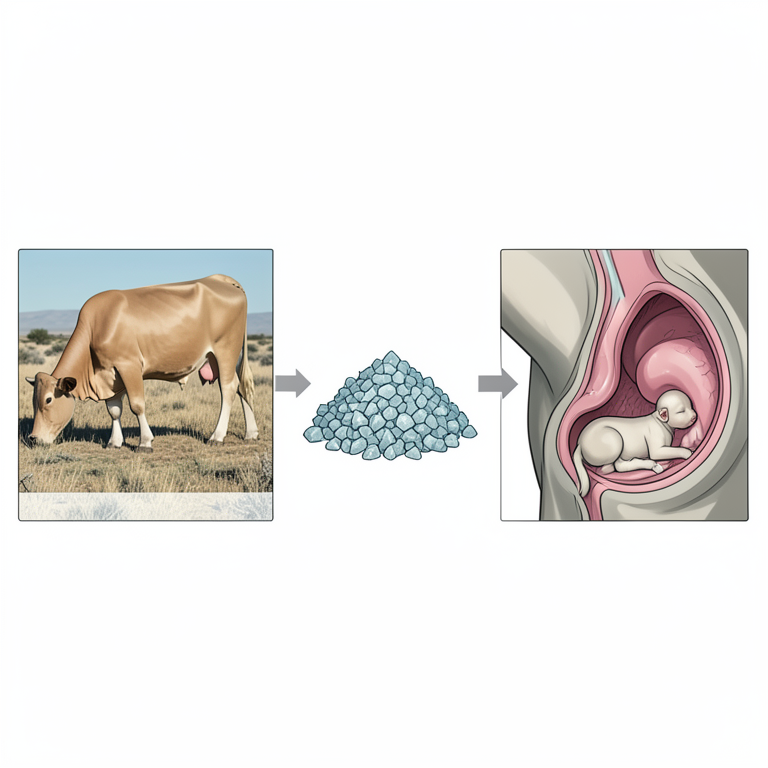
Mineral Supplementation Workflow
AI-generated conceptual illustration (Criollo cattle). It explains the idea and does not show study data.
View source evidence ↗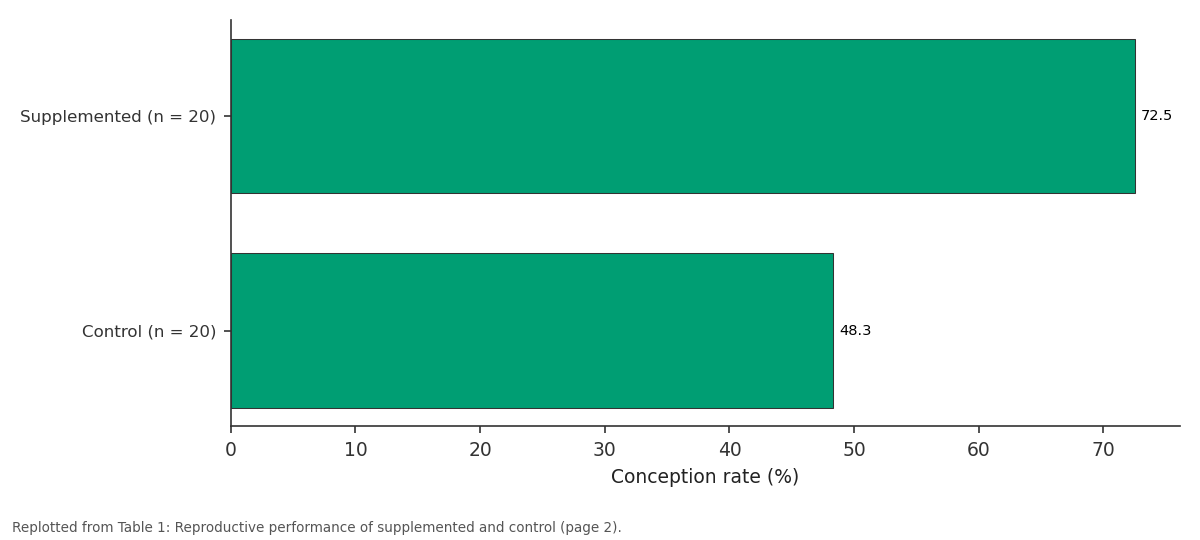
Conception rate (%): Supplemented (n = 20) vs Control (n = 20)
Replotted from Table 1 (page 2) of the original paper. Every bar is the paper's own table value.
View source evidence ↗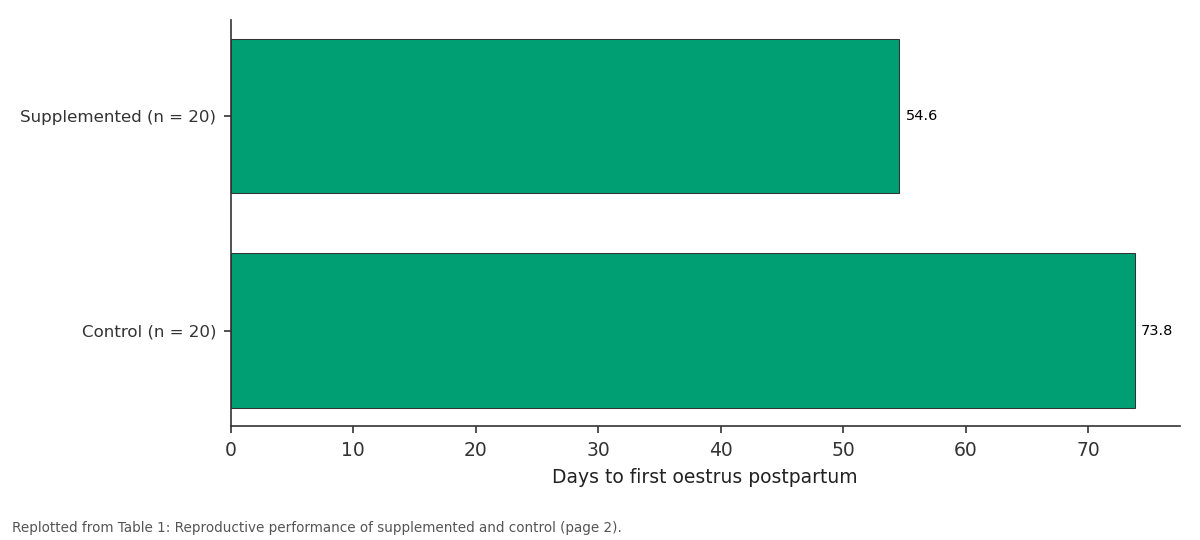
Days to first oestrus postpartum: Supplemented (n = 20) vs Control (n = 20)
Replotted from Table 1 (page 2) of the original paper. Every bar is the paper's own table value.
View source evidence ↗Figures & tables
From the original paper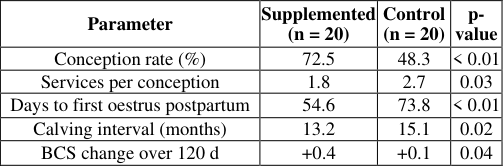 Table 1
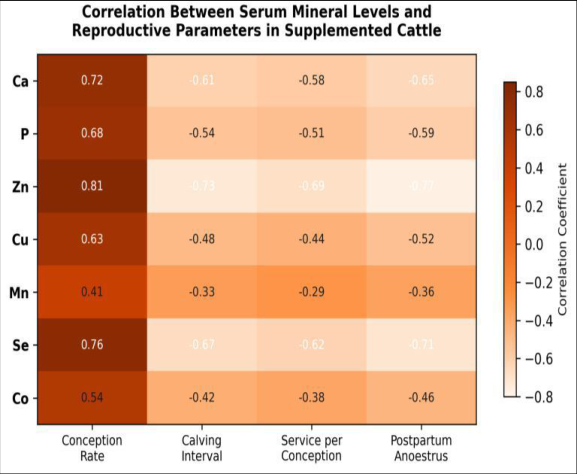 Figure 1
 Table 2
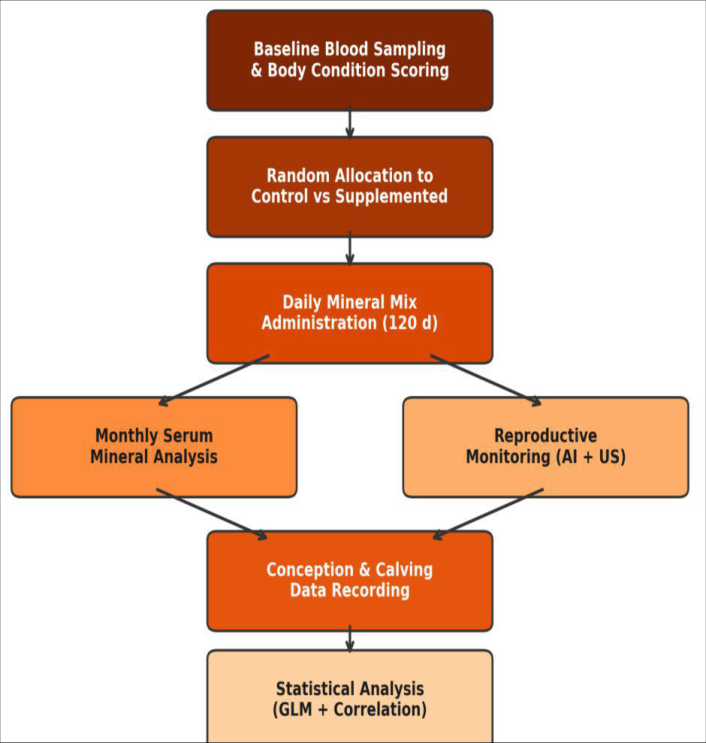 Figure 2
Introduction
Low reproductive rates remain the most expensive bottleneck for beef cattle producers on the arid and semi-arid rangelands of Sonora, Mexico. Average conception rates across the state hover near 50-55%, well below the 70-75% threshold considered economically viable [1] . While genetics, heat stress, and body condition all contribute, mineral deficiency in grazing cattle is consistently underestimated as a causative factor [2] . Native pastures in Sonora's desert grasslands are typically low in phosphorus, zinc, copper, and selenium, especially from March through June when standing forage is dry and leached of soluble minerals [3] . Cattle grazing these pastures without supplementation often develop subclinical deficiencies that suppress ovarian function, delay uterine involution, and increase embryonic mortality-effects that may not be visible to the producer but that erode herd productivity year after year [4,5] . Mineral mixture supplementation is a well-established practice in intensive dairy systems, but its adoption in extensive beef operations on indigenous breeds like the Mexican Criollo remains limited [6] . Criollo cattle are valued for their heat tolerance and foraging ability, yet their reproductive performance data under supplemented conditions are scarce. Most published supplementation trials in Mexico have focused on European or crossbred cattle under feedlot or semi-intensive management [7] . This research aimed to: (a) evaluate the effect of a balanced mineral mixture on conception rate and related reproductive traits in Criollo cows; (b) track changes in serum mineral concentrations over a 120-day supplementation period; and (c) identify which specific minerals correlate most strongly with reproductive outcomes. The results are expected to provide evidence-based guidance for rangeland cattle producers considering low-cost nutritional interventions. Seasonal Variation in Forage Mineral Content Forage samples collected from the grazing paddocks at monthly intervals revealed a marked seasonal pattern. During the wet season (July-October), forage P averaged 0.21% DM and Zn reached 28.4 mg kg⁻¹, both near adequate thresholds for breeding cattle. By the dry season peak (April-May), P had fallen to 0.09% DM and Zn to 14.7 mg kg⁻¹-roughly half the wet-season values. Se content was uniformly low year-round at 0.03-0.06 mg kg⁻¹, well below the 0.10 mg kg⁻¹ requirement. This seasonal deficit coincided exactly with the breeding window, reinforcing the rationale for targeted supplementation during November through February when cows are expected to conceive [3,8] .
Material and Methods
Material and Methods
Material
Forty multiparous Criollo cows aged 4-8 years, with body condition scores of 2.5-3.0, were selected from the university's herd at the Escuela Superior de Agricultura de Sonora, Hermosillo, Sonora (29°05'N, 110°57'W). The mineral mixture (Minerales del Norte, Hermosillo) contained per kg: Ca 180 g, P 90 g, NaCl 200 g, Zn 5,000 mg, Cu 1,500 mg, Mn 3,000 mg, Se 30 mg, Co 100 mg, I 200 mg, and vitamin A 500,000 IU. Supplementation was provided in covered mineral feeders at 80 g cow⁻¹ day⁻¹ for 120 consecutive days (15 November 2022 -14 March 2023). Control cows had access to plain salt blocks only. Both groups grazed the same Cenchrus ciliaris pasture at a stocking rate of 12 ha per animal unit [9] .
Methods
Cows were allocated to supplemented (n = 20) and control (n = 20) groups by stratified randomisation based on body condition score and parity. Artificial insemination using frozen semen from proven Criollo bulls was performed following oestrus detection with tail-paint and visual observation. Pregnancy diagnosis was confirmed by transrectal ultrasonography at 45 and 90 days postinsemination. Serum samples were collected via jugular venipuncture at baseline and at 30, 60, 90, and 120 days for mineral analysis by inductively coupled plasma optical emission spectrometry (ICP-OES, Thermo iCAP 7400). Body condition was scored at the same intervals by two trained evaluators. Reproductive parameters recorded were: conception rate, services per conception, days to first oestrus postpartum, and calving interval. Data were analysed using a generalised linear model in SAS 9.4 with treatment as a fixed effect and initial BCS as a covariate. Pearson correlations between serum mineral levels and reproductive parameters were computed [10] .
Mineral Input-Output Assessment
Total mineral intake was estimated by combining measured supplement consumption with forage mineral content (based on monthly forage analyses) and estimated dry matter intake (2.2% of body weight). Output was calculated from mineral content of milk (estimated at 4 kg d⁻¹ during lactation) and calf tissue accretion. The net mineral balance showed that supplemented cows achieved positive balances for Zn (+8.3 mg d⁻¹), Se (+0.07 mg d⁻¹), and P (+1.4 g d⁻¹), whereas control cows remained in negative balance for Zn (-3.1 mg d⁻¹) and Se (-0.04 mg d⁻¹) throughout the breeding period [11] . Mineral supplementation produced clear improvements in every reproductive parameter measured (Table 1). Conception rate in supplemented cows was 24.2 percentage points higher than controls. The number of services required per conception dropped by a full unit, and cows returned to oestrus nearly 19 days earlier postpartum. Calving interval was shortened by almost two months. Body condition improvement, while modest, was significantly greater in supplemented animals [12] . Correlation analysis (Figure 1) revealed that serum Zn and Se had the strongest associations with reproductive outcomes. Zn showed the highest positive correlation with conception rate (r = 0.81) and the strongest negative correlation with postpartum anoestrus duration (r = -0.77).
| Parameter | Supplemented (n = 20) | Control (n = 20) | p- value |
|---|---|---|---|
| Conception rate (%) | 72.5 | 48.3 | < 0.01 |
| Services per conception | 1.8 | 2.7 | 0.03 |
| Days to first oestrus postpartum | 54.6 | 73.8 | < 0.01 |
| Calving interval (months) | 13.2 | 15.1 | 0.02 |
| BCS change over 120 d | +0.4 | +0.1 | 0.04 |
Table text extracted from the original PDF; superscript letters are shown inline. The original table image is below.
View original table image
Results
Se followed a similar pattern (r = 0.76 and -0.71, respectively). Ca and P had moderate positive effects, while Mn showed the weakest correlations across all parameters. All supplemented minerals increased significantly (p<0.05) from baseline to 120 d; control values did not change significantly.
Discussion
The 24-point improvement in conception rate following mineral supplementation is consistent with findings from tropical beef systems in Brazil, where Zn and Se supplementation raised conception by 15-22 percentage points in Nelore cattle [13] . The strong correlation between serum Zn and reproductive success aligns with zinc's known roles in follicular development, oocyte maturation, and early embryonic survival [5] .
Se's effect appears to operate through its role in glutathione peroxidase, which protects reproductive tissues from oxidative damage-a particular concern under the heatstress conditions of Sonora's breeding season [14] . The nearly twofold increase in serum Se from baseline to 120 days in supplemented cows (31.4 to 68.2 μg L⁻¹) brought values into the adequate range for the first time, suggesting these animals were genuinely deficient beforehand.
The modest BCS improvement (+0.4 units) suggests that the reproductive response was driven primarily by mineral status correction rather than energy supply. This is an important distinction for extension messaging: mineral supplements are not a substitute for adequate forage, but they address a specific nutritional gap that energy alone cannot fill [15] . The cost of supplementation was roughly MXN 340 per cow for the 120-day period, which is easily recovered if even one additional calf is produced per 5-6 cows treated.
Conclusion
This research confirmed that a 120-day mineral mixture supplementation programme during the breeding season raised conception rates from 48.3% to 72.5% in indigenous Criollo cattle under semi-arid rangeland conditions in Sonora, Mexico. Serum Zn and Se levels showed the strongest correlations with reproductive improvement, pointing to these trace elements as the primary drivers of the response.
The intervention is low-cost, practical for extensive systems, and didn't require changes to grazing management or breeding protocols. Rangeland cattle producers in similar environments should consider targeted mineral supplementation as a first-line strategy for lifting herd reproductive performance. Future work should test multiyear supplementation effects on lifetime productivity and calf growth, and evaluate whether Se-enriched salt blocks can deliver comparable benefits at even lower labour input.
Figures and tables from the paper
| Mineral | Supplemented Baseline | Supplemented 120 d | Control Baseline | Control 120 d |
|---|---|---|---|---|
| Zn (μg dL⁻¹) | 62.3±8.1 | 94.7±7.4 | 61.8±9.2 | 58.4±10.1 |
| Se (μg L⁻¹) | 31.4±5.6 | 68.2±6.3 | 30.9±6.1 | 29.7±5.8 |
| Cu (μg dL⁻¹) | 71.6±9.3 | 89.4±8.7 | 70.2±10.4 | 68.1±9.8 |
| Ca (mg dL⁻¹) | 8.9±0.7 | 10.1±0.6 | 8.8±0.8 | 8.6±0.9 |
| P (mg dL⁻¹) | 4.1±0.5 | 5.8±0.4 | 4.0±0.6 | 3.7±0.7 |
Table text extracted from the original PDF; superscript letters are shown inline. The original table image is below.
View original table image
References
13 in the original paper- Instituto Nacional de Estadística y Geografía. Agricultural census: livestock production in Sonora 2020. Aguascalientes: INEGI; c2021.
- Ramírez RG, Haenlein GFW, Núñez-González FA. Seasonal variation of macro and trace mineral contents in native forages of Sonoran rangelands. Small Ruminant Res. 2001;39(3):209-215.
- Corah LR, Ives S. The effects of essential trace minerals on reproduction in beef cattle. Vet Clin North Am Food Anim Pract. 1991;7(1):41-57.
- Hostetler CE, Kincaid RL, Mirando MA. The role of essential trace elements in embryonic and fetal development in livestock. Vet J. 2003;166(2):125-139.
- Martínez-Marín AL, Pérez-Hernández P. Mineral supplementation strategies for extensive beef cattle systems in Mexico. Trop Subtrop Agroecosyst. 2012;15(S2):87-96.
- García-Bañuelos ML, Rivera-López J, Herrera-Torres E. Mineral status of beef cattle in northern Mexico: a regional survey. Rev Mex Cienc Pecu. 2018;9(3):536551.
- Arthington JD, Swenson CK. Effects of trace mineral source and feeding method on the productivity of grazing Braford cows. Prof Anim Sci. 2004;20(2):155161.
- Echavarría-Cháirez FG, Gutiérrez-Luna R, LedezmaRivas RA. Carrying capacity and management of buffelgrass pastures in Sonora. Tec Pecu Mex. 2006;44(1):73-84.
- Ahola JK, Baker DS, Burns PD, Mortimer RG, Enns RM, et al. Effect of copper, zinc, and manganese supplementation and source on reproduction, mineral status, and performance in grazing beef cattle. J Anim Sci. 2004;82(8):2375-2383.
- Sales JNS, Pereira RVV, Bicalho RC, Baruselli PS. Effect of injectable copper, selenium, zinc and manganese on the pregnancy rate of crossbred heifers synchronized for timed embryo transfer. Livest Sci. 2011;142(1-3):59-62.
- Hoque SAM, Kabiraj SK, Khandoker MAMY, Mondal A, Tareq KMA. Effect of selenium and vitamin E supplementation on reproductive performance of Brahman cross cows. Bangladesh J Anim Sci. 2016;45(1):1-8.
- Muehlenbein EL, Brink DR, Deutscher GH, Carlson MP, Johnson AB. Effects of inorganic and organic copper supplemented to first-calf cows on cow reproduction and calf health and performance. J Anim Sci. 2001;79(7):1650-1659.
- Mehdi Y, Dufrasne I. Selenium in cattle: a review. Molecules. 2016;21(4):545.