
Research article · 2025 · Full text
International Journal of Agriculture and NutritionParticipatory rural appraisal for identifying agricultural training needs of women farmers
Volume 7(2) · Pages 42–45 · DOI: 10.33545/26646064.2025.v7.i2a.456 ↗
Research areasAgricultural Development and ManagementAgricultural Innovations and PracticesLivestock Management and Performance Improvement
Abstract
Author-writtenWomen perform 60-80% of agricultural labour in rural India, yet their training requirements are seldom assessed participatively. This research used PRA techniques focus groups, seasonal calendars, problem ranking, Venn diagrams, and transect walks to identify training needs of 120 women farmers across four villages in Ahmednagar district, Maharashtra. Organic farming emerged as the highest priority (gap score 2.5/5), followed by post-harvest handling (2.7) and market linkages (2.6). The PRA process was valued by participants as empowering and inclusive. Findings inform gender-responsive training curricula for extension agencies in semi-arid western India.
Summary
Source-checkedPlain-language reading of the full paper, prepared with AI and checked against the text. Each point links to the authors' own words.
Why it matters
- Women provide the majority of agricultural labor in rural India, but their specific training needs are rarely identified through participatory methods. View evidence ↗
- Despite making up approximately 65% of the agricultural workforce in India, women receive less than 10% of agricultural extension services. View evidence ↗
- Current agricultural extension programs often fail women because they are designed based on male priorities and scheduled at inconvenient times. View evidence ↗
The question
- The study aimed to use a multi-tool Participatory Rural Appraisal (PRA) approach to identify and prioritize training needs specific to women farmers to help design better extension curricula. View evidence ↗
What they did
- The study took place in the Ahmednagar district of Maharashtra from March to August 2023. View evidence ↗
- The sample consisted of 120 women farmers aged 22-58, with 30 participants selected from each of four villages with active self-help groups (SHGs). View evidence ↗
- The researchers used five sequential PRA tools: transect walks, Venn diagrams, problem ranking matrices, seasonal calendars, and focus group discussions. View evidence ↗
What they found
- Organic farming was identified as the top priority for training, with a gap score of 2.5 and a Mean Weighted Discrepancy Score (MWDS) of 10.75. View evidence ↗
- Post-harvest handling was the second highest priority, showing a gap score of 2.7 and an MWDS of 11.07. View evidence ↗
- Market linkages ranked third in priority, with a gap score of 2.6 and an MWDS of 9.88. View evidence ↗
- Financial literacy had a significant knowledge gap (2.0) but was ranked as the lowest priority (7th) due to lower perceived importance (3.1). View evidence ↗
- Seasonal calendar data indicated that training attendance would be maximized if scheduled during the slack periods of January-February or August-September. View evidence ↗
- There were no statistically significant differences in the top training priorities across the different villages studied. View evidence ↗
What it means
- The authors conclude that extension agencies must redesign their training curricula based on the actual priorities of women farmers instead of relying on assumptions. View evidence ↗
- A limitation of the study is that the purposive selection of villages may mean the results do not represent women who are not part of self-help group (SHG) networks. View evidence ↗
Visual summary
1 visualsIllustrations explain the paper; charts are replotted from the paper's own table values.
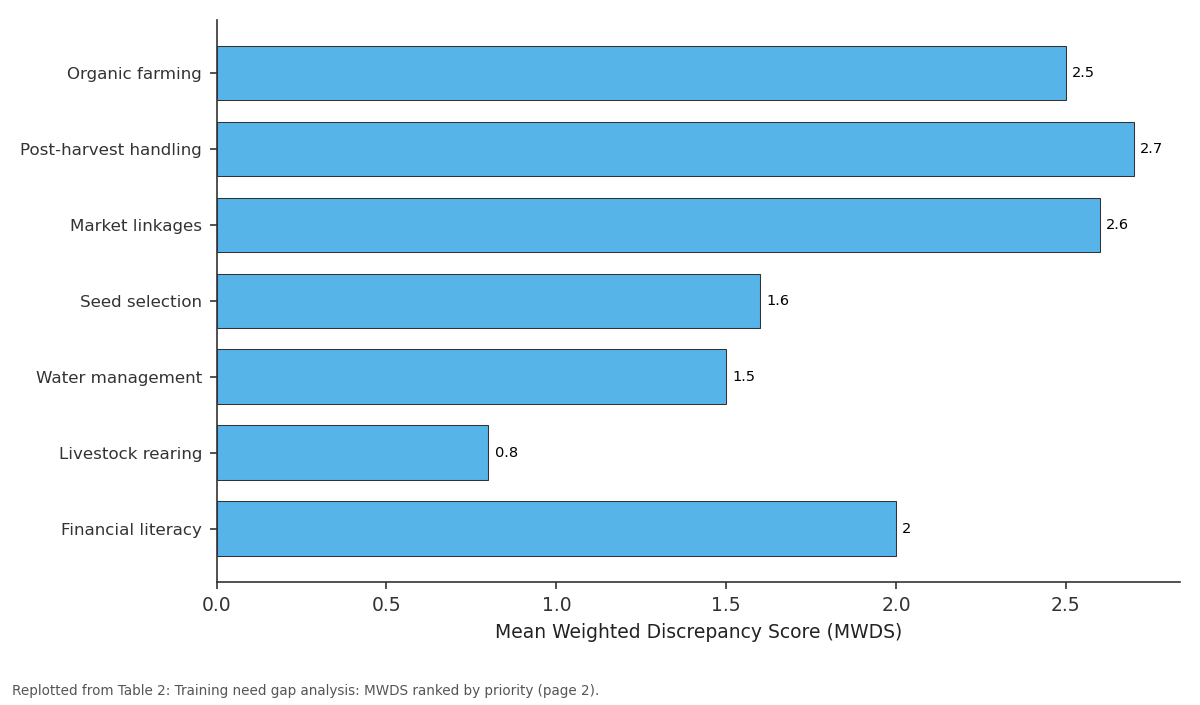
Gap: Organic farming vs Post-harvest handling vs Market linkages vs Seed selection vs Water management
Replotted from Table 2 (page 2) of the original paper. Every bar is the paper's own table value.
View source evidence ↗Figures & tables
From the original paper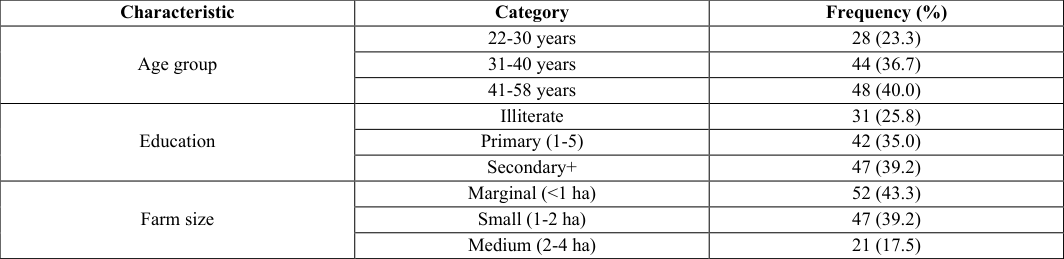 Table 1
 Table 2
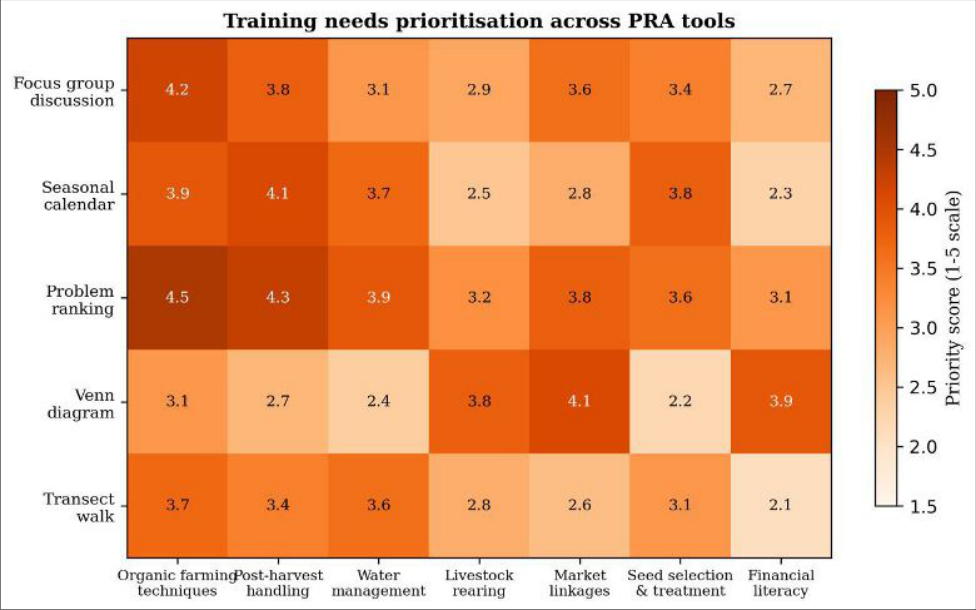 Figure 1
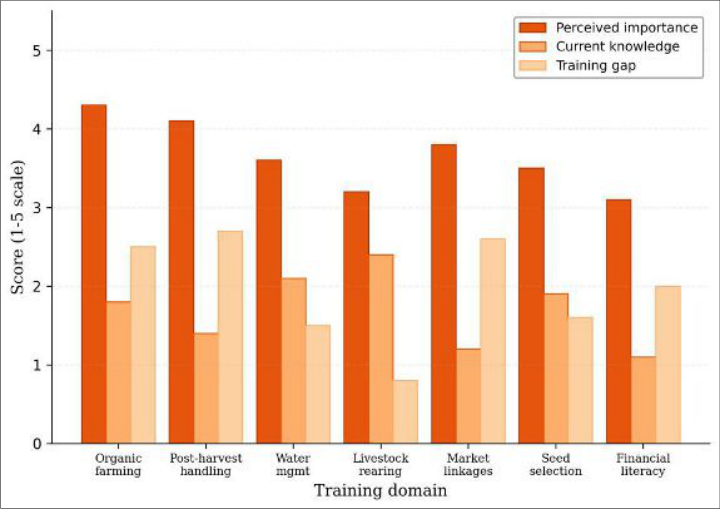 Figure 2
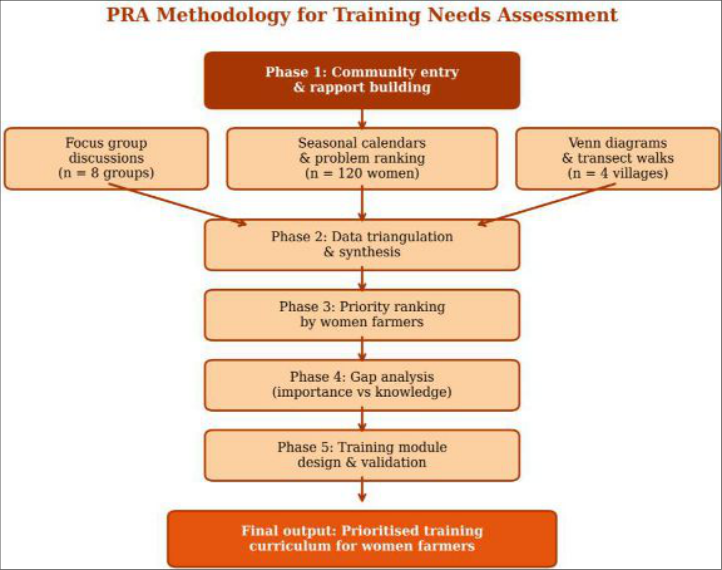 Figure 3
Introduction
Despite providing the bulk of farm labour, women farmers remain excluded from extension services [1]. In India, women account for ~65% of the agricultural workforce but receive less than 10% of extension contacts [2]. Existing programmes are designed around male priorities, delivered at inconvenient times, and rarely address tasks women actually perform [3]. Participatory rural appraisal offers tools that place women at the centre of needs assessment using visual methods that don't require literacy [4, 5].
Yet PRA applications specifically for gender-differentiated agricultural training needs in India have been limited [6]. Maharashtra, where women's self-help groups have played an important role, and Ahmednagar district's semi-arid rainfed conditions, make an ideal setting for this research [7]. This research used a multi-tool PRA approach to identify and prioritise women-specific training needs for informing extension curricula. Theoretical framework The research combined Borich's (1980) needs assessment model, which defines training need as the discrepancy between perceived importance and current knowledge [8], with Chambers' (1994) participatory framework [4].
The Borich model has been used in agricultural extension but rarely within a PRA rather than survey methodology [9].
Material And Methods
Material The research was conducted in Ahmednagar district, Maharashtra, between March and August 2023. Four villages with active women's SHGs were selected. A total of 120 women farmers (30 per village) aged 22-58 years were sampled from SHG member lists. Ethical approval was obtained from MPKV, Rahuri (Protocol No.
MPKV/IREC/2023-04) [10].
Methods
Five PRA tools were employed sequentially in each village: focus group discussions, seasonal calendars, problem ranking matrices, Venn diagrams, and transect walks [5, 11]. Following PRA exercises, a structured questionnaire quantified training gaps using the Borich discrepancy model [8]. For each topic, respondents rated importance (1-5) and IJAN 2025; 7(2): 42-45 Indu Dubey Department of Agricultural Extension, Mahatma Phule Krishi Vidyapeeth, Rahuri, Maharashtra, India Rajeev Rana Department of Agricultural Communication, Sardarkrushinagar Dantiwada Agricultural University, Dantiwada, Gujarat, India Prerna Phukan Department of Agricultural Communication, Sardarkrushinagar Dantiwada Agricultural University, Dantiwada, Gujarat, India Dhanush Pawar Department of Agricultural Communication, Sardarkrushinagar Dantiwada Agricultural University, Dantiwada, Gujarat, India Indu Dubey Department of Agricultural Extension, Mahatma Phule Krishi Vidyapeeth, Rahuri, Maharashtra, India https://www.agriculturejournal.net knowledge (1-5). Mean Weighted Discrepancy Score (MWDS) was calculated as: Σ(importance × (importance - knowledge)) / n.
Data were analysed using Kruskal-Wallis tests and Spearman correlations in R 4.2.1 [12]. The questionnaire was validated with Cronbach's alpha of 0.84 (importance) and 0.81 (knowledge) [13].
Results
Table 1: Socio-demographic profile of participating women farmers (n = 120) Characteristic Category Frequency (%) Age group 22-30 years 28 (23.3) 31-40 years 44 (36.7) 41-58 years 48 (40.0) Education Illiterate 31 (25.8) Primary (1-5) 42 (35.0) Secondary+ 47 (39.2) Farm size Marginal (<1 ha) 52 (43.3) Small (1-2 ha) 47 (39.2) Medium (2-4 ha) 21 (17.5) Most participants (63.3%) were 31-58 years old and 60.8% had primary or no formal education Table 2: Training need gap analysis: MWDS ranked by priority Training domain Import. Knowl. Gap MWDS Rank Organic farming 4.3 1.8 2.5 10.75 1 Post-harvest handling 4.1 1.4 2.7 11.07 2 Market linkages 3.8 1.2 2.6 9.88 3 Seed selection 3.5 1.9 1.6 5.60 4 Water management 3.6 2.1 1.5 5.40 5 Livestock rearing 3.2 2.4 0.8 2.56 6 Financial literacy 3.1 1.1 2.0 6.20 7 Organic farming, post-harvest handling, and market linkages were the top three priorities. Financial literacy had a large gap but lower perceived importance Fig 1: Training need priority scores across PRA tools and training domains https://www.agriculturejournal.net Fig 2: Perceived importance, current knowledge, and gap for each training domain Fig 3: PRA-based training needs assessment workflow
| Training domain | Import. | Knowl. | Gap | MWDS | Rank |
|---|---|---|---|---|---|
| Organic farming | 4.3 | 1.8 | 2.5 | 10.75 | 1 |
| Post-harvest handling | 4.1 | 1.4 | 2.7 | 11.07 | 2 |
| Market linkages | 3.8 | 1.2 | 2.6 | 9.88 | 3 |
| Seed selection | 3.5 | 1.9 | 1.6 | 5.60 | 4 |
| Water management | 3.6 | 2.1 | 1.5 | 5.40 | 5 |
| Livestock rearing | 3.2 | 2.4 | 0.8 | 2.56 | 6 |
| Financial literacy | 3.1 | 1.1 | 2.0 | 6.20 | 7 |
Table text extracted from the original PDF; superscript letters are shown inline. The original table image is below.
View original table image
| Characteristic | Category | Frequency (%) |
|---|---|---|
| Age group | 22-30 years | 28 (23.3) |
| 31-40 years | 44 (36.7) | |
| 41-58 years | 48 (40.0) | |
| Education | Illiterate | 31 (25.8) |
| Primary (1-5) | 42 (35.0) | |
| Secondary+ | 47 (39.2) | |
| Farm size | Marginal (<1 ha) | 52 (43.3) |
| Small (1-2 ha) | 47 (39.2) | |
| Medium (2-4 ha) | 21 (17.5) |
Table text extracted from the original PDF; superscript letters are shown inline. The original table image is below.
View original table image
Discussion
The dominance of organic farming reflects a broader shift in Indian smallholder agriculture. Government schemes like PKVY have promoted organic practices but provided limited hands-on training for women [2]. The low priority for financial literacy, despite its large knowledge deficit, may indicate that women don't yet recognise its importance or that cultural norms place financial matters in the male domain [3, 7]. Extension programmes should integrate financial modules within higher-priority topics rather than offering them standalone.
Between-village differences in top priorities were non- significant (Kruskal-Wallis p>0.05), but livestock rearing ranked higher in villages where goat-keeping supplements income. The seasonal calendar revealed that training should be scheduled during August-September or January-February slack periods to maximise attendance. Limitations Purposive village selection may not represent women outside SHG networks. Self-reported knowledge may be affected by social desirability bias.
The cross-sectional design captures needs at one point; priorities may shift with changing conditions.
Conclusion
This PRA-based research identified organic farming, post- harvest handling, and market linkages as top training https://www.agriculturejournal.net priorities for women farmers in Ahmednagar. The approach proved effective at eliciting women-specific needs that conventional methods might miss. Extension agencies should redesign curricula around actual priorities of women farmers rather than assumptions. Future research should extend this methodology to other districts and women outside SHG networks.
References
17 in the original paper- Ragasa C, Berhane G, Tadesse F, Taffesse AS. Gender differences in access to extension services. Journal of Agricultural Education and Extension. 2013;19(5):437- 468.
- Agarwal B. Gender and land rights revisited. Journal of Agrarian Change. 2003;3(1-2):184-224.
- Patel SJ, Patel MD, Patel JH, Patel AS, Gelani RN. Role of women gender in livestock sector. Journal of Livestock Science. 2016;7:92-96.
- Chambers R. The origins and practice of participatory rural appraisal. World Development. 1994;22(7):953- 969.
- Kumar S. Methods for Community Participation. ITDG Publishing, London. 2002.
- Singh AK, Sah U, Singh A. Training needs of farm women: a systematic review. Indian Journal of Extension Education. 2018;54(3):1-10.
- Desai BM, Namboodiri NV. Whither structural reforms in Indian agriculture. Economic and Political Weekly. 2001;36(13):1148-1155.
- Borich GD. A needs assessment model for conducting follow-up studies. Journal of Teacher Education. 1980;31(3):39-42.
- Swanson BE, Rajalahti R. Strengthening Agricultural Extension. World Bank Discussion Paper 45. 2010.
- ICMR. National Ethical Guidelines for Biomedical Research. ICMR, New Delhi. 2017.
- Mukherjee N. Participatory Learning and Action: With 100 Field Methods. Concept Publishing, New Delhi. 2003.
- R Core Team. R: A Language and Environment for Statistical Computing. Vienna, Austria. 2022.
- Cronbach LJ. Coefficient alpha and the internal structure of tests. Psychometrika. 1951;16(3):297-334.
- Pretty JN, Guijt I, Thompson J, Scoones I. Participatory Learning and Action: A Trainer's Guide. IIED, London. 1995.
- Oakley P, Marsden D. Approaches to Participation in Rural Development. ILO, Geneva. 1984.
- Creswell JW, Creswell JD. Research Design. Fifth edition. SAGE Publications, Los Angeles. 2018.
- Sabarathnam VE. Manuals for Training on Technology Assessment and Transfer. NAARM, Hyderabad. 1988.