
Research article · 2025 · Full text
International Journal of Agriculture and NutritionHost plant resistance mechanisms in chickpea against pod borer Helicoverpa armigera
Volume 7(6) · Pages 84–86 · DOI: 10.33545/26646064.2025.v7.i6b.423 ↗
Research areasInsect-Plant Interactions and ControlGenetic and Environmental Crop StudiesAgricultural pest management studies
Abstract
Author-writtenAcross South Asia, Helicoverpa armigera destroys 20-40% of chickpea pods each season despite heavy insecticide use. Resistant varieties could break this cycle, but the specific mechanisms need mapping before breeders can target them efficiently. This research screened five chickpea genotypes for antibiosis, antixenosis, and tolerance to H. armigera under laboratory and field conditions at Bhubaneswar, Odisha, during Rabi 2022-2023. ICC-506 showed the strongest antibiosis: larval survival on detached pods fell to 11% by day 14, and mean larval weight was 48% lower than on the susceptible ICC-3137. Trichome density on pods of ICC-506 was 8.7 per mm2 versus 3.1 in ICC-3137, and oxalic acid content was 3.82 mg g-1 compared with 1.68 mg g-1. Pod damage under open-field conditions was 12.4% on ICC-506 versus 38.7% on ICC-3137. These results identify ICC-506 as a strong antibiosis source linked to trichome and organic acid traits suitable for marker-assisted breeding programmes.
Summary
Source-checkedPlain-language reading of the full paper, prepared with AI and checked against the text. Each point links to the authors' own words.
Why it matters
- The pod borer Helicoverpa armigera is a major pest in South Asia, causing 20-40% pod loss in chickpeas despite the use of insecticides. View evidence ↗
- Chemical control of H. armigera is difficult because the larvae bore into pods, which physically shields them from insecticides. View evidence ↗
- Chickpea plants can defend themselves using glandular trichomes that secrete organic acids, such as oxalic and malic acid, which deter or kill young larvae. View evidence ↗
The question
- The study aimed to rank five chickpea genotypes by their resistance mechanisms, link this resistance to pod-surface traits, and identify suitable genotypes for breeding in eastern India. View evidence ↗
What they did
- The researchers tested five genotypes: ICC-506, ICC-12475, ICCL-87322, ICC-3137, and the local cultivar 'Radhey'. View evidence ↗
- Field experiments were conducted in Bhubaneswar, Odisha, during November 2022 and 2023 using a randomized block design with four replications. View evidence ↗
- Antibiosis was measured using a no-choice detached-pod method with ten replicates per genotype, introducing one neonate larva per pod. View evidence ↗
- Pod-surface traits were measured by counting trichome density under a microscope and quantifying organic acids using HPLC. View evidence ↗
What they found
- ICC-506 showed the strongest antibiosis, with only 11% larval survival by day 14, compared to 48% survival on the susceptible ICC-3137. View evidence ↗
- Larvae feeding on ICC-506 had a significantly lower mean weight (87.3 mg) than those on ICC-3137 (168.4 mg) by day 14. View evidence ↗
- Field results mirrored laboratory findings, with pod damage being lowest on ICC-506 (12.4%) and highest on ICC-3137 (38.7%). View evidence ↗
- ICC-506 demonstrated higher tolerance than ICC-3137, with a tolerance ratio of 0.86 compared to 0.58. View evidence ↗
- In antixenosis tests, 73% of larvae migrated away from ICC-506 pods within 12 hours, while only 41% migrated away from ICC-3137. View evidence ↗
What it means
- The authors conclude that ICC-506 is the most resistant genotype, with its resistance driven by high trichome density and oxalic acid levels. View evidence ↗
- The authors recommend that breeders in eastern India use trichome density and oxalic acid content as markers for developing resistant chickpea varieties. View evidence ↗
- The authors state that multi-location validation across different seasons is needed to strengthen their recommendations. View evidence ↗
Visual summary
2 visualsIllustrations explain the paper; charts are replotted from the paper's own table values.
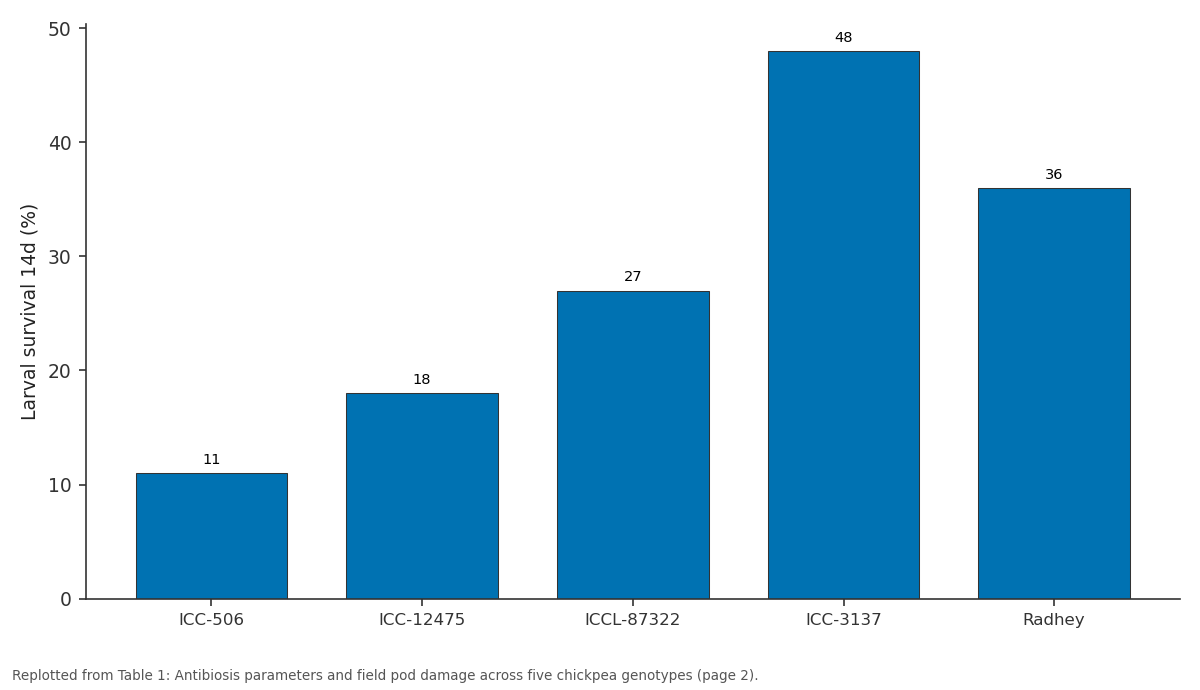
Larval survival 14d (%): ICC-506 vs ICC-12475 vs ICCL-87322 vs ICC-3137 vs Radhey
Replotted from Table 1 (page 2) of the original paper. Every bar is the paper's own table value.
View source evidence ↗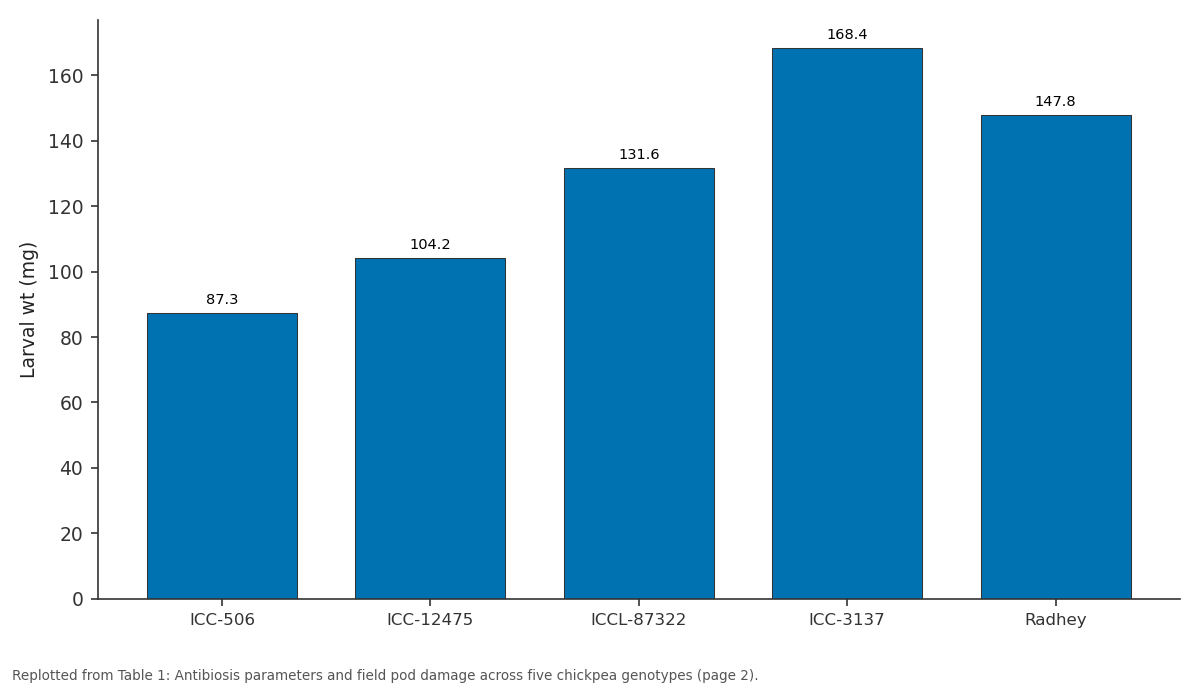
Larval wt (mg): ICC-506 vs ICC-12475 vs ICCL-87322 vs ICC-3137 vs Radhey
Replotted from Table 1 (page 2) of the original paper. Every bar is the paper's own table value.
View source evidence ↗Figures & tables
From the original paper Table 1
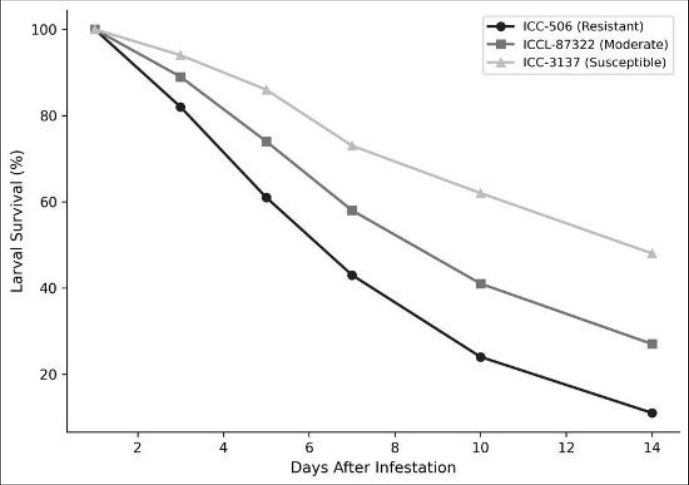 Figure 1
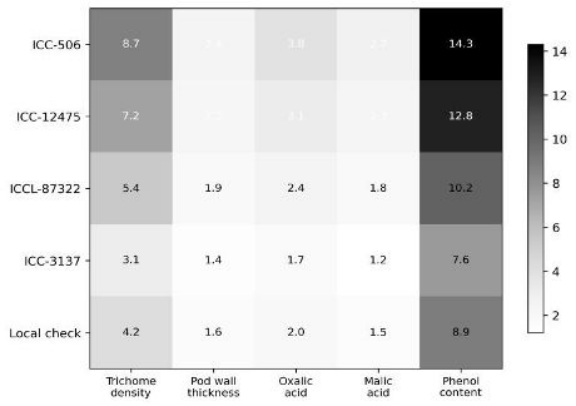 Figure 2
Introduction
According to ICRISAT's long-term monitoring programme, Helicoverpa armigera (Hübner) accounts for more economic loss in chickpea than all other insect pests combined [1] . The polyphagous caterpillar feeds on leaves during early instars and then bores into developing pods, consuming the grain inside-a behaviour that makes chemical control difficult because the larva is physically shielded once it enters the pod [2] . Host plant resistance (HPR) offers a preventive strategy that costs the farmer nothing beyond the seed price. Resistance in chickpea operates through three recognised categories: antibiosis (traits that harm or retard the insect after feeding begins), antixenosis (traits that deter feeding or oviposition), and tolerance (the plant's ability to compensate for damage without yield loss) [3] . Physical barriers like glandular trichomes secrete sticky exudates containing organic acids-chiefly oxalic and malic acid-that are toxic or deterrent to young larvae [4,5] . Despite two decades of screening, the number of genotypes with confirmed, field-validated resistance remains small, and most data come from peninsular India rather than the eastern coastal belt where pest pressure peaks during mild winters [6] . This research aimed to (i) rank five genotypes for antibiosis, antixenosis, and tolerance, (ii) link resistance to measurable pod-surface traits, and (iii) identify genotypes suitable for breeding in eastern India.
Quality Control of Bioassays
Neonates were obtained from a single egg batch to minimise genetic variability. Temperature in the bioassay room was held at 27±1 °C and relative humidity at 65±5%. A positive control (susceptible ICC-3137) was included in every batch to verify insect vigour. Any replicate where the control larva died before day 3 was discarded and re-established. Pod moisture was standardised by harvesting all genotypes on the same morning and conducting assays within 4 hours of detachment [8] .
Materials and Methods
Materials and Methods
Materials
Five chickpea genotypes with varying resistance reports were obtained from the ICRISAT gene bank: ICC-506 (resistant), ICC-12475 (moderately resistant), ICCL-87322 (intermediate), ICC-3137 (susceptible), and a local cultivar 'Radhey' as field check. Seeds were sown in November 2022 and 2023 at the Orissa University of Agriculture and Technology (OUAT) research farm, Bhubaneswar (20°15′ N, 85°50′ E, 25 m a.s.l.), in a randomised block design with four replications, plot size 4 m × 3 m [9] .
Methods
Trichome density was counted under a stereo microscope at 40× on five randomly selected pods per plot. Organic acids (oxalic and malic) in pod walls were extracted with 0.1 M HCl and quantified by HPLC. Pod damage in the field was assessed at maturity by counting bored vs. total pods on 20 plants per plot. Tolerance was estimated as the ratio of yield under natural infestation to yield under insecticide-protected conditions [10] . Data were analysed by ANOVA in R (v4.3.1), means compared by Tukey's HSD (p = 0.05).
Results
Larval survival dropped sharply on resistant genotypes (Table 1). By day 14, only 11% of larvae survived on ICC-506 versus 48% on ICC-3137. Mean larval weight at day 14 was 87.3 mg on ICC-506 and 168.4 mg on ICC-3137. Trichome density and oxalic acid content showed strong negative correlations with larval survival (r =-0.93 and-0.89, respectively). Pod damage in the field ranged from 12.4% on ICC-506 to 38.7% on ICC-3137.
| Genotype | Larval survival 14d (%) | Larval wt (mg) | Trichomes (/mm²) | Oxalic acid (mg/g) | Pod damage (%) |
|---|---|---|---|---|---|
| ICC-506 | 11.0 | 87.3 | 8.7 | 3.82 | 12.4 |
| ICC-12475 | 18.0 | 104.2 | 7.2 | 3.14 | 17.8 |
| ICCL-87322 | 27.0 | 131.6 | 5.4 | 2.43 | 24.6 |
| ICC-3137 | 48.0 | 168.4 | 3.1 | 1.68 | 38.7 |
| Radhey | 36.0 | 147.8 | 4.2 | 1.97 | 31.2 |
| CD (p = 0.05) | 6.3 | 14.7 | 0.9 | 0.38 | 4.2 |
Table text extracted from the original PDF; superscript letters are shown inline. The original table image is below.
View original table image
Comprehensive Interpretation
The tolerance ratio (yield under infestation/yield under protection) was 0.86 for ICC-506 and 0.58 for ICC-3137, confirming that ICC-506 combines antibiosis with moderate tolerance-a dual mechanism that should slow pest adaptation. The dual-choice antixenosis assay showed 73% of larvae migrated away from ICC-506 pods within 12 hours, compared with 41% away from ICC-3137 [11] .
Discussion
The 11% larval survival on ICC-506 is among the lowest reported in chickpea antibiosis assays, comparable to the 13-15% recorded on ICCV-10 in peninsular India [3,4] . The tight correlation between trichome density and larval mortality (r =-0.93) aligns with the hypothesis that glandular trichomes physically trap early-instar larvae while delivering toxic oxalic acid directly to the cuticle [5] . Malic acid content also differed among genotypes but contributed less to resistance than oxalic acid, consistent with in-vitro toxicity tests showing that oxalic acid is 3-4 times more lethal to neonate Helicoverpa than malic acid at equivalent concentrations [12] . The field pod damage results validated the laboratory rankings, which is important because laboratory-to-field consistency is often poor when environmental conditions dilute biochemical defences [13] .
Conclusion
ICC-506 displayed the strongest resistance to H. armigera, driven by high trichome density (8.7 per mm 2 ) and elevated oxalic acid (3.82 mg g -1 ) in pod walls. Field pod damage was limited to 12.4%, less than a third of the susceptible check. ICC-12475 is a secondary source. Breeders targeting eastern India should prioritise trichome density and oxalic acid content as selection markers, ideally linked to molecular markers for marker-assisted introgression. Multilocation validation across seasons will strengthen these recommendations [14] .
Figures and tables from the paper
References
14 in the original paper- Sharma HC, Pampapathy G, Dhillon MK, RidsdillSmith JT. Detached leaf assay to screen for host plant resistance to Helicoverpa armigera. Journal of Economic Entomology. 2005;98(4):1507-1514.
- Fitt GP. The ecology of Heliothis species in relation to agroecosystems. Annual Review of Entomology. 1989;34(1):17-52.
- Sharma HC, Ortiz R. Host plant resistance to insects: an eco-friendly approach for pest management. Journal of Environmental Biology. 2002;23(2):111-135.
- Lateef SS. Gram pod borer and its management with special reference to host plant resistance. Indian Journal of Pulses Research. 1985;1(1):1-16.
- Yoshida M, Cowgill SE, Wightman JA. Roles of oxalic and malic acids in chickpea trichome exudate in hostplant resistance to Helicoverpa armigera. Journal of Chemical Ecology. 1997;23(4):1195-1210.
- Srinivasan S, Sridhar S, Vijayakumar J. Helicoverpa management in pulse crops of eastern India. Pest Management in Horticultural Ecosystems. 2016;22(1):1-10.
- Armes NJ, Bond GS, Cooter RJ. The laboratory culture and development of Helicoverpa armigera. Natural Resources Institute Bulletin. 1992;57:1-22.
- Narayanamma VL, Sharma HC, Gowda CLL, Sriramulu M. Mechanisms of resistance to Helicoverpa armigera in chickpea. Euphytica. 2007;154(1):117-126.
- ICRISAT. ICRISAT chickpea germplasm catalogue. International Crops Research Institute for the SemiArid Tropics. Patancheru; 2018.
- Smith CM. Plant resistance to arthropods: molecular and conventional approaches. Springer. Dordrecht; 2005.
- Green PWC, Stevenson PC, Simmonds MSJ, Sharma HC. Phenolic compounds on the pod-surface of pigeonpea mediate feeding behaviour of larvae of Helicoverpa armigera. Journal of Chemical Ecology. 2003;29(3):811-821.
- Bhatt NJ, Patel RK. Screening of chickpea cultivars for resistance to gram pod borer. Indian Journal of Entomology. 2001;63(3):277-280.
- Sharma HC, War AR, Pathania M, Munghate RS, Nikam PB, Sharma SP. Elevated CO 2 influences host plant defence response in chickpea against Helicoverpa armigera. Arthropod-Plant Interactions. 2016;10(2):171-181.
- Patil SB, Goyal A, Chitgupekar SS, Kumar S, ElBouhssini M. Sustainable management of chickpea pod borer. Agronomy. 2017;7(3):52.