
Research article · 2025 · Full text
International Journal of Agriculture and NutritionAssessment of precision levelling on water saving and crop yield in rice-based cropping systems
Volume 7(1) · Pages 171–174 · DOI: 10.33545/26646064.2025.v7.i1c.402 ↗
Research areasRice Cultivation and Yield ImprovementIrrigation Practices and Water ManagementEngineering and Agricultural Innovations
Abstract
Author-writtenA clear trend across South Asian rice research is the growing gap between water availability and crop water demand—a gap that precision land levelling can partly close. This research compared laser-guided precision levelling (PL) with traditional farmer-levelled fields (TL) across two rice–wheat cycles (2021–22 and 2022–23) at Dr. Rajendra Prasad Central Agricultural University, Pusa, Bihar. PL reduced total irrigation water applied to rice by 20.4% (1,067 vs. 1,340 mm) while raising grain yield by 18.2% (4.87 vs. 4.12 t ha⁻¹). Water productivity improved from 3.07 to 4.56 kg grain m⁻³. In the subsequent wheat crop, PL plots maintained a 12.7% yield advantage. The benefit-cost ratio of PL was 2.18 compared with 1.74 for TL. These results confirm that one-time laser levelling generates multi-season water and yield benefits in the rice–wheat system of the eastern Indo-Gangetic Plains.
Summary
Source-checkedPlain-language reading of the full paper, prepared with AI and checked against the text. Each point links to the authors' own words.
Why it matters
- Groundwater levels in Bihar's rice-growing regions have been declining by 0.3 to 0.5 meters annually for ten years, primarily due to flood irrigation on uneven fields. View evidence ↗
- Traditional land levelling using animal-drawn planks results in surface variations of ±8–12 cm, which leads to water waste through runoff and uneven ponding. View evidence ↗
- Rice cultivation is a primary target for water conservation efforts because it consumes 34% of the water used in Indian agriculture. View evidence ↗
The question
- The study aimed to compare water savings and rice yields between precision levelling (PL) and traditional levelling (TL) on clay loam, evaluate the impact on subsequent wheat crops, and determine the economic returns. View evidence ↗
What they did
- The experiment was conducted at Dr. Rajendra Prasad Central Agricultural University in Pusa, Bihar, using calcareous alluvial clay loam soil. View evidence ↗
- The researchers used a randomized complete block design with six replications on plots measuring 0.4 hectares each. View evidence ↗
- The study utilized Rajendra Bhagwati rice transplanted in July 2021 and 2022, and HD-2967 wheat sown in November. View evidence ↗
- Irrigation was maintained at a 5 cm standing-water depth, with volumes measured using Parshall flumes in the inlet channels. View evidence ↗
What they found
- Precision levelling provided a higher net return of 47,830 INR ha⁻¹ and a benefit-cost ratio (BCR) of 2.18, compared to 38,210 INR ha⁻¹ and a BCR of 1.74 for traditional levelling. View evidence ↗
What it means
- The authors conclude that promoting precision levelling via custom-hire centers is a practical and high-impact strategy for the rice-wheat systems in Bihar. View evidence ↗
- The study was limited to a single location over two cycles; the authors state that longer monitoring across various soil types is needed to understand how benefits degrade over time. View evidence ↗
- The researchers did not measure groundwater quality or seasonal salinity spikes, which could potentially interact with the reduced water application. View evidence ↗
Visual summary
3 visualsIllustrations explain the paper; charts are replotted from the paper's own table values.
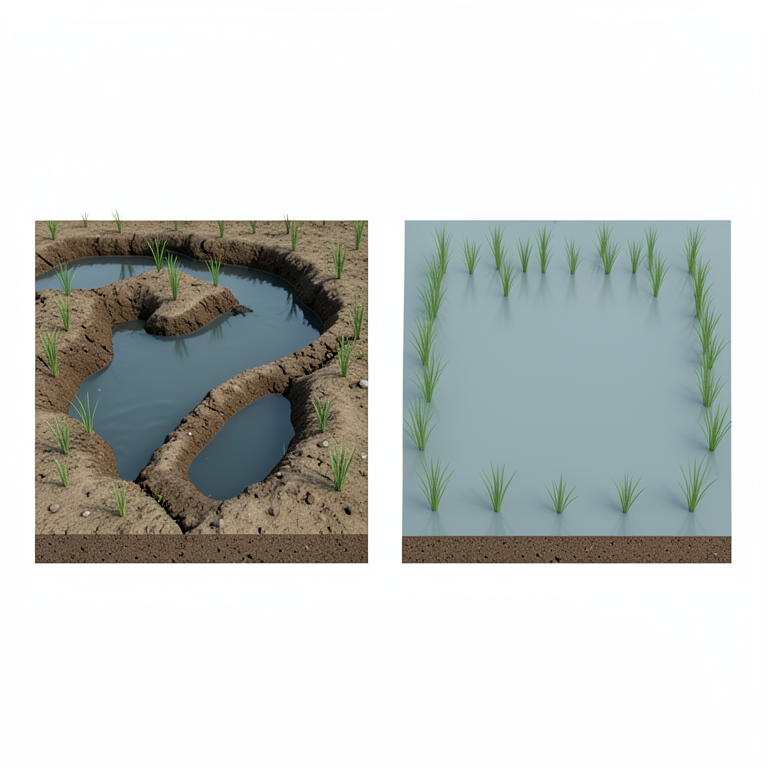
Comparison of Field Topography and Water Distribution
AI-generated conceptual illustration (paddy rice fields). It explains the idea and does not show study data.
View source evidence ↗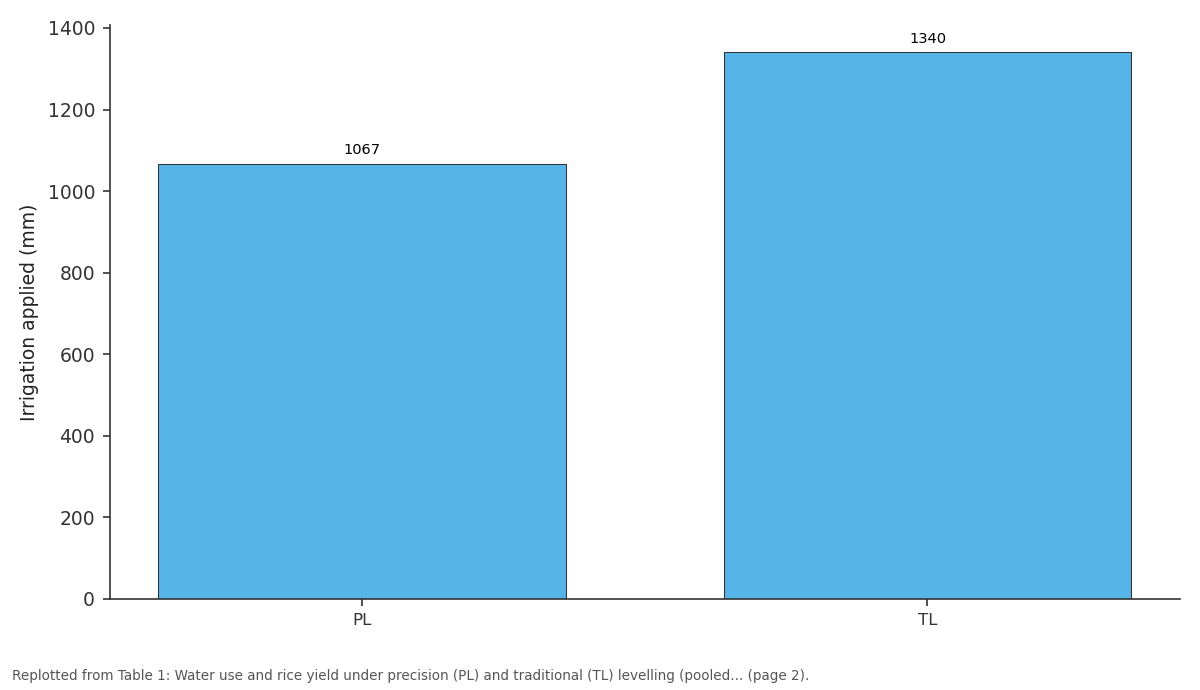
Irrigation applied (mm): PL vs TL
Replotted from Table 1 (page 2) of the original paper. Every bar is the paper's own table value.
View source evidence ↗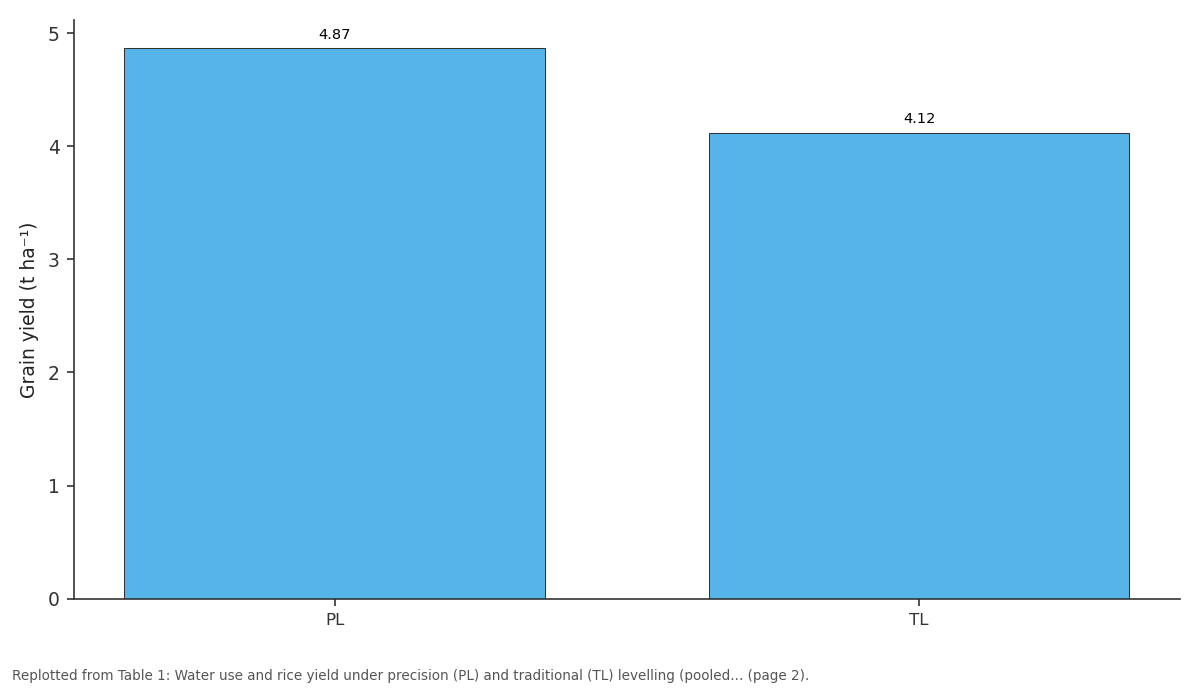
Grain yield (t ha⁻¹): PL vs TL
Replotted from Table 1 (page 2) of the original paper. Every bar is the paper's own table value.
View source evidence ↗Figures & tables
From the original paper Table 1
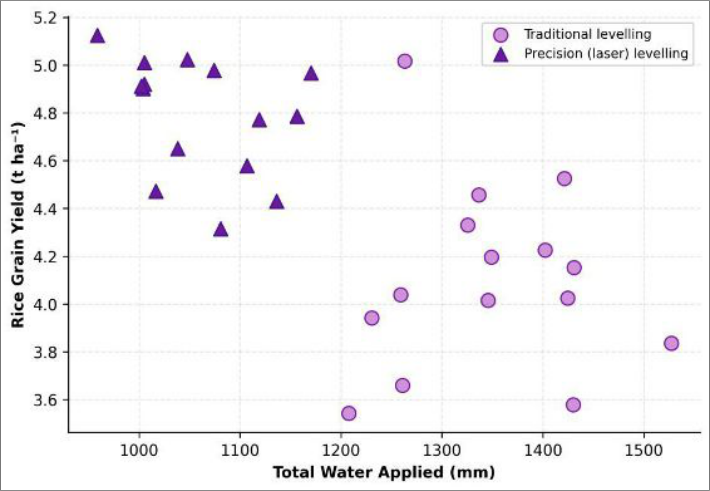 Figure 1
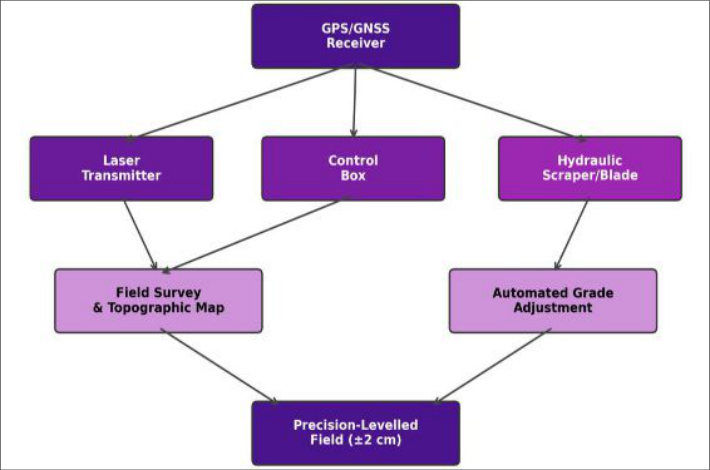 Figure 2
Introduction
The trend is unmistakable: groundwater tables in Bihar's rice belt have fallen by 0.3-0.5 m per year over the past decade, driven largely by flood irrigation on unevenly graded fields [1,2] . Traditional levelling with an animal-drawn plank leaves surface undulations of ±8-12 cm, creating high and low spots that waste water through uneven ponding and runoff [3] . Rice, which accounts for 34% of India's agricultural water use, is the obvious target for savings [4] . Laser-guided precision levelling uses a rotating laser transmitter, a receiver-equipped scraper, and a GPS-linked control box to grade the field surface to within ±2 cm of a target plane [5,6] . On-farm trials in Punjab and Haryana have reported 15-25% water savings and 7-18% yield increases after a single levelling pass, with benefits lasting three to four years before re-levelling is needed [7,8] . Bihar's eastern Indo-Gangetic Plains differ from the western plains in soil type (alluvial clay loams vs. sandy loams) and farm size (mean <1 ha), so results from Punjab may not transfer directly [9] . This research was designed to: (a) measure water savings and rice yield under PL versus TL on a clay loam at Pusa, (b) track carry-over effects on the subsequent wheat crop, and (c) calculate the economic return to laser levelling under local cost conditions.
Cost Analysis
Laser levelling was contracted from a custom-hire service centre at 3,500 INR ha⁻¹ (one-time charge), covering equipment mobilisation, diesel, and operator wages. This trial covered only two rice-wheat cycles at a single location; a longer monitoring period across multiple soil types would clarify how quickly levelling benefits degrade. The research farm's plot size (0.4 ha) is larger than the median Bihar holding (~0.39 ha), but access to custom-hire services remains patchy in remote blocks [9] . Groundwater quality-specifically seasonal salinity spikes-was not measured and could interact with reduced water application. Lastly, the BCR does not account for soil compaction risk from heavy scraper equipment, which could partially offset the yield gains on poorly drained clay soils if levelling is repeated too frequently. Comprehensive Interpretation PL outperformed TL on every metric: 20.4% less water, 18.2% more rice yield, and a 48.5% jump in water productivity. The yield gain was driven mainly by 10.8% more panicles per square metre-a consequence of more uniform seedling establishment on a flat surface-and 6.2% heavier grains, likely reflecting steadier water supply during grain filling. The wheat crop that followed also benefited, with a 12.7% yield lift, indicating that the improved microtopography persisted across seasons.
Material and Methods
Material and Methods
Discussion
The 20.4% irrigation saving falls within the 15-25% range reported from western India [7,8] but is notable for a heavier clay loam where infiltration rates are lower. On such soils, even small surface undulations create ponded areas that lose water sideways rather than downward; PL eliminates this lateral redistribution [5,6] . The carry-over benefit to wheat has been less documented. Jat et al. [8] observed 8-14% wheat yield gains after riceseason PL in Haryana; the 12.7% here is at the upper end, possibly because Bihar's calcareous soils respond strongly to the improved drainage that PL provides after rice harvest [9,10] . The BCR of 2.18 makes a strong case for custom-hire promotion. If state subsidies covered the initial levelling cost-as Haryana already does under RKVY-the BCR would exceed 3.0, likely accelerating adoption among marginal farmers [11] . Multi-site and multi-year validation remains the priority before scaling recommendations statewide.
Conclusion
One-time laser precision levelling reduced rice irrigation water by 20.4% and raised grain yield by 18.2%, with benefits carrying into the subsequent wheat crop (+12.7%).
Water productivity nearly doubled. The economic return (BCR 2.18) justifies the investment even without subsidies. For Bihar's rice-wheat system, promoting PL through custom-hire centres is a practical, high-impact intervention. Multi-location trials across eastern India's diverse soil types would strengthen the evidence for state-level policy support.
Acknowledgement
AcknowledgementsThis research was supported by Dr. Rajendra Prasad Central Agricultural University. Technical assistance from Mr. Arvind Kumar with Parshall flume calibration is gratefully acknowledged.
Figures and tables from the paper
| Parameter | PL | TL | Saving/ Gain (%) | t-value | p-value | SE(d) |
|---|---|---|---|---|---|---|
| Irrigation applied (mm) | 1,067 | 1,340 | −20.4 | 6.83 | <0.001 | 39.9 |
| Grain yield (t ha⁻¹) | 4.87 | 4.12 | +18.2 | 5.41 | <0.001 | 0.14 |
| Panicles m⁻² | 318 | 287 | +10.8 | 3.74 | 0.004 | 8.3 |
| 1000-grain wt (g) | 24.1 | 22.7 | +6.2 | 2.98 | 0.012 | 0.47 |
| WP (kg m⁻³) | 4.56 | 3.07 | +48.5 | 7.12 | <0.001 | 0.21 |
| Wheat yield (t ha⁻¹) | 4.23 | 3.75 | +12.7 | 3.28 | 0.008 | 0.15 |
Table text extracted from the original PDF; superscript letters are shown inline. The original table image is below.
View original table image
References
15 in the original paper- Shah T. Taming the anarchy: groundwater governance in South Asia. Washington: Resources for the Future; 2009.
- Rodell M, Velicogna I, Famiglietti JS. Satellite-based estimates of groundwater depletion in India. Nature. 2009;460(7258):999-1002.
- Rickman JF. Manual for laser land leveling. RiceWheat Consortium Technical Bulletin 5. New Delhi: CIMMYT; 2002.
- Bouman BAM, Humphreys E, Tuong TP, Barker R. Rice and water. Advances in Agronomy. 2007;92:187237.
- Jat ML, Chandna P, Gupta RK, Sharma SK, Gill MA. Laser land leveling: a precursor technology for resource conservation. Rice-Wheat Consortium Technical Bulletin 7. New Delhi: CIMMYT; 2006.
- Abdullaev I, Ul Hassan M, Manthrithilake H, Yakubov M. Water use efficiency in the Syr Darya River basin. Irrigation and Drainage. 2006;55(1):93-100.
- Aryal JP, Mehrotra MB, Jat ML, Sidhu HS. Impacts of laser land leveling in rice-wheat systems of the northwestern Indo-Gangetic Plains. Food Policy. 2015;61:126-140.
- Jat ML, Gathala MK, Saharawat YS, Tetarwal JP, Gupta R, Singh Y. Double no-till and permanent raised beds in maize-wheat rotation of north-western IndoGangetic Plains of India. Field Crops Research. 2013;149:291-299.
- Sinha SK, Singh GB, Rai M. Decline in crop productivity in Haryana and Punjab: myth or reality? New Delhi: Indian Council of Agricultural Research; 1998.
- Humphreys E, Kukal SS, Christen EW, Hira GS, Singh B, Yadav S, et al. Halting the groundwater decline in north-west India-which crop technologies will be winners? Advances in Agronomy. 2010;109:155-217.
- Government of Haryana. Rashtriya Krishi Vikas Yojana: component-wise allocation 2019-20. Chandigarh: Department of Agriculture; 2019.
- Akhtar ME, Ali MZ, Aslam M, Ahmad E, Sagir M. Effect of land leveling on water saving and rice yield. Sarhad Journal of Agriculture. 2003;19(2):271-275.
- Ahmad MD, Masih I, Giordano M. Constraints and opportunities for water savings and increasing productivity through resource conservation technologies in Pakistan. Agriculture Ecosystems and Environment. 2014;187:106-115.
- Erenstein O, Farooq U, Malik RK, Sharif M. On-farm impacts of zero tillage wheat in South Asia's rice-wheat systems. Field Crops Research. 2008;105(3):240-252.
- Sidhu HS, Singh M, Humphreys E, Singh Y, Singh B, Dhillon SS, et al. The happy seeder enables direct drilling of wheat into rice stubble. Australian Journal of Experimental Agriculture. 2007;47(7):844-854.