
Research article · 2025 · Full text
International Journal of Agriculture and NutritionEffect of establishment methods and weed management on direct seeded basmati rice
Volume 7(4) · Pages 161–164 · DOI: 10.33545/26646064.2025.v7.i4c.429 ↗
Research areasWeed Control and Herbicide ApplicationsRice Cultivation and Yield ImprovementAgricultural Science and Fertilization
Abstract
Author-writtenFor centuries, basmati rice has been transplanted by hand into puddled fields—a method that demands roughly 30 to 40 person-days of labour per hectare and consumes 1,200 to 1,500 mm of water per crop season. Direct seeding offers a way to cut both inputs, but its success depends heavily on the establishment method used and the weed management program adopted. This research compared three establishment methods—dry broadcasting, wet drum seeding, and conventional transplanting—under five weed management treatments at Vikram Dev Agricultural College, Jeypore, Odisha, during kharif 2022. The experiment followed a split-plot design with establishment methods in main plots and weed management in subplots. Transplanting produced the highest grain yield (5.13 t ha⁻¹), but wet drum seeding combined with pretilachlor followed by bispyribac-sodium reached 4.61 t ha⁻¹—within 10 percent of the transplanted check. Weed density and dry weight were significantly higher under dry broadcasting than under the other two methods. The sequential herbicide treatment (pretilachlor fb bispyribac-sodium) reduced weed density by 71.4 percent compared to the unweeded control. Labour savings under wet drum seeding were 18.6 person-days ha⁻¹ relative to transplanting. These results suggest that wet drum seeding with a pre- and post-emergence herbicide sequence is a viable labour-saving alternative for basmati rice production in eastern India.
Summary
Source-checkedPlain-language reading of the full paper, prepared with AI and checked against the text. Each point links to the authors' own words.
Why it matters
- Traditional basmati rice transplanting is resource-intensive, requiring 30 to 40 person-days of labor per hectare and 1,200 to 1,500 mm of water per season. View evidence ↗
- Basmati rice is particularly vulnerable to weed competition due to its thin culms and tall stature. View evidence ↗
What they did
- The research was conducted from June to November 2022 at Vikram Dev Agricultural College in Jeypore, Odisha. View evidence ↗
- The study used a split-plot design with three methods: dry broadcasting (80 kg ha⁻¹), wet drum seeding (60 kg ha⁻¹), and transplanting (25-day seedlings at 20 × 15 cm). View evidence ↗
- Five weed management treatments were tested: an unweeded control, manual weeding, bispyribac-sodium, fenoxaprop + ethoxysulfuron, and a sequential pretilachlor and bispyribac-sodium application. View evidence ↗
- Researchers measured weed density and dry weight at 45 and 90 days after sowing (DAS), and tracked crop growth every 30 days. View evidence ↗
What they found
- Dry broadcasting resulted in the highest weed density (134.7 plants m⁻² in unweeded plots at 90 DAS), while transplanting had the lowest (72.6 plants m⁻²). View evidence ↗
- The sequential herbicide treatment (pretilachlor followed by bispyribac-sodium) reduced weed density by 71.4% to 74.8% across all establishment methods. View evidence ↗
- Transplanting achieved the highest mean grain yield (4.40 t ha⁻¹), followed by wet drum seeding (3.96 t ha⁻¹) and dry broadcasting (3.01 t ha⁻¹). View evidence ↗
- Wet drum seeding reduced labor requirements by 18.6 person-days per hectare compared to transplanting (23.4 vs 42.0 person-days ha⁻¹). View evidence ↗
- Water consumption was 21% lower for wet drum seeding (1,084 mm) than for transplanting (1,374 mm). View evidence ↗
What it means
- The authors conclude that wet drum seeding with sequential herbicides is a viable alternative for eastern Indian growers, trading a modest 10% yield reduction for significant labor and water savings. View evidence ↗
Visual summary
3 visualsIllustrations explain the paper; charts are replotted from the paper's own table values.
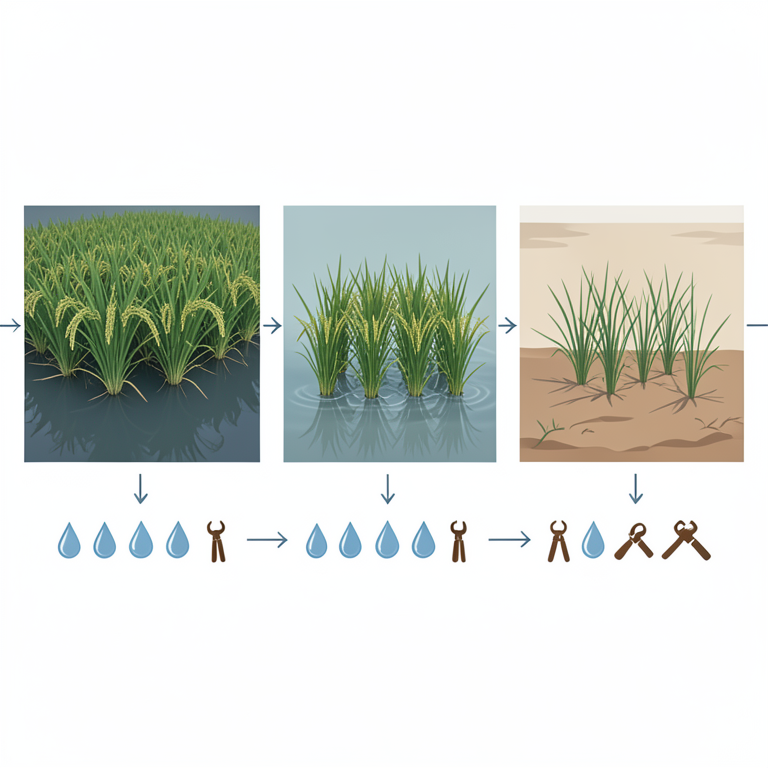
Trade-off Analysis of Rice Establishment
AI-generated conceptual illustration (Basmati rice plants in a paddy field). It explains the idea and does not show study data.
View source evidence ↗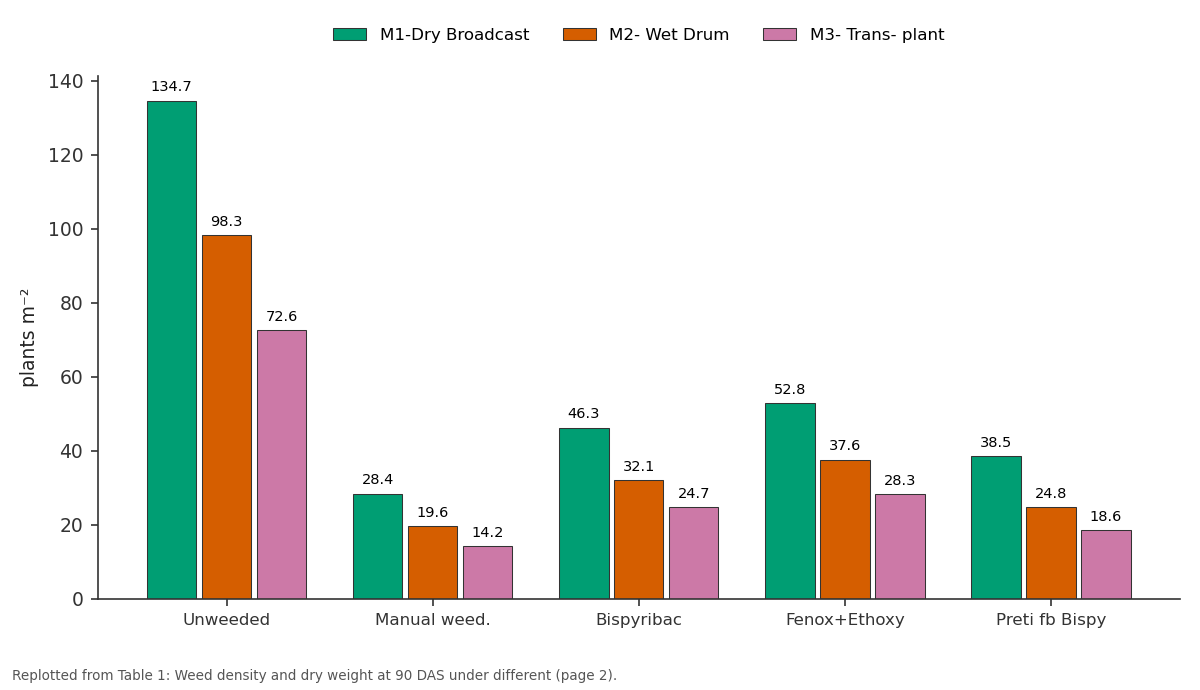
M1-Dry Broadcast and M2- Wet Drum and more: Unweeded vs Manual weed. vs Bispyribac vs Fenox+Ethoxy vs Preti fb Bispy
Replotted from Table 1 (page 2) of the original paper. Every bar is the paper's own table value.
View source evidence ↗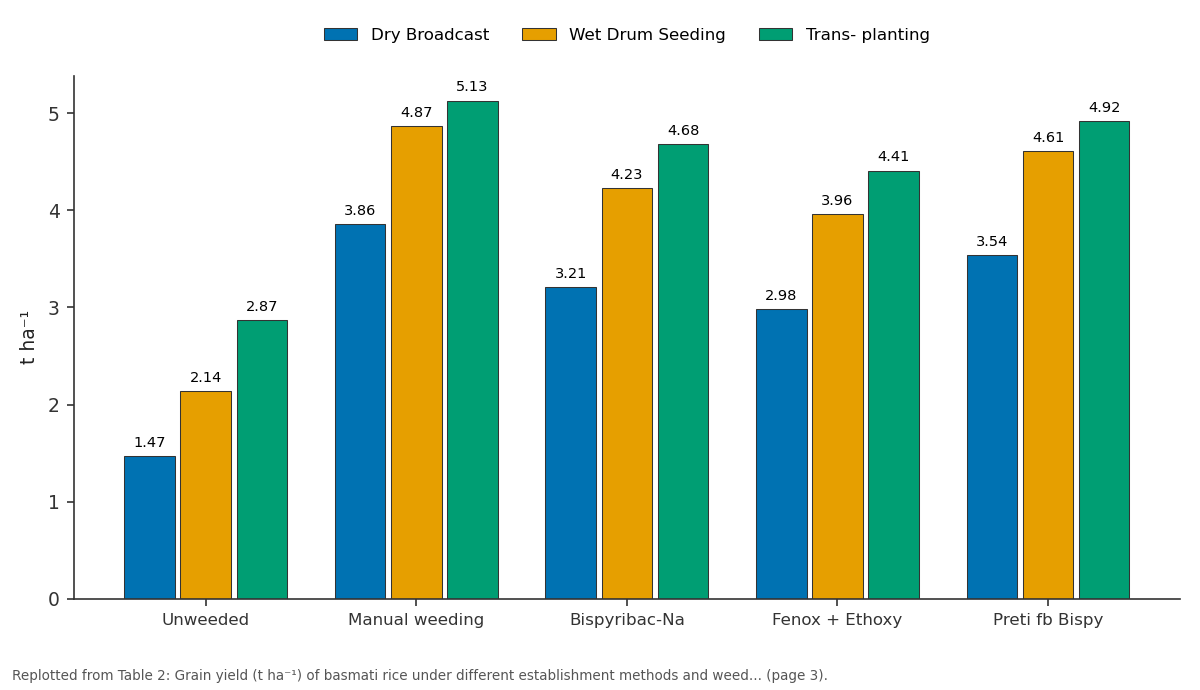
Dry Broadcast and Wet Drum Seeding and more: Unweeded vs Manual weeding vs Bispyribac-Na vs Fenox + Ethoxy vs Preti fb Bispy
Replotted from Table 2 (page 3) of the original paper. Every bar is the paper's own table value.
View source evidence ↗Figures & tables
From the original paper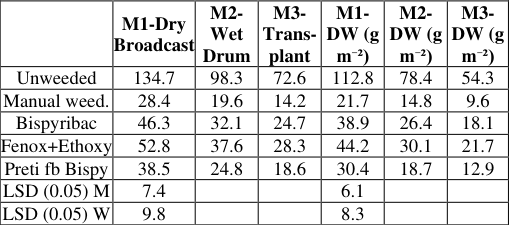 Table 1
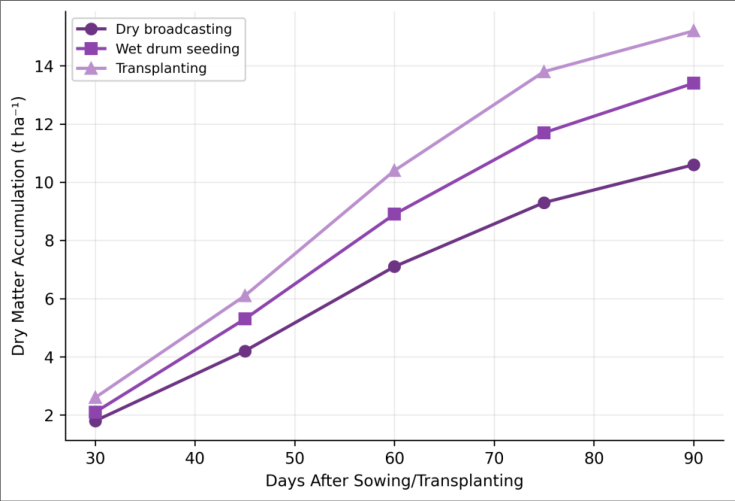 Figure 1
 Table 2
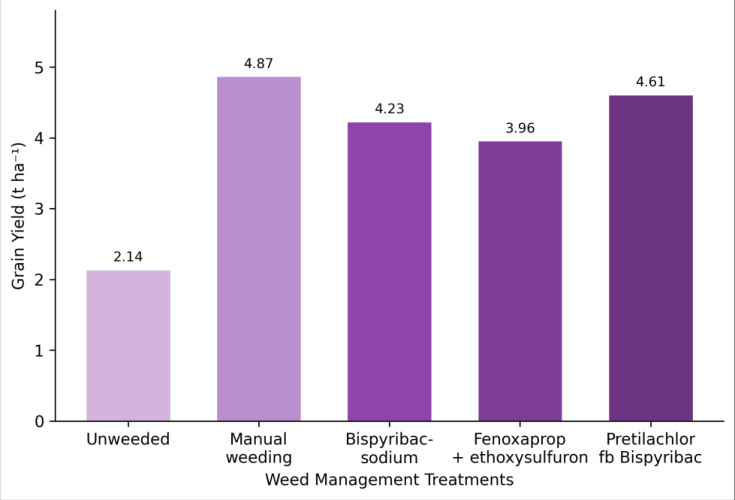 Figure 2
Introduction
Basmati rice cultivation in India has remained anchored to the transplanting method for generations, despite its heavy dependence on manual labour and standing water [1] . The system works well when labour is cheap and water abundant, but both resources are shrinking. Across Odisha and neighbouring states, rural-to-urban migration has reduced the agricultural workforce by an estimated 14 percent over the past decade [2] , and groundwater tables in rice-growing districts have fallen by 0.3 to 0.8 m per year [3] . Direct seeded rice (DSR) bypasses the nursery-raising and transplanting steps altogether. Seeds are placed directly into the field either by dry broadcasting onto prepared soil, by wet drum seeding into puddled beds, or by mechanical line sowing [4] . DSR can save 20 to 35 percent of irrigation water and reduce labour needs by up to 50 percent compared with transplanting [5] . However, weeds are the main biological constraint in DSR because the crop and weeds germinate simultaneously, and the standing water layer that suppresses weeds in transplanted fields is absent or delayed [6] . Effective weed management in DSR requires a combination of pre-emergence and postemergence herbicides. Pretilachlor applied within 3 days after sowing (DAS) controls germinating grasses and some broadleaf weeds, while bispyribac-sodium at 15-20 DAS targets later-emerging species including Echinochloa spp. and sedges [7] . Manual weeding remains an option but is rarely feasible at scale given the labour economics of eastern India [8] . Basmati cultivars add another layer of complexity: their tall stature and thin culms make them poor competitors against weeds compared with semi-dwarf high-yielding varieties [9] . Whether basmati can perform satisfactorily under DSR with chemical weed management hasn't been well documented for the Jeypore region of Odisha. This research was therefore undertaken to (i) compare the performance of three crop establishment methods for basmati
Material
The basmati cultivar Pusa Basmati 1509 was used as the test variety. Herbicides tested were pretilachlor 50 EC (Rifit, Syngenta) applied pre-emergence at 0.75 kg ha⁻¹, bispyribac-sodium 10 SC (Nominee Gold, Bayer) at 25 g ha⁻¹ post-emergence, fenoxaprop-p-ethyl 6.9 EC at 60 g ha⁻¹ combined with ethoxysulfuron 15 WDG at 18.75 g ha⁻¹ post-emergence, and manual weeding at 20 and 40 DAS. A weedy check served as the control.
Field Design
The experiment used a split-plot design with three replications.
Methods
Weed density and dry weight were recorded at 45 and 90 DAS using a 0.5 m² quadrat at two random spots per subplot. Crop growth was measured as plant height, tiller count, and dry matter accumulation at 30-day intervals. Yield components-panicles m⁻², grains per panicle, 1000grain weight-were recorded at maturity. Grain yield was determined from the net plot and adjusted to 14 percent moisture. Water use was tracked through field inflow meters, and labour input was logged for each operation. Data were analysed using split-plot ANOVA in OPSTAT, with means separated by LSD at p=0.05.
Results
Table Transplanting maintained a consistent dry matter advantage over both direct-seeded methods throughout the season (Figure 1). However, the gap between wet drum seeding and transplanting narrowed from 24 percent at 30 DAS to 12 percent at 90 DAS, indicating that the drum-seeded crop partially compensated through higher tiller production at later stages.
Discussion
The yield penalty associated with direct seeding compared to transplanting is well documented across rice-growing regions [4,5] . In this trial, the penalty was 10 percent for wet drum seeding and 32 percent for dry broadcasting when averaged across weed management treatments. Dry broadcasting suffered most because seeds placed on the soil surface face uneven germination, poor root anchorage, and intense weed competition from the outset [6] . Wet drum seeding, by contrast, places seed into puddled soil at uniform spacing and depth, resulting in better crop establishment and a more competitive canopy. The sequential herbicide program (pretilachlor fb bispyribac-sodium) delivered the best chemical weed control across all three establishment methods. Pretilachlor provided early-season grass suppression, and bispyribacsodium-a broad-spectrum acetolactate synthase inhibitorcontrolled later emerging sedges and broadleaf weeds that escaped the pre-emergence barrier [7] . This two-step approach mirrors findings from Punjab and Haryana, where sequential herbicide applications are now standard practice in DSR [10] . From a labour perspective, wet drum seeding saved 18.6 person-days ha⁻¹ relative to transplanting (23.4 vs 42.0 person-days ha⁻¹), primarily by eliminating nursery raising and manual transplanting. Water use was 21 percent lower under wet drum seeding than transplanting (1,084 vs 1,374 mm), because the puddled-field phase was shorter and the crop relied on soil moisture for initial establishment rather than continuous flooding [3] . The practical message for basmati growers in eastern India is that switching from transplanting to wet drum seeding with pretilachlor followed by bispyribac-sodium can save labour and water at the cost of a modest (about 10%) yield reduction-a trade-off that may be economically favorable when labour costs exceed ₹350 per person-day [8] .
Conclusion
This research showed that crop establishment method strongly influences weed pressure, water use, and grain Dry broadcasting, although the cheapest to establish, suffered a 32 percent yield penalty and the highest weed infestation, making it unsuitable for basmati varieties that compete poorly with weeds. Wet drum seeding strikes a better balance between input savings and yield security. Among weed management options, the sequential application of pretilachlor (pre-emergence) followed by bispyribac-sodium (post-emergence) was the most effective chemical treatment and statistically comparable to two manual weedings. For eastern Indian basmati systems where labour is scarce and costly, this herbicide combination paired with wet drum seeding offers a practical pathway to reduce production costs without large yield sacrifices.
Figures and tables from the paper
| Weed Management | Dry Broadcast | Wet Drum Seeding | Trans- planting | Mean |
|---|---|---|---|---|
| Unweeded | 1.47 | 2.14 | 2.87 | 2.16 |
| Manual weeding | 3.86 | 4.87 | 5.13 | 4.62 |
| Bispyribac-Na | 3.21 | 4.23 | 4.68 | 4.04 |
| Fenox + Ethoxy | 2.98 | 3.96 | 4.41 | 3.78 |
| Preti fb Bispy | 3.54 | 4.61 | 4.92 | 4.36 |
| Mean | 3.01 | 3.96 | 4.40 | - |
| LSD (0.05): M = 0.31; W = 0.28; M×W = 0.49 |
Table text extracted from the original PDF; superscript letters are shown inline. The original table image is below.
View original table image
References
21 in the original paper- Mahajan G, Chauhan BS. Transplanting rice in Asia: Status and challenges. Field Crops Research. 2017;204:190-198.
- Chand R, Srivastava SK, Singh J. Changes in rural labour markets and their implications for agriculture. Economic and Political Weekly. 2017;52(47):47-54.
- Humphreys E, Kukal SS, Christen EW. Halting the groundwater decline in northwest India: Which crop technologies will be winners? Advances in Agronomy. 2010;109:155-217.
- Kumar V, Ladha JK. Direct seeding of rice: Recent developments and future research needs. Advances in Agronomy. 2011;111:297-413.
- Bhushan L, Ladha JK, Gupta RK. Saving of water and labour in rice-wheat systems with no-tillage and direct seeding. Agronomy Journal. 2007;99(5):1288-1296.
- Rao AN, Johnson DE, Sivaprasad B. Weed management in direct-seeded rice. Advances in Agronomy. 2007;93:153-255.
- Khaliq A, Matloob A, Shafiq HM. Weed control in direct-seeded rice using bispyribac-sodium and pretilachlor. Philippine Journal of Crop Science. 2012;37(1):34-43.
- Sarangi SK, Maji B, Singh S. Economics of directseeded rice versus transplanted rice in salt-affected lowlands. Journal of the Indian Society of Coastal Agricultural Research. 2018;36(2):84-91.
- Singh VP, Singh G, Singh SP. Effect of weed management practices on basmati rice under direct seeding. Indian Journal of Weed Science. 2015;47(2):119-124.
- Mahajan G, Ramesha MS, Kaur R. Evaluation of herbicides for weed management in dry direct-seeded rice in Punjab. Indian Journal of Agronomy. 2016;61(4):410-416.
- Chauhan BS, Johnson DE. Relative importance of shoot and root competition in dry-seeded rice systems. Weed Research. 2010;50(6):564-572.
- Dixit A, Varshney JG. Assessment of post-emergence herbicides in direct-seeded rice. Indian Journal of Weed Science. 2008;40(3-4):144-148.
- Walia US, Bhullar MS, Nayyar S. Sequential application of herbicides in direct-seeded rice under Punjab conditions. Indian Journal of Weed Science. 2012;44(4):217-222.
- Singh S, Ladha JK, Gupta RK. Evaluation of mulching, intercropping with Sesbania and herbicide use for weed management in dry-seeded rice. Crop Protection. 2007;26(4):518-524.
- Pathak H, Tewari AN, Sankhayan S. Direct-seeded rice: Potential, performance and problems. Current Science. 2011;101(9):1171-1177.
- Gathala MK, Ladha JK, Kumar V. Tillage and crop establishment affects sustainability of South Asian ricewheat system. Agronomy Journal. 2011;103(4):961971.
- Farooq M, Siddique KHM, Rehman H. Rice direct seeding: Experiences, challenges and opportunities. Soil and Tillage Research. 2011;111(2):87-98.
- Yadav DB, Yadav A, Punia SS. Evaluation of bispyribac-sodium for weed control in transplanted and direct seeded rice. Indian Journal of Weed Science. 2009;41(3-4):161-164.
- Prasad R, Shivay YS, Kumar D. Agronomic management of basmati rice in the Indo-Gangetic plains. Agricultural Reviews. 2017;38(4):259-272.
- Senapati BK, Swain SK, Nayak BR. Direct-seeded rice in Odisha: Prospects and constraints. Oryza. 2019;56(3):316-323.
- Mohanty S, Nayak AK, Bhaduri D. Resource conservation technologies for direct-seeded rice in eastern India. International Journal of Ecology and Environmental Sciences. 2020;2(4):126-133.