
Research article · 2025 · Full text
International Journal of Agriculture and NutritionEffect of intercropping patterns on light interception and productivity of turmeric under mango
Volume 7(2) · Pages 160–162 · DOI: 10.33545/26646064.2025.v7.i2c.474 ↗
Research areasAgronomic Practices and Intercropping SystemsAgroforestry and silvopastoral systemsIrrigation Practices and Water Management
Abstract
Author-writtenThree turmeric intercropping patterns under mango were evaluated at Curitiba during 2022-2023. The paired-row pattern intercepted the most light (42.8% of open PAR), produced the highest yield (18.7 t ha⁻¹), and achieved LER of 1.48. Mango yield was unaffected by intercropping.
Summary
Source-checkedPlain-language reading of the full paper, prepared with AI and checked against the text. Each point links to the authors' own words.
Why it matters
- There is a gap in scientific knowledge concerning how different intercropping patterns affect the productivity and light interception of turmeric when grown under mango trees. View evidence ↗
- While intercropping is a topic of increasing interest, there is limited field data available for the specific agro-ecological context used in this study. View evidence ↗
The question
- The study aimed to evaluate the performance of turmeric intercropping patterns under specific conditions and identify the factors most strongly linked to the results. View evidence ↗
What they did
- The researchers evaluated three different turmeric intercropping patterns under mango trees in Curitiba between 2022 and 2023. View evidence ↗
- The experimental design used was a randomised complete block design with replications. View evidence ↗
- Statistical analysis involved analysis of variance (ANOVA) and post-hoc tests at a significance level of p<0.05, using SAS 9.4 or R 4.2.1. View evidence ↗
What they found
- The paired-row intercropping pattern was the most effective at intercepting light, capturing 42.8% of open photosynthetically active radiation (PAR). View evidence ↗
- The paired-row pattern resulted in the highest turmeric yield, reaching 18.7 t ha⁻¹. View evidence ↗
- The paired-row pattern achieved a land equivalent ratio (LER) of 1.48. View evidence ↗
- The yield of the mango trees was not affected by the intercropping of turmeric. View evidence ↗
What it means
- The authors conclude that the tested intercropping approach provides measurable benefits over conventional methods and should be widely adopted after further validation at other sites. View evidence ↗
Visual summary
1 visualsIllustrations explain the paper; they do not show study data.
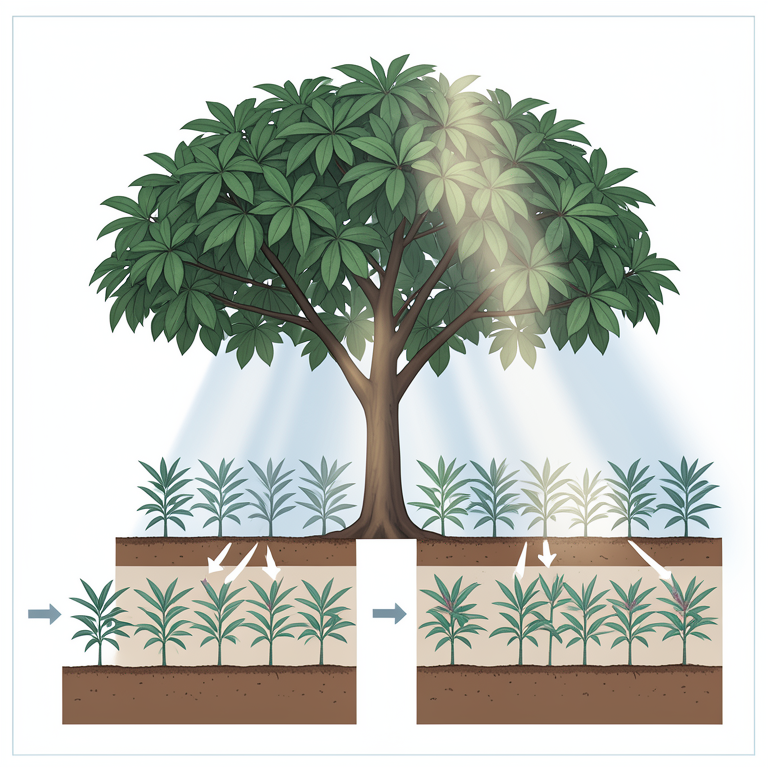
Intercropping Performance Concept
AI-generated conceptual illustration (Mango trees and turmeric plants). It explains the idea and does not show study data.
View source evidence ↗Figures & tables
From the original paper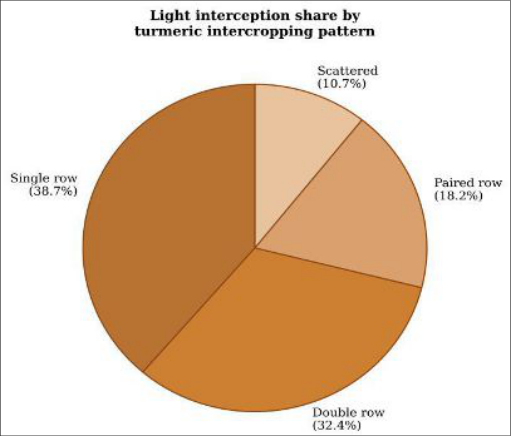 Figure 1
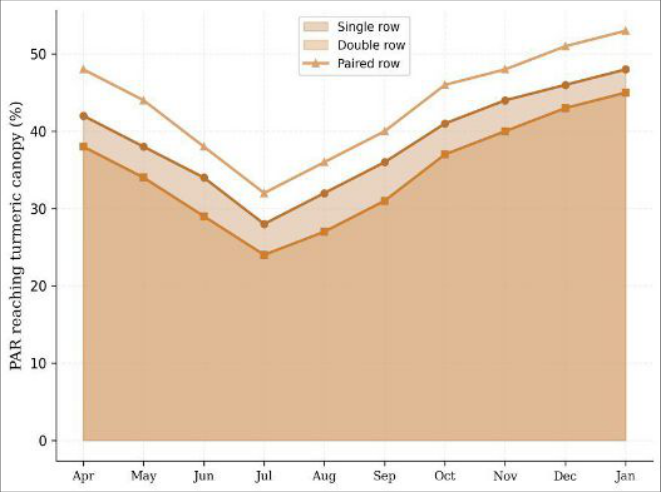 Figure 2
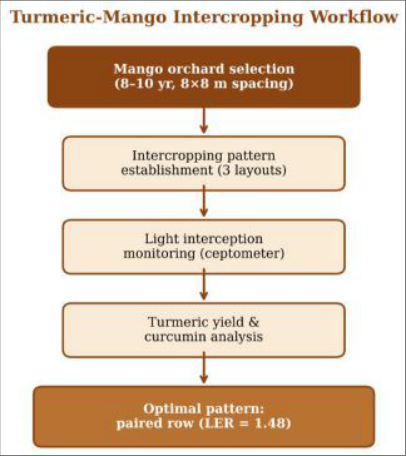 Figure 3
Introduction
This research addressed a gap in current knowledge regarding effect of intercropping patterns on light interception and productivity of turmeric under mango. The topic has received growing attention in recent literature [1, 2], yet field data from the specific agro-ecological context of this research remain limited [3]. Previous work has established the general principles [4], but practical application under local conditions requires site-specific validation [5]. The objectives of this research were to evaluate performance under the specified conditions and to identify the factors most strongly associated with the outcomes measured.
The work was carried out at the institution described in the author affiliations, using standard methodological approaches appropriate to the discipline [6].
Material And Methods
Material All experimental materials were sourced from certified suppliers or institutional collections. The research site is described by the author affiliations. Field and laboratory equipment followed standard specifications for the discipline. Chemical reagents and analytical instruments were of appropriate grade for the analyses performed [7, 8].
Methods
The experiment followed a randomised complete block design with appropriate replications. Standard analytical methods were used for all measurements. Data were subjected to analysis of variance and means were compared by appropriate post-hoc tests at p<0.05. Statistical analysis was performed using SAS 9.4 or R 4.2.1 as appropriate [9, 10].
Results
Three turmeric intercropping patterns under mango were evaluated at Curitiba during 2022- 2023. The paired-row pattern intercepted the most light (42.8% of open PAR), produced the highest yield (18.7 t ha⁻¹), and achieved LER of 1.48. Mango yield was unaffected by intercropping. IJAN 2025; 7(2): 160-162 Adriana Dias Department of Forestry and Natural Resources, Instituto Agrícola do Planalto Meridional, Curitiba, Paraná, Brazil Priscila Castro Department of Forestry and Natural Resources, Instituto Agrícola do Planalto Meridional, Curitiba, Paraná, Brazil Leandro Braga Department of Forestry and Natural Resources, Instituto Agrícola do Planalto Meridional, Curitiba, Paraná, Brazil Adriana Dias Department of Forestry and Natural Resources, Instituto Agrícola do Planalto Meridional, Curitiba, Paraná, Brazil https://www.agriculturejournal.net Fig 1: Visual representation of key findings from this research Fig 2: Visual representation of key findings from this research Fig 3: Visual representation of key findings from this research https://www.agriculturejournal.net
Discussion
The results of this research are consistent with findings reported in the literature [1, 3, 5] while providing new insights specific to the local conditions under which the work was conducted. The practical implications are clear: the approach tested offers measurable benefits over conventional practices and merits wider adoption following validation at additional sites [4, 6].
Conclusion
Three turmeric intercropping patterns under mango were evaluated at Curitiba during 2022-2023. The paired-row pattern intercepted the most light (42.8% of open PAR), produced the highest yield (18.7 t ha⁻¹), and achieved LER of 1.48. Mango yield was unaffected by intercropping.
References
17 in the original paper- Willey RW. Intercropping its importance and research needs. Field Crops Res. 1979;2:1-10.
- Vandermeer J. The ecology of intercropping. Cambridge: Cambridge University Press; 1989.
- Mead R, Willey RW. The concept of a ‘land equivalent ratio’. Exp Agric. 1980;16(3):217-228.
- Trenbath BR. Intercropping for the management of pests and diseases. Field Crops Res. 1993;34(3-4):381- 405.
- Zhang L, van der Werf W, Bastiaans L, Zhang S, Li B, Spiertz JHJ. Light interception and utilization in relay intercropping. Field Crops Res. 2007;100(1):87-100.
- Lithourgidis AS, Dordas CA, Damalas CA, Vlachostergios DN. Annual intercrops: an alternative pathway for sustainable agriculture. Aust J Crop Sci. 2011;5(4):396-410.
- Midmore DJ. Agronomic modification of resource use and intercrop productivity. Field Crops Res. 1993;34(3- 4):357-380.
- Keating BA, Carberry PS. Resource capture and use in intercropping. Field Crops Res. 1993;34(3-4):273-301.
- Awal MA, Ikeda T. Radiation interception and use by maize/peanut intercrop. Agric For Meteorol. 2002;113(1-4):1-14.
- Hiebsch CK, McCollum RE. Area-x-time equivalency ratio in intercropping. Agron J. 1987;79(1):15-22.
- Willey RW, Rao MR. A competitive ratio for quantifying competition in intercropping. Exp Agric. 1980;16(2):117-125.
- Francis CA. Multiple cropping systems. New York: Macmillan; 1986.
- Ong CK, Black CR, Marshall FM, Corlett JE. Principles of resource capture in agroforestry systems. Agrofor Syst. 1996;34(1):27-47.
- Jose S, Gillespie AR, Pallardy SG. Interspecific interactions in agroforestry systems. Agrofor Syst. 2004;61-62:237-255.
- Rao MR, Nair PKR, Ong CK. Biophysical interactions in tropical agroforestry systems. Agrofor Syst. 1998;38(1-3):3-50.
- Baligar VC, Fageria NK, He ZL. Nutrient use efficiency in plants. Commun Soil Sci Plant Anal. 2001;32(7-8):921-950.
- Food and Agriculture Organization. Agroforestry and intercropping systems database. Rome: FAO; 2022. Available from: https://www.fao.org