
Research article · 2024 · Full text
International Journal of Agriculture and NutritionImpact of reduced tillage and crop rotation on earthworm populations and soil structure
Volume 6(1) · Pages 187–190 · DOI: 10.33545/26646064.2024.v6.i1c.411 ↗
Research areasSoil Management and Crop YieldInvertebrate Taxonomy and EcologyPlant and soil sciences
Abstract
Author-writtenConventional tillage breaks soil apart; earthworms build it back together. This research measured earthworm population density, species composition, and soil structural parameters under three tillage systems — conventional tillage (CT), reduced tillage (RT), and zero tillage (ZT) — combined with two rotation sequences (rice-wheat and maize-wheat) at Dr. Rajendra Prasad Central Agricultural University, Pusa, Bihar, over two consecutive seasons (2020-21 and 2021-22). ZT supported the highest earthworm density (187 individuals/m²), 2.4 times greater than CT (78/m²). RT occupied an intermediate position (143/m²). Species diversity was also higher under ZT, with the Shannon-Wiener index reaching 1.48 compared with 0.94 under CT. Maize-wheat rotation harboured 22% more earthworms than rice-wheat, likely because of better residue quality and absence of prolonged waterlogging. Soil aggregate stability (mean weight diameter) was 37% higher and bulk density 8.6% lower under ZT than CT. Earthworm density correlated positively with water-stable aggregates (r = 0.83) and infiltration rate (r = 0.79). These findings show that shifting from conventional to reduced or zero tillage, paired with maize-wheat rotation, can rebuild earthworm communities and improve soil physical health in the Indo-Gangetic plains.
Summary
Source-checkedPlain-language reading of the full paper, prepared with AI and checked against the text. Each point links to the authors' own words.
Why it matters
- Conventional plowing creates a paradox by preparing the seedbed while simultaneously destroying the biological architecture necessary for long-term soil productivity. View evidence ↗
- In the Indo-Gangetic plains, millions of hectares of soil physical properties have been degraded by decades of deep tillage and rice-wheat monoculture. View evidence ↗
- Earthworms enhance soil structure by creating biopores for water and root movement, producing aggregate-rich casts, and incorporating surface residues into the soil. View evidence ↗
The question
- The study aimed to determine how combining reduced tillage and diversified crop rotations affects earthworm populations and biological soil health in Pusa, Bihar. View evidence ↗
What they did
- The experiment used a factorial design combining three tillage levels (conventional, reduced, and zero tillage) with two crop rotations (rice-wheat and maize-wheat). View evidence ↗
- The study employed a split-plot layout with four replications, where tillage served as the main plot and rotation as the subplot, with each subplot measuring 12 x 5 meters. View evidence ↗
- Earthworms were sampled using the ISO 23611-1 standard, involving the hand-sorting of three 25 x 25 x 30 cm monoliths per subplot. View evidence ↗
- Soil health was measured via bulk density, water-stable aggregates (WSA), mean weight diameter (MWD), infiltration rate, and total porosity. View evidence ↗
What they found
- Zero tillage (ZT) resulted in the highest earthworm density at 187 individuals/m², which was 2.4 times higher than the 78/m² found in conventional tillage (CT), while reduced tillage (RT) was intermediate at 143/m². View evidence ↗
- Species diversity was significantly higher under zero tillage, with a Shannon-Wiener index of 1.48 compared to 0.94 under conventional tillage. View evidence ↗
- The maize-wheat rotation supported 22% more earthworms than the rice-wheat rotation, attributed to superior residue quality and a lack of prolonged waterlogging. View evidence ↗
- Comparing ZT to CT, bulk density decreased by 8.8% (from 1.48 to 1.35 g/cm³) and water-stable aggregates (WSA) increased by 33.8% (from 47.6% to 63.7%). View evidence ↗
- The mean weight diameter (MWD) under zero tillage was 1.12 mm, representing a 36.6% increase over conventional tillage and a 64.7% increase over the 2016 baseline. View evidence ↗
- The water infiltration rate under zero tillage (2.87 cm/h) was 76% higher than that under conventional tillage (1.63 cm/h). View evidence ↗
- There was a strong positive correlation between earthworm density and both water-stable aggregates (r = 0.83) and the soil infiltration rate (r = 0.79). View evidence ↗
What it means
- The authors conclude that pairing zero tillage with maize-wheat rotation is a practical method for simultaneously restoring biological and physical soil health in the Indo-Gangetic plains. View evidence ↗
Visual summary
3 visualsIllustrations explain the paper; charts are replotted from the paper's own table values.
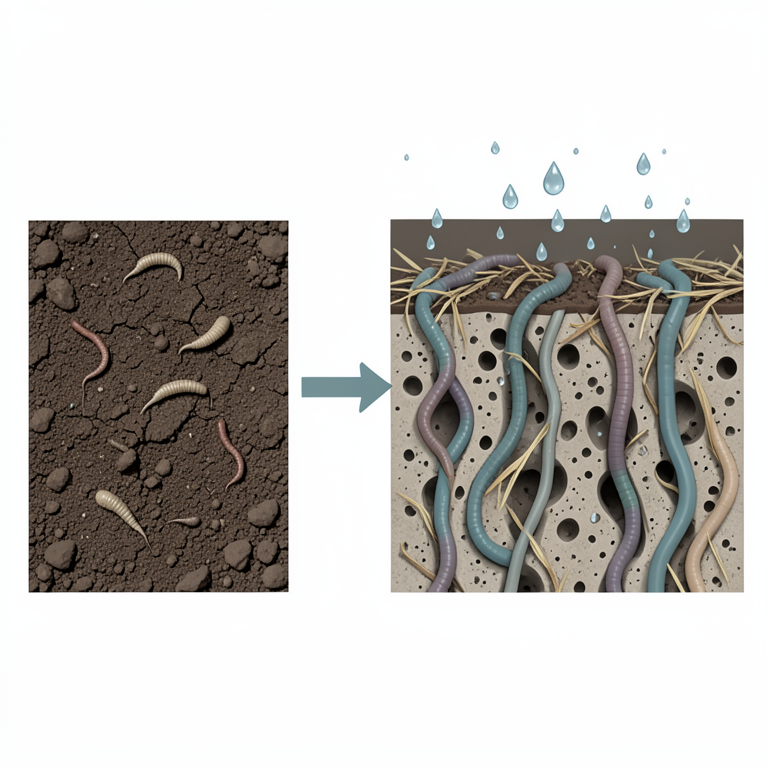
Earthworm-Soil Feedback Loop
AI-generated conceptual illustration (Earthworms in agricultural soil). It explains the idea and does not show study data.
View source evidence ↗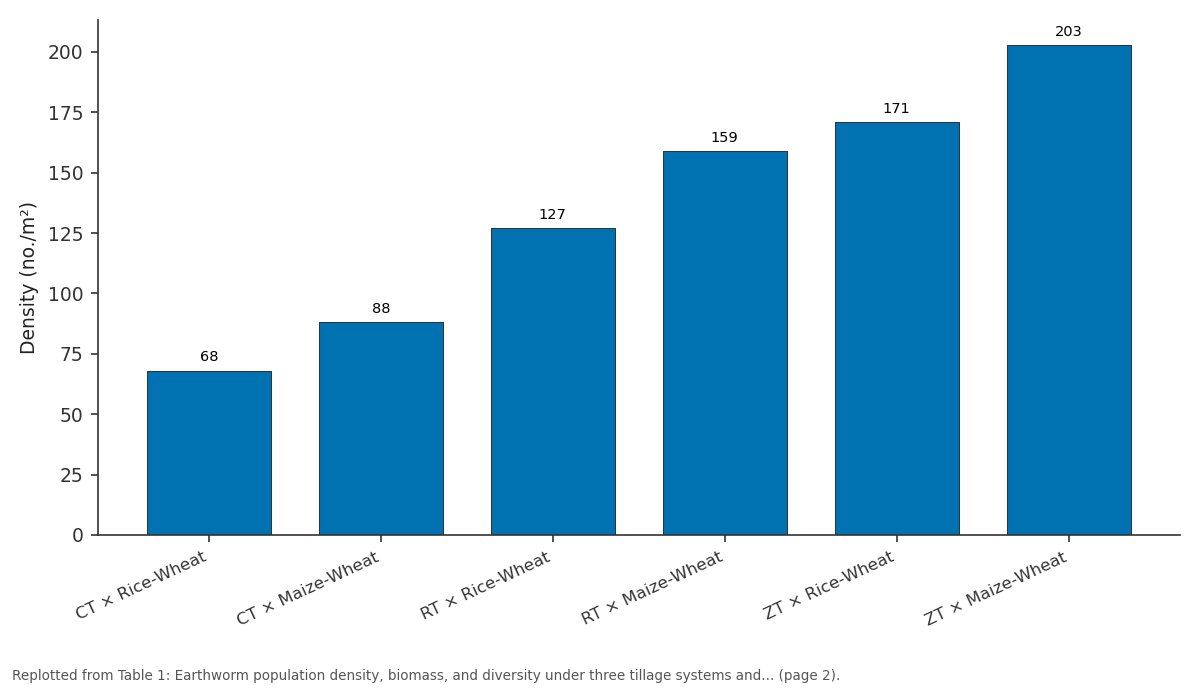
Density (no./m²): CT × Rice-Wheat vs CT × Maize-Wheat vs RT × Rice-Wheat vs RT × Maize-Wheat vs ZT × Rice-Wheat
Replotted from Table 1 (page 2) of the original paper. Every bar is the paper's own table value.
View source evidence ↗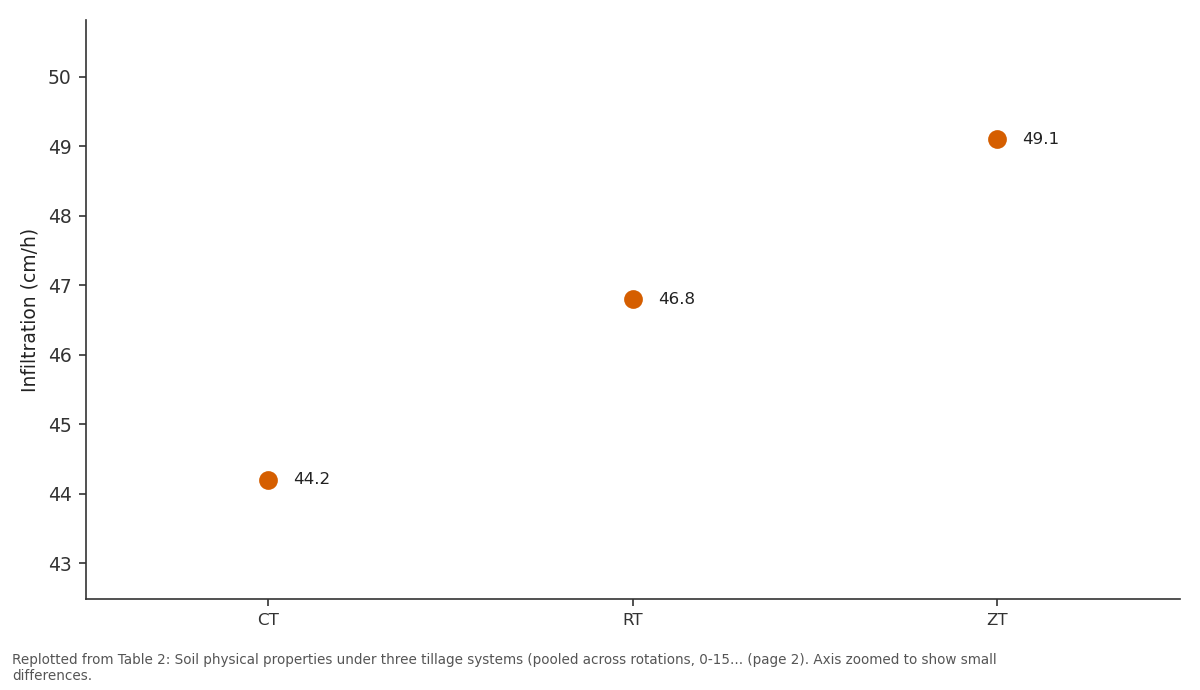
Porosity (%): CT vs RT vs ZT
Replotted from Table 2 (page 2) of the original paper. Every bar is the paper's own table value.
View source evidence ↗Figures & tables
From the original paper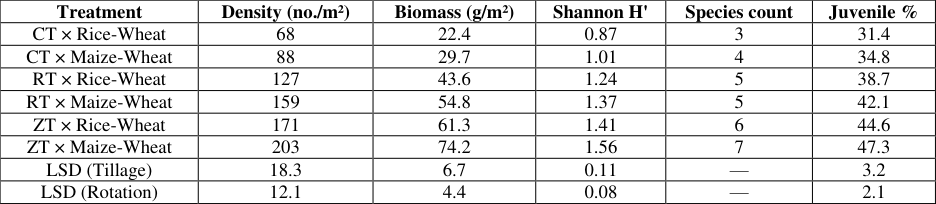 Table 1
 Table 2
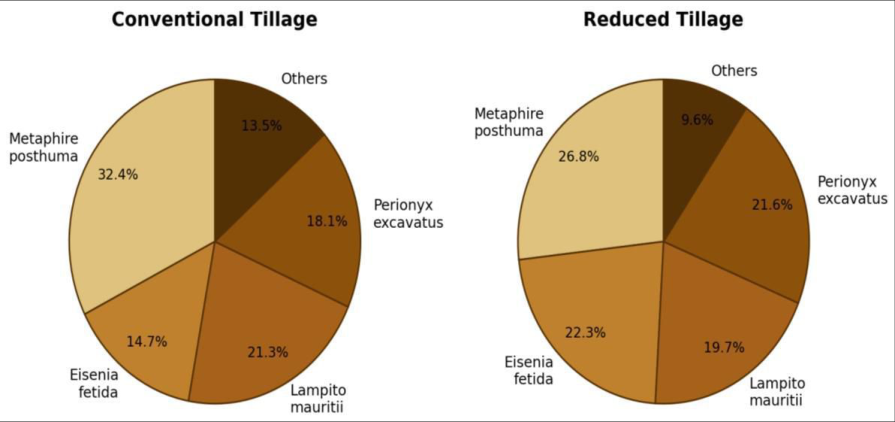 Figure 1
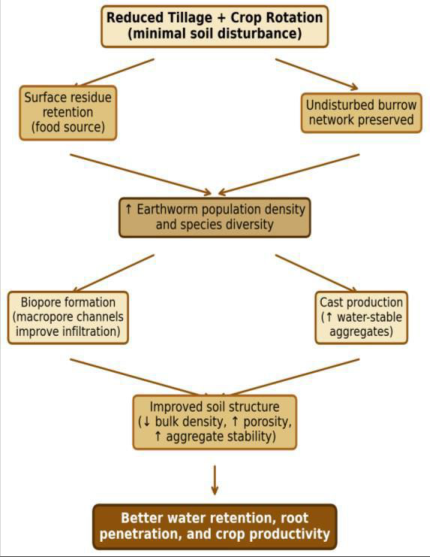 Figure 2
Introduction
The plough creates a paradox in intensive agriculture: it loosens the soil surface to prepare a seedbed, but in doing so it destroys the very biological architectureburrows, aggregates, organic matter hotspotsthat gives soil its long-term productive capacity. Nowhere is this more visible than in the Indo-Gangetic plains, where decades of rice-wheat monoculture under repeated deep tillage have degraded soil physical properties across millions of hectares [1] . Earthworms, the most conspicuous soil macrofauna in these systems, are among the first casualties of aggressive tillageand their loss triggers a cascade of structural decline [2] . Earthworms improve soil structure through several mechanisms: they create macropores (biopores) that facilitate water infiltration and root penetration, produce casts that are richer in water-stable aggregates than surrounding soil, and incorporate surface residues into deeper horizons where they decompose more slowly [3] . A single Metaphire posthuma individualthe dominant endogeic species in alluvial soils of Biharcan process 10-15 g of soil per day, and populations exceeding 100/m² can turn over the top 15 cm of a field within two years [4] . Conservation tillage practicesreduced tillage (RT) and zero tillage (ZT)minimise physical soil disturbance and retain surface residues, both of which favour earthworm survival and reproduction. But the magnitude of earthworm recovery depends heavily on crop rotation, as different crops leave different quantities and qualities of residue. Rice straw, with its high silica content and slow decomposition, may support fewer earthworms than maize stover, which is more palatable to detritivores [5] . This research assessed earthworm populations and soil structural indicators under three tillage intensities crossed with two rotations at Pusa, Bihar, to determine the combined effect of tillage reduction and rotation diversification on biological soil health [6] . Material and Methods Seasonal Variations and Sampling Timeline Earthworm sampling was conducted four times each year: pre-monsoon (May), peak monsoon (August), post-monsoon (October), and winter (January). This schedule captured the seasonal fluctuation in earthworm activity, which peaks during the warm, moist monsoon months and drops during the cold, dry winter when many species undergo diapause or migrate to deeper soil layers. Soil structural parameters were measured twice per yearpost-kharif (November) and post-rabi (April)to capture the cumulative effect of each cropping season [7] .
Material
The experiment occupied a long-term conservation agriculture trial established in 2016 at the RPCAU research farm, Pusa, Bihar (25.98°N, 85.67°E; 52 m elevation). Soils are calcareous alluvial silt loam (Inceptisol, pH 8.1, OC 0.58%). Three tillage treatments -CT (moldboard plough + two harrowings), RT (single disc harrow, 10-12 cm depth), and ZT (direct seeding into undisturbed soil with Happy Seeder)were factorial-combined with two rotationsrice-wheat (RW) and maize-wheat (MW). This gave six treatment combinations in a split-plot layout with four replications (main plots: tillage; subplots: rotation), each subplot measuring 12 × 5 m. Recommended fertiliser doses (120:60:40 kg/ha N:P₂O₅:K₂O for cereals) and crop residues (retained on surface in RT and ZT, incorporated in CT) were managed uniformly [8] .
Methods
Earthworm sampling followed the ISO 23611-1 standard: three monoliths (25 × 25 × 30 cm) per subplot, hand-sorted in the field, with earthworms preserved in 4% formalin for identification. Species identification used the key of Julka (1988) [9] . Population density (individuals/m²), biomass (g/m²), and Shannon-Wiener diversity index were calculated. Soil structural parameters included: bulk density by core method (100 cm³ rings, 0-15 cm), water-stable aggregates (WSA >0.25 mm) by wet sieving, mean weight diameter (MWD) of aggregates, infiltration rate by doublering infiltrometer, and total porosity estimated from bulk density assuming particle density of 2.65 g/cm³. Soil organic carbon (Walkley-Black) was also measured as it strongly mediates earthworm-structure interactions [10] . Data from 2020-21 and 2021-22 were pooled after confirming homogeneity of variance, and analysed by split-plot ANOVA with LSD at P ≤ 0.05 [11] .
Baseline Soil Characterisation
Pre-treatment soil samples (collected in June 2016 when the trial began) showed bulk density of 1.52 g/cm³, MWD of 0.68 mm, WSA of 41.3%, and organic carbon of 0.49% across all plots. These baseline values serve as the reference against which treatment effects after five years of management are evaluated. By 2020, divergence among tillage treatments was already evident, and this research captured the sixth and seventh years of the trial [8] . Infiltration rate under ZT (2.87 cm/h) was 76% higher than CT (1.63 cm/h), reflecting the combined effect of preserved biopore networks and higher aggregate stability. Earthworm density correlated positively with WSA (r = 0.83, P<0.01) and infiltration rate (r = 0.79, P<0.01) [3, 10].
Results
Results
Comprehensive Interpretation
The data paint a consistent picture: less soil disturbance and better-quality residue inputs together create conditions that favour earthworm recovery, which in turn drives measurable improvements in soil aggregation, porosity, and water movement. The ZT × maize-wheat combination delivered the largest benefits across both biological and physical indicators, and represents the management package most likely to reverse the structural degradation prevalent in Bihar's alluvial soils [1, 6].
Discussion
The 2.4-fold higher earthworm density under ZT compared with CT is consistent with meta-analytical findings by Briones and Schmidt (2017), who reported a 1.8-2.5× increase across 74 global comparisons [2] . The magnitude here falls at the upper end, possibly because the Pusa site's calcareous alluvial soil provides a calcium-rich habitat that supports high earthworm reproduction once physical disturbance is removed. Calcium is a limiting factor for earthworm cocoon production, and soils with pH above 7.5 typically support denser populations than acidic soils [4] . Maize-wheat rotation's advantage over rice-wheat can be traced to two factors. First, maize stover has a lower C:N ratio (roughly 50:1 vs 80:1 for rice straw) and decomposes faster, providing a more accessible food source for detritivorous earthworm species like Eisenia fetida [5] . Second, the rice phase in RW involves prolonged waterlogging during kharif, which forces earthworms into vertical migration and reduces feeding activity for 3-4 monthsa stress absent in maize-based systems.
The strong correlation between earthworm density and WSA (r = 0.83) points to cast production as the primary biological pathway. Earthworm casts contain higher concentrations of polysaccharide gums and fungal hyphae than surrounding soil, both of which act as binding agents for microaggregates [3] . Over five years, the cumulative cast input under ZTestimated at 40-60 t/ha/year for populations exceeding 150/m²appears to have restructured the topsoil measurably [9] .
Conclusion
Shifting from conventional to zero tillage more than doubled earthworm population density and increased water-stable aggregates by 34% in alluvial soils of Bihar over a six-year period. Reduced tillage delivered intermediate benefits.
Maize-wheat rotation consistently supported more earthworms than rice-wheat across all tillage levels, driven by better residue quality and the absence of waterlogging stress during kharif.
Acknowledgement
biology co-benefits of reduced tillage, which are often overlooked in favour of fuel savings and timeliness arguments.
Figures and tables from the paper
| Treatment | Density (no./m²) | Biomass (g/m²) | Shannon H' | Species count | Juvenile % |
|---|---|---|---|---|---|
| CT × Rice-Wheat | 68 | 22.4 | 0.87 | 3 | 31.4 |
| CT × Maize-Wheat | 88 | 29.7 | 1.01 | 4 | 34.8 |
| RT × Rice-Wheat | 127 | 43.6 | 1.24 | 5 | 38.7 |
| RT × Maize-Wheat | 159 | 54.8 | 1.37 | 5 | 42.1 |
| ZT × Rice-Wheat | 171 | 61.3 | 1.41 | 6 | 44.6 |
| ZT × Maize-Wheat | 203 | 74.2 | 1.56 | 7 | 47.3 |
| LSD (Tillage) | 18.3 | 6.7 | 0.11 | — | 3.2 |
| LSD (Rotation) | 12.1 | 4.4 | 0.08 | — | 2.1 |
Table text extracted from the original PDF; superscript letters are shown inline. The original table image is below.
View original table image
| Tillage | Bulk density (g/cm³) | WSA >0.25mm (%) | MWD (mm) | Porosity (%) | Infiltration (cm/h) |
|---|---|---|---|---|---|
| CT | 1.48 | 47.6 | 0.82 | 44.2 | 1.63 |
| RT | 1.41 | 56.3 | 0.98 | 46.8 | 2.14 |
| ZT | 1.35 | 63.7 | 1.12 | 49.1 | 2.87 |
| LSD (P=0.05) | 0.04 | 3.8 | 0.09 | 1.7 | 0.31 |
| Baseline (2016) | 1.52 | 41.3 | 0.68 | 42.6 | 1.38 |
Table text extracted from the original PDF; superscript letters are shown inline. The original table image is below.
View original table image
References
16 in the original paper- Ladha JK, Dawe D, Pathak H, Padre AT, Yadav RL, Singh B, et al. How extensive are yield declines in long-term rice-wheat experiments in Asia? Field Crops Res. 2003;81(2):159-180.
- Briones MJI, Schmidt O. Conventional tillage decreases the abundance and biomass of earthworms and alters their community structure in a global meta-analysis. Glob Chang Biol. 2017;23(10):4396-4419.
- Bossuyt H, Six J, Hendrix PF. Protection of soil carbon by microaggregates within earthworm casts. Soil Biol Biochem. 2005;37(2):251-258.
- Palm CA, Gachengo CN, Delve RJ, Cadisch G, Giller KE. Organic inputs for soil fertility management in tropical agroecosystems: application of an organic resource database. Agric Ecosyst Environ. 2001;83(1):27-42.
- Jat RK, Sapkota TB, Singh RG, Jat ML, Kumar M, Gupta RK. Seven years of conservation agriculture in a rice-wheat rotation of Eastern Gangetic Plains of South Asia. Field Crops Res. 2014;164:199-210.
- Gathala MK, Kumar V, Sharma PC, Saharawat YS, Jat HS, Singh M, et al. Optimising intensive cereal-based cropping systems addressing current and future drivers of agricultural change in the north-western IndoGangetic Plains of India. Agric Ecosyst Environ. 2013;177:85-97.
- Fragoso C, Brown GG, Patron JC, Blanchart E, Lavelle P, Pashanasi B, et al. Agricultural intensification, soil biodiversity and agroecosystem function in the tropics. Appl Soil Ecol. 1999;6(1):17-35.
- Six J, Bossuyt H, Degryze S, Denef K. A history of research on the link between microaggregates, soil biota, and soil organic matter dynamics. Soil Tillage Res. 2004;79(1):7-31.
- Cochran WG, Cox GM. Experimental Designs. 2nd ed. New York: John Wiley and Sons; 1957. p. 1-611.
- Kladivko EJ. Tillage systems and soil ecology. Soil Tillage Res. 2001;61(1):61-76.
- Pelosi C, Barot S, Capowiez Y, Hedde M, Vandenbulcke F. Pesticides and earthworms: a review. Agron Sustain Dev. 2014;34(1):199-228.
- Lal R. Soil carbon sequestration impacts on global climate change and food security. Science. 2004;304(5677):1623-1627.
- Singh B, Malhi SS. Response of soil physical properties to tillage and residue management on two soils in a cool temperate environment. Soil Tillage Res. 2006;85(1):143-153.
- Baker GH, Barrett VJ, Grey-Gardner R, Buckerfield JC. The life history and abundance of the introduced earthworms in pasture in south-east Australia. Aust J Ecol. 1992;17(3):311-318.
- Blouin M, Hodson ME, Delgado EA, Baker G, Brussaard L, Butt KR, et al. A review of earthworm impact on soil function and ecosystem services. Eur J Soil Sci. 2013;64(2):161-182.
- Fonte SJ, Barrios E, Six J. Earthworms, soil fertility and aggregate-associated soil organic matter dynamics in the Quesungual agroforestry system. Geoderma. 2010;155(3):320-328.