
Research article · 2024 · Full text
International Journal of Agriculture and NutritionEvaluation of strawberry cultivars for yield and post-harvest quality under subtropical climate
Volume 6(1) · Pages 163–166 · DOI: 10.33545/26646064.2024.v6.i1c.405 ↗
Research areasBerry genetics and cultivation researchPostharvest Quality and Shelf Life ManagementGenetics and Plant Breeding
Abstract
Author-writtenCan subtropical climates sustain profitable strawberry production?This research evaluated five cultivars -Chandler, Camarosa, Sweet Charlie, Winter Dawn, and Festivalfor yield and postharvest quality at Sri Venkateswara Veterinary and Agricultural University, Tirupati, Andhra Pradesh (October 2021 to March 2022).A randomised block design with three replications was used.Growth attributes, yield components, and post-harvest traits (total soluble solids, titratable acidity, firmness, anthocyanin content, shelf life) were recorded.Camarosa produced the highest total yield (17.8 t/ha) and marketable yield (15.2 t/ha), while Sweet Charlie recorded the lowest values.Festival had the best firmness (4.31 N) and longest shelf life (5.7 days) at room temperature.Correlation analysis indicated a positive association between firmness and shelf life (r = 0.87).The findings suggest Camarosa suits yield-focused production, whereas Festival fits supply chains demanding post-harvest durability under subtropical conditions.
Summary
Source-checkedPlain-language reading of the full paper, prepared with AI and checked against the text. Each point links to the authors' own words.
Why it matters
- There is an increasing demand for fresh strawberries among consumers in subtropical India. View evidence ↗
- Selecting the right strawberry cultivar is critical because the crop is sensitive to high temperatures, and performance varies significantly across different regions. View evidence ↗
- High yield alone is insufficient for farmers; cultivars must also possess post-harvest durability to be viable in local markets. View evidence ↗
The question
- The study aimed to evaluate the yield potential and post-harvest behavior of five common strawberry cultivars in open-field subtropical conditions. View evidence ↗
What they did
- The trial tested five cultivars (Chandler, Camarosa, Sweet Charlie, Winter Dawn, and Festival) in Tirupati, Andhra Pradesh, from October 2021 to March 2022. View evidence ↗
- The experiment used a randomized block design with three replications, where each plot contained 24 plants spaced at 30 x 30 cm. View evidence ↗
- Researchers measured growth attributes, yield components, and post-harvest quality traits, including total soluble solids (TSS), acidity, firmness, anthocyanin, and shelf life. View evidence ↗
What they found
- Camarosa achieved the highest total yield (17.8 t/ha) and marketable yield (15.2 t/ha), whereas Sweet Charlie had the lowest total yield (12.6 t/ha). View evidence ↗
- Festival exhibited the highest firmness (4.31 N) and the longest shelf life (5.7 days), although it had the lowest total soluble solids (6.8 °Brix). View evidence ↗
- Sweet Charlie was the sweetest cultivar with the highest TSS (9.4 °Brix), but it had the softest texture (2.84 N) and the shortest shelf life (2.9 days). View evidence ↗
- Festival contained the highest amount of anthocyanin at 39.7 mg/100 g. View evidence ↗
- Fruit firmness was positively correlated with shelf life (r = 0.87) and anthocyanin (r = 0.79), but negatively correlated with sweetness/TSS (r = -0.71). View evidence ↗
What it means
- The authors recommend a mixed planting strategy using Camarosa for high volume yield and Festival for premium markets due to its durability. View evidence ↗
- The study concludes that strawberry production is feasible in the subtropical plains of Andhra Pradesh, provided the appropriate cultivar is chosen. View evidence ↗
- The authors suggest that future research should investigate the use of modified atmosphere packaging and calcium-based foliar sprays to extend the shelf life of softer cultivars. View evidence ↗
Visual summary
3 visualsIllustrations explain the paper; charts are replotted from the paper's own table values.
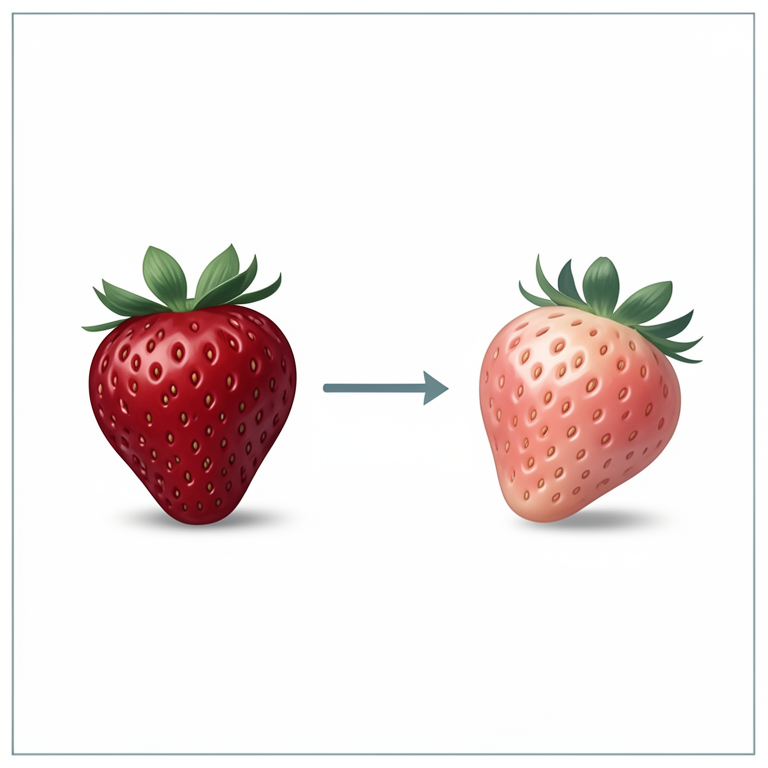
The Quality Trade-off
AI-generated conceptual illustration (strawberry fruits). It explains the idea and does not show study data.
View source evidence ↗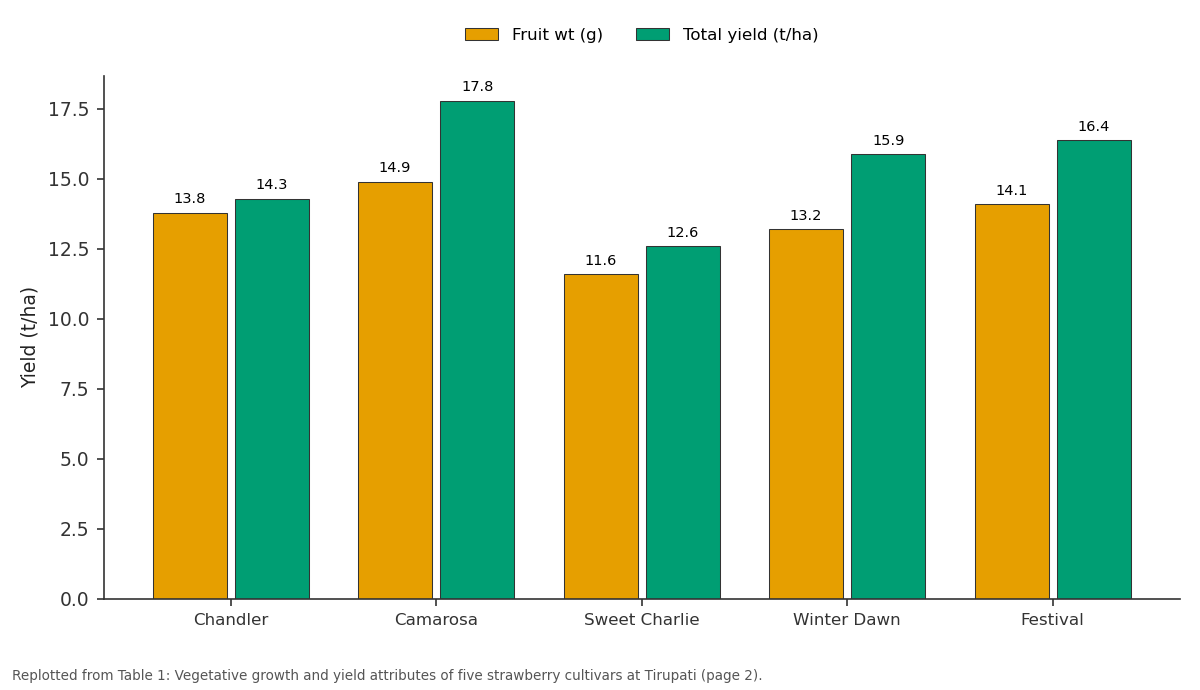
Fruit wt (g) and Total yield (t/ha): Chandler vs Camarosa vs Sweet Charlie vs Winter Dawn vs Festival
Replotted from Table 1 (page 2) of the original paper. Every bar is the paper's own table value.
View source evidence ↗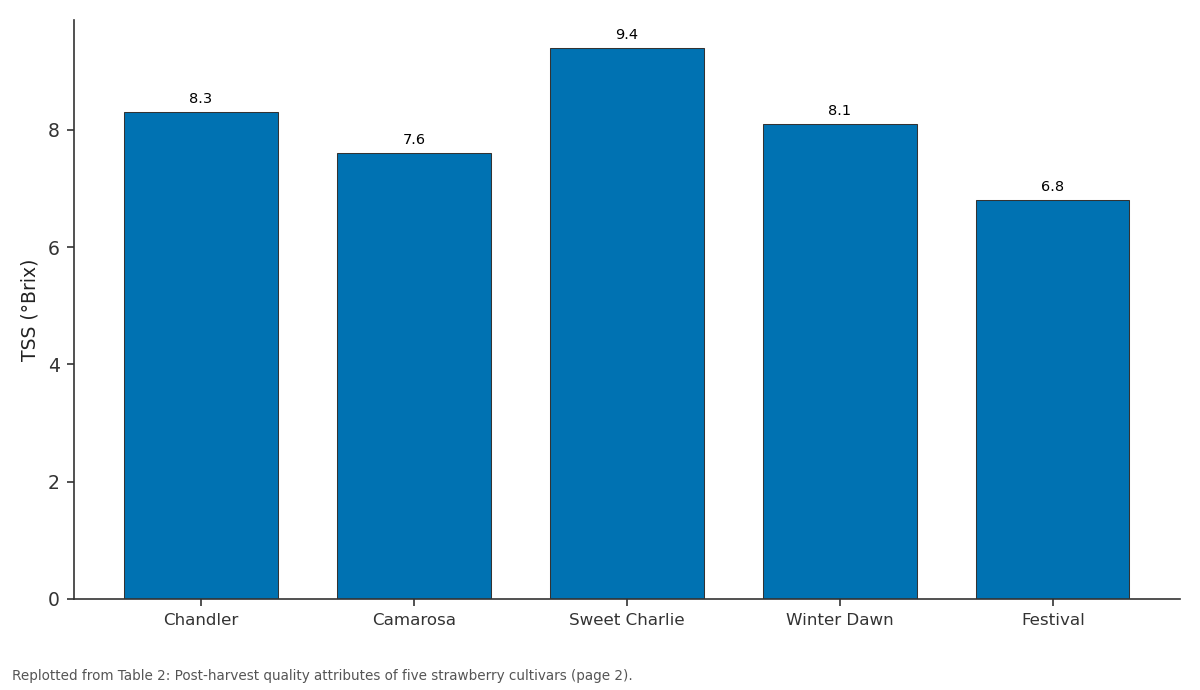
TSS (°Brix): Chandler vs Camarosa vs Sweet Charlie vs Winter Dawn vs Festival
Replotted from Table 2 (page 2) of the original paper. Every bar is the paper's own table value.
View source evidence ↗Figures & tables
From the original paper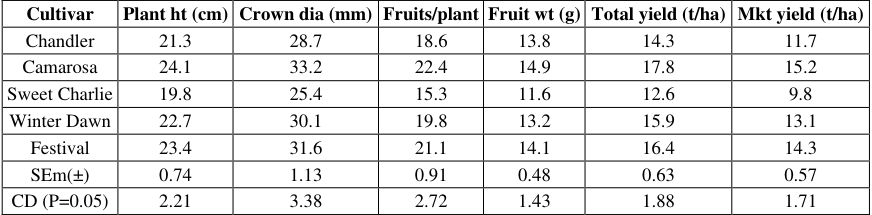 Table 1
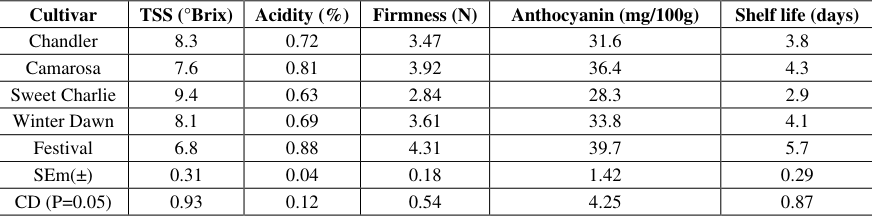 Table 2
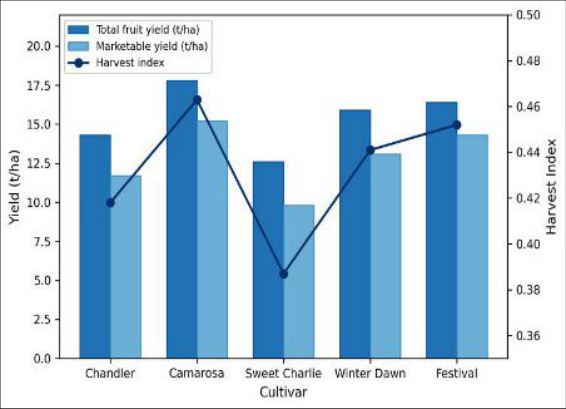 Figure 1
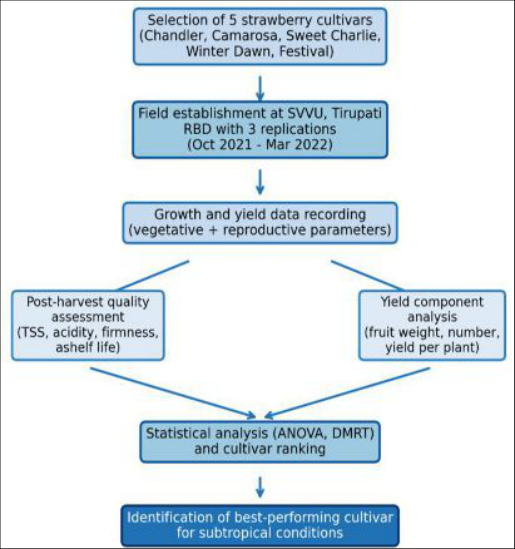 Figure 2
Introduction
What makes a strawberry cultivar worth growing in warm, humid zones that lie outside the crop's temperate comfort range? Growers in subtropical India have asked this with increasing urgency as consumer demand for fresh berries rises. Strawberry (Fragaria × ananassa Duch.) production remains concentrated in cooler highland districts, yet scattered attempts in peninsular India hint at unexploited potential [1] . The crop's sensitivity to high temperatures means cultivar selection isn't trivial; a genotype performing well in Mahabaleshwar may fail in the Deccan plateau [2] . Short-day types such as Chandler and Camarosa were bred for mild-winter conditions in California and have been adopted across Mediterranean and semi-arid regions [3] . Varieties like Sweet Charlie and Winter Dawn originated in Florida, where warm nights and high humidity overlap with parts of peninsular India's climate [4] . Festival has gained attention for firm fruit and extended shelf lifetraits that matter in supply chains lacking cold-chain infrastructure [5] . Despite this genetic pool, rigorous cultivar evaluation in the subtropical plains of southern India remains thin. Most published comparisons were conducted above 800 m elevation or in protected structures [6] . Open-field data under true subtropical conditionsmean winter temperatures of 22-27 °C and humidity above 70%are scarce. And when such data exist, they rarely address post-harvest quality in depth. A cultivar that yields well but deteriorates within two days of picking offers limited value to farmers selling through local markets [7] . This research was designed to evaluate five widely available strawberry cultivars under open-field subtropical conditions for yield potential and post-harvest behaviour. The objectives were (a) to compare vegetative growth and fruit yield, (b) to assess quality parameters at harvest and during ambient storage, and (c) to identify cultivar-trait combinations suited to the Tirupati region [8] .
The site falls within the semi-arid tropical zone with mean annual rainfall of 1,024 mm. Soils are red sandy loam (Alfisol) with pH 6.3, organic carbon 0.47%, and available N, P, K of 218, 24.6, and 187 kg/ha respectively. Mean temperatures during the cropping season (October-March) ranged from 19.8 °C (minimum) to 31.4 °C (maximum), with relative humidity of 58-79%.
Material
Five cultivars -Chandler, Camarosa, Sweet Charlie, Winter Dawn, and Festivalwere obtained as tissueculture plantlets from IIHR, Bengaluru, and hardened under shade-net for 14 days. Raised beds (1.2 m width, 20 cm height) with black polyethylene mulch and drip irrigation (2 L/h emitters at 30 cm spacing) were prepared. Basal fertilisation was 120:80:80 kg/ha N:P₂O₅:K₂O, supplemented with fortnightly 19:19:19 fertigation from four weeks after transplanting [9] . Integrated pest management included neem oil (3 mL/L) and Trichoderma viride (2 g/L) at 15-day intervals.
Methods
The randomised block design had three replications and five treatments (cultivars), each plot containing 24 plants at 30 × 30 cm spacing. Transplanting was done on 18 October 2021; harvesting began at the three-quarter red stage and concluded on 25 March 2022. Vegetative parameters were recorded at 60 and 90 days after transplanting. Yield parameters included fruits per plant, average fruit weight, total and marketable yield (fruits below 8 g or malformed were excluded) [10] . Post-harvest evaluation used 20 fruits per cultivar per replication: TSS by digital refractometer (Atago PAL-1), titratable acidity by 0.1 N NaOH titration, firmness by texture analyser (Brookfield CT3, 2 mm probe), and anthocyanin by pH differential method [11] . Shelf life was assessed at ambient temperature (26 ± 2 °C). Data were analysed by ANOVA with DMRT at P ≤ 0.05 using SPSS v26 [12] .
Climatic Conditions During the Trial
Monthly mean temperatures ranged from 24. and heavier fruit weight (14.9 g). Plant height and crown diameter were also largest in Camarosa, pointing to a vigorous vegetative frame that supports higher fruiting under warm conditions [1,3] . Anthocyanin was highest in Festival (39.7 mg/100 g). These numbers point to a trade-off between sugar accumulation and textural integrity with practical consequences for market targeting.
Comprehensive Interpretation
Considering yield and quality together, cultivars form three clusters. Camarosa and Festival constitute a high-yield, moderate-to-good quality group; Chandler and Winter Dawn sit in the middle; Sweet Charlie lags in yield while excelling only in sweetness. Fruit firmness correlated positively with shelf life (r = 0.87, p<0.05) and anthocyanin (r = 0.79, p<0.05), but negatively with TSS (r = -0.71, p<0.05). This inverse TSS-firmness relationship aligns with earlier temperate-zone findings [8] , confirming the pattern persists under subtropical heat stress.
Discussion
Camarosa's superior performance echoes reports from semiarid environments in Brazil and Turkey, where its heat tolerance and vigorous canopy translated into consistently higher yields [3,5] . Its larger crown diameter likely enabled greater radiation interception, directly fuelling fruit load. The fruit weight advantage (14.9 g vs 11.6 g for Sweet Charlie) probably reflects stronger sink capacity during the cooler December-January phase of early fruit development.
Festival's standout trait was post-harvest durability rather than yield. Its firm texture and high anthocyanin gave it a clear edge for market chains lacking cold storage. In Indian wholesale markets, where strawberries often travel unrefrigerated for 12-24 hours, an extra 1-2 days of shelf life can determine profit or loss [7] . Festival's deep red colour driven by 39.7 mg/100 g anthocyaninalso commands a retail premium. Sweet Charlie's poor showing was expected. Bred for flavour rather than field resilience, its thin skin and soft cell wall matrix don't hold up under ambient storage [4] . Its high TSS (9.4 °Brix) attracts consumers at purchase, but rapid post-harvest decay limits practical utility without cold chains.
The negative TSS-firmness correlation (r = -0.71) has been reported in multiple genotype-by-environment interaction trials [13,14] . The mechanism likely involves cell wall pectin hydrolysis, which softens texture while releasing sugars. This trade-off may be amplified under subtropical warmth, where enzymatic activity accelerates. Whether foliar calcium or pre-harvest gibberellic acid applications could shift this balance is worth pursuing in follow-up work.
Conclusion
Conclusion
Figures and tables from the paper
| Cultivar | Plant ht (cm) | Crown dia (mm) | Fruits/plant | Fruit wt (g) | Total yield (t/ha) | Mkt yield (t/ha) |
|---|---|---|---|---|---|---|
| Chandler | 21.3 | 28.7 | 18.6 | 13.8 | 14.3 | 11.7 |
| Camarosa | 24.1 | 33.2 | 22.4 | 14.9 | 17.8 | 15.2 |
| Sweet Charlie | 19.8 | 25.4 | 15.3 | 11.6 | 12.6 | 9.8 |
| Winter Dawn | 22.7 | 30.1 | 19.8 | 13.2 | 15.9 | 13.1 |
| Festival | 23.4 | 31.6 | 21.1 | 14.1 | 16.4 | 14.3 |
| SEm(±) | 0.74 | 1.13 | 0.91 | 0.48 | 0.63 | 0.57 |
| CD (P=0.05) | 2.21 | 3.38 | 2.72 | 1.43 | 1.88 | 1.71 |
Table text extracted from the original PDF; superscript letters are shown inline. The original table image is below.
View original table image
| Cultivar | TSS (°Brix) | Acidity (%) | Firmness (N) | Anthocyanin (mg/100g) | Shelf life (days) |
|---|---|---|---|---|---|
| Chandler | 8.3 | 0.72 | 3.47 | 31.6 | 3.8 |
| Camarosa | 7.6 | 0.81 | 3.92 | 36.4 | 4.3 |
| Sweet Charlie | 9.4 | 0.63 | 2.84 | 28.3 | 2.9 |
| Winter Dawn | 8.1 | 0.69 | 3.61 | 33.8 | 4.1 |
| Festival | 6.8 | 0.88 | 4.31 | 39.7 | 5.7 |
| SEm(±) | 0.31 | 0.04 | 0.18 | 1.42 | 0.29 |
| CD (P=0.05) | 0.93 | 0.12 | 0.54 | 4.25 | 0.87 |
Table text extracted from the original PDF; superscript letters are shown inline. The original table image is below.
View original table image
References
16 in the original paper- Kumar D, Singh JN. Strawberry cultivation in subtropical plains of India: challenges and opportunities. Indian J Hortic. 2018;75(3):412-418.
- Sharma RR, Patel VB. Genotype × environment interaction in strawberry under diverse agroclimatic conditions. J Hortic Sci. 2017;12(1):34-41.
- Antunes LEC, Ristow NC, Krolow ACR, Carpenedo S, Reisser Junior C. Yield and quality of Camarosa strawberry under subtropical climate. Hortic Bras. 2010;28(2):222-226.
- Whitaker VM, Chandler CK, Santos BM, Peres NA. Characteristics of selected Florida strawberry cultivars. Proc Fla State Hortic Soc. 2013;126:143-147.
- Adak N, Gubbuk H, Tetik N. Yield, quality, and biochemical properties of various strawberry cultivars under Mediterranean conditions. J Sci Food Agric. 2018;98(12):4550-4560.
- Singh A, Patel RK, De LC, Pereira LS. Performance of strawberry cultivars under sub-tropical conditions of Meghalaya. Indian J Hill Farming. 2008;21(1):37-42.
- Negi SS, Singh SP, Rana MK. Post-harvest handling and marketing of strawberry in India. J Food Process Preserv. 2021;45(4):e15376.
- Kader AA. Fruit maturity, ripening, and quality relationships. Acta Hortic. 1999;485:203-208.
- Muthukumar P, Selvakumar R. Nutrient management in strawberry: a subtropical perspective. Ann Plant Soil Res. 2019;21(2):166-172.
- Hancock JF. Strawberries: crop production science in horticulture. Wallingford (UK): CABI Publishing; 1999. p. 1-237.
- Giusti MM, Wrolstad RE. Characterization and measurement of anthocyanins by UV-visible spectroscopy. Curr Protoc Food Anal Chem. 2001;F1.2.1-F1.2.13.
- Panse VG, Sukhatme PV. Statistical Methods for Agricultural Workers. New Delhi: ICAR; 1985. p. 1381.
- Capocasa F, Scalzo J, Mezzetti B, Battino M. Combining quality and antioxidant attributes in the strawberry: the role of genotype. Food Chem. 2008;111(4):872-878.
- Ruan J, Lee YH, Hong SJ, Yeoung YR. Sugar and acid content of day-neutral and short-day strawberry cultivars. Korean J Hortic Sci Technol. 2013;31(5):549555.
- Wang SY, Lin HS. Antioxidant activity in fruits and leaves of blackberry, raspberry, and strawberry varies with cultivar and developmental stage. J Agric Food Chem. 2000;48(2):140-146.
- Kishan Swaroop K, Sudarshan MR. An overview of strawberry production in India. Curr Hortic. 2020;8(1):3-10.