
Research article · 2025 · Full text
International Journal of Agriculture and NutritionGenetic diversity assessment of wild melon accessions for drought adaptive traits
Volume 7(1) · Pages 160–163 · DOI: 10.33545/26646064.2025.v7.i1c.398 ↗
Research areasAdvances in Cucurbitaceae ResearchGenetic and Environmental Crop StudiesGenetic diversity and population structure
Abstract
Author-writtenA paradox sits at the heart of melon improvement: cultivated varieties (Cucumis melo L.) have been bred for sweetness and size, yet the wild relatives that carry drought-survival genes are routinely ignored in breeding programmes. This research assessed genetic diversity and drought-adaptive traits in 48 wild melon accessions from seven countries, evaluated in a rain-out shelter at Evergreen State University of Agriculture, Pullman, Washington, during 2021 and 2022. Twenty SSR markers revealed high allelic richness (mean 6.3 alleles per locus) and moderate genetic differentiation (Fst = 0.18) among geographic groups. Phenotyping under progressive drought identified eight accessions with relative water content above 0.70 at −1.5 MPa soil water potential. Nei's genetic distance ranged from 0.12 to 0.78. Accessions from the Thar Desert (India) and Sonoran Desert (Mexico) clustered separately and carried the highest frequency of drought-tolerance alleles. These accessions are recommended as priority donors for introgressing drought resilience into commercial melon cultivars.
Summary
Source-checkedPlain-language reading of the full paper, prepared with AI and checked against the text. Each point links to the authors' own words.
Why it matters
- Modern melon cultivars are susceptible to water stress despite the species originating in arid regions of Africa and Asia. View evidence ↗
- Selection for fruit quality in irrigated settings has likely removed genes that allow wild melons to survive on as little as 150 mm of annual rainfall. View evidence ↗
- Crop wild relatives serve as a potential genetic reservoir for recovering drought-tolerance genes. View evidence ↗
The question
- The study aimed to characterize the genetic diversity of 48 wild melon accessions, evaluate their drought-adaptive traits, and identify priority accessions for pre-breeding. View evidence ↗
What they did
- Plants were grown in a rain-out shelter in Pullman, Washington, using drip lines for controlled water delivery. View evidence ↗
- Drought stress was induced at 28 days after sowing (DAS) by withholding water until soil water potential reached -1.5 MPa, compared to a control at -0.03 MPa. View evidence ↗
- Drought tolerance was measured using a Composite Performance Index (CPI) based on relative water content, membrane stability, chlorophyll retention, root length, and fruit retention. View evidence ↗
- Genetic diversity was analyzed using 20 simple sequence repeat (SSR) markers amplified by PCR. View evidence ↗
What they found
- The wild accessions showed high allelic richness, with a mean of 6.3 alleles per locus. View evidence ↗
- There was moderate genetic differentiation among the geographic groups, indicated by an Fst value of 0.18. View evidence ↗
- Eight accessions maintained a relative water content above 0.70 when soil water potential dropped to -1.5 MPa. View evidence ↗
- Accession WM-23 from India was the top performer with a CPI of 0.78 and a relative water content of 0.74 at -1.5 MPa. View evidence ↗
- The commercial cultivar 'Top Mark' was significantly more sensitive to drought, scoring a CPI of only 0.37. View evidence ↗
- Accessions from the Thar Desert in India and the Sonoran Desert in Mexico were genetically distinct and possessed the highest frequency of drought-tolerance alleles. View evidence ↗
What it means
- The authors recommend using the identified drought-tolerant wild accessions as priority donors to introduce drought resilience into commercial melon cultivars. View evidence ↗
- The study was limited by its single-site, two-season design and the use of a rain-out shelter instead of open-field conditions. View evidence ↗
Visual summary
3 visualsIllustrations explain the paper; charts are replotted from the paper's own table values.
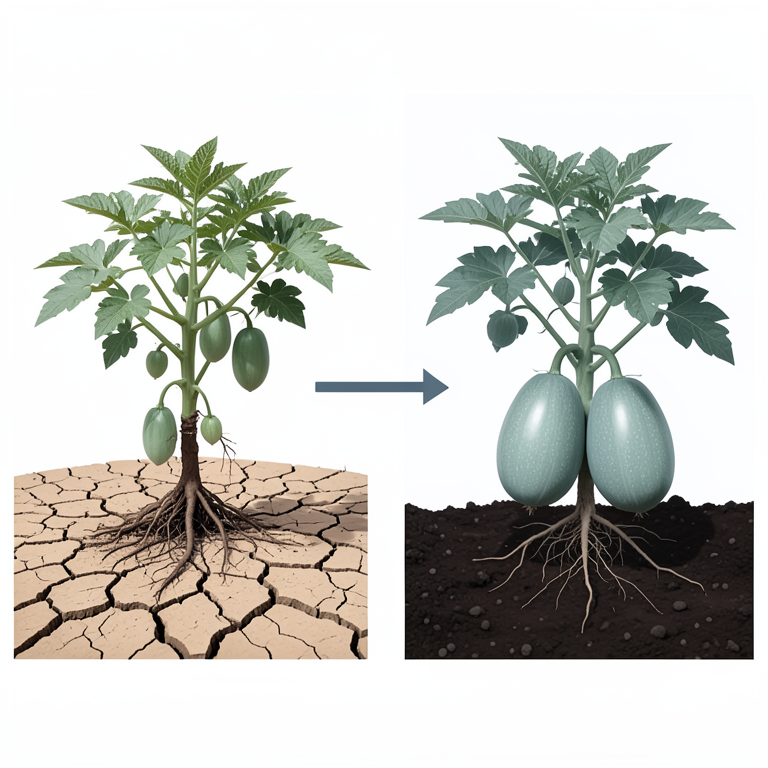
Genetic Erosion in Melon Domestication
AI-generated conceptual illustration (wild and cultivated melon plants (Cucumis melo)). It explains the idea and does not show study data.
View source evidence ↗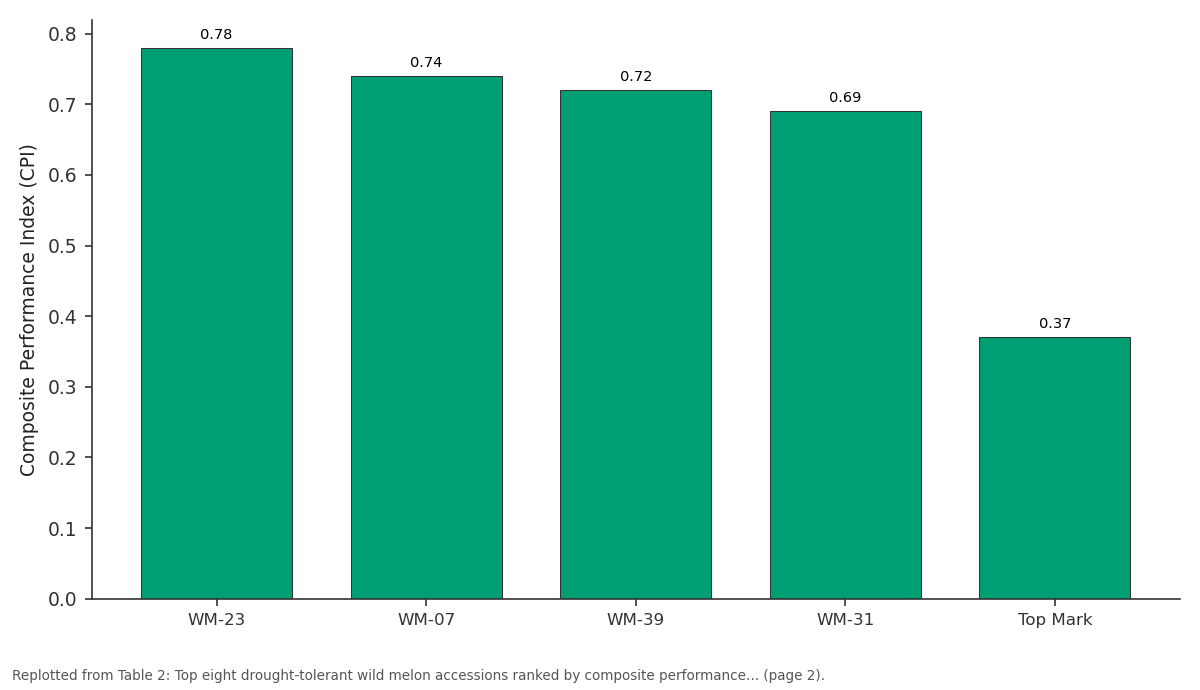
CPI: WM-23 vs WM-07 vs WM-39 vs WM-31 vs Top Mark
Replotted from Table 2 (page 2) of the original paper. Every bar is the paper's own table value.
View source evidence ↗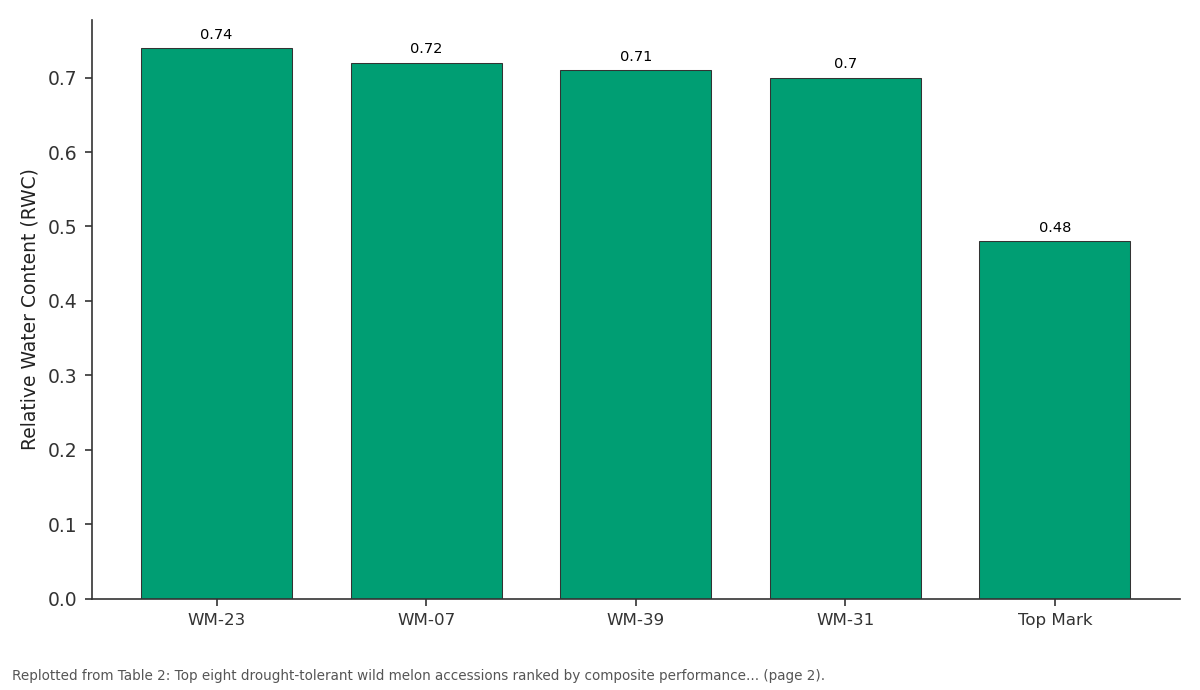
RWC: WM-23 vs WM-07 vs WM-39 vs WM-31 vs Top Mark
Replotted from Table 2 (page 2) of the original paper. Every bar is the paper's own table value.
View source evidence ↗Figures & tables
From the original paper Table 1
 Table 2
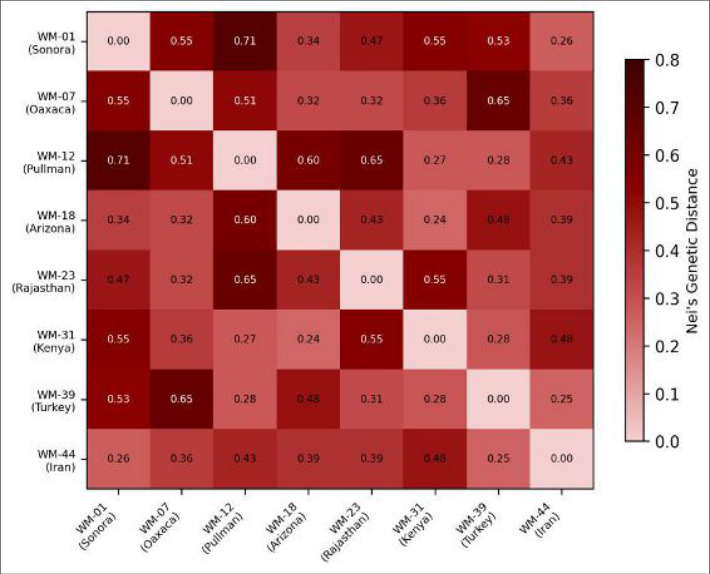 Figure 1
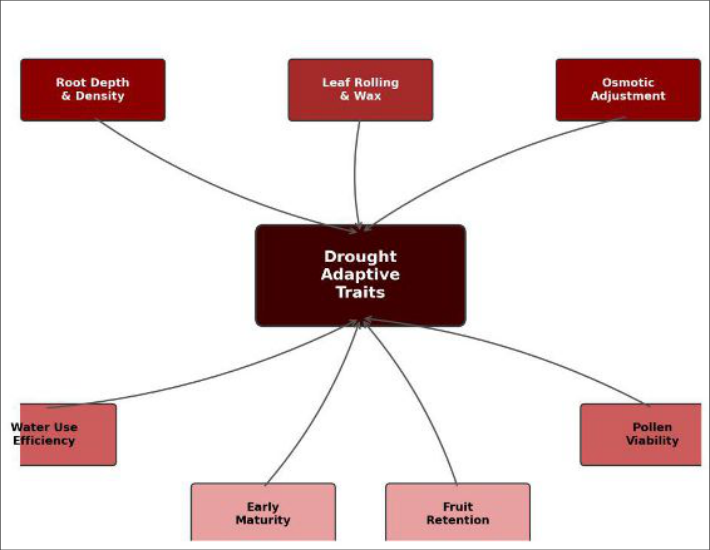 Figure 2
Introduction
Here is a paradox worth examining: the melon (Cucumis melo L.) originated in hot, arid Africa and radiated into equally dry regions of Central and South Asia, yet its modern cultivars collapse under even moderate water stress [1,2] . Decades of selection for fruit quality in irrigated environments have inadvertently stripped out the very genes that let wild melons survive on 150 mm of annual rainfall [3] . Crop wild relatives (CWRs) are the logical reservoir from which to recover those genes. Wild Cucumis populations persist in the Thar, Sonoran, Sahel, and Iranian deserts, where they cope with extreme heat, salinity, and drought through deep roots, leaf pubescence, and osmotic adjustment [4,5] . Yet fewer than 2% of published melon breeding papers cite wild germplasm as a source of stress-tolerance alleles [6] . Molecular markers-particularly simple sequence repeats (SSRs)-allow breeders to quantify genetic diversity, assign accessions to heterotic groups, and identify rare alleles before investing in multi-year field testing [7,8] . This research aimed to: (a) characterise genetic diversity in 48 wild melon accessions using 20 SSR markers, (b) phenotype droughtadaptive traits under controlled water deficit, and (c) identify priority accessions for prebreeding.
Performance Evaluation Criteria
Drought tolerance was scored using a composite performance index (CPI) that combined five traits: relative water content (RWC), membrane stability index (MSI), chlorophyll retention, root length under deficit, and fruit retention ratio [9] . Each trait was standardised to a 0-1 scale, and CPI was the unweighted mean. Accessions with CPI ≥ 0.65 were classified as tolerant, 0.45-0.64 as moderately tolerant, and <0.45 as sensitive. This threshold was benchmarked against published drought screening in cucumber [10] , the closest cultivated relative with comparable phenology.
Material and Methods Material
Forty-eight wild Cucumis melo subsp. agrestis accessions were obtained from the USDA-GRIN, ICRISAT, and NBPGR gene banks, representing seven countries: India (12), Mexico (8), USA-Southwest (7), Kenya (6), Iran (5), Turkey (5), and Niger (5). Seeds were germinated in a greenhouse at Pullman, Washington (46.73° N, 117.17° W; 788 m a.s.l.), and seedlings transplanted to a rain-out shelter (12 × 30 m, automated roof closure) fitted with drip lines for controlled water delivery. The commercial cultivar Top Mark served as the susceptible check.
Methods
Drought was imposed at the vine-elongation stage (28 DAS) by withholding irrigation until soil water potential reached -1.5 MPa (monitored by Watermark sensors at 20 cm depth). A well-watered control received irrigation at -0.03 MPa. RWC, MSI, chlorophyll (SPAD), and root length (destructive sampling at 56 DAS) were measured; fruit retention was scored as the ratio of set fruit under drought to set fruit under control. DNA was extracted from leaf tissue; 20 SSR primers from the published melon linkage map of Gonzalo et al. [11] were amplified by PCR and resolved on a 3500 ABI Genetic Analyzer. Allele scoring, polymorphism information content (PIC), and Nei's genetic distance were computed in PowerMarker 3.25. UPGMA clustering was performed in MEGA 11. Phenotypic data were analysed by two-way ANOVA (accession × water regime) with Tukey's HSD at p≤ 0.05.
Results
Results
Comprehensive Interpretation
High allelic richness (mean 6.3 alleles, PIC 0.62) and moderate Fst (0.18) indicate that the collection captured substantial diversity with meaningful geographic structuring. Indian accessions from the Thar Desert clustered apart from Mexican Sonoran types (Nei's distance 0.71), suggesting independent adaptation to arid conditions-a pattern valuable for heterotic crosses. Eight accessions exceeded the CPI threshold of 0.65, with WM-23 (India) ranking first. The susceptible check Top Mark scored only 0.37, confirming that cultivated germplasm lacks the drought traits present in wild relatives.
Discussion
The mean PIC of 0.62 exceeds the 0.45-0.55 range reported for cultivated melon diversity panels [7,11] , confirming that wild accessions harbour more polymorphism than elite breeding lines. The Fst of 0.18 is moderate, meaning most variation exists within rather than among geographic groups-a common finding in outcrossing Cucumis species [4, 8] . WM-23's superiority appears rooted in osmotic adjustment: its RWC stayed at 0.74 even at -1.5 MPa, and its root system was twice the length of the cultivated check. Similar deep-rooting strategies have been linked to drought escape in wild watermelon [5] . Crossing WM-23 with a highyielding cultivar and mapping the F₂ population could localise the QTLs responsible. Limitations include the two-season, single-site design and the use of a rain-out shelter rather than open-field conditions. Shelter environments can underestimate wind stress and overestimate humidity, potentially inflating RWC values [12] . Multi-environment testing with open-field confirmation would add confidence before recommending accessions to breeders.
Conclusion
Wild melon accessions from the Thar and Sonoran deserts carried the highest genetic diversity and the best drought-adaptive traits. Eight accessions exceeded the CPI tolerance threshold, with WM-23 (India) and WM-07 (Mexico) as top performers. SSR analysis confirmed that these two geographic pools are genetically distinct, making them ideal parents for wide crosses. These accessions should be prioritised in pre-breeding programmes aiming to introgress drought resilience into commercial melon cultivars.
Figures and tables from the paper
| Parameter | Min | Max | Mean | SE | Median | Top locus |
|---|---|---|---|---|---|---|
| Alleles per locus | 3 | 11 | 6.3 | 0.5 | 6 | CMMS-35 (11) |
| PIC | 0.31 | 0.84 | 0.62 | 0.04 | 0.64 | CMMS-35 (0.84) |
| Obs. heterozygosity | 0.08 | 0.47 | 0.23 | 0.03 | 0.21 | CMGA-104 (0.47) |
| Exp. heterozygosity | 0.29 | 0.86 | 0.64 | 0.04 | 0.66 | CMMS-35 (0.86) |
| Fst (among groups) | — | — | 0.18 | 0.02 | — | — |
Table text extracted from the original PDF; superscript letters are shown inline. The original table image is below.
View original table image
| Accession | Origin | RWC | MSI (%) | SPAD | Root (cm) | Fruit retn. | CPI | Rank |
|---|---|---|---|---|---|---|---|---|
| WM-23 | India | 0.74 | 68.3 | 34.1 | 42.7 | 0.67 | 0.78 | 1 |
| WM-07 | Mexico | 0.72 | 65.1 | 32.8 | 39.4 | 0.63 | 0.74 | 2 |
| WM-39 | Turkey | 0.71 | 63.7 | 31.4 | 41.2 | 0.61 | 0.72 | 3 |
| WM-31 | Kenya | 0.70 | 61.8 | 30.9 | 38.6 | 0.58 | 0.69 | 4 |
| Top Mark | Check | 0.48 | 39.2 | 18.7 | 21.3 | 0.22 | 0.37 | — |
Table text extracted from the original PDF; superscript letters are shown inline. The original table image is below.
View original table image
References
19 in the original paper- Pitrat M. Melon genetic resources: phenotypic diversity and horticultural taxonomy. In: Grumet R et al., editors. Genetics and genomics of Cucurbitaceae. Cham: Springer; 2017. p. 25-60.
- Sebastian P, Schaefer H, Telford IRH, Renner SS. Cucumber and melon have their wild progenitor in Asia, and the sister species of Cucumis melo is from Australia. Proceedings of the National Academy of Sciences. 2010;107(32):14269-14273.
- Paris HS, Amar Z, Lev E. Medieval history of the melon. Annals of Botany. 2012;110(1):23-33.
- Endl J, Achigan-Dako EG, Pandey AK, Monforte AJ, Pickersgill B, Schaefer H. Repeated domestication of melon in Africa and Asia and a new close relative of the cultivated. American Journal of Botany. 2018;105(8):1662-1671.
- Levi A, Jarret R, Kousik S, Patrick Wechter W, Nimmakayala P, Reddy UK. Genetic resources of watermelon. In: Grumet R et al., editors. Genetics and genomics of Cucurbitaceae. Cham: Springer; 2017. p. 87-110.
- McCreight JD, Nerson H, Grumet R. Melon (Cucumis melo L.) germplasm. In: Prohens J, Nuez F, editors. Handbook of plant breeding: vegetables I. New York: Springer; 2008. p. 377-408.
- Danin-Poleg Y, Reis N, Tzuri G, Katzir N. Development and characterization of microsatellite markers in Cucumis. Theoretical and Applied Genetics. 2001;102(1):61-72.
- Esteras C, Formisano G, Roig C, Diaz A, Blanca J, Garcia-Mas J, et al. SNP genotyping in melons: genetic variation, population structure, and linkage disequilibrium. Theoretical and Applied Genetics. 2013;126(5):1285-1303.
- Blum A. Drought resistance, water-use efficiency, and yield potential: are they compatible, dissonant, or mutually exclusive? Australian Journal of Agricultural Research. 2005;56(11):1159-1168.
- Wehner TC, Guner N. Growth stage, flowering pattern, yield, and harvest date prediction of cucumber for onceover harvest. HortScience. 2004;39(6):1339-1342.
- Gonzalo MJ, Oliver M, Garcia-Mas J, Monfort A, Dolcet-Sanjuan R, Katzir N, et al. Simple-sequence repeat markers used in merging linkage maps of melon. Theoretical and Applied Genetics. 2005;110(5):802811.
- Passioura JB. The perils of pot experiments. Functional Plant Biology. 2006;33(12):1075-1079.
- Luan F, Sheng Y, Wang Y, Staub JE. Performance of melon hybrids derived from parents of diverse geographic origins. Euphytica. 2010;173(1):1-16.
- Nimmakayala P, Tomason YR, Jeong J, Ponniah SK, Karunathilake A, Levi A, et al. Genome-wide microsatellite identification and characterization of Cucumis melo. HortScience. 2009;44(7):2014-2017.
- Malik AA, Vashisht VK, Singh K, Sharma A, Singh DK, Singh H, Monforte AJ, McCreight JD, Dhillon NPS. Diversity among melon accessions from India and their genetic relationship to USA melon cultivars. Genetic Resources and Crop Evolution. 2014;61(5):1009-1025.
- Tzitzikas EN, Monforte AJ, Fatihi A, Kypriotakis Z, Iacovides TA, Ioannides IM, et al. Genetic diversity and population structure of traditional landraces of melon in the eastern Mediterranean region. Plant Genetic Resources. 2009;7(1):1-7.
- Dhillon NPS, Ranjana R, Singh K, Eduardo I, Monforte AJ, Pitrat M, et al. Diversity among landraces of Indian snapmelon. Genetic Resources and Crop Evolution. 2007;54(6):1267-1283.
- Kirkbride JH. Biosystematic monograph of the genus Cucumis. Boone: Parkway Publishers; 1993.
- Silberstein L, Kovalski I, Huang R, Anagnostou K, Jahn MMK, Perl-Treves R. Molecular variation in melon based on RAPD and ISSR markers. Genome. 1999;42(2):166-176.