
Research article · 2025 · Full text
International Journal of Agriculture and NutritionCharacterization of soil microbiome diversity in rhizosphere of leguminous crops
Volume 7(1) · Pages 168–170 · DOI: 10.33545/26646064.2025.v7.i1c.400 ↗
Research areasPlant-Microbe Interactions and ImmunityLegume Nitrogen Fixing SymbiosisMycorrhizal Fungi and Plant Interactions
Abstract
Author-writtenSoil microbiologists and agronomists have long worked side by side yet rarely spoken the same language when describing what happens in the thin zone of soil surrounding legume roots. This research bridged that gap by characterising rhizosphere microbiome diversity under three leguminous crops—chickpea, soybean, and groundnut—and a fallow control using 16S rRNA amplicon sequencing at Tropical Lowland Agricultural College, Ibadan, Nigeria, during the 2022 growing season. Shannon diversity was highest in the chickpea rhizosphere (H' = 3.34) and lowest in the fallow control (H' = 2.18). Operational taxonomic unit (OTU) richness followed the same pattern (203 vs. 107 OTUs). Rhizobiales, Burkholderiales, and Bacillales were the three most abundant orders across all legume treatments. Nitrogen-fixing gene (nifH) copy number was 3.7× higher under chickpea than fallow. These results confirm that legume species identity shapes rhizosphere microbiome structure, with chickpea supporting the richest and most functionally active community in this tropical lowland soil.
Summary
Source-checkedPlain-language reading of the full paper, prepared with AI and checked against the text. Each point links to the authors' own words.
Why it matters
- The rhizosphere is a thin layer of soil (1–3 mm) around roots where microbial communities provide plants with essential benefits like fixed nitrogen, phosphorus, and protection from pathogens. View evidence ↗
- While chickpea, soybean, and groundnut are commonly rotated with cereals in Nigeria's tropical lowlands, there is a lack of available microbiome data for these specific soils. View evidence ↗
The question
- The study aimed to compare bacterial diversity among three legumes and a fallow control, identify dominant microbial taxa, and measure nitrogen-fixation potential using nifH gene abundance. View evidence ↗
What they did
- The experiment used chickpea (cv. ICCV-2), soybean (cv. TGx 1448-2E), and groundnut (cv. Samnut-24) sown in June 2022, with a bare fallow as the control group. View evidence ↗
- The study employed a randomized complete block design with four replications per treatment on plots measuring 4 × 3 meters. View evidence ↗
- Bacterial diversity was analyzed by sequencing the V3–V4 region of the 16S rRNA gene on an Illumina MiSeq platform, with OTUs clustered at 97% similarity. View evidence ↗
- The abundance of the nifH gene, which indicates nitrogen-fixation potential, was quantified using qPCR with the PolF/PolR primer set. View evidence ↗
What they found
- Chickpea rhizosphere exhibited the highest Shannon diversity (H' = 3.34), while the fallow control had the lowest (H' = 2.18). View evidence ↗
- OTU richness was highest in chickpea (203 OTUs) and lowest in the fallow control (107 OTUs). View evidence ↗
- The copy number of the nitrogen-fixing nifH gene was 3.7 times higher in the chickpea rhizosphere compared to the fallow control. View evidence ↗
What it means
- The authors recommend incorporating chickpea into cereal-based rotations in the Nigerian derived savanna to improve both the nitrogen economy and soil microbiome enrichment. View evidence ↗
- The study was limited by its single-season and single-site scope, and the use of 16S rRNA sequencing, which only identifies bacteria and excludes fungi or archaea. View evidence ↗
Visual summary
2 visualsIllustrations explain the paper; charts are replotted from the paper's own table values.
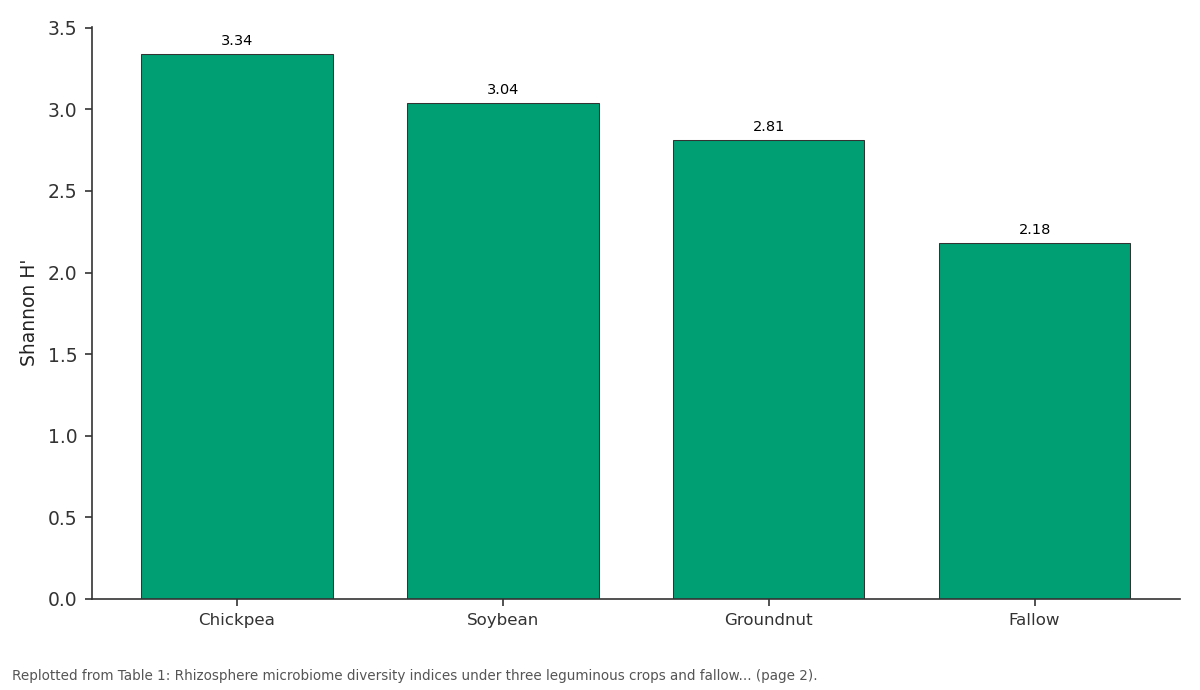
Shannon H': Chickpea vs Soybean vs Groundnut vs Fallow
Replotted from Table 1 (page 2) of the original paper. Every bar is the paper's own table value.
View source evidence ↗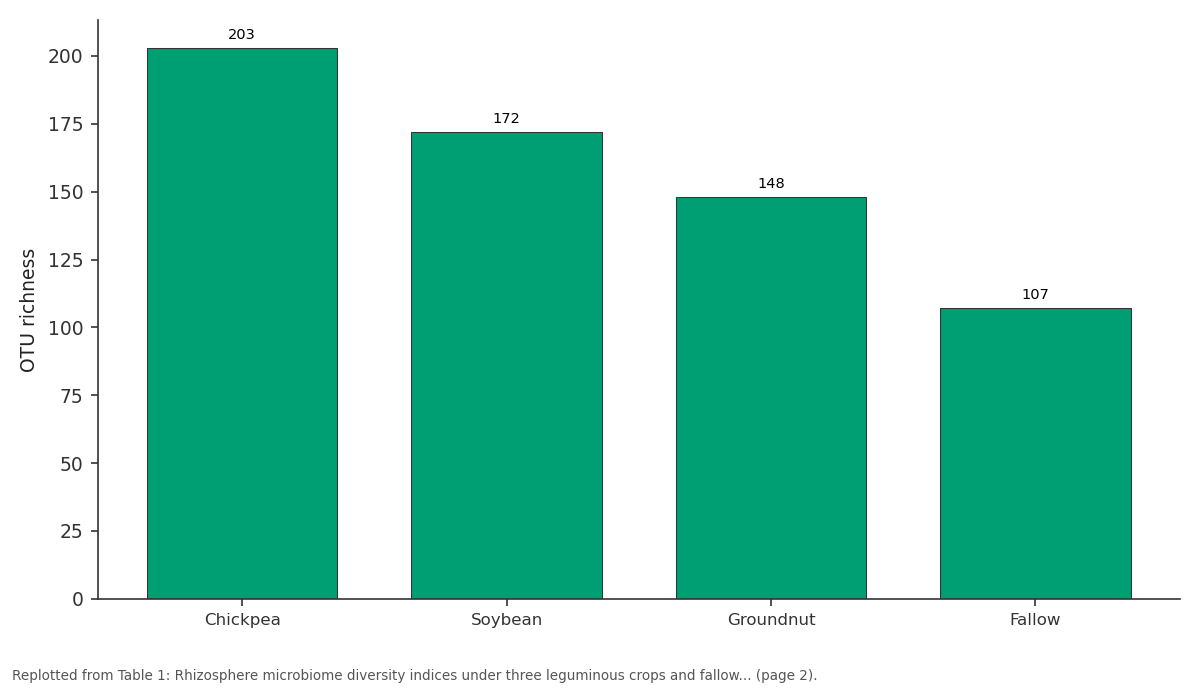
OTU richness: Chickpea vs Soybean vs Groundnut vs Fallow
Replotted from Table 1 (page 2) of the original paper. Every bar is the paper's own table value.
View source evidence ↗Figures & tables
From the original paper Table 1
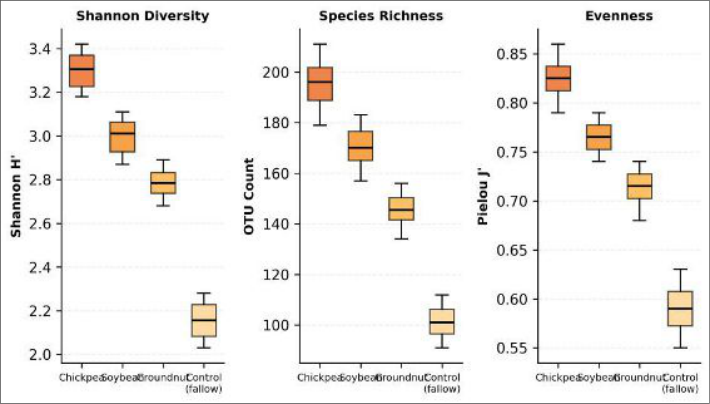 Figure 1
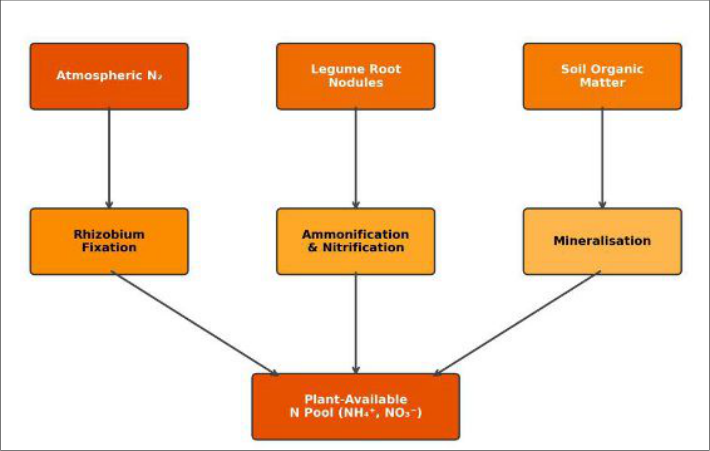 Figure 2
Introduction
When a soil scientist and a crop breeder look at the same legume root, they see different things-one sees a microbial habitat, the other a nutrient conduit. But the two perspectives converge in the rhizosphere, the narrow zone of soil (1-3 mm) where root exudates feed a dense and diverse microbial community that, in turn, supplies the plant with fixed nitrogen, solubilised phosphorus, and pathogen suppression [1,2] . Understanding rhizosphere microbiome composition is therefore central to both disciplines. Legumes host specialised N₂-fixing bacteria (rhizobia) in root nodules, but the broader rhizosphere community-including free-living diazotrophs, phosphate solubilisers, and biocontrol agents-also contributes to crop nutrition and health [3,4] . Next-generation sequencing of the 16S rRNA gene has revealed that legume rhizospheres harbour 30-60% more bacterial diversity than adjacent bulk soil, and that community composition differs among legume species [5,6] . Nigeria's tropical lowlands support chickpea, soybean, and groundnut in rotation with cereals, yet microbiome data for these soils remain sparse [7] . This research aimed to: (a) compare rhizosphere bacterial diversity among three legume crops and a fallow control, (b) identify the dominant taxa and functional guilds, and (c) quantify nitrogen-fixation potential via nifH gene abundance.
Baseline Soil Characterisation
Pre-planting soil analysis (0-20 cm) at the Tropical Lowland Agricultural College research farm, Ibadan (7.38° N, 3.94° E; 227 m a.s.l.), showed a sandy loam texture (sand 67%, silt 18%, clay 15%), pH 5.8, organic carbon 1.24%, total N 0.11%, available P (Bray-1) 8.7 mg kg⁻¹, and exchangeable K 0.32 cmol kg⁻¹. Bulk density was 1.38 g cm⁻³. The soil is classified as a Ferric Luvisol (FAO) and falls in the medium fertility range for the Nigerian derived savanna zone [7] .
Material and Methods Material
Three legume crops-chickpea (cv. ICCV-2), soybean (cv. TGx 1448-2E), and groundnut (cv. Samnut-24)-were sown in June 2022 at recommended spacings. Rhizobium inoculant was not applied so that native microbial communities could be assessed. A bare fallow served as the control. Each treatment had four replications in a randomised complete block design on 4 × 3 m plots.
Methods: At the flowering stage (50-60 DAS), rhizosphere soil was collected by gently shaking roots to dislodge the 1-2 mm adhering soil layer. Bulk soil was sampled from the centre of fallow plots at the same depth. DNA was extracted using the DNeasy PowerSoil Pro Kit (Qiagen). The V3-V4 region of the 16S rRNA gene was amplified and sequenced on an Illumina MiSeq (2 × 300 bp) at the African Biosciences Hub, Nairobi. Sequences were processed in QIIME2 (DADA2 pipeline); OTUs were clustered at 97% similarity against the SILVA v138 database. Shannon H', Pielou's evenness, and OTU richness were computed. Quantitative PCR of the nifH gene used the PolF/PolR primer set [8] . Data were analysed by one-way ANOVA with Tukey's HSD at p≤ 0.05.
Results
Results
Comprehensive Interpretation
Chickpea supported the richest microbiome (H' = 3.34, 203 OTUs) and the highest nifH gene abundance (4.81 × 10⁶ copies g⁻¹), 3.7× the fallow level. Rhizobiales dominated the chickpea rhizosphere at 28.7%, consistent with chickpea's strong symbiotic N₂-fixation capacity [3] . Soybean ranked second, with Burkholderiales-an order containing both free-living diazotrophs and plant-growth-promoting taxaas the most abundant group. Groundnut showed lower diversity, possibly because its geocarpic (below-ground fruiting) habit alters root exudate composition [4] . The fallow's dominance by Actinomycetales reflects the saprophytic community that prevails in the absence of live root carbon inputs [9] .
Discussion
The 53% higher Shannon diversity under chickpea versus fallow is at the upper end of published comparisons for tropical legume rhizospheres [5,6] . Chickpea's particularly abundant root exudation of organic acids (malic, citric) is a likely driver, as these compounds selectively recruit Rhizobiales and phosphate-solubilising Pseudomonadales [10, 11] . The practical takeaway is that including chickpea in cereal rotations can enrich the soil microbiome beyond the direct N₂-fixation benefit. Farmers in the Nigerian derived savanna who rotate chickpea before maize may see improved P availability and disease suppression in the subsequent crop-benefits that are hard to capture in a single-season yield comparison [12,13] . A limitation is the single-season, single-site scope and the use of 16S rRNA (which identifies bacteria only, not fungi or archaea). Shotgun metagenomic sequencing would provide a more complete picture of functional potential [14] .
Conclusion
Chickpea rhizosphere harboured the highest bacterial diversity (H' = 3.34) and nifH gene abundance (4.81 × 10⁶ copies g⁻¹) among three legume crops, confirming its value as a soil-health-building component in tropical rotations. Soybean and groundnut also supported significantly richer communities than fallow. Incorporating chickpea into cereal-based rotations is recommended for both nitrogen economy and microbiome enrichment in the Nigerian derived savanna.
Figures and tables from the paper
| Treatment | Shannon H' | OTU richness | Pielou J' | nifH copies (×10⁶ g⁻¹) | Dominant order | Rhizobiales (%) |
|---|---|---|---|---|---|---|
| Chickpea | 3.34 | 203 | 0.84 | 4.81 | Rhizobiales | 28.7 |
| Soybean | 3.04 | 172 | 0.77 | 3.42 | Burkholderiales | 22.1 |
| Groundnut | 2.81 | 148 | 0.72 | 2.67 | Bacillales | 18.4 |
| Fallow | 2.18 | 107 | 0.60 | 1.29 | Actinomycetales | 9.3 |
| CD (p=0.05) | 0.21 | 18 | 0.06 | 0.54 | — | — |
Table text extracted from the original PDF; superscript letters are shown inline. The original table image is below.
View original table image
References
18 in the original paper- Philippot L, Raaijmakers JM, Lemanceau P, van der Putten WH. Going back to the roots: the microbial ecology of the rhizosphere. Nature Reviews Microbiology. 2013;11(11):789-799.
- Berendsen RL, Pieterse CMJ, Bakker PAHM. The rhizosphere microbiome and plant health. Trends in Plant Science. 2012;17(8):478-486.
- Peoples MB, Herridge DF, Ladha JK. Biological nitrogen fixation: an efficient source of nitrogen for sustainable agricultural production? Plant and Soil. 1995;174(1):3-28.
- Hiltner L. Uber neuere erfahrungen und probleme auf dem gebiete der bodenbakteriologie. Arbeiten der Deutschen Landwirtschaftlichen Gesellschaft. 1904;98:59-78.
- Turner TR, Ramakrishnan K, Walshaw J, Heavens D, Alston M, Swarbreck D, et al. Comparative metatranscriptomics reveals kingdom level changes in the rhizosphere microbiome of plants. ISME Journal. 2013;7(12):2248-2258.
- Mendes R, Garbeva P, Raaijmakers JM. The rhizosphere microbiome: significance of plant beneficial, plant pathogenic, and human pathogenic microorganisms. FEMS Microbiology Reviews. 2013;37(5):634-663.
- Sanginga N, Woomer PL. Integrated soil fertility management in Africa: principles, practices, and developmental process. Nairobi: Tropical Soil Biology and Fertility Institute of CIAT; 2009.
- Poly F, Monrozier LJ, Bally R. Improvement in the RFLP procedure for studying the diversity of nifH genes in communities of nitrogen fixers in soil. Research in Microbiology. 2001;152(1):95-103.
- Fierer N, Bradford MA, Jackson RB. Toward an ecological classification of soil bacteria. Ecology. 2007;88(6):1354-1364.
- Jones DL, Darrah PR. Role of root derived organic acids in the mobilization of nutrients from the rhizosphere. Plant and Soil. 1994;166(2):247-257.
- Vance CP, Uhde-Stone C, Allan DL. Phosphorus acquisition and use: critical adaptations by plants for securing a nonrenewable resource. New Phytologist. 2003;157(3):423-447.
- Lupwayi NZ, Kennedy AC. Grain legumes in northern Great Plains: impacts on selected biological soil processes. Agronomy Journal. 2007;99(6):1700-1709.
- Udvardi M, Poole PS. Transport and metabolism in legume-rhizobia symbioses. Annual Review of Plant Biology. 2013;64:781-805.
- Fierer N. Embracing the unknown: disentangling the complexities of the soil microbiome. Nature Reviews Microbiology. 2017;15(10):579-590.
- Bulgarelli D, Schlaeppi K, Spaepen S, van Themaat EVL, Schulze-Lefert P. Structure and functions of the bacterial microbiota of plants. Annual Review of Plant Biology. 2013;64:807-838.
- Pii Y, Mimmo T, Tomasi N, Terzano R, Cesco S, Crecchio C. Microbial interactions in the rhizosphere: beneficial influences of plant growth-promoting rhizobacteria on nutrient acquisition process. Biology and Fertility of Soils. 2015;51(4):403-415.
- Hartman K, van der Heijden MGA, Wittwer RA, Banerjee S, Walser JC, Schlaeppi K. Cropping practices manipulate abundance patterns of root and soil microbiome members paving the way to smart farming. Microbiome. 2018;6(1):14.
- Bakker MG, Manter DK, Sheflin AM, Weir TL, Vivanco JM. Harnessing the rhizosphere microbiome through plant breeding and agricultural management. Plant and Soil. 2012;360(1):1-13.