
Research article · 2025 · Full text
International Journal of Agriculture and NutritionInfluence of tree canopy on microclimate modification and understory crop productivity
Volume 7(1) · Pages 109–112 · DOI: 10.33545/26646064.2025.v7.i1b.382 ↗
Research areasAgroforestry and silvopastoral systemsAfrican Botany and Ecology StudiesAgronomic Practices and Intercropping Systems
Abstract
Author-writtenImagine a smallholder field where trees shade half the ground yet the farmer harvests more total value per hectare than the neighbour who cleared every tree. This research measured how two levels of tree canopy cover dense (>70%) and moderate (40–70%) modified microclimate and affected understory crop yields in a Leucaena leucocephala-based agroforestry system at Sri Venkateswara Veterinary and Agricultural University, Tirupati, India, during 2021–22 and 2022–23. Dense canopy reduced photosynthetically active radiation (PAR) by 65.8% and air temperature by 3.8 °C but raised relative humidity by 12.7%. Understory groundnut yield was 28.4% lower under dense canopy compared with the open field, yet moderate canopy reduced yield by only 11.6% while cutting soil temperature by 2.9 °C. Land equivalent ratio (LER) peaked at 1.47 under moderate canopy. These findings indicate that managing canopy at 40–70% cover optimises the microclimate–productivity trade-off in semi-arid agroforestry.
Summary
Source-checkedPlain-language reading of the full paper, prepared with AI and checked against the text. Each point links to the authors' own words.
Why it matters
- In semi-arid regions like Rayalaseema, extreme summer temperatures (over 42 °C) and rapid soil drying can lead to crop failure, making temperature and evaporation reduction critical for harvest success. View evidence ↗
- Agroforestry trees can protect crops by modifying the microclimate, but they also create competition for essential resources like light, water, and nutrients. View evidence ↗
The question
- The study aimed to measure how different canopy cover levels affect microclimate parameters and groundnut yield, and to evaluate overall system productivity using the land equivalent ratio (LER). View evidence ↗
What they did
- The experiment was conducted on red sandy loam Alfisol at Sri Venkateswara Veterinary and Agricultural University in Tirupati, India. View evidence ↗
- The study used Leucaena leucocephala trees pruned to three levels (dense >70%, moderate 40–70%, and open field) with groundnut (cv. K-6) grown as the understory crop. View evidence ↗
- The research employed a randomized complete block design with four replications of three treatments on plots measuring 10 × 8 m. View evidence ↗
- Microclimate measurements included PAR at solar noon, hourly air temperature and humidity, soil temperature at 5 cm depth, and wind speed at 2 m height. View evidence ↗
What they found
- Dense canopy (>70%) significantly modified the microclimate, reducing PAR to 34.2% of open field levels (a 65.8% reduction), lowering air temperature by 3.8 °C, and increasing relative humidity by 12.7%. View evidence ↗
- Moderate canopy (40–70%) reduced soil temperature by 2.9 °C and air temperature by 2.1 °C, while maintaining PAR at 58.7% of open field levels. View evidence ↗
What it means
- Dense canopy (>70%) should be avoided if the goal is understory crop productivity, as it over-shades the crop. View evidence ↗
- The study is limited by the use of only one tree species and one crop; results might vary with different tree root depths or more shade-tolerant crops. View evidence ↗
Visual summary
2 visualsIllustrations explain the paper; charts are replotted from the paper's own table values.
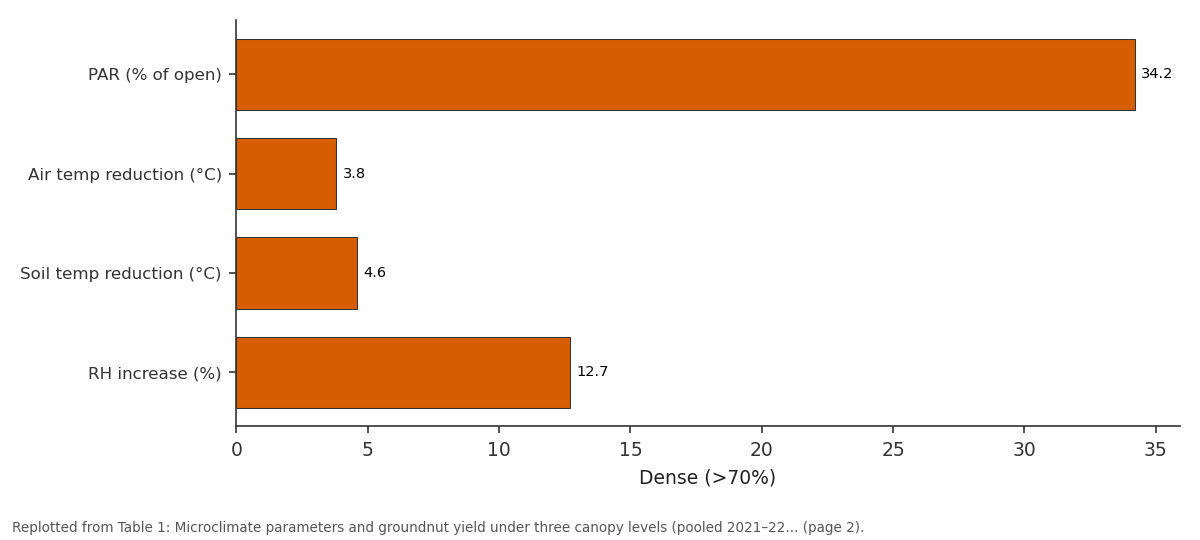
Dense (>70%): PAR (% of open) vs Air temp reduction (°C) vs Soil temp reduction (°C) vs RH increase (%)
Replotted from Table 1 (page 2) of the original paper. Every bar is the paper's own table value.
View source evidence ↗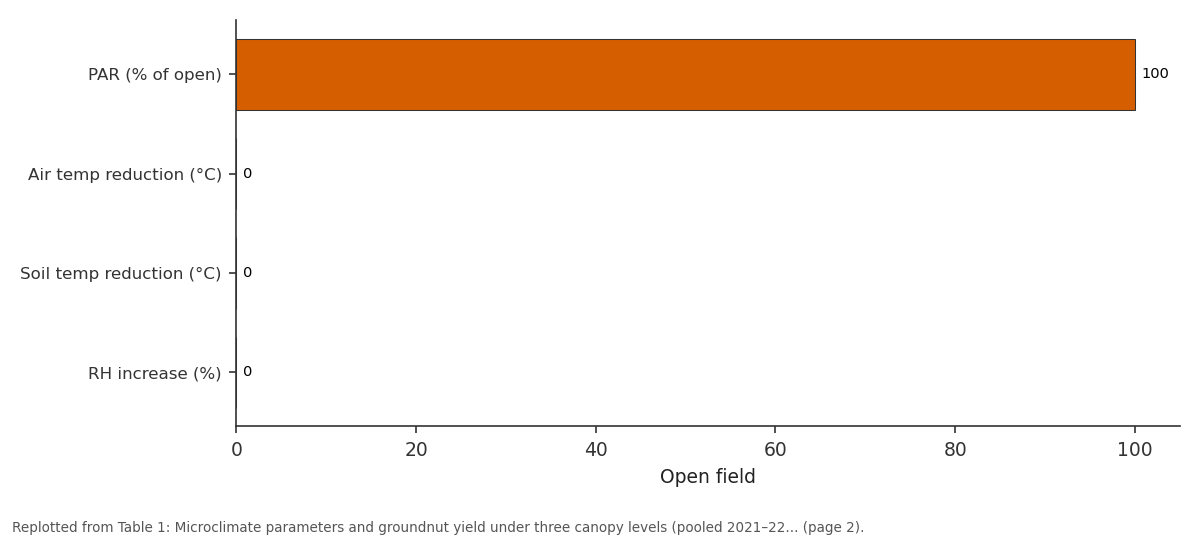
Open field: PAR (% of open) vs Air temp reduction (°C) vs Soil temp reduction (°C) vs RH increase (%)
Replotted from Table 1 (page 2) of the original paper. Every bar is the paper's own table value.
View source evidence ↗Figures & tables
From the original paper Table 1
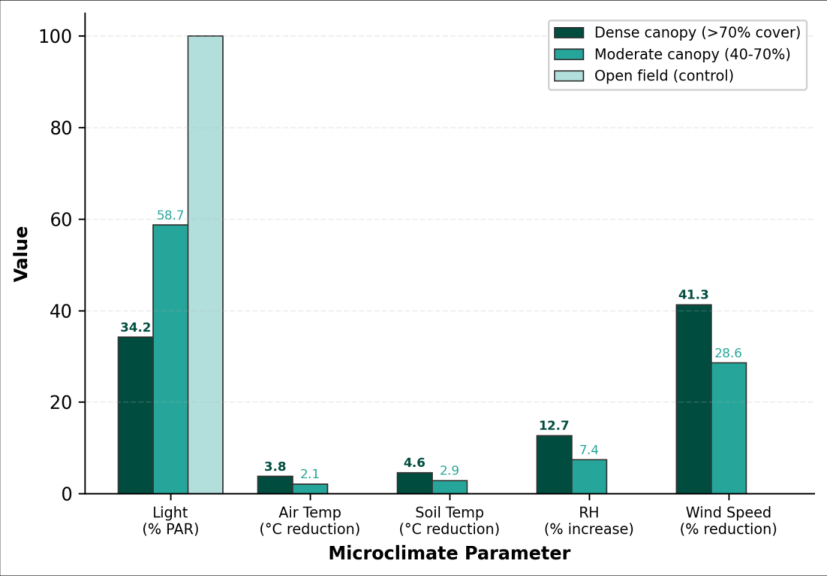 Figure 1
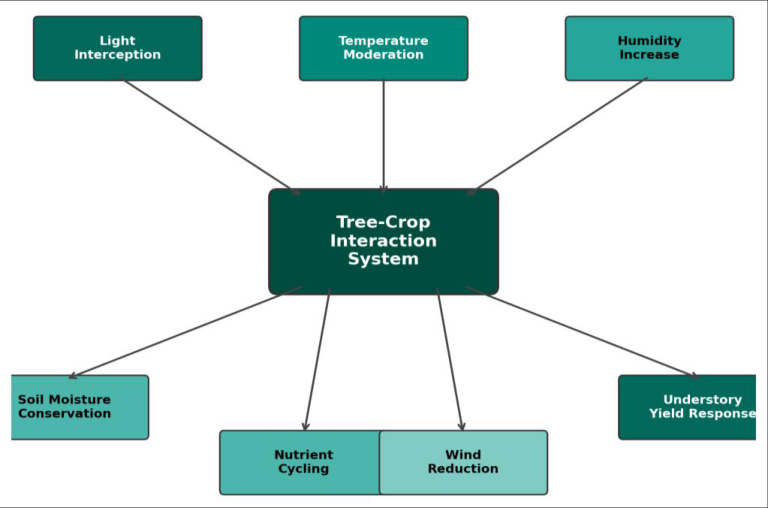 Figure 2
Introduction
Picture a semi-arid landscape in Rayalaseema where summer air temperatures routinely exceed 42 °C and topsoil dries within days of the last rain [1] . In that scenario, even a modest reduction in temperature and evaporation demand can shift a crop from failure to a harvestable stand. Trees in agroforestry systems provide exactly that service but at the cost of competing for light, water, and nutrients with the understory crop [2,3] . The net outcome depends on canopy density. A dense canopy intercepts too much PAR for a C₃ crop like groundnut, while a sparse canopy offers little thermal buffering [4,5] . Between these extremes lies a "sweet spot" where microclimate benefits outweigh light competition. Quantifying that optimum for specific tree-crop combinations under field conditions is essential for designing productive agroforestry layouts [6,7] .
This research aimed to a) Measure microclimate parameters PAR, air and soil temperature, relative humidity, and wind speed under dense, moderate, and zero canopy cover. b) Relate those parameters to groundnut growth and yield. c) Compute the land equivalent ratio to assess overall system productivity at Tirupati, Andhra Pradesh.
Instrumentation and Measurement Protocol
PAR was measured at solar noon using an AccuPAR LP-80 ceptometer (Meter Group, USA) held horizontally 30 cm above the crop canopy at five random points per plot. Air temperature and relative humidity were recorded hourly by HOBO Pro v2 dataloggers (Onset Computer Corp.) mounted at 1.5 m height on wooden stakes within each treatment. Soil temperature was read at 5 cm depth at 14:00 h with digital probe thermometers. Wind speed was logged by a Davis Vantage Pro2 cup anemometer at 2 m height. All sensors were calibrated at the start of each season following manufacturer protocols, and data were downloaded weekly to a field laptop.
Material and Methods Material
The trial was at the agroforestry research block of Sri Venkateswara Veterinary and Agricultural University, Tirupati (13.63° N, 79.42° E; 182 m a.s.l.), on a red sandy loam Alfisol. Leucaena leucocephala (cv. K-636) trees, planted in 1998 at 4 × 4 m spacing, were pruned to create three canopy levels: dense (>70% cover, unpruned), moderate (40-70%, selective branch removal), and open field (all trees removed). Groundnut (cv. K-6) was sown as the understory crop at 30 × 10 cm in the kharif season of both years. Basal fertiliser (25-50-25 kg N-P₂O₅-K₂O ha⁻¹) was applied uniformly.
Methods
A randomised complete block design with three treatments and four replications was used on 10 × 8 m plots. Canopy cover was estimated monthly from hemispherical photographs analysed with Gap Light Analyzer 2.0. Groundnut growth (plant height, branches per plant, dry matter) was recorded at 30, 60, and 90 DAS. Pod yield, kernel yield, and 100-kernel weight were measured at harvest. LER was calculated as the sum of partial LERs: (tree yield under agroforestry / sole tree yield) + (crop yield under agroforestry / sole crop yield) [8] . Data were analysed by two-way ANOVA (canopy × year) with Tukey's HSD at p ≤ 0.05 in R 4.3.1.
Results
Results
Comprehensive Interpretation
Moderate canopy offered the best trade-off: PAR remained at 58.7% of open-field levels above the light-saturation point of groundnut (~400 µmol m⁻² s⁻¹) while air and soil temperatures dropped enough to reduce evaporative stress during the critical pegging phase [4] . The LER of 1.47 means that 47% more land would be needed in sole cropping to match the combined output of the moderate-canopy agroforestry system. Dense canopy depressed groundnut yield by 28.4% but still achieved an LER of 1.28, because the tree component (fodder and fuelwood) compensated.
Discussion
The LER of 1.47 under moderate canopy compares favourably with published values of 1.2-1.6 for tropical agroforestry systems [2,6] . The mechanism is primarily thermal: by lowering soil temperature by 2.9 °C, the moderate canopy extended the soil moisture depletion curve by an estimated 3-4 days between irrigations, allowing deeper groundnut root penetration [3,9] . The dense canopy's PAR reduction (65.8%) pushed below the threshold for optimal groundnut photosynthesis, triggering etiolation and lower pod set [4] . Managing Leucaena canopy through biannual pruning to maintain 40-70% cover is therefore a practical recommendation and the harvested branches provide livestock fodder worth an estimated 8,000-12,000 INR ha⁻¹ yr⁻¹ [10] .
A limitation is the single tree species and single crop; results may differ with deeper-rooted trees or shade-tolerant crops like turmeric [11] . Multi-species and multi-crop trials across agro-climatic zones would expand the recommendation domain.
Conclusion
Moderate canopy cover (40-70%) in a Leucaena-based agroforestry system reduced air temperature by 2.1 °C and soil temperature by 2.9 °C while retaining 58.7% of openfield PAR. Groundnut yield dropped by only 11.6%, and the system's LER of 1.47 confirmed strong complementarity. Dense canopy (>70%) over-shaded the crop and should be avoided unless the primary objective is timber or fodder.
Pruning to maintain moderate cover is the recommended management strategy for semi-arid agroforestry in Andhra Pradesh.
Acknowledgement
AcknowledgementsThis research was supported by Sri Venkateswara Veterinary and Agricultural University. Mr. K. Ravi assisted with datalogger maintenance and canopy photography.
Figures and tables from the paper
| Canopy level | PAR (% of open) | Air temp reduction (°C) | Soil temp reduction (°C) | RH increase (%) | Pod yield (t ha⁻¹) | LER |
|---|---|---|---|---|---|---|
| Dense (>70%) | 34.2 | 3.8 | 4.6 | 12.7 | 1.43 | 1.28 |
| Moderate (40-70%) | 58.7 | 2.1 | 2.9 | 7.4 | 1.77 | 1.47 |
| Open field | 100.0 | 0.0 | 0.0 | 0.0 | 2.00 | 1.00 |
| CD (p=0.05) | 4.3 | 0.4 | 0.5 | 1.8 | 0.14 | 0.09 |
Table text extracted from the original PDF; superscript letters are shown inline. The original table image is below.
View original table image
References
16 in the original paper- Rao KPC, Steenhuis TS, Cogle AL, Srinivasan ST, Yule DF, Smith GD. Rainfall infiltration and runoff from an Alfisol in semi-arid tropical India. Soil and Tillage Research. 1998;48(3):195-207.
- Nair PKR. An introduction to agroforestry. Dordrecht: Kluwer Academic Publishers; 1993.
- Jose S. Agroforestry for ecosystem services and environmental benefits: an overview. Agroforestry Systems. 2009;76(1):1-10.
- Ong CK, Huxley P. Tree-crop interactions: physiological approach. 2nd ed. Wallingford: CABI; 2015.
- Lin BB. The role of agroforestry in reducing water loss through soil evaporation and crop transpiration in coffee agroecosystems. Agricultural and Forest Meteorology. 2010;150(4):510-518.
- Mead R, Willey RW. The concept of a land equivalent ratio and advantages in yields from intercropping. Experimental Agriculture. 1980;16(3):217-228.
- Luedeling E, Smethurst PJ, Baudron F, Bayala J, Huth NI, van Noordwijk M, Cadisch G. Field-scale modeling of tree-crop interactions. Agricultural Systems. 2016;142:51-69.
- Willey RW. Intercropping: its importance and research needs. Part 1. Competition and yield advantages. Field Crop Abstracts. 1979;32(1):1-10.
- Lott JE, Ong CK, Black CR. Understorey microclimate and crop performance in a Grevillea robusta-based agroforestry system in semi-arid Kenya. Agricultural and Forest Meteorology. 2009;149(6):1140-1151.
- Prasad JVNS, Korwar GR, Rao KV, Mandal UK, Rao GR, Srinivas I, Venkateswarlu B, Rao SN, Kulkarni HD. Optimum stand density of Leucaena leucocephala for wood energy in semi-arid conditions. Biomass and Bioenergy. 2011;35(5):1663-1669.
- Gill AS, Burman D, Arunachalam A. Agroforestry research developments in India. In: Dagar JC et al., editors. Agroforestry systems in India. New Delhi: Springer; 2014. p. 1-34.
- Kho RM. On crop production and the balance of available resources. Agriculture Ecosystems and Environment. 2000;80(1-2):71-85.
- Rao MR, Nair PKR, Ong CK. Biophysical interactions in tropical agroforestry systems. Agroforestry Systems. 1997;38(1):3-50.
- Bellow JG, Nair PKR. Comparing common methods for assessing understory light availability in shadedperennial agroforestry systems. Agricultural and Forest Meteorology. 2003;114(3):197-211.
- Chirwa PW, Black CR, Ong CK, Maghembe JA. Tree and crop productivity in gliricidia-maize-pigeonpea cropping systems in southern Malawi. Agroforestry Systems. 2003;59(3):265-277.
- Jackson NA, Wallace JS, Ong CK. Tree pruning as a means of controlling water use in an agroforestry system in Kenya. Forest Ecology and Management. 2000;126(2):133-148.