
Research article · 2025 · Full text
International Journal of Agriculture and NutritionCrop diversification strategies for enhancing farm income in monoculture rice systems
Volume 7(6) · Pages 77–80 · DOI: 10.33545/26646064.2025.v7.i6b.421 ↗
Research areasAgronomic Practices and Intercropping SystemsAgricultural Systems and PracticesRice Cultivation and Yield Improvement
Abstract
Author-writtenRice monoculture dominates more than 9 million hectares in Thailand, yet falling paddy prices have squeezed farm margins to near-zero in many provinces. This research compared four diversification strategies against continuous rice at two locations—Chiang Mai and Nakhon Pathom—over the 2021-2023 cropping cycle. Systems evaluated were rice-maize, rice-pulse (mungbean), rice-vegetable (yard-long bean), and rice-oilseed (sesame). The rice-vegetable rotation delivered the highest system productivity (9.23 t rice-equivalent yield ha-1) and net return (USD 1,387 ha-1), roughly double the rice monoculture (USD 687 ha-1). The benefit-cost ratio reached 2.68 for rice-vegetable versus 1.72 for monoculture. Rice-maize and rice-pulse also outperformed monoculture, though by smaller margins. Soil organic carbon improved under all diversified systems. These findings indicate that even simple two-crop rotations can lift farm profitability without requiring major changes in equipment or expertise.
Summary
Source-checkedPlain-language reading of the full paper, prepared with AI and checked against the text. Each point links to the authors' own words.
Why it matters
- Rice monoculture is widespread in Thailand, covering over 9 million hectares, but farmers are facing near-zero profit margins due to declining paddy prices. View evidence ↗
- From 2018 to 2023, the financial situation for rice farmers in the Central Plains worsened as unmilled rice prices fell by nearly 22% while input costs increased by 17%. View evidence ↗
- The economic vulnerability of these farmers is driven by an over-reliance on a single crop, with over 60% of irrigated lowlands practicing continuous rice cultivation without rotation. View evidence ↗
The question
- The study aimed to compare four crop diversification strategies against continuous rice in two Thai locations to evaluate their impact on productivity, economics, and soil organic carbon. View evidence ↗
What they did
- The research was conducted at two distinct sites: Chiang Mai Agricultural University and the Central Plains Institute of Agriculture in Nakhon Pathom. View evidence ↗
- The study tested five systems, continuous rice, rice-maize, rice-mungbean, rice-yard-long bean, and rice-sesame, using a randomized block design with four replications in 8m x 5m plots. View evidence ↗
- The experimental period spanned four crop cycles between 2021 and 2023. View evidence ↗
- Soil organic carbon was measured using wet oxidation on samples taken from 0-15 cm depth before the first cycle and after the fourth. View evidence ↗
What they found
- Wet-season rice yields remained stable across all systems (4.47-4.82 t ha-1), showing that diversification did not negatively impact the subsequent rice crop. View evidence ↗
- The rice-vegetable system was the most productive and profitable, achieving a rice-equivalent yield of 9.23 t ha-1 and a net return of USD 1,387 ha-1, which is approximately double the USD 687 ha-1 from monoculture. View evidence ↗
- The benefit-cost ratio for the rice-vegetable system (2.68) was significantly higher than that of the monoculture system (1.72). View evidence ↗
- The rice-pulse system provided the greatest improvement in soil organic carbon, increasing by 0.10% (from 0.54% to 0.64%), suggesting better long-term soil fertility. View evidence ↗
- Rice-maize is considered the safest diversification option due to its consistent benefit-cost ratio of 2.31 and established market chains. View evidence ↗
- The rice-oilseed system performed poorly partly because cooler temperatures in Chiang Mai caused pod shattering in sesame cultivars. View evidence ↗
What it means
- The authors conclude that all diversification strategies are superior to continuous rice, with rice-vegetables offering the highest profit and rice-maize providing the most stability. View evidence ↗
- The authors recommend that extension programs combine technical farming advice with support for market linkages to maximize the economic benefits of diversification. View evidence ↗
- A limitation of the high-profit rice-vegetable system is significant price volatility, as seen in yard-long bean prices swinging from THB 18 to THB 42 per kg. View evidence ↗
Visual summary
2 visualsIllustrations explain the paper; charts are replotted from the paper's own table values.
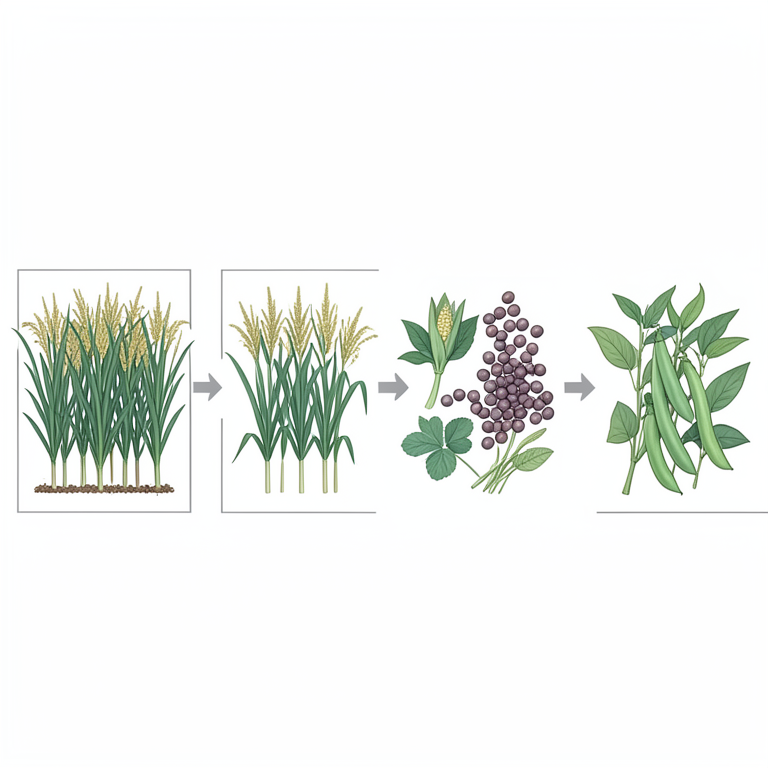
Diversification Comparison Framework
AI-generated conceptual illustration (Rice plants, maize, mungbeans, yard-long beans, and sesame plants in agricultural plots). It explains the idea and does not show study data.
View source evidence ↗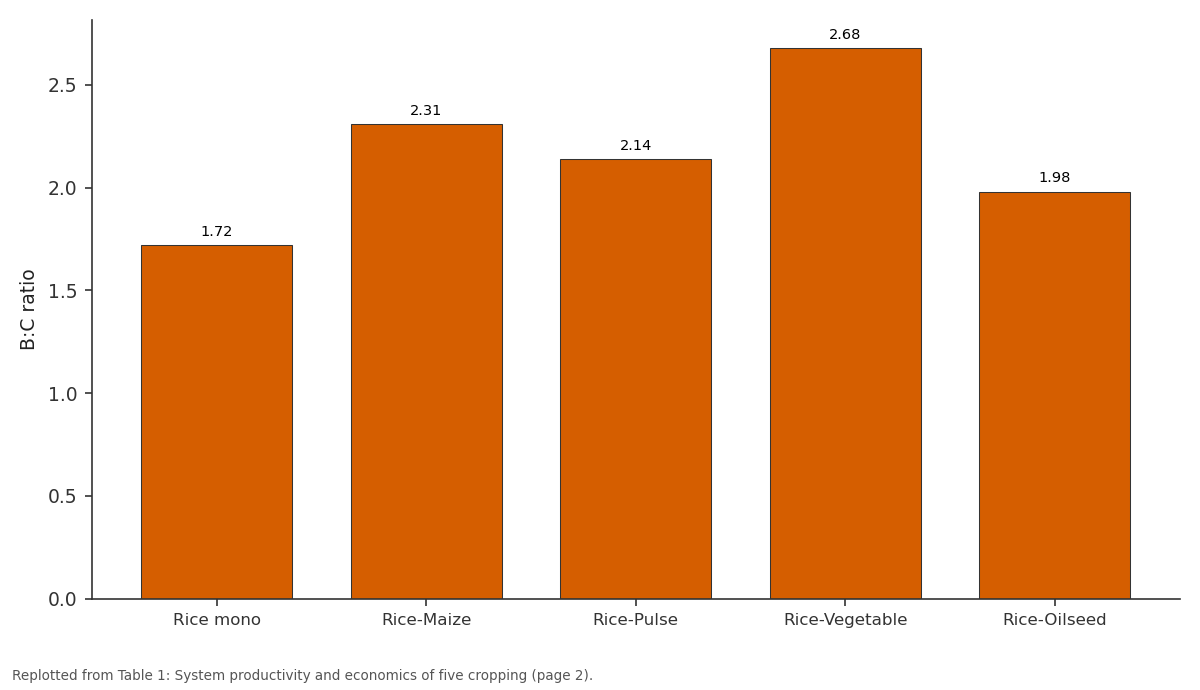
B:C ratio: Rice mono vs Rice-Maize vs Rice-Pulse vs Rice-Vegetable vs Rice-Oilseed
Replotted from Table 1 (page 2) of the original paper. Every bar is the paper's own table value.
View source evidence ↗Figures & tables
From the original paper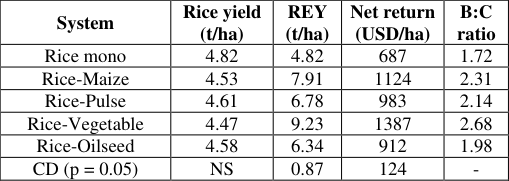 Table 1
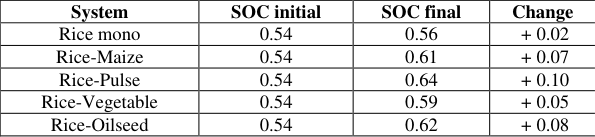 Table 2
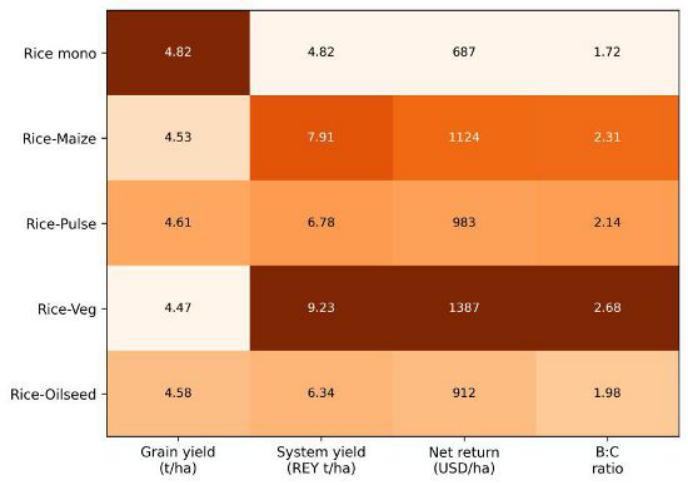 Figure 1
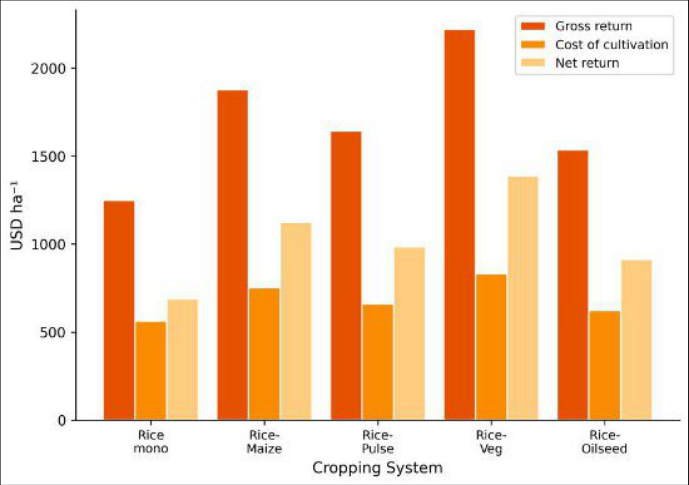 Figure 2
Introduction
Falling paddy prices are pushing Thai rice farmers toward a financial cliff. Between 2018 and 2023, farmgate prices for unmilled rice in the Central Plains dropped by nearly 22%, while input costs rose by 17%, squeezing net returns to their lowest level in a decade [1] . The root of the problem is over-dependence on a single commodity: more than 60% of Thailand's irrigated lowlands grow rice in both the wet and dry seasons, with no rotation [2] . Crop diversification-replacing one rice season with a legume, cereal, oilseed, or vegetable-offers a well-documented pathway out of monoculture traps. Research in the Indo-Gangetic Plains showed that rice-maize and rice-pulse systems raised system productivity by 30-60% over continuous rice [3] . Legume rotations also fix atmospheric nitrogen, reducing the fertiliser bill for the following rice crop [4] . Vegetables bring the highest per-hectare revenue but carry more market and pest risk [5] . Despite these findings, adoption in Thailand has been slow, partly because local agronomic and economic data comparing multiple rotation options side by side are limited [6] . This research was designed to (i) compare four diversification strategies with continuous rice at two contrasting locations in Thailand, (ii) quantify system productivity in rice-equivalent yield and economic terms, and (iii) assess the effect of rotation on soil organic carbon as an indicator of long-term sustainability.
Economic and Sustainability Assessment
Net return was calculated as gross return minus total variable cost. Rice-equivalent yield (REY) was computed by converting the companion crop yield to its rice equivalent using the prevailing price ratio [7] . The benefit-cost ratio (BCR) was derived as gross return divided by total cost. Additionally, the production efficiency index (PEI) was calculated as REY per unit of irrigation water applied, giving a water-use profitability metric relevant to regions facing seasonal allocation cuts.
Seasonal Crop Performance
The companion crops occupied the dry season (December-April) following wet-season rice (July-November). At Chiang Mai, cooler night temperatures (12-18 °C in January) favoured mungbean and sesame, while yard-long bean performed better at Nakhon Pathom where winter minima stayed above 20 °C. Maize tolerated both locations equally. Seasonal rainfall during the dry crop period averaged 84 mm at Chiang Mai and 62 mm at Nakhon Pathom, with the deficit met by supplemental canal irrigation scheduled at 10-day intervals [8] .
Materials and Methods
Materials and Methods
Materials
The trial was established at two sites: the research farm of Chiang Mai Agricultural University (18°47′ N, 98°59′ E, 310 m a.s.l.) and the Central Plains Institute of Agriculture, Nakhon Pathom (13°49′ N, 100°04′ E, 8 m a.s.l.). Five cropping systems were tested: (T 1 ) continuous rice, (T 2 ) rice-maize, (T 3 ) rice-mungbean, (T 4 ) rice-yard-long bean, and (T 5 ) rice-sesame. Treatments were arranged in a randomised block design with four replications, plot size 8 m × 5 m. Rice variety 'KDML 105' was transplanted in the wet season; companion crops were sown on residual moisture plus supplemental irrigation during the dry season [9] . The research covered four crop cycles (2021-2023).
Methods
Grain and biomass yields were recorded at harvest from the net plot area. Market prices for each crop were collected from district wholesale markets. Soil samples (0-15 cm) were taken before the first cycle and after the fourth for organic carbon determination by wet oxidation. Data were analysed by combined ANOVA across locations in R (v4.3.1), with means compared by Tukey's HSD at 5% probability.
Results
Rice grain yield in the wet season was statistically similar across all five systems (4.47-4.82 t ha -1 ), indicating that companion crops didn't depress the following rice crop (Table 1). System productivity, expressed as rice-equivalent yield (REY), was highest for rice-vegetable (9.23 t ha -1 ) and lowest for monoculture (4.82 t ha -1 ). Net return followed the same ranking, with rice-vegetable earning USD 1,387 ha -1more than double the monoculture return.
| System | Rice yield (t/ha) | REY (t/ha) | Net return (USD/ha) | B:C ratio |
|---|---|---|---|---|
| Rice mono | 4.82 | 4.82 | 687 | 1.72 |
| Rice-Maize | 4.53 | 7.91 | 1124 | 2.31 |
| Rice-Pulse | 4.61 | 6.78 | 983 | 2.14 |
| Rice-Vegetable | 4.47 | 9.23 | 1387 | 2.68 |
| Rice-Oilseed | 4.58 | 6.34 | 912 | 1.98 |
| CD (p = 0.05) | NS | 0.87 | 124 | - |
Table text extracted from the original PDF; superscript letters are shown inline. The original table image is below.
View original table image
Comprehensive Interpretation
The rice-pulse system deserves attention beyond its moderate income gain: mungbean residues contributed an estimated 28-34 kg N ha -1 through biological fixation [4] , which may explain why rice yields in the following wet season were marginally higher (4.61 t ha -1 ) than in the vegetable rotation (4.47 t ha -1 ). The SOC gain under ricepulse (+ 0.10%) was the largest among all systems, pointing to a long-term fertility payoff.
Discussion
The economic superiority of rice-vegetable is consistent with on-farm trials in Vietnam [10] and Bangladesh [11] where high-value crops lifted system returns by 80-120% over monoculture. But the BCR of 2.68 masks considerable price volatility-yard-long bean prices at Nakhon Pathom swung from THB 18 to THB 42 per kg within a single season. Farmers without access to contract markets may find such variability daunting [5] . Rice-maize is arguably the safest diversification option.
Maize has an established market chain in Thailand, input requirements are well understood, and the BCR of 2.31 was consistent across locations. The rice-oilseed system lagged partly because sesame yields were hit by pod shattering at Chiang Mai, a known problem in indeterminate cultivars at cooler temperatures [12] . The lack of a significant effect on wet-season rice yield is reassuring: it confirms that the companion crop didn't compete for residual soil moisture or leave allelopathic residues that might suppress the next rice crop. The SOC data further support this-every diversified system raised carbon stocks, with legume-based rotations showing the largest gain, likely because root nodule biomass adds recalcitrant carbon to the soil [13] . Adoption will depend on market access, irrigation reliability, and extension support. Policy incentives such as crop insurance tied to rotation contracts could accelerate the shift [14] .
Conclusion
All four diversified systems outperformed continuous rice in system productivity, net return, and benefit-cost ratio. Ricevegetable (yard-long bean) was the most profitable option, nearly doubling net income, while rice-maize offered the most stable returns. None of the companion crops depressed the following wet-season rice yield, and every rotation improved soil organic carbon. For Thai farmers locked into rice monoculture, these results show that even a single dryseason substitution can sharply improve household income.
The choice of companion crop should match local markets and climate. In cooler upland areas like Chiang Mai, mungbean and maize are reliable options; in warmer lowlands, vegetables deliver the highest income but carry more price risk. Extension programmes should pair agronomic recommendations with market linkage support to help farmers realise the full economic potential of diversification.
Acknowledgement
Acknowledgements
Figures and tables from the paper
| System | SOC initial | SOC final | Change |
|---|---|---|---|
| Rice mono | 0.54 | 0.56 | + 0.02 |
| Rice-Maize | 0.54 | 0.61 | + 0.07 |
| Rice-Pulse | 0.54 | 0.64 | + 0.10 |
| Rice-Vegetable | 0.54 | 0.59 | + 0.05 |
| Rice-Oilseed | 0.54 | 0.62 | + 0.08 |
Table text extracted from the original PDF; superscript letters are shown inline. The original table image is below.
View original table image
References
17 in the original paper- Office of Agricultural Economics. Thailand agricultural statistics 2023. Ministry of Agriculture and Cooperatives. Bangkok; 2023.
- Isvilanonda S, Bunyasiri I. Food security in Thailand: status, rural poor vulnerability, and some policy options. Asian Journal of Agriculture and Development. 2009;6(2):1-14.
- Timsina J, Connor DJ. Productivity and management of rice-wheat cropping systems: issues and challenges. Field Crops Research. 2001;69(2):93-132.
- Peoples MB, Herridge DF, Ladha JK. Biological nitrogen fixation: an efficient source of nitrogen for sustainable agricultural production. Plant and Soil. 1995;174(1):3-28.
- Weinberger K, Lumpkin TA. Diversification into horticulture and poverty reduction: a research agenda. World Development. 2007;35(8):1464-1480.
- Grandstaff TB, Grandstaff SW, Rathakette P, Thomas DE, Thomas JK. Trees in paddy fields in northeast Thailand. Agroforestry and Land Tenure. 1986;120152.
- Ahlawat IPS, Sharma RP. Agronomy-rabi crops. Indian Agricultural Research Institute. New Delhi; 2002.
- Polthanee A, Marten GG. Cropping patterns in northeast Thailand. Journal of Sustainable Agriculture. 1996;8(4):5-31.
- Vanavichit A, Kamolsukyunyong W, Siangliw M, Siangliw JL, Trapsilp P, Ruengphayak S. Thai jasmine rice KDML 105: origin, breeding and quality improvement. Rice. 2018;11(1):20.
- Huan NH, Thiet LV, Chien HV, Heong KL. Farmers' participatory evaluation of reducing pesticides, fertilisers and seed rates in rice farming in the Mekong Delta. Crop Protection. 2005;24(5):457-464.
- Biswas JC, Ladha JK, Dazzo FB. Rhizobia inoculation improves nutrient uptake and growth of lowland rice. Soil Science Society of America Journal. 2000;64(5):1644-1650.
- Langham DR, Riney J, Smith G, Wiemers T. Sesame harvest guide. Sesame Coordinators. San Antonio; 2008.
- Poeplau C, Don A. Carbon sequestration in agricultural soils via cultivation of cover crops. Agriculture, Ecosystems and Environment. 2015;200:33-41.
- FAO. Climate-smart agriculture sourcebook. Food and Agriculture Organization of the United Nations. Rome; 2013.
- Choudhary AK, Yadav DS, Singh A. Technological and extension yield gaps in oilseeds in Mandi district. Indian Journal of Soil Conservation. 2009;37(3):224229.
- Jat RA, Sahrawat KL, Kassam AH. Conservation agriculture: global prospects and challenges. CABI Publishing. Wallingford; 2014.
- Pooniya V, Shivay YS, Rana A, Nain L, Prasanna R. Enhancing soil nutrient dynamics and productivity of basmati rice through residue incorporation and zinc fertilisation. European Journal of Agronomy. 2012;41:28-37.