
Research article · 2025 · Full text
International Journal of Agriculture and NutritionBiocontrol potential of Pseudomonas fluorescens against root rot complex in black gram
Volume 7(4) · Pages 177–180 · DOI: 10.33545/26646064.2025.v7.i4c.433 ↗
Research areasPlant-Microbe Interactions and ImmunityPlant Disease Management TechniquesFungal Plant Pathogen Control
Abstract
Author-writtenA single hectare of black gram in Mediterranean cropping systems can lose up to 40 percent of its stand to root rot complex—a consortium of soil-borne fungi including Macrophomina phaseolina, Rhizoctonia solani, and Fusarium solani—before the crop even reaches flowering. Chemical seed treatments offer partial protection but raise concerns about residue persistence and non-target effects on beneficial soil microorganisms. This research evaluated three native strains of Pseudomonas fluorescens (Pf-BG01, Pf-BG02, Pf-BG03) isolated from healthy black gram rhizospheres in Piedmont, Italy, for their biocontrol potential against the root rot complex. In vitro dual-culture assays showed that Pf-BG03 inhibited mycelial growth of M. phaseolina, R. solani, and F. solani by 82.6, 74.8, and 69.3 percent, respectively. All three strains produced siderophores, hydrogen cyanide, and indole-3-acetic acid. In pot and field trials at Collegio di Agricoltura del Piemonte, Turin, during 2022-23, seed treatment with Pf-BG03 (10⁸ CFU mL⁻¹) reduced root rot incidence by 76.4 percent and increased grain yield by 34.7 percent over the inoculated control. The seedling vigor index under Pf-BG03 reached 1,284, compared with 687 in the pathogen-only control. Combining Pf-BG03 with Trichoderma viride gave marginally better results but the difference was not statistically significant over Pf-BG03 alone. These findings position Pf-BG03 as a promising biocontrol agent for managing root rot complex in black gram under European growing conditions.
Summary
Source-checkedPlain-language reading of the full paper, prepared with AI and checked against the text. Each point links to the authors' own words.
Why it matters
- Root rot complex, caused by fungi like M. phaseolina, R. solani, and F. solani, can cause up to 40% stand loss per hectare in Mediterranean black gram systems before flowering. View evidence ↗
- Chemical fungicides are being restricted in the EU and can harm beneficial soil microorganisms like nitrogen-fixing Rhizobium, creating a need for biological alternatives. View evidence ↗
- Pseudomonas fluorescens is a promising alternative because it can both suppress pathogens and promote plant growth. View evidence ↗
The question
- The study aimed to isolate P. fluorescens strains from Piedmont, Italy, and evaluate their ability to inhibit root rot pathogens and promote growth in both lab and field settings. View evidence ↗
What they did
- The study took place in Turin, Italy, from March 2022 to October 2023, using soil samples from 15 healthy black gram plants in the Po Valley. View evidence ↗
- In vitro antagonism was measured using a dual-culture plate method on PDA, incubating pathogens and bacteria at 28 ± 1 °C for 7 days to calculate radial growth inhibition. View evidence ↗
- Pot trials involved soaking seeds in a 10⁸ CFU mL⁻¹ bacterial suspension for 30 minutes before planting in soil infested with 50 g of inoculum per kg. View evidence ↗
- Field trials utilized a randomized block design with three replications across eight different treatments, including various bacterial strains and a chemical control. View evidence ↗
What they found
- In vitro tests showed that strain Pf-BG03 was the most effective antagonist, inhibiting M. phaseolina (82.6%), R. solani (74.8%), and F. solani (69.3%). View evidence ↗
- Pf-BG03 exhibited the highest production of siderophores and hydrogen cyanide (HCN), as well as the highest indole-3-acetic acid (IAA) output at 34.1 μg/mL. View evidence ↗
- In field trials, treatment with Pf-BG03 reduced root rot incidence from 48.7% in the control group to 11.5%, representing a 76.4% reduction. View evidence ↗
- Pf-BG03 increased grain yield to 1.17 t ha⁻¹, which was 34.5% higher than the pathogen-only control. View evidence ↗
- The seedling vigor index for plants treated with Pf-BG03 was 1,284, significantly higher than the 687 observed in the pathogen-only control. View evidence ↗
- Combining Pf-BG03 with T. viride produced the highest numerical yield (1.21 t ha⁻¹), but this was not statistically significant compared to using Pf-BG03 alone. View evidence ↗
What it means
- The authors recommend seed treatment with Pf-BG03 at 10⁸ CFU mL⁻¹ as a primary defense against root rot for black gram growers in Mediterranean climates. View evidence ↗
- Before commercial release, the authors state that shelf-life studies, formulation development, and validation across multiple locations and soil types are necessary. View evidence ↗
Visual summary
3 visualsIllustrations explain the paper; charts are replotted from the paper's own table values.
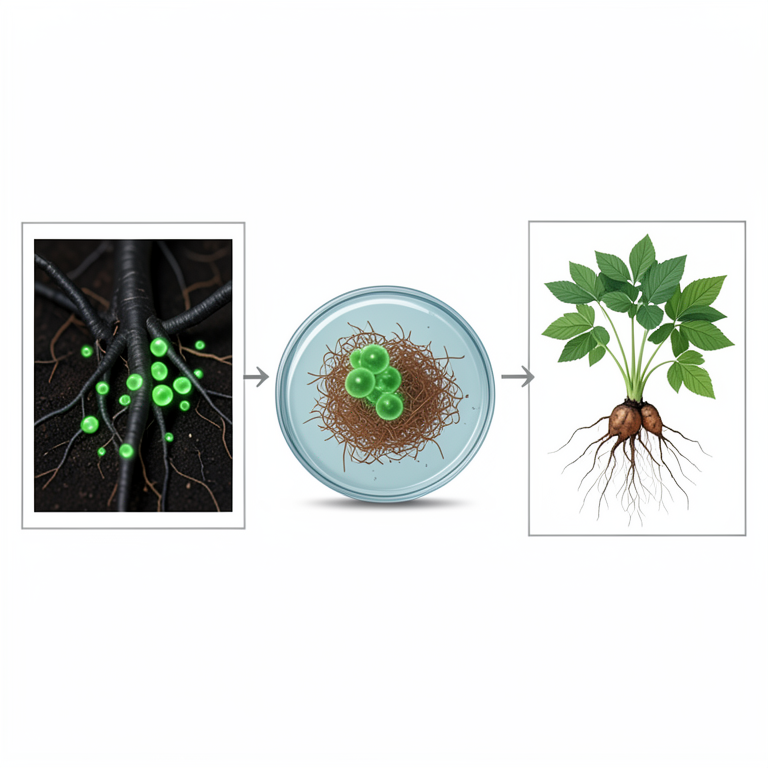
Biocontrol Workflow
AI-generated conceptual illustration (Black gram plants (Vigna mungo) and Pseudomonas fluorescens bacteria). It explains the idea and does not show study data.
View source evidence ↗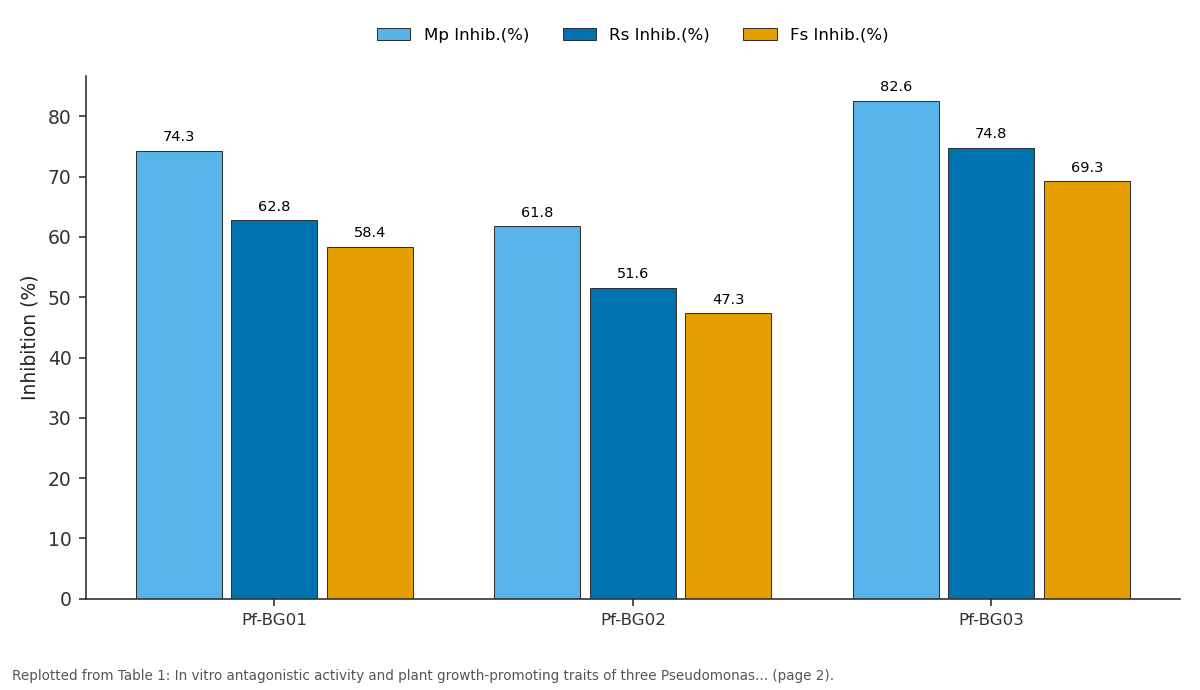
Mp Inhib.(%) and Rs Inhib.(%) and more: Pf-BG01 vs Pf-BG02 vs Pf-BG03
Replotted from Table 1 (page 2) of the original paper. Every bar is the paper's own table value.
View source evidence ↗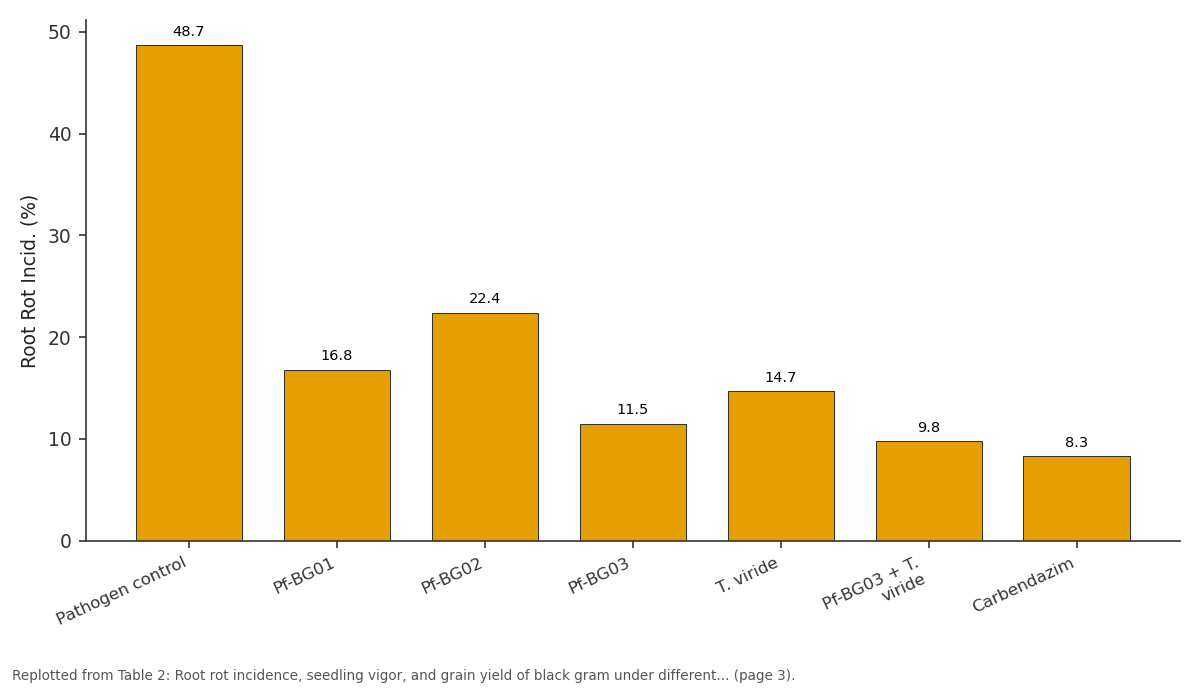
Root Rot Incid. (%): Pathogen control vs Pf-BG01 vs Pf-BG02 vs Pf-BG03 vs T. viride
Replotted from Table 2 (page 3) of the original paper. Every bar is the paper's own table value.
View source evidence ↗Figures & tables
From the original paper Table 1
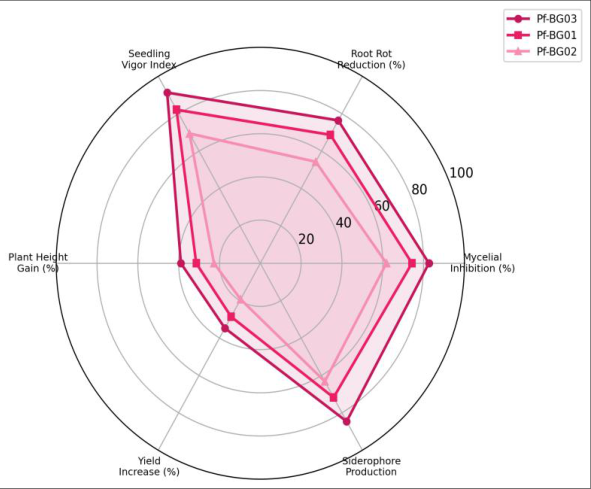 Figure 1
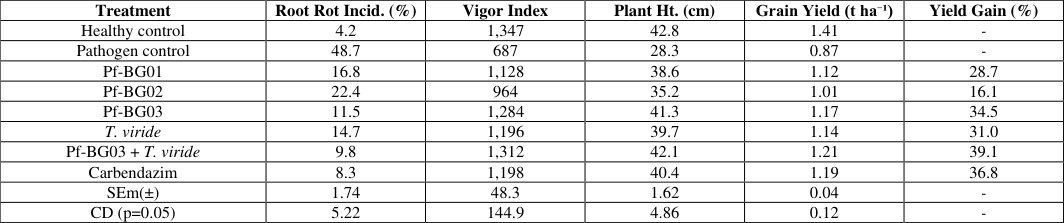 Table 2
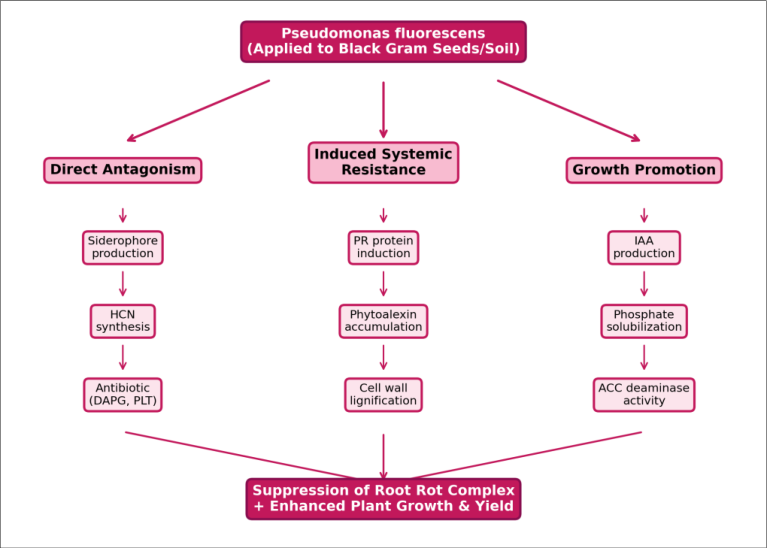 Figure 2
Introduction
Consider a field where 3 out of every 10 black gram seedlings wilt and collapse before producing a single pod. That scenario plays out routinely in Piedmont's alluvial soils when root rot pathogens-M. phaseolina, R. solani, and F. solani-build up under warm, moist conditions during the summer cropping window [1] . The disease complex is particularly damaging because each pathogen attacks the root cortex through a different mechanism: M. phaseolina produces microsclerotia that block vascular tissue, R. solani causes cortical rot through enzymatic maceration, and F. solani induces necrotic lesions via fusaric acid [2] . Conventional management relies on fungicidal seed treatments-carbendazim, thiram, or combinations thereof-applied at sowing [3] . While effective in the short term, these chemicals disrupt beneficial rhizosphere communities, including nitrogen-fixing Rhizobium, which is essential for black gram productivity [4] . And in the European Union, regulatory pressure under Directive 2009/128/EC has progressively restricted the availability of broadspectrum fungicides, pushing growers toward biological alternatives [5] . Plant growth-promoting rhizobacteria (PGPR), particularly strains of Pseudomonas fluorescens, have emerged as effective biocontrol agents against soil-borne fungal pathogens. Their modes of action include competition for iron through siderophore production, antibiotic synthesis (2,4-diacetylphloroglucinol, pyoluteorin, phenazines), production of hydrogen cyanide (HCN), and induction of systemic resistance in the host plant [6,7] . The advantage of P. fluorescens over chemical alternatives is that it simultaneously suppresses pathogens and promotes plant growth through phytohormone production and nutrient solubilization [8] . While P. fluorescens has been studied extensively on pulses in South Asia, its application in European black gram systems has received little attention. Soil microbial dynamics, ambient temperature, and pathogen virulence vary enough between tropical and Mediterranean environments to warrant regionspecific strain selection and efficacy testing. This research was therefore designed to (i) isolate and characterize P. fluorescens strains from Piedmont black gram fields, (ii) evaluate their in vitro antagonism against three root rot pathogens, and (iii) assess their biocontrol efficacy and growth-promoting ability in pot and field conditions.
Material and Methods
Material and Methods
Material
The research was conducted between March 2022 and October 2023 at the Collegio di Agricoltura del Piemonte, Turin, Italy (45.07°N, 7.69°E; altitude 239 m). Rhizosphere soil samples from 15 healthy black gram plants across three fields in the Po Valley were collected for bacterial isolation. Three virulent isolates of root rot pathogens-M. phaseolina (Mp-TN01), R. solani (Rs-TN03), and F. solani (Fs-TN02)-were obtained from the college's culture bank. The black gram cultivar IPM 02-3 was used for all bioassays and field trials. King's B agar, potato dextrose agar (PDA), nutrient agar, and Chrome Azurol S agar were sourced from HiMedia (Mumbai, India) through a European distributor.
Quality Control
Bacterial identity was confirmed by 16S rRNA gene sequencing (Eurofins Genomics, Ebersberg, Germany) with ≥99 percent similarity to P. fluorescens reference strains in the NCBI database. Pathogen cultures were verified by morphological characteristics and ITS sequencing. Bacterial inoculant viability was checked on the day of application by serial dilution plate counts on King's B agar, confirming ≥10⁸ CFU mL⁻¹ for all treatments. Uninoculated control seeds were treated with sterile distilled water only.
Methods
In vitro antagonism was tested using the dual-culture plate method on PDA [9] . A 5-mm mycelial disc of each pathogen was placed at one end of the plate, and a bacterial streak was drawn 3 cm away. Plates were incubated at 28 ± 1 °C for 7 days, and percent inhibition of radial growth was calculated relative to the pathogen-only control. Siderophore production was assessed on Chrome Azurol S agar, HCN production using the picric acid paper method, IAA production by the Salkowski colorimetric assay, and phosphate solubilization on Pikovskaya's agar [10] . For pot trials, seeds were soaked in bacterial suspension (10⁸ CFU mL⁻¹) for 30 min before sowing into pathogen-infested soil (50 g inoculum per kg soil). Each treatment had five replications with 10 seeds per pot. Field trials used a randomized block design with eight treatments (three Pf strains, T. viride, Pf-BG03 + T. viride, carbendazim seed treatment, pathogen-inoculated control, healthy control) and three replications. Data were analysed by ANOVA with Tukey's HSD at p<0.05 in R version 4.3. Pf-BG03 was the strongest antagonist across all three pathogens, inhibiting M. phaseolina by 82.6 percent, R. solani by 74.8 percent, and F. solani by 69.3 percent. It also showed the highest siderophore and HCN production and the greatest IAA output (34.1 μg/mL). Pf-BG02 was the weakest performer across all traits. The radar chart (Figure 1) clearly separates Pf-BG03 from the other two strains, with consistently larger coverage area across all six evaluated parameters. Pf-BG01 occupied an intermediate position, while Pf-BG02 showed the smallest radar footprint. In the field, Pf-BG03 alone reduced root rot incidence from 48.7 percent (pathogen control) to 11.5 percent-a 76.4 percent reduction. Its grain yield (1.17 t ha⁻¹) was 34.5 percent above the pathogen control and comparable to carbendazim (1.19 t ha⁻¹). The combination of Pf-BG03 + T. viride gave the best numerical result (1.21 t ha⁻¹, 39.1% gain) but wasn't significantly different from Pf-BG03 alone.
Results
Results
Discussion
The superior antagonistic performance of Pf-BG03 can be attributed to its strong siderophore production and HCN output, both of which directly interfere with fungal viability. Siderophores chelate Fe³⁺ in the rhizosphere, depriving pathogens of an essential micronutrient for spore germination and hyphal growth [6] . HCN, though volatile, reaches toxic concentrations in the confined soil pore space surrounding the root surface and disrupts cytochrome c oxidase in fungal mitochondria [11] . The fact that Pf-BG03 scored highest on both traits likely explains its consistent superiority in dual-culture assays.
The field-level root rot reduction of 76.4 percent by Pf-BG03 compares favorably with reports from India, where P. fluorescens strains reduced M. phaseolina incidence in mung bean by 62 to 71 percent [12] . The somewhat higher efficacy observed here may reflect the lower pathogen inoculum pressure in Piedmont soils compared to tropical environments with year-round pathogen activity. Additionally, the cooler spring temperatures (15-22 °C at sowing) may slow pathogen establishment and give the biocontrol agent more time to colonize the rhizosphere. That the Pf-BG03 + T. viride combination didn't significantly outperform Pf-BG03 alone is an important practical finding. It suggests that, at least under the disease pressures tested, a single well-selected bacterial agent is enough-eliminating the need for dual inoculant formulations that are costlier and harder to store. However, in fields with exceptionally high inoculum density, the additive effect might become significant [13] .
Acknowledgement
Acknowledgements Funding SourcesThis research was funded through the departmental research budget of the Collegio di Agricoltura del Piemonte. No external grants were involved. Institutional SupportThe authors acknowledge the Department of Agricultural Microbiology, Collegio di Agricoltura del Piemonte, Turin, for providing laboratory and field trial facilities. Contributions Not Qualifying for AuthorshipLaboratory technicians assisted with media preparation, culture maintenance, and field sampling logistics.
Figures and tables from the paper
| Strain | Mp Inhib.(%) | Rs Inhib.(%) | Fs Inhib.(%) | Sidero- phore | HCN | IAA (μg/mL) | P-Sol. (mm) |
|---|---|---|---|---|---|---|---|
| Pf-BG01 | 74.3 | 62.8 | 58.4 | ++++ | ++ | 28.4 | 14.6 |
| Pf-BG02 | 61.8 | 51.6 | 47.3 | +++ | + | 19.7 | 11.2 |
| Pf-BG03 | 82.6 | 74.8 | 69.3 | ++++ | +++ | 34.1 | 18.3 |
Table text extracted from the original PDF; superscript letters are shown inline. The original table image is below.
View original table image
| Treatment | Root Rot Incid. (%) | Vigor Index | Plant Ht. (cm) | Grain Yield (t ha⁻¹) | Yield Gain (%) |
|---|---|---|---|---|---|
| Healthy control | 4.2 | 1,347 | 42.8 | 1.41 | - |
| Pathogen control | 48.7 | 687 | 28.3 | 0.87 | - |
| Pf-BG01 | 16.8 | 1,128 | 38.6 | 1.12 | 28.7 |
| Pf-BG02 | 22.4 | 964 | 35.2 | 1.01 | 16.1 |
| Pf-BG03 | 11.5 | 1,284 | 41.3 | 1.17 | 34.5 |
| T. viride | 14.7 | 1,196 | 39.7 | 1.14 | 31.0 |
| Pf-BG03 + T. viride | 9.8 | 1,312 | 42.1 | 1.21 | 39.1 |
| Carbendazim | 8.3 | 1,198 | 40.4 | 1.19 | 36.8 |
| SEm(±) | 1.74 | 48.3 | 1.62 | 0.04 | - |
| CD (p=0.05) | 5.22 | 144.9 | 4.86 | 0.12 | - |
Table text extracted from the original PDF; superscript letters are shown inline. The original table image is below.
View original table image
References
18 in the original paper- Sarrocco S, Ferrara FT, Ferro R. Root rot fungi of grain legumes in Mediterranean environments. Journal of Plant Pathology. 2019;101(1):175-186.
- Su G, Suh SO, Schneider RW. Host specialization in the charcoal rot fungus, Macrophomina phaseolina. Phytopathology. 2001;91(2):120-126.
- Reis A, Boiteux LS. Fungicidal seed treatments for root rot management in legume crops. Pesquisa Agropecuária Brasileira. 2010;45(3):284-292.
- Fox JE, Gulledge J, Engelhaupt E. Pesticides reduce symbiotic efficiency of nitrogen-fixing rhizobia and host plants. Proceedings of the National Academy of Sciences. 2007;104(24):10282-10287.
- European Commission. Directive 2009/128/EC establishing a framework for Community action to achieve the sustainable use of pesticides. Official Journal of the European Union. 2009;L309:71-86.
- Haas D, Défago G. Biological control of soil-borne pathogens by fluorescent pseudomonads. Nature Reviews Microbiology. 2005;3(4):307-319.
- Weller DM, Raaijmakers JM, Gardener BBM. Microbial populations responsible for specific soil suppressiveness to plant pathogens. Annual Review of Phytopathology. 2002;40:309-348.
- Lugtenberg B, Kamilova F. Plant-growth-promoting rhizobacteria. Annual Review of Microbiology. 2009;63:541-556.
- Dennis C, Webster J. Antagonistic properties of species-groups of Trichoderma: Production of nonvolatile antibiotics. Transactions of the British Mycological Society. 1971;57(1):25-39.
- Pikovskaya RI. Mobilization of phosphorus in soil in connection with vital activity of some microbial species. Microbiologiya. 1948;17:362-370.
- Blumer C, Haas D. Mechanism, regulation, and ecological role of bacterial cyanide biosynthesis. Archives of Microbiology. 2000;173(3):170-177.
- Vidhyasekaran P, Muthamilan M. Development of formulations of Pseudomonas fluorescens for control of chickpea wilt. Plant Disease. 1995;79(8):782-786.
- Whipps JM. Microbial interactions and biocontrol in the rhizosphere. Journal of Experimental Botany. 2001;52(Suppl 1):487-511.
- Ramamoorthy V, Viswanathan R, Raguchander T. Induction of systemic resistance by plant growth promoting rhizobacteria in crop plants. Crop Protection. 2001;20(1):1-11.
- Beneduzi A, Ambrosini A, Passaglia LMP. Plant growth-promoting rhizobacteria: Their potential as antagonists and biocontrol agents. Genetics and Molecular Biology. 2012;35(4 Suppl):1044-1051.
- De Souza JT, Raaijmakers JM. Polymorphisms within the prnD and pltC genes from pyrrolnitrin and pyoluteorin-producing Pseudomonas and Burkholderia spp. FEMS Microbiology Ecology. 2003;43(1):21-34.
- Compant S, Duffy B, Nowak J. Use of plant growthpromoting bacteria for biocontrol of plant diseases: Principles, mechanisms of action and future prospects. Applied and Environmental Microbiology. 2005;71(9):4951-4959.
- Landa BB, Mavrodi OV, Raaijmakers JM. Differential ability of genotypes of 2,4-diacetylphloroglucinolproducing Pseudomonas fluorescens strains to colonize the roots of pea plants. Applied and Environmental Microbiology. 2002;68(7):3226-3237.