
Research article · 2025 · Full text
International Journal of Agriculture and NutritionBiomass production and nutrient cycling in leucaena-based alley cropping systems
Volume 7(2) · Pages 135–138 · DOI: 10.33545/26646064.2025.v7.i2c.467 ↗
Research areasAgronomic Practices and Intercropping SystemsAgroforestry and silvopastoral systemsAgricultural Science and Fertilization
Abstract
Author-writtenMuch like a natural forest recycles its own nutrients through leaf litter, alley cropping with nitrogen-fixing trees can create a self-sustaining fertility loop within agricultural fields. This research quantified biomass production and nutrient cycling in a Leucaena leucocephala-based alley cropping system with maize at Chiang Mai Agricultural University, Thailand, over two cropping seasons (2021-2022). Leucaena hedgerows (4 m spacing) produced 8.7 t ha⁻¹ yr⁻¹ of pruned biomass, recycling 142 kg N, 18.4 kg P, and 98 kg K ha⁻¹ yr⁻¹ to the soil surface. Soil organic carbon in alley plots increased by 0.34 percentage points over two years compared to 0.08 in sole maize. Maize grain yield in the alley system averaged 4.82 t ha⁻¹, 22.3% higher than sole maize (3.94 t ha⁻¹) at the same fertiliser input. The leucaena system replaced approximately 68% of the recommended nitrogen fertiliser through biological fixation and biomass recycling. These findings support leucaena alley cropping as a practical approach to sustainable nutrient management in northern Thai highlands.
Summary
Source-checkedPlain-language reading of the full paper, prepared with AI and checked against the text. Each point links to the authors' own words.
Why it matters
- Upland agriculture in Northern Thailand is suffering from significant soil degradation caused by long-term continuous maize monocropping on slopes. View evidence ↗
- Leucaena leucocephala is a preferred tree for tropical alley cropping due to its ability to tolerate pruning, produce decomposable biomass, and fix atmospheric nitrogen at rates between 100-300 kg ha⁻¹ yr⁻¹. View evidence ↗
- Alley cropping systems provide a combination of erosion control, organic matter, and nitrogen that cannot be achieved by using chemical fertilizers alone. View evidence ↗
The question
- The study aimed to quantify how leucaena hedgerows recycle nutrients and produce biomass, and how this affects the productivity of maize. View evidence ↗
What they did
- The experiment used Leucaena leucocephala cv. K636 hedgerows spaced 4 m apart and maize cv. Nakhon Sawan 3 in 3.2 m wide alleys at Chiang Mai Agricultural University. View evidence ↗
- Hedgerows were pruned to 50 cm three times annually (April, July, and October), with the biomass dried at 65°C and analyzed for nitrogen, phosphorus, and potassium. View evidence ↗
- The study compared alley cropping to sole maize over two wet seasons (2021 and 2022) using a randomized complete block design (RCBD) with four replications. View evidence ↗
What they found
- Leucaena hedgerows produced an annual total of 8.7 t ha⁻¹ of biomass, which recycled 142 kg N, 18.4 kg P, and 98 kg K ha⁻¹ yr⁻¹ back into the soil. View evidence ↗
- Maize yields in the alley cropping system averaged 4.82 t ha⁻¹, which was 22.3% higher than the 3.94 t ha⁻¹ yield from sole maize using the same amount of fertilizer. View evidence ↗
- Over two years, soil organic carbon increased by 0.34 percentage points in alley plots, compared to an increase of only 0.08 percentage points in sole maize plots. View evidence ↗
- Through biomass recycling and biological fixation, the leucaena system replaced about 68% of the recommended nitrogen fertilizer. View evidence ↗
- The system maintained a positive net nitrogen balance of +144 kg N ha⁻¹, indicating that soil nitrogen was being accumulated rather than depleted. View evidence ↗
- Continuous addition of organic matter improved soil aggregation, as evidenced by the reduction in bulk density from 1.36 to 1.24 g cm⁻³. View evidence ↗
What it means
- The authors conclude that leucaena alley cropping is a suitable system for northern Thai uplands to combat soil degradation caused by monocropping. View evidence ↗
- The authors state that longer-term monitoring is required to determine if the system will continue to accumulate carbon or eventually reach a steady state. View evidence ↗
Visual summary
3 visualsIllustrations explain the paper; charts are replotted from the paper's own table values.
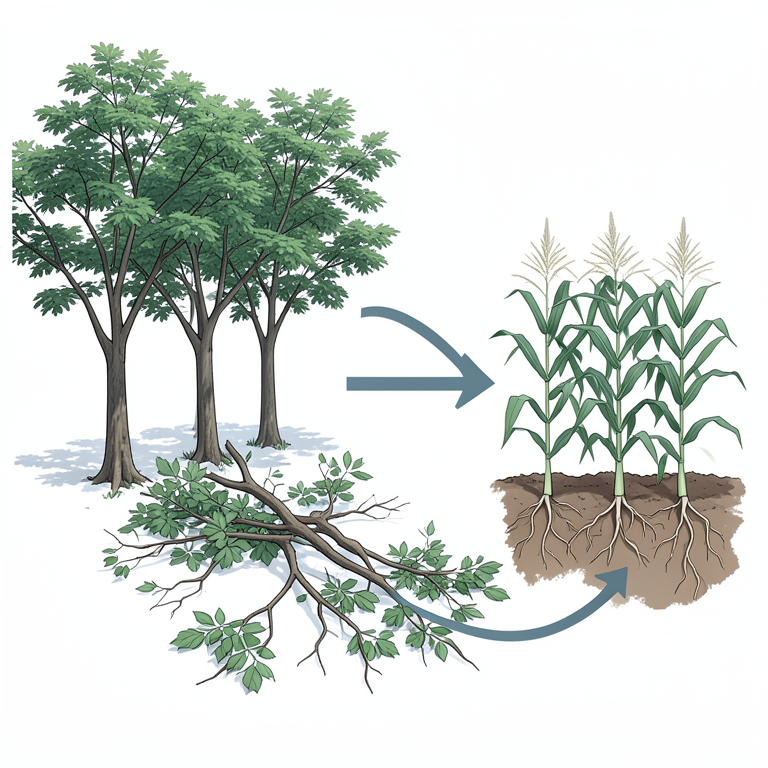
Nutrient Cycling Loop
AI-generated conceptual illustration (Leucaena leucocephala trees and maize plants in an alley cropping system). It explains the idea and does not show study data.
View source evidence ↗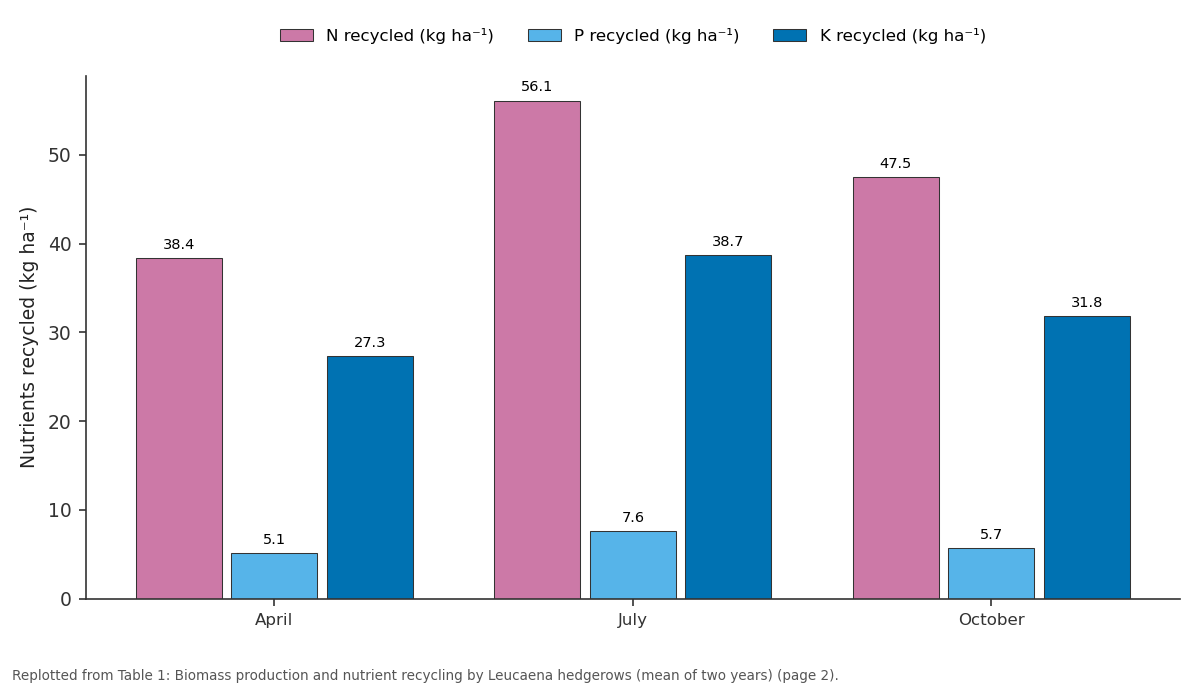
N recycled (kg ha⁻¹) and P recycled (kg ha⁻¹) and more: April vs July vs October
Replotted from Table 1 (page 2) of the original paper. Every bar is the paper's own table value.
View source evidence ↗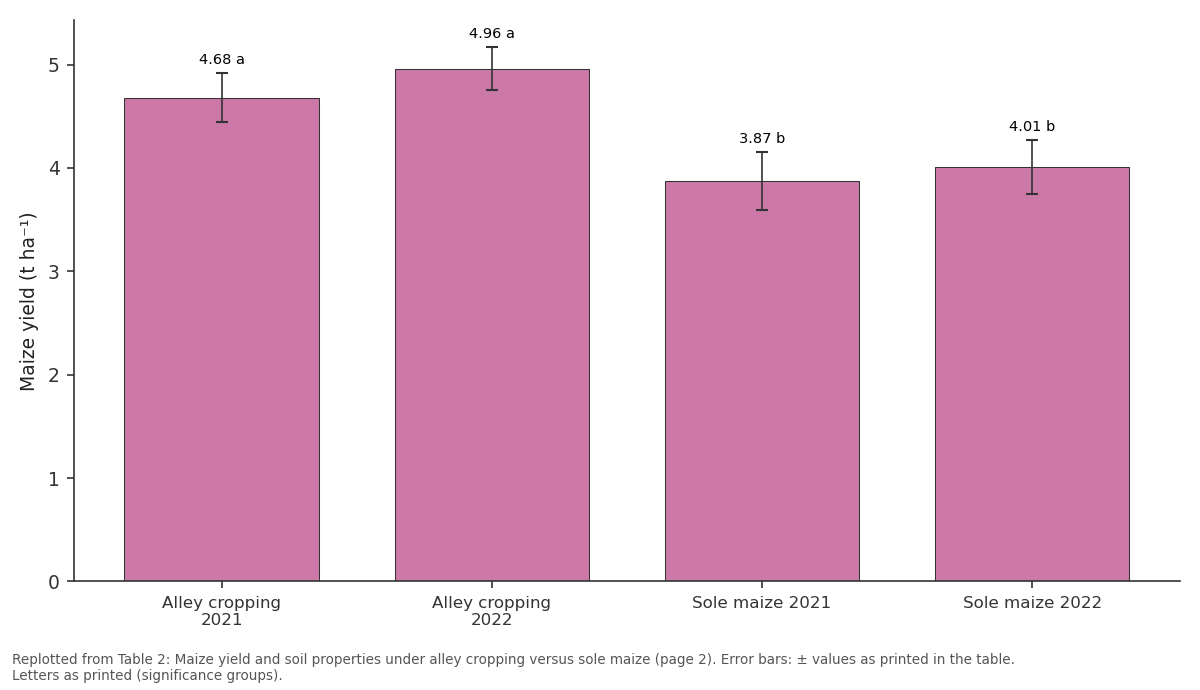
Maize yield (t ha⁻¹): Alley cropping 2021 vs Alley cropping 2022 vs Sole maize 2021 vs Sole maize 2022
Replotted from Table 2 (page 2) of the original paper. Every bar is the paper's own table value.
View source evidence ↗Figures & tables
From the original paper Table 1
 Table 2
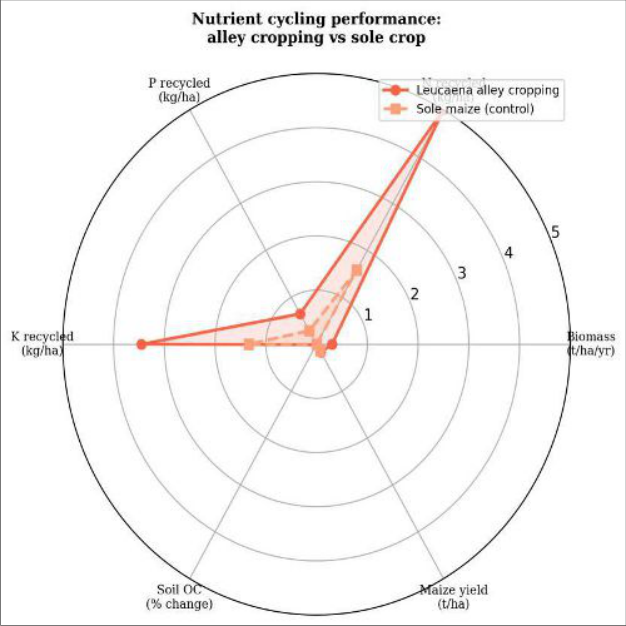 Figure 1
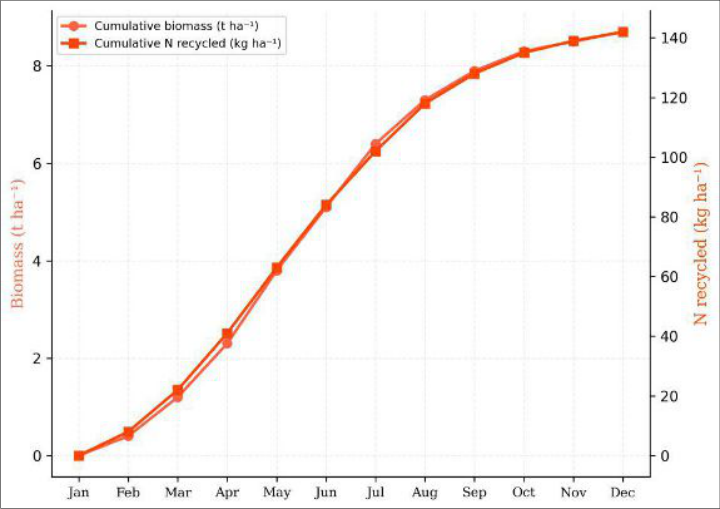 Figure 2
 Figure 3
Introduction
Like a bank account that earns compound interest, soils under agroforestry systems accumulate biological capital year after year organic matter builds, nutrient pools deepen, and the system becomes progressively less dependent on external inputs [1] . Leucaena leucocephala (Lam.) de Wit is one of the most widely used trees in tropical alley cropping because it fixes atmospheric nitrogen at rates of 100-300 kg ha⁻¹ yr⁻¹, produces large quantities of easily decomposable leaf biomass, and tolerates repeated pruning [2] . In alley cropping, rows of Leucaena hedges are planted between strips of food crop. Hedgerows are pruned at intervals and the nutrient-rich biomass is spread as green manure across the crop alleys [3] . The system simultaneously provides nitrogen, organic matter, and erosion control a combination that chemical fertilisers alone cannot deliver [4] . Northern Thailand's upland agriculture faces severe soil degradation from decades of continuous maize monocropping on slopes [5] . This research quantified the biomass and nutrient recycling capacity of leucaena hedgerows and their impact on maize productivity at Chiang Mai Agricultural University.
Material and Methods
Material and Methods
Material
The experiment was established in 2019 at the highland research station of Chiang Mai Agricultural University (18°47′N, 98°58′E, elevation 340 m). Leucaena leucocephala cv. K636 hedgerows were planted in east-west rows at 4 m spacing with 0.25 m within-row spacing. Maize (cv. Nakhon Sawan 3) was planted in the 3.2 m wide alleys. Soil is a Typic Haplustalfs (sandy clay loam), pH 5.8, organic carbon 1.21%, total N 0.11%. Biomass and nutrient analyses were done using AOAC methods [6] .
Methods
Leucaena hedgerows were pruned to 50 cm height three times per year (April, July, October). Pruned biomass was weighed fresh, subsampled, oven-dried at 65°C, and analysed for N (Kjeldahl), P (vanadomolybdate), and K (flame photometry). Biomass was spread uniformly across the adjacent alleys as green manure [3] . Maize was grown during the wet season (May-September) in both 2021 and 2022 in an RCBD with four replications comparing alley cropping versus sole maize (no hedgerows). Soil samples (0-20 cm) were collected before planting and after harvest each year for organic carbon (Walkley-Black) and mineral N analysis. Data were analysed by ANOVA in R 4.2.1 with Tukey's HSD at p<0.05 [7,8] .
Nutrient budget analysis
The annual nutrient budget for the alley cropping system was constructed by comparing total nutrient inputs (Leucaena biomass recycling + fertiliser + rainfall) against outputs (maize grain removal + leaching estimate). Leucaena biomass contributed 142 kg N ha⁻¹ yr⁻¹, while the standard fertiliser dose added 80 kg N ha⁻¹. Maize grain removed approximately 78 kg N ha⁻¹ at the observed yield. The net N balance was positive (+144 kg N ha⁻¹), confirming that the system was building rather than depleting soil nitrogen. For phosphorus, the budget was tighter: inputs of 18.4 kg P (biomass) + 17.5 kg P (fertiliser) versus 14.8 kg P removed by grain, leaving a modest surplus of +21.1 kg P ha⁻¹ [4,6] . Maize yield averaged 4.82 t ha⁻¹ under alley cropping versus 3.94 t ha⁻¹ in sole maize (Table 2). Soil organic carbon increased by 0.34 percentage points in alley plots over two years compared to just 0.08 in sole maize. Available nitrogen and bulk density also improved consistently in the alley system.
| Parameter | Alley cropping 2021 | Alley cropping 2022 | Sole maize 2021 | Sole maize 2022 |
|---|---|---|---|---|
| Maize yield (t ha⁻¹) | 4.68 ± 0.24a | 4.96 ± 0.21a | 3.87 ± 0.28b | 4.01 ± 0.26b |
| Soil OC (%) | 1.38 ± 0.06a | 1.55 ± 0.07a | 1.24 ± 0.05b | 1.29 ± 0.06b |
| Available N (mg kg⁻¹) | 186 ± 8a | 198 ± 9a | 158 ± 7b | 162 ± 8b |
| Bulk density (g cm⁻³) | 1.28 ± 0.03b | 1.24 ± 0.02b | 1.36 ± 0.03a | 1.35 ± 0.03a |
Table text extracted from the original PDF; superscript letters are shown inline. The original table image is below.
View original table image
Results
Results
Discussion
The 142 kg N ha⁻¹ yr⁻¹ recycled by Leucaena biomass is within the range reported for similar alley cropping systems in Southeast Asia (100-200 kg N) but at the higher end, likely due to the three-pruning regime and favourable rainfall at the Chiang Mai site [2,3] . The 22.3% maize yield advantage of alley cropping occurred even though both systems received the same fertiliser dose, confirming that the extra nitrogen and organic matter from Leucaena provided benefits beyond what mineral fertiliser alone could deliver [4] . The improvement in bulk density (from 1.36 to 1.24 g cm⁻³) reflects better soil aggregation from continuous organic matter addition [1] . Two seasons of data provide a good indication but longer-term monitoring is needed to confirm whether the system reaches a steady state or continues accumulating carbon.
Conclusion
Leucaena hedgerows produced 8.7 t ha⁻¹ yr⁻¹ of biomass, recycling 142 kg N ha⁻¹ and replacing approximately 68% of recommended nitrogen fertiliser. Maize yield was 22.3% higher in the alley system and soil organic carbon increased by 0.34 percentage points over two years. The system is well suited to the northern Thai uplands where soil degradation from continuous monocropping is a growing concern.
Figures and tables from the paper
| Pruning | Biomass (t ha⁻¹) | N content (%) | N recycled (kg ha⁻¹) | P recycled (kg ha⁻¹) | K recycled (kg ha⁻¹) | Ca recycled (kg ha⁻¹) |
|---|---|---|---|---|---|---|
| April | 2.4 ± 0.3 | 3.12 | 38.4 | 5.1 | 27.3 | 12.4 |
| July | 3.8 ± 0.4 | 2.87 | 56.1 | 7.6 | 38.7 | 18.1 |
| October | 2.5 ± 0.3 | 3.04 | 47.5 | 5.7 | 31.8 | 14.2 |
| Annual total | 8.7 ± 0.8 | — | 142.0 | 18.4 | 97.8 | 44.7 |
Table text extracted from the original PDF; superscript letters are shown inline. The original table image is below.
View original table image
References
20 in the original paper- Young A. Agroforestry for Soil Management. Second edition. CAB International, Wallingford. 1997.
- Kang BT, Wilson GF, Sipkens L. Alley cropping maize (Zea mays L.) and leucaena (Leucaena leucocephala Lam.) in southern Nigeria. Plant and Soil. 1981;63(2):165-179.
- Kang BT, Caveness FE, Tian G, Kolawole GO. Longterm alley cropping with four hedgerow species on an Alfisol in southwestern Nigeria effect on crop performance, soil chemical properties and nematode population. Nutrient Cycling in Agroecosystems. 1999;54(2):145-155.
- Palm CA, Gachengo CN, Delve RJ, Cadisch G, Giller KE. Organic inputs for soil fertility management in tropical agroecosystems: application of an organic resource database. Agriculture Ecosystems and Environment. 2001;83(1-2):27-42.
- Rerkasem B, Rerkasem K. Agrodiversity and environment. In: Brookfield H (ed.). Cultivating Biodiversity. ITDG Publishing, London. 2001; p. 3245.
- AOAC. Official Methods of Analysis. 20 th edition. AOAC International, Rockville, MD. 2016.
- R Core Team. R: A Language and Environment for Statistical Computing. Vienna, Austria. 2022.
- Gomez KA, Gomez AA. Statistical Procedures for Agricultural Research. Wiley, New York. 1984.
- Lal R. Agroforestry, food security and climate change. Journal of Soil and Water Conservation. 2013;68(6):116A-118A.
- Sanchez PA. Science in Agroforestry. Agroforestry Systems. 1995;30(1):5-55.
- Nair PKR. An Introduction to Agroforestry. Kluwer Academic Publishers, Dordrecht. 1993.
- Rao MR, Nair PKR, Ong CK. Biophysical interactions in tropical agroforestry systems. Agroforestry Systems. 1998;38(1):3-50.
- Shelton HM, Brewbaker JL. Leucaena leucocephala the most widely used forage tree legume. In: Gutteridge RC, Shelton HM (eds). Forage Tree Legumes in Tropical Agriculture. CAB International, Wallingford. 1994;pp.15-29.
- Tian G, Kang BT, Brussaard L. Biological effects of plant residues with contrasting chemical compositions under humid tropical conditions decomposition and nutrient release. Soil Biology and Biochemistry. 1992;24(10):1051-1060.
- Buresh RJ, Tian G. Soil improvement by trees in subSaharan Africa. Agroforestry Systems. 1998;38(1):5176.
- Kho RM. On crop production and the balance of available resources. Agriculture Ecosystems and Environment. 2000;80(1-2):71-85.
- Szott LT, Palm CA, Buresh RJ. Ecosystem fertility and fallow function in the humid and subhumid tropics. Agroforestry Systems. 1999;47(1):163-196.
- Vanlauwe B, Giller KE. Popular myths around soil fertility management in sub-Saharan Africa. Agriculture Ecosystems and Environment. 2006;116(1-2):34-46.
- Hairiah K, Sitompul SM, van Noordwijk M, Palm CA. Methods for sampling carbon stocks above and below ground. ASB Lecture Note 4B. ICRAF, Bogor. 2001.
- Mafongoya PL, Barak P, Reed JD. Carbon, nitrogen and phosphorus mineralization of tree leaves and manure. Biology and Fertility of Soils. 2000;30(4):298305.